 How to resolve AdBlock issue?
State teen birth rate hits record low; local rate edges upward
LAKE COUNTY, Calif. – A new report released by the California Department of Public Health showed a drop in the state’s teen birth rate, but on the local level the numbers experienced a slight increase.
The California Department of Public Health’s report on the teen birth rate, released last week, said the state rate for the two-year period of 2008-10 declined to 29 births for every 1,000 females aged 15-19.
That’s down from the rate of 32.1 births for 2007-09 and 35.2 in 2006-08, according to state statistics.
The most recent numbers showed a significant drop from the teen birth rate of 70.9 births per 1,000 teen females recorded in 1991, when the number reached a the record high.
“Teen pregnancy has been a long-standing public health challenge associated with increased maternal and infant morbidity and mortality,” said Dr. Ron Chapman, the state public health officer. “Early teenage childbearing has been recognized to have negative health and social consequences to adolescent mothers, but we must continue to work together if we are to reduce the state’s teen birth rates even further.”
By comparison, Lake County’s teen birth rate is well above the state average.
For the 2008-10 reporting period, Lake’s teen birth rate was 43.4 percent, up from 41.8 percent in 2007-09 and 43.2 percent in 2006-2008, according to state statistics.
The local epidemiological data on which the state report is based lags by a minimum of two years, which is how long it takes the state to collect and process it, according to Jane MacLean, Lake County’s maternal and child health director.
The state report said teen birth rates across California declined in all major racial/ethnic groups.
Teens aged 18-19 experienced a decline of 9 percent – from 53.5 in 2009 to 48.6 in 2010 – and teens aged 15-17 saw a drop from 17.5 to 15.2, representing a 13 percent reduction, the report showed.
While Hispanic teens aged 15-19 continued to have the highest birth rate in 2010, they demonstrated the second highest decline at 11 percent between 2009 and 2010. Hispanic teen birth rates dropped from 50.8 in 2009 to 45.0 in 2010.
African-American teen birth rate was 37.0 in 2009; it dropped to 34.0 in 2010, representing a decrease of 8 percent, the state said. Asian/Pacific Islander teens and white teens had reductions of 14 and 8 percent, respectively.
California’s teen population appears to be leveling off, however changes in its composition can influence the teen birth rate, the state reported.
In 2000, nearly equal proportions of female teens were Hispanic (39%) and white (38%); by 2010, Hispanics comprised 47 percent and whites 33 percent, according to the report.
The state Department of Public Health credited public and private teen pregnancy prevention efforts with bringing about the decline in the teen birth rate.
The agency said its funds programs including the Information and Education Program, the Adolescent Family Life Program and the Family PACT (Planning, Access, Care and Treatment) Program.
However, Lake County is being impacted by the loss of important grant funding to assist such efforts.
Lake Family Resource Center formerly ran a teen pregnancy prevention program in partnership with local schools, said the center’s executive director, Gloria Flaherty.
However, Flaherty told Lake County News that all of the state funding for that program was eliminated in the last budget year. As a result, the program was discontinued.
Flaherty said the program had been run on a relatively small annual budget of $127,000.
“We were always so amazed with what we could do with that,” she said.
Lake Family Resource Center began providing the services in the 2003-04 fiscal year. During the period from 2003 to the end of the program in 2011, she said the local teen pregnancy rate dropped, and she said she believed their program contributed to that decline.
With the elimination of state funding, the only programs the center now offers for teen pregnancy prevention focus on stopping second pregnancies, Flaherty said.
Last year, the California Department of Public Health received a Personal Responsibility Education Program grant from the U.S. Department of Health & Human Services Administration to focus services in 19 counties in California with teen birth rates that have consistently remained higher than the statewide teen birth rates.
With Lake among those 19 counties, Flaherty said Lake Family Resource Center and other local stakeholders – including the Lake County Office of Education, Lake County Public Health and the Lake County Department of Social Services – responded to a recently released request for proposals from the state for the grant funding. That would help the center revive a teen pregnancy prevention program.
“So hopefully there will be funding coming again starting July 1,” Flaherty said.
The new funding amount would be $50,000 annually. Because of the lower amount of funding, Flaherty said Lake Family Resource Center would not be able to entirely replicate its previous program.
If funded, the new teen pregnancy prevention program would again be school-based, and would focus on abstinence, as the previous program did, Flaherty explained.
“We’re really hoping we’re funded,” she said.
Email Elizabeth Larson at
Loftin, Cilley to challenge Thompson for new Fifth Congressional District seat

Two Republicans are challenging Congressman Mike Thompson in this year's race for Congress.
Randy Loftin of Napa and Stewart Cilley of Rohnert Part are challenging Thompson for the newly redrawn Fifth Congressional District seat, which includes the southern portion of Lake County along with Napa County.
Loftin, a Vietnam-era veteran, lives in Napa and owns a successful tax and retirement planning business.
He wants to pursue private sector job creation to spur economic recovery, and pledges to work to cut taxes to put more money in the pockets of consumers.
Cilley is a certified public accountant concerned about addressing restrictions on personal freedom and bringing about a “less over-arching control by an invasive, unwelcome federal government,” he states on his Web site.
According to his Web site, Cilley pledges to “work like crazy to radically reduce the size of the federal government, lessen its controls over our behavior and, consequently, lower the burden of taxation on all of us who 'yearn to breathe free'!”
Earlier this month Loftin received the endorsement of the California Republican Party. California’s new open primary system replaces the customary ballot process to determine Republican nominees.
Loftin expressed his gratitude for the state party's endorsement, and said he is determined to build strong affiliations with other Republican leaders to “take on” the issues that strangle the counties, the state of California and the people nationwide.
He also has received the endorsements of the Republican central committees for Napa, Lake, Solano and Contra Costa counties.
Loftin's Web site is www.loftinforcongress.com ; Cilley's is http://cilleycampaigncommittee.danielpatrickcilley.com .
More rain, snow in higher elevations possible Sunday
LAKE COUNTY, Calif. – More rain, thunderstorms, as well as snow in higher elevations are part of the forecast for the remainder of the weekend based on a storm system moving over interior California.
On Saturday snow was reported in Lake County's higher elevations, including on the hilltops along the Northshore, in Cobb and over the Hopland Grade.
The National Weather Service issued a winter weather advisory and hazardous weather outlook for Lake County on Saturday evening due to the potential for more precipitation.
Agency forecasters are predicting more rain Sunday, with totals estimated at two-tenths of an inch at most.
Thunderstorms could occur later in the day and into the evening, according to the forecast.
At the same time, light snow accumulations are possible in higher elevations – above 2,000 feet – around the region.
E-mail Elizabeth Larson at
The Veggie Girl: Almond ardor
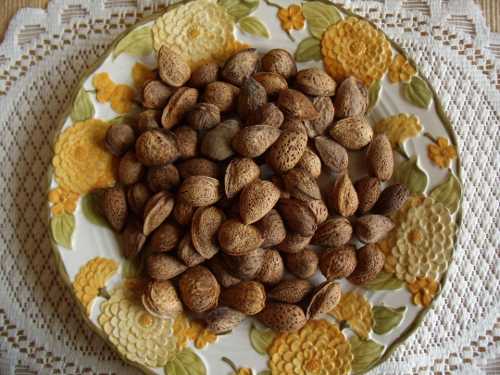
The cold and rain couldn’t dampen my excitement when I spotted almonds for sale during a recent farm visit.
There they were, nestled in a wooden bushel basket on the floor, with their light brown, roughly textured shells calling my name.
As soon as I spotted them, a rush of childhood memories flooded over me.
When I was a kid, nearly every family I knew had a bowl or basket full of mixed, unshelled nuts on their table. There was always a nutcracker lying on top as an invitation to dig right in and start cracking.
It was hard work to get some of those shells open (the filberts and Brazil nuts in particular), but that made the nut meat inside all the more satisfying.
Thankfully, almonds aren’t hard nuts to crack, so my son and I made quick work of the little pile when I got home. As I suspected, he’d never seen almonds in the shell before, and I was happy to share the experience with him.
Almonds are cousins of peaches, nectarines and apricots, which you might have suspected if you’ve seen them in the shell, since in that state they look similar to the pits of those fruits.
Like their relatives, almonds are drupes, not true nuts, meaning they’re comprised of a seed contained within a hard shell and outer hull. The almonds we consume are the seeds of the almond tree.
Almond trees are native to the Mediterranean climate region of the Middle East, stretching east as far as the Indus River in what is now southern Pakistan, and were spread by ancient man along the shores of the Mediterranean into northern Africa and southern Europe.
Almonds are one of the earliest domesticated trees because of the ease with which they grow from seed. It’s estimated they’ve been cultivated since 3000 B.C., before the introduction of grafting to agriculture.
California is responsible for all the U.S. almond production, and we’ve just passed the season for almond blooms, which happens each year in February.
Sometimes I’m lucky enough to have an excuse to drive from Lake County to Sacramento when almonds are in bloom, and I happily wind through fields of blooming almond trees on my way to Interstate 5.
After blossoms fall, green almond buds appear on trees, and they’ll continue to mature until June, as the shell hardens and the kernel forms within it.
The surrounding green hull, which can be compared to a thinner version of the fleshy portion of a peach, splits in the heat of summer, exposing the almond shell and allowing it to dry.
As the season progresses, the split widens and the hull becomes tough and leathery.
Shortly before harvest, which occurs from mid-August to November, the hulls open completely. Mechanical tree shakers are utilized to knock nuts to the ground during the harvest.
Bitter almonds, a cousin of the sweet almonds we eat, are used in such products as almond extract, almond liqueur and cosmetic almond oil, but are illegal to sell to the public in the United States because of their high levels of cyanide.
The poison is processed out during the making of these products; however, if eaten raw, a generous handful or two of bitter almonds (between 20 and 50, depending on the source) can kill an adult.
Almond oil is often used in massage or as a moisturizer, and I have to say it’s one of the sweetest things I’ve ever smelled.
Almond flour may be used as an alternative baking product for those sensitive to gluten, almond milk is available for those who prefer to avoid milk from cows, and almond butter is a substitute for peanut butter for those with ground nut allergies.
All these products, in my opinion, are worthy of consumption based on their own merits, rather than as substitute for other things.
Marzipan (oh, delightful sweet!) is a confection consisting mainly of almond meal and sugar. It’s used in making pastries (it fills almond croissants, for example) or candies, such as a filling for molded chocolates.
Because of its malleable consistency, it’s often used for molding sweets, such as the brightly painted miniature marzipan fruits seen in gift packages at Christmastime.
If purchasing marzipan, beware of cheap imitations made with soy paste and almond essence.
Horchata, a cold, sweet beverage popular in Mexico, is sometimes made with almonds, though can also be made with rice or even melon seeds.
Almonds are sold in many forms: whole, slivered, sliced, flaked, halved, diced, or as almond meal, and each of these variations can be natural or blanched, meaning the brown skin surrounding the nut has been removed.
Unshelled almonds, such as the ones I purchased, will store much longer than those without their shell.
If purchasing almonds from bulk bins, be sure the nuts smell sweet and not bitter, which is an indication of rancidness. A good rule of thumb is to buy bulk from stores which have a quick sales turnover.
The fat in almonds is wonderful for our health; however, care should be taken when storing them, as their high fat content makes them susceptible to spoiling.
A sealed container in a cool, dry place away from sunlight is best. Cold storage prolongs shelf life, and refrigerated almonds will last for several months. Almonds stored in the freezer will last up to a year.
Studies have shown that almonds contain an array of health benefits, including lowering LDL (bad) cholesterol, prevention against diabetes and cardiovascular disease, improving blood fats, assisting in weight loss, prevention of weight gain, protection against gallstones, and production of energy.
In addition, they’re full of a powerful antioxidant in the form of vitamin E, vitamin B2 (riboflavin), and trace minerals such as copper, manganese and phosphorus.
Almonds are a protein powerhouse, with a quarter cup containing more protein than an egg. They contain tryptophan, the essential amino acid which some believe has sedative effects.
Today’s recipes, almond-butter crisp and almond-parsley pesto, can be used as ingredients in a variety of dishes.
The almond-butter crisp, for example, makes a wonderful topping in place of bread crumbs for oven-baked casseroles. Or try it atop cooked veggies like asparagus or green beans.
Use almond-parsley pesto wherever traditional pesto might be used, such as a sauce for pasta, a spread or a dip.
And before I go, I’d like to introduce you to green almonds, which are gaining popularity as a delicacy in the culinary world. They’re available for only eight weeks a year, between late April and mid June, and have a very distinct taste.
Within the green fuzzy hull are a jelly-like inside and a skinless, white almond with a gelatinous texture, similar to a firm grape. Chefs in high-end restaurants are using them in dishes such as gazpacho or as a component in an entrée.
If you have access to developing almond buds in an orchard, perhaps you can pick one, open the hull with a knife and try the tender seed inside for yourself. Let me know what you think.

Almond butter crisp
1 head garlic, roasted and squeezed from skin
3 ounces butter, at room temperature
¼ cup dry bread crumbs
¼ cup grated Parmesan cheese
1 teaspoon salt
1 cup toasted almonds
Combine all ingredients, except almonds, and mix well. Gently fold in almonds, trying not to crush them.
Mixture can be dotted atop casseroles or other dishes before going in the oven, or melted to drizzle over cooked vegetables.
To store until ready to use, cover and refrigerate.
Almond parsley pesto
2 garlic cloves
2 cups flat-leaf (Italian) parsley (one bunch of leaves)
1 cup or more finely grated aged Parmesan cheese
1/3 cup slivered almonds
1 tablespoon fresh lemon juice
½ teaspoon freshly ground black pepper
1 teaspoon kosher salt
½ cup extra virgin olive oil
With food processor running, drop in garlic and finely chop. Stop motor and add parsley, cheese*, almonds, lemon juice, salt and pepper. Process until finely chopped. With motor running, add oil, blending until a smooth paste is formed.
*Begin with one cup of cheese and add more to taste.
Hint: When using as a sauce for pasta, pesto may be thinned with a bit of the cooking water for ease in coating.
Esther Oertel, a freelance writer, cooking teacher, and speaker, is passionate about local produce and all foods in the vegetable kingdom. She welcomes your questions and comments and may be reached at




