 How to resolve AdBlock issue?
 Lakeport Police logs: Saturday, Jan. 10
Saturday, Jan. 10, 2026
00:00 EXTRA PATROL 2601100001
Occurred at Lake County Law Library on 3D....


KELSEYVILLE, Calif. – The staff at the SPCA of Clear Lake is winding down the organization's shelter operations, with the facility scheduled to be completely closed by the end of the day Saturday.
The nonprofit organization announced earlier this month that it had closed its shelter, was working to find homes for the dogs and cats remaining in its care, and transitioning to a focus on its low-cost vaccination and spay/neuter clinics, as Lake County News has reported.
Lake County Animal Care and Control Director Bill Davidson told Lake County News that he does not expect to see a large increase in animals at his facility due to the SPCA shelter closure, as the SPCA primarily took owner surrenders.
On Thursday, the remaining staffers were fielding phone calls, caring for animals and working on adoptions.
A family stopped in for a visit, and one young man came came in to adopt a black cat.
Executive Director Mary Jane Montana said that as of Thursday afternoon, there were six remaining cats – all of which would be taken to a rescue after the Saturday closure – as well as 12 dogs, most of them pit bull mixes, with some lab and Doberman mixes also available. She plans to take four or five of the dogs to a Walnut Creek rescue on Sunday.
When SPCA's shelter stopped animal intake earlier this month it had 26 dogs and 29 cats, Montana said.
Of those, 15 cats went to Sonoma Humane Society, six to Mendocino Coast Humane Society and two to the Humane Society of Inland Mendocino County, Montana said, while two dogs went to facilities in Fort Bragg and four to Ukiah.
Except for two, all of the fosters have adopted their dogs, and the two foster dogs that were returned are spoken for, Montana said. “So people have stepped up.”
Montana said all of the staff – including herself – will be laid off once the shelter is closed. Board members will continue to volunteer, caring for any remaining animals while they work to rehome them.
As for what led to the decision to close, Montana said it was due to a loss of income for the nonprofit from its two main revenue streams – spay/neuter surgeries and general donations.
In the case of the spay/neuter surgeries, Dr. Glenn Benjamin – the clinic's volunteer vet – retired, necessitating the temporary closure of the clinic while the SPCA searched for his successor, Montana said.
Benjamin had been offering his services for free, and in a year had done 1,500 spay/neuter surgeries, Montana said.
She called Benjamin SPCA's “angel.”
“He's the best ever,” Montana added.
The halt in the SPCA's spay/neuter surgeries may account for the increase in demand for such services that Davidson reported experiencing at Animal Care and Control.
Montana said donations also dropped, a fact which she attributes to the wildland fires and the resulting shift in donations to help survivors.
“Everyone was just so overwhelmed with the fires,” she said.
The SPCA had an October fundraiser, but Montana said the results didn't meet the need. “Everyone had already given what they could give already.”
Going forward the SPCA hopes to begin generating income again by restarting its low-cost spay/neuter program, she said.
Montana said the SPCA currently is talking with two veterinarians, one of them being Dr. Richard Bachman, who is working with Lake County Animal Care and Control in its clinic.
He specializes in high-volume spay/neuter services, and has some ideas on how the SPCA can get its clinic going again, she said.
In addition, Montana said the SPCA also is talking with a veterinarian from the Sacramento Valley who is interested in helping part-time.
The SPCA also is hoping to get some grants from the ASPCA for the low-cost spay/neuter services, with Montana adding that the group may also approach the Board of Supervisors during its budgeting process later this year to ask for some assistance, because the services are offered countywide.
Montana said the SPCA board – which she has been asked to join after her employment ends – may be able to have the spay/neuter clinic open two to three days a week by the end of February, depending on how negotiations go with the two veterinarians.
Vaccination clinics will continue on the third Saturday of every month, from 9 to 11 a.m. Upcoming clinics are Feb. 20, March 19 and April 16 at the SPCA, located at 8025 Highway 29 near Kit's Corner in Kelseyville.
A lot of other decisions have yet to be made, said Montana.
Those include what might be done with the facilities, which Montana said could include making the space available to other veterinarians or for other uses.
“The priority is spay and neuter,” she said.
Visit the SPCA online at http://www.spcaofclearlake.com/ and on Facebook at https://www.facebook.com/SPCA-of-Clear-Lake-408416852586913/ .
Email Elizabeth Larson at
CLEARLAKE, Calif. – The Clearlake City Council on Thursday held its second reading of a new ordinance to tighten regulations on the cultivation of medical marijuana in the city, and ended by making minor changes that will require it be brought back for a final reading next month.
Ordinance No. 181-2016 bans commercial cultivation; implements a six-plant limits on parcels of all sizes; prohibits – as current regulations do – growing on vacant parcels or within 600 feet of schools or daycare centers; requires that grows be away from creeks, drainages and Clear Lake; keeps grows away from mixed use residential, scenic corridor or beautification zones; and implements a $150-per-year permit fee for grows, among other rules.
The ordinance was crafted by a council-appointed ad hoc committee that included council members Russ Perdock and Bruno Sabatier, plus Lakeside Herbal Solutions dispensary owner Liz Byrd, Realtor Dave Hughes, business owners Dan Griffin and Vince Metzger, and Lake County Fire Protection District Chief Willie Sapeta.
The ad hoc committee began meeting Oct. 7. Two days later, Gov. Jerry Brown signed the three-bill package known as the Medical Marijuana Regulation and Safety Act.
Perdock, who since the committee began has become mayor, pointed out during the Thursday meeting that the state law maintains the ability of local governments to implement regulations and fees.
“The ball's in our court,” Perdock said during the discussion.
The draft ordinance was sent to the Clearlake Planning Commission in December, where commissioners voted unanimously to recommend council approval.
The council took that recommendation and unanimously passed the ordinance's first reading on Jan. 14.
After a brief report from City Manager Greg Folsom the council discussed some of the points of the ordinance on Thursday.
During that discussion it was discovered that a suggestion Sabatier had made at the previous meeting about changing setbacks from 10 feet to 5 feet – which didn't have consensus – had been mistakenly worked into the document's language by staff.
One of the changes the council had approved previously was removing a permanent ban for growing violations on properties due to the possibility of changing ownership, with the ad hoc committee's recommendation of a permanent ban changed to a five-year growing prohibition.
Sabatier said he had been approached by large landowners about the new rules, and he was not aware of complaints on large properties. He indicated he would like to reconsider allowing larger plant numbers on bigger parcels.
Vice Mayor Gina Fortino Dickson said that she wanted to make sure that all outstanding fines are paid by growers found to be out of compliance before the city issues new permits.
Folsom asked City Attorney Ryan Jones if that requirement to be current on payment of fines could be done by city policy or if it needed to be included in the ordinance. Jones suggested the latter.
Councilwoman Joyce Overton said she liked the ordinance as it was – in reference to Sabatier's suggestion of reconsidering larger grows on larger properties – but agreed to Fortino Dickson's proposed change on fine payment.
“I believe our ordinance is clean,” said Councilwoman Denise Loustalot, saying clear rules needed to be established throughout the city.
Until Thursday's meeting, the ordinance had drawn little public comment other than from a few owners of large properties wanting the ability to grow larger amounts of marijuana, as is the case under the current city ordinance.
Eight community members on Thursday night spoke to the council, five of them against the ordinance and three of them for it.
One man, who did not give his name and who left the chambers shortly after speaking, said the ordinance “is not going to fly,” and that the city cannot put such restrictions “on people who are sick.”
He took particular issue with the requirement for confining grows to 10-foot by 10-foot fenced and locked areas, and claimed at least 12 plants are needed to fight cancer.
Earl Richardson, a large property owner who also spoke at the Jan. 14 council meeting, said he wanted the council to amend the ordinance to enable larger grows under a conditional process.
“I think the ordinance that you have put together is perfect for this town,” said Marie Weathers, adding she didn't think there are many grows on the larger 40-acre plots. “I'm looking for stronger penalties if they violate.”
Liz Byrd, who served on the ad hoc committee, said her dispensary operates with compassion and ensures those who need medicine have it. She supported the ordinance, telling the council, “The product that is grown here needs to remain here.”
She said the community needs to take care of its own, not have warehouses full of product going somewhere else.
Another man said the council was creating a haven for carpetbagging with small grows, and that they could expect that marijuana legalization was coming.
“Let's get something right for once,” he said. “It's a lot of work to get it right the second time.”
While Fortino Dickson agreed that the future likely will see the legalization of commercial, nonmedicinal growing, “At this moment in time I don't think we're ready to deal with that.”
She said she believed some of the changes sought relating to larger properties should be taken up in the form of a dispensary ordinance.
Loustalot also was against making changes, explaining that the council needed to be clear and precise, and that it had the best ordinance it can have at this time.
Perdock said the ad hoc committee was meant to focus on residential areas. They weren't trying to deny people medicine but to stop violent crimes.
He said the city is willing to reconvene the ad hoc committee to talk about compassion centers and dispensaries. “ We as a council have to look at all of those sites.”
Sabatier said the matter of large grows in residential areas is not an issue of patients but of criminals. “We need to really differentiate between a patient and a criminal.”
He added of cultivation, “It needs to stay out of the residential areas, like we're trying to do … it needs to remain that way forever.”
Sabatier said he agreed with Perdock and wanted to continue discussing the issue of larger properties in the future, especially as laws change. He said he hoped they could bring back the ad hoc committee to consider additional issues.
Sabatier moved to approve the ordinance's second reading, with the modifications to the setback number and the fines payment, which will require the document be brought back again for another reading before being finalized. The council voted to support the ordinance 5-0.
In other business, the council heard a presentation from Susan Jen of the Health Leadership Network, and Terry Krieg, whose firm was hired to do the city's annual audit, gave a presentation on the audit and noted changes in state law.
Also on Thursday, the council debated two items that council members had pulled from the consent agenda – a job description for a community development management position to oversee animal control operations that Folsom was told to bring back in two weeks and whether to approve a $35,000 contract for preparing the Austin Park master plan, which Sabatier voted against.
The meeting ended with Perdock paying tribute to Folsom's father, Mel, who died of cancer earlier this month.
Perdock, who lost his mother to cancer, dedicated the meeting to the elder Folsom, who was a Marine who went on to college where he studied engineering, earning his degree and going on to pursue a career as an engineer.
The council honored him with a standing ovation. The gestures left the city manager visibly moved.
Email Elizabeth Larson at
012816 Clearlake City Council - Medical marijuana cultivation Ordinance No. 181-2016 by LakeCoNews

LAKEPORT, Calif. – Faced with high costs for renovating and refurbishing the current Westshore Pool, the Lakeport Unified School District plans to move ahead with construction of a new pool, a project to be financed through a 2014 voter-approved bond measure.
District Superintendent Erin Smith-Hagberg said a timeline for when the construction will take place has yet to be determined.
Funds for the new pool project will come from the Measure T bond that voters in the Lakeport Unified School District approved in November 2014.
The $17 million bond measure is meant to fund new facilities including the pool and a fitness center at the high school; expansion of current cafeteria and kitchen facilities; upgraded playgrounds and play structures; improved roadways, utilities and grounds; Americans with Disabilities access projects; and an overall modernization of school facilities in order to embrace a new learning environment, among a lengthy list of projects.
Smith-Hagberg said the first series of Measure T bonds was sold, and totaled $6 million.
The latest financial summary report of the Measure T Bond Program gives a budget number of a little more than $2.1 million for the new pool. Of that, so far, just over $300 has been spent for a pool area soil analysis.
The Westshore Pool was built next to Clear Lake High School in 1973, and over the past 43 years has served not just as a center of recreation for the community at large but also a place where children learned to swim, a key skill because of nearby Clear Lake.
Lakeport Unified owns the pool, however in 2004 the district entered into a 20-year memorandum of understanding with the city of Lakeport, which under the terms of the agreement operates the facility during the summer.
Smith-Hagberg said the goal is to let the city of Lakeport keep the pool open as long as possible – specifically, for the coming summer – while the district prepares to begin the process of designing and constructing the new pool.
“This summer we are going to have swim as usual,” confirmed Lakeport City Manager Margaret Silveira, adding this is expected to be the last summer for the current pool.
Jennifer Hanson, president of the Channel Cats swim team, said the team will get to use the pool once again this summer. Currently they are using the pool at Quail Run Fitness Center.
Hanson said the Westshore Pool is old and needs to be resurfaced at the very minimum. The growing team – which helped advocate for the bond that includes the pool as a project – would benefit from the use of a new pool facility.
The timeline for the pool project will depend on the first phase of projects being completed, Smith-Hagberg said. That list includes a project from each of the district's schools.
The first construction project to get under way occurred last summer and included installation of new door entries, rain gutters, drains, ramps and sidewalks at Terrace Middle School, the district reported.
Other projects Smith-Hagberg said are slated to be included in the first phase are new indoor and outdoor eating areas and a culinary kitchen at the Clear Lake High School cafeteria, the Terrace School library and media center, and new playground access and modernization of classrooms at Lakeport Elementary School.
The new Westshore Pool complex is scheduled to be in the second phase of Measure T projects, according to the district's bond master plan.
Smith-Hagberg said the new pool is intended to be built at the same time as the high school's new fitness center, as the two facilities will share parking.
The pool now sits on a small knoll, which has created issues for wheelchair access. Smith-Hagberg said the plan is to demolish the current pool and lower the building pad by removing soil, which will be used to backfill other projects in order to raise them out of the floodplain.
Concerns arise over the existing pool
A few years after the city and district signed the 2004 memorandum of understanding for the pool's operation, budget cuts caused the district to stop contributing to pool costs and repairs.
The city, however, continued to pay for upkeep and maintenance, and used a combination of grants and general fund money for a major resurfacing of the pool in 2007.
At the end of 2013, the Lakeport City Council began to approach the district about once again contributing to the pool's operation costs.
As the district was exploring its options, over the 2013 Christmas holiday break Smith-Hagberg discovered in the district's files a December 2003 letter from the Division of the State Architect – the agency responsible for oversight and certification of K-12 school construction projects – that raised issues about the pool's accessibility and structural safety.
Subsequent meetings between state, school and city officials concluded that the pool had not been certified by the Division of the State Architect, which continued to raise concerns about the stability of the structure. That caused the district to stop allowing students to use the pool due to liability concerns.
In the spring of 2014 SHN Consulting Engineers and Geologists of Willits completed a report – that was reviewed by the California Geological Survey – that found the ground in which the pool was built was stable.
However, because the pool had not been state-certified, the school district maintained it could not allow students to use the facility.
Because of the testing and associated delays, the city of Lakeport could not get the pool ready for an open public swim that summer, so the pool was used only by the Channel Cats at that point.
The pool did, however, open for a full summer season in 2015.
Silveira said the summer 2016 swim will start as soon as school is out. She said the Channel Cats typically start using it before then.
As for what is expected to happen with the memorandum of understanding between the district and the city of Lakeport for pool operation, Silveira said, “We haven't gotten that far yet.”
Regarding that agreement, Smith-Hagberg said she will want to go back to the drawing board since they will have a new pool. At that time, she will want not just the district and city at the table, but also the county, which has not contributed regularly to the pool.
Both city and district officials have urged the county to contribute financially, as pool attendance reports show that the majority of children and adults who use it come from outside the city of Lakeport.
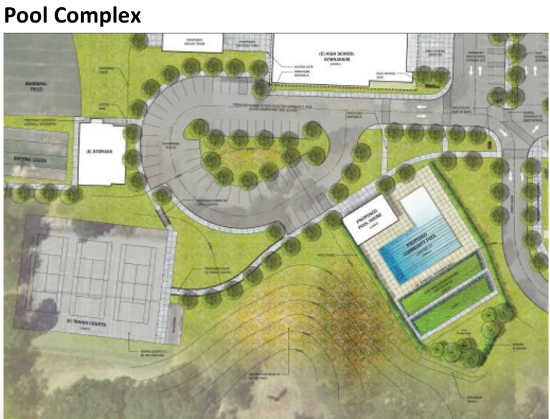
Next steps for the new pool project
Upgrades to the Westshore Pool were included in the list of projects presented to voters who approved Measure T in 2014.
Smith-Hagberg said the Division of the State Architect hired a pool specialist, whose study concluded it was not a fiscally sound option to upgrade the pool but instead it was preferable to build a new one.
She said there is still a lot of work to be done to determine particulars of the new pool, including its exact size and and design.
The school's master plan includes a sketch of the pool complex, but the design is not detailed and gives mostly an overview of its location and orientation to other facilities on the campus.
In addition to the bond's overall master plan committee, for every single bond project separate committees are being established to weigh in on the project specifications, Smith-Hagberg said, with people who use the facilities being asked to contribute input and suggestions to help shape the outcome.
“We want to use the public's money very wisely,” Smith-Hagberg said.
In the case of the pool, Smith-Hagberg said she wants representatives from the district, city, county and Channel Cats on the pool committee, adding the Channel Cats team knows a lot more about the pool than the others.
Hanson said she also sits on the bond oversight committee, which meets four times a year to approve expense reports.
She said she wants to see a pool that is designed for competitive swimming, and she hopes it could be ready for the 2017 summer season, although that timeline is yet to be determined.
The Westshore Pool has historically been a place where the community's children have learned to swim, which Lakeport City Council members – in supporting the pool operations and expenses – have indicated is critical because of Clear Lake.
Hanson said the swim team is the only organization training local children to swim. Many of those children have gone on to swim competitively with the Channel Cats and its high school team. Some of those top swimmers have, in turn, continued on to swim at the university level.
This year, the high school swim team has 25 members, the biggest team yet, said Hanson, adding that the Channel Cats finished the summer with 210 swimmers – a record number – with 150 of those swimmers being brand new.
“We're just really focused on teaching these kids to swim safely,” she said.
She added that she hopes the district will add swimming to the physical education program once it has a new pool that is available to students. Hanson said it doesn't make sense for children to know how to play badminton but not to swim, and she said not offering swimming is akin to taking driving classes out of school.
Hanson has been president of the Channel Cats for some 16 years. The team's coach, Agustin Merodio, has been involved for about the same length of time, she said.
“We're going to stick around at least long enough to see this pool built, that's for sure,” Hanson said.
Email Elizabeth Larson at
CLEARLAKE, Calif. – The Clearlake City Council is set this week to hold the second and final reading of a new ordinance to tighten regulations for medical marijuana cultivation.
A half-hour closed session to discuss two cases of existing litigation and property negotiations will precede the public portion of the council meeting, which begins at 6 p.m. Thursday, Jan. 28, in the council chambers at Clearlake City Hall, 14050 Olympic Drive.
City staff will take to the council the second reading of Ordinance No. 181-2016, which the council unanimously passed on its first reading on Jan. 14.
The updated medical marijuana cultivation ordinance was the result of work done last fall by an ad hoc committee the council appointed.
The Clearlake Planning Commission reviewed the proposed ordinance at its December meeting and recommended the council accept the new rules.
Key provisions of the new rules would include a ban on commercial cultivation, a limit of six plants on parcels of any size, a continuation of the current rule that prohibits cultivation on vacant properties, requirements for an on-property water source and no cultivation within 100 feet of drainages, creeks or Clear Lake.
The new ordinance also would institute a city permitting system that would cost growers $150 a year, with fines and penalties for failure to register and follow rules.
It's estimated that, if 500 permits were to be issued annually, the permit system could generate about $75,000 a year, which city staff said would be used to offset the costs of enforcement.
Thursday's meeting also will include a presentation by the Health Leadership Network and acceptance of the annual audit for fiscal year ending 2015, including the report to those charged with the governance and the appropriations limit report.
On the meeting's consent agenda – items considered noncontroversial and usually accepted as a slate on one vote – are warrant registers; minutes of the council meetings on Nov. 12 and 17, Dec. 10, Dec. 15 and Jan. 14; consideration of a second reading and option of Ordinance No. 180-2015 requiring dogs to be leashed and owners to pick up dog waste; consideration of establishing a job description and range for Community Development manager; award of contract for asbestos survey and lead-based paint assessment and report in preparation of demolition of structures located at 14061 Lakeshore Drive; review and consideration of the recognized obligation payments schedule for July 1 , 2016, to June 30, 2017, and authorization of submission to the oversight board; amendment to the Clearlake Police Officer Association memorandum of understanding adding POST incentive pay for dispatchers; award of the contract for the Austin Park Master Plan; and a resolution to accept the offer of the donation of property at 15886 18th Ave.
Email Elizabeth Larson at
012816 Clearlake City Council - Medical marijuana cultivation Ordinance No. 181-2016 by LakeCoNews
Saturday, Jan. 10, 2026
00:00 EXTRA PATROL 2601100001
Occurred at Lake County Law Library on 3D....
Friday, Jan. 9, 2026
00:00 EXTRA PATROL 2601090001
Occurred at Lake County Law Library on 3D....