 How to resolve AdBlock issue?
 Lakeport Police logs: Saturday, Jan. 10
Saturday, Jan. 10, 2026
00:00 EXTRA PATROL 2601100001
Occurred at Lake County Law Library on 3D....

CLEARLAKE, Calif. – The city of Clearlake is moving ahead with plans to demolish a dilapidated building on the former Austin Resort property.
At its last regular meeting of the year on Dec. 10, the Clearlake City Council came to unanimous consent to give city staff direction to remove an old building on the 4.5-acre property at 14061 Lakeshore Drive, across from Clearlake City Hall.
City Manager Greg Folsom said the building is a “blighted eyesore” and he wanted the council to clarify how city staff should proceed with the property, which it acquired following the dissolution of the Clearlake Redevelopment Agency.
Folsom said there exists in city documents a discrepancy as to how the property should be used.
While the Long Term Property Management Plan aimed to market the site as a prime anchor location such as a destination resort, Folsom's report to the council explained that the Lakeshore Drive Downtown Corridor Plan concluded that such a use would be detrimental to Clear Lake and the goal of revitalizing the city's historic commercial center, and suggested instead uses such as a campground or smaller commercial uses.
“This building is an embarrassment to the city,” and gives potential investors a negative image of the city, Folsom said.
He said city staff wanted to demolish the building and clean up the property. The city had previously attempted to take the property off a disposition list and use it for a park, but the state – which has to OK such requests related to former redevelopment properties – denied it.
Folsom said a demolition contractor gave the city a “drive by” estimate of $55,000 to remove the building. He said his written report to the council contained a typo and so had incorrectly reported an estimate of $35,000 to remove the structure.
Finance Director Chris Becnel told the council that the property has to be sold and the cash proceeds distributed back to the taxing entities that contributed to the tax increment used in redevelopment. The city of Clearlake is one of those entities.
Vice Mayor Gina Fortino Dickson pointed out that while the Long Term Property Management Plan goes along with the requirement to sell the property, the corridor plan doesn't, instead suggesting that it be a campground.
She asked if the building was red-tagged or if it could not be occupied due to its condition. “Yes, basically,” Folsom replied.
Councilman Russ Perdock asked about the city storing items in the building. Folsom said that practice was going to end regardless of the council's decision.
“Let's tear it down,” Perdock responded.
“Anything that we can afford to do to clean up the city and follow the plans that we have accepted,” said Mayor Denise Loustalot, who added, “I thought this was supposed to be torn down years and years and years ago.”
Added Perdock, “It's an embarrassment.”
“We should be setting the example and that building does not help us whatsoever,” said Councilman Bruno Sabatier, who supported tearing it down but wanted to discuss further at a future time what the council's vision is for the property.
During public comment, Chuck Leonard, a retired councilman, said the reason the building hadn't been torn down already is that someone had the idea of renting out part of the building for a small amount of money.
Leonard said the building needed to go and that the property was a prime place for a resort or business. The idea, he added, had been to place a hotel there to draw people to the city.
Supervisor Jeff Smith, who was on the city council when the city had purchased the property for the purpose of developing it, said the vision for the parcel has “been pretty much the same for years.”
Smith said the highest and best use for the property is to bring more income into the city, and that can't be done with a park or campground.
Sabatier said the city isn't using the property correctly, and that the council would lose a great opportunity if it didn't make the property generate revenue for the city.
Fortino Dickson said the Lakeshore Drive Downtown Corridor Plan says the property should be used as a campground and promenade, and that the council should amend the plan and change that.
The council then agreed unanimously that the building should be torn down. Councilwoman Joyce Overton had recused herself from the discussion since she has worked with the city's youth center, which has storage at the Austin Resort property.
The city subsequently put out a request for proposals and qualifications for a contractor to demolish the property.
The notice seeking contractors, issued on Dec. 18, sets a Jan. 6 deadline for proposals. More information is available at http://clearlake.ca.us/CivicAlerts.aspx?AID=72 .
Email Elizabeth Larson at
LAKE COUNTY, Calif. – The Lake County Library got a big Christmas gift this week – in the form of a state grant to help it meet the information and resource needs of the county's fire victims.
In response to the wildfires that devastated the south county this summer, the California State Library said Thursday that it is offering $15,000 in federal Library Services and Technology Act funds to the Lake County Library for the purpose of collection development.
County residents have sought help from the county's libraries to both rebuild and cope with property and personal loss, and California State Library officials said the one-time funds are aimed at helping the library system meet that demand.
The grant program's genesis, according to State Library spokesperson Kimberly Brown, came from a conversation between Lake County Librarian Christopher Veach and State Librarian Greg Lucas.
Veach told Lucas about some of the unique collection issues he was seeing stemming from recovering from a disaster like the Valley fire, Brown said.
She credited Veach with putting forward the notion of helping libraries respond to calamities more quickly on the State Library’s radar screen.
In a letter to Veach informing him of the grant dated Dec. 23, Lucas wrote, “It's clear, particularly in the wake of the Valley, Rocky and Jerusalem fires how essential libraries are to Lake County's residents. Hopefully, this grant will help you respond even more nimbly to the unique challenges created by the wildfire and other unexpected natural disasters.”
The Middletown Library itself was in the path of the fire, although it escaped major damage.
County officials reported in the days after the fire began in early September that the Middletown Library had sustained some minor damage to its roof. That was due to embers landing on it and damaging the rubber base, as Lake County News has reported.
Veach was appointed the county's librarian by the Board of Supervisors in June 2013 following the retirement of Susan Clayton.
Under his leadership, the county library system has sponsored an increasing number of educational events for children and adults alike, including the “Know Lake County” series and classes on using technology and digital devices.
In giving his annual report to the Board of Supervisors on Nov. 3, one of the key issues Veach highlighted was the need for more funding for materials and collections expansion, an issue that the new grant is expected to help.
Email Elizabeth Larson at
 LAKEPORT, Calif. – A group of local churches is moving forward with plans to open a warming center for the homeless early next month.
On Jan. 4, the warming center will open at the Lakeport Seventh-day Adventist Church, at the corner of Hill Road East and Park Way.
The center will be open from 6 p.m. to 7 a.m., Monday through Friday, through April 1.
During their stay, shelter guests will receive dinner and breakfast and have access to showers.
The center’s mission is to provide a warm and safe place to sleep for unsheltered individuals during intemperate weather.
The goal is to create a space that is physically and emotionally safe for all, regardless of race, ethnicity, nationality, religion, gender, gender identity or sexual orientation.
“Being homeless should not be a death sentence,” said Randy Brehms, pastor of the Lakeport Seventh-day Adventist Church.
Lake Transit will provide free transportation to and from the center. In the evening, people will be picked up at the bus stop at Third and Main Street in Lakeport at 6:14 p.m. after a brief intake procedure with a warming center volunteer.
In the morning, a bus will stop at the center and provide free transportation to any Lakeport stop on Route 8.
“This year many in Lake County came to realize just how precious and precarious our homes can be. Lake Transit welcomes the opportunity to support this compassionate initiative,” said Mark Wall, general manager of Lake Transit.
The warming center is organized by the Lake Ministerial Association and will be staffed entirely by volunteers.
Five different churches will take turns recruiting volunteers and staffing the center each night.
“This is a huge undertaking,” said association President Rev. Shannon Kimbell-Auth. “It is the culmination of months and years of planning that involved a wide spectrum of local agencies and organizations. A critical piece was gaining the support of the county planning commission and the Board of Supervisors.”
The goals of the warming center go beyond providing nourishment and shelter from harsh winter weather.
A secondary goal will be to connect individuals with appropriate continuum of care resources to get the help they need.
A broader goal is to gather information and experience to help improve the county’s development and implementation of interventions to address homelessness.
The association leadership wants to minister to those who have fallen through the cracks, and help them move forward.
There is a great need for volunteers in a variety of areas – team leader, intake, sleeping room and shower attendants, dinner and breakfast preparation and service, and security.
“At Christmas time especially, we might contemplate the time when Mary, Joseph and Jesus had to leave their home,” Kimbell-Auth said. “Presumably they were assisted by others who saw their plight and offered shelter and nourishment. What if no one had helped them?”
Anyone interested in helping or wanting more information about the warming center can contact Kimbell-Auth at 707-263-4788 or email
For information on transportation to the warming center, go to www.laketransit.com .
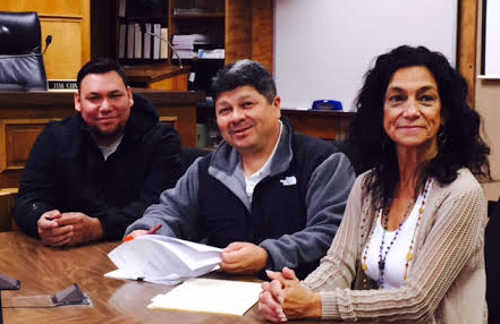
LAKEPORT, Calif. – Representatives from the county government and three local tribes gathered on Monday to sign an agreement meant to help increase protections for native cultural resources.
The memorandum of agreement between the county and the tribal consortium Ancestors 1 was signed on Monday morning in the Lake County Courthouse in Lakeport.
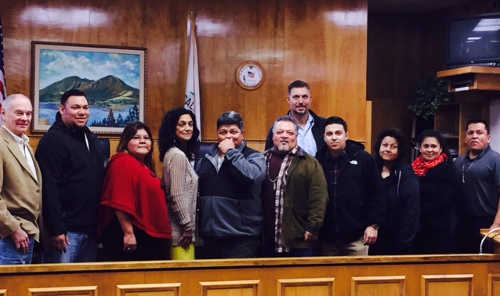
Tribal representatives on hand for the event included Dino Beltran, Darin F. Beltran, Drake Beltran and Judy Morgan-Faber of the Koi Nation; Eddie Crandell and Jaime Boggs of Robinson Rancheria; and Sherry Treppa, Angelina Arroyo and Ida Morrison from the Habematolel Pomo of Upper Lake. Supervisors Anthony Farrington and Jim Steele represented the county.
Dino Beltran, treasurer and tribal administrator for the Koi Nation, said the agreement is historical.
“It's only the sixth agreement of its type in the state of California, according to the Native American Heritage Commission,” Beltran said, adding that the fifth such agreement was between the Koi Nation and the city of Clearlake in August 2014.
“These things don’t happen all that often,” Beltran added.
Ancestors 1 was formed in April 2014. Beltran said it's one of only two organizations of its kind working to protect native cultural resources in California.
Beltran worked to start the effort to forge the agreement with the county, getting support in the early days from Habematolel, other local tribes and, then, from the county.
The Board of Supervisors unanimously approved entering into the agreement at its Dec. 1 meeting.
Community Development Director Rick Coel told the board that the collaborative effort between the tribes and the county to create the agreement began in the spring, and had involved considerable staff time.
Deputy County Counsel Shanda Harry explained that AB 52 – signed in September 2014 – added a new category for cultural resources to the California Environmental Quality Act. AB 52 went into effect July 1.
The memorandum of agreement says that the new “tribal cultural resources” category includes – but is not limited to – archaeological sites, traditional cultural properties, funerary objects, human remains, and burial and ceremonial sites, “and considers tribal cultural values in addition to the scientific and archaeological values when determining impacts and mitigation.”
The agreement also explains that AB 52 sets forth a process that clarifies California tribal government involvement in the CEQA consultation process, including requirements and timing for lead agencies to consult with tribes on avoiding or mitigating impacts to cultural resources.
Harry said AB 52 essentially requires consultation with tribes regarding cultural resources encountered during development, and deals with local issues such as what experts are to be used and how the Community Development Department alerts tribes when there are cultural resource issues with projects.
She said the agreement is meant to codify a working relationship between the tribes and the county.
Beltran told the board at the Dec. 1 meeting that the goal was to create an agreement that, among other things, would protect private property owners' rights and promote development.
He said he arranged a meeting of representatives from the county and the city governments with the governor's land use council to discuss how they are to adhere to the new rules established by AB 52.
“This is all about community building,” he said, as well as respect for sites and objects sacred to local tribes.
Treppa said her tribe supported it, explaining that many tribes in the area have lost control and ownership of lands through misguided policies of the federal government.
The Habematolel were landless until 2008, when they reestablished tribally held property of just over 11 acres, which Treppa said is well below the amount of land the tribe once held.
She called the agreement “a positive step forward” the county and tribal governments are taking in the effort to protect the cultural and archaeological sites the tribes value.
Beltran told Lake County News that the cultural resources management plan that the new legislation requires is something that's going to be worked on by the tribes, Coel and Harry. He said that document will describe how items that are uncovered will be handled.
He said the tribes already have established excellent working relationships with Sheriff Brian Martin and District Attorney Don Anderson, and are working together on addressing archaeological crimes.
Those strengthening relationships are part of the effort to continue to expand upon government to government relations between the tribes and local agencies, Beltran said.
Email Elizabeth Larson at
Saturday, Jan. 10, 2026
00:00 EXTRA PATROL 2601100001
Occurred at Lake County Law Library on 3D....
Friday, Jan. 9, 2026
00:00 EXTRA PATROL 2601090001
Occurred at Lake County Law Library on 3D....