 How to resolve AdBlock issue?
 Lakeport Police logs: Saturday, Jan. 10
Saturday, Jan. 10, 2026
00:00 EXTRA PATROL 2601100001
Occurred at Lake County Law Library on 3D....

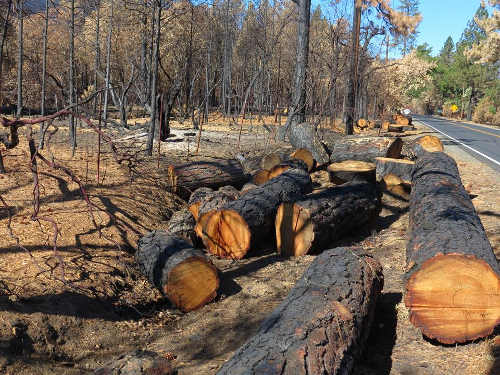
LAKE COUNTY, Calif. – In the wake of the Valley fire, county and state agencies along with Pacific Gas and Electric are working throughout the fire area to remove damaged trees that create safety issues for public utilities and right of ways.
Starting almost immediately after the fire broke out on Sept. 12, the effort to deal with trees and other vegetation in the 118-square-mile fire area has been ongoing, with officials explaining that removing the trees is necessary to protect infrastructure and public safety.
However, in some cases, community members are raising concerns with tree removal, alleging that trees that don't appear to be damaged and which are not close to right of way or infrastructure are being cut down.
County Supervisor Rob Brown said he's received complaints of such tree removal, which also has inspired a petition from community members asking the removal be stopped.
“I've invited people to call me with specific addresses,” where the tree cutting is taking place, so he can investigate, he said.
In one case, Brown said he was personally aware of trees being cut on a property that wasn't near public right of way.
He said he's meeting on Thursday with PG&E and the Office of Emergency Services to talk about tree-related issues.
Lake County Public Works Director Scott De Leon said the county hired a contractor that went through the fire area – particularly areas that were being repopulated after the fire – to check for hazardous trees in the right of way for county roads.
He said the county's contractor, Pacific Tree Care, began work on Sept. 19, with the contract ending on Tuesday.
The county contractor followed along behind PG&E's crews. De Leon said the majority of the trees he has seen cut down in the fire area were taken down by PG&E, which was in the process of installing new overhead facilities.
De Leon said he didn't know the number of trees the county's contractor took down, with the contract costing the county $144,000.
He said the county's contractor is leaving any trees it cuts down on the roadside.
If county road crews can get freed up, they will remove the trees or put them out to bid for removal by another contractor.
He acknowledged, “There's a lot of trees getting cutting down.”
Caltrans addresses hazardous trees
Phil Frisbie, the public information officer for Caltrans District 1, said that agency and PG&E are doing much of the tree removal, estimating that Caltrans is removing the most trees.
As for how many trees exactly have been cut, he didn't have an exact figure.
“We are removing thousands of trees,” he said.
Frisbie said he sat in on the Tuesday Board of Supervisors meeting – during which community members spoke about the tree removal – and that Caltrans is aware of the concerns.
He explained that the work – being carried out by Caltrans' contractor, Granite Construction, and its subcontractors – is being done as quickly as possible due to safety concerns.
“They've been hard at it for almost two weeks right now,” he said.
Although the National Weather Service has a longterm forecast for a wet winter – with most of the rain expected to hit in January – Frisbie said the weather is not a critical concern at this time.
Explaining the process, Frisbie said every tree that has the potential to fall into a roadway is being inspected by an arborist. That process is ongoing.
If, after being inspected by an arborist, the tree is determined to not be viable, it's marked and the crews respond to remove it, he said.
“That's the biggest thing we're doing right now,” he said.
“They have another two to three weeks of tree removal still until they have all the trees removed to ensure the highway is safe this winter,” Frisbie said.
He added, “Not all of these trees that we're removing are on the state right of way.”
In normal conditions, when Caltrans sees a tree that's dead or damaged on private property, they go through public records, contact the owner and have them remove the tree, or else remove the tree and charge the landowner, Frisbie said.
While Frisbie said they're trying to follow their normal procedures as much as possible, the Valley fire has created an emergency situation.
As such, he said Caltrans is moving forward with dropping all trees that need to be removed for safety – whether they were damaged by the fire or could potentially fall into the state right of way.
If those trees are on private land, crews are cleaning them up and leaving them in place for the landowners, he said.
“We're only hauling off the ones that were in the state right of way,” Frisbie said.
As for what will happen with the trees being removed from the public right of way, Frisbie said, “That is being negotiated right now.”
Due to the fact that Caltrans entered into an emergency contract with Granite Construction, Frisbie said a lot of details were left out, one of those being disposing of the trees.
Because of the presence of sudden oak death, Frisbie said the trees are restricted as to where they can be moved. For example, they can't be taken east, to areas including the Sacramento Valley.
He said that restriction is in place even though most of the trees are pines, which can still transport sudden oak death spores. “That's what we're being told.”
He said Caltrans is looking for local nonprofit groups that would be interested in having the wood as part of sponsoring a firewood program, and could accept donation of the wood. “We would love to do that,” he said.
Because Caltrans is a state agency, Frisbie said special arrangements for disposing of the trees need to be made with groups like nonprofits. Because the trees are a resource, simply giving them away becomes a gift of public funds.
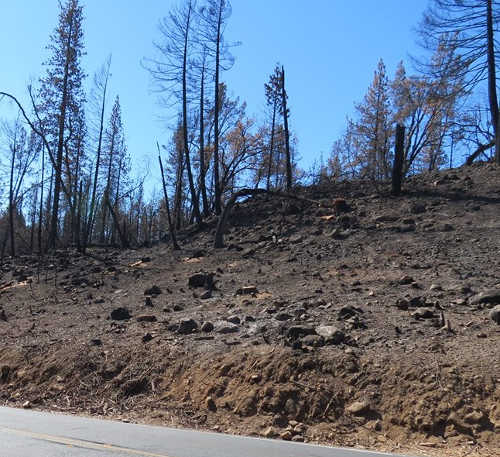
PG&E crews at work in the fire area
PG&E spokeswoman Brittany McKannay said crews were out in response to the fire right away, both working on repairing damaged utility infrastructure, and dealing with trees and vegetation.
The work related to trees and vegetation is two-fold, she explained.
The first prong of that response was to remove vegetation that was posing a problem for first responders, especially in areas close to power facilities, she said.
Once access to certain areas was cleared, she said crews started taking out vegetation that had come in contact with power equipment.
The second part of the vegetation-related work was an assessment, McKannay said.
She said PG&E crews went through the entire fire area to assess what trees posed hazards to equipment. Those trees were in the right of way or near it.
The crews looked for trees that could come down and cause further damage to equipment or create fire hazards, McKannay said. As a result of that assessment, crews have been pruning or removing hazardous trees.
She did not have a number immediately available for how many trees PG&E has removed.
In addition to the first assessment, McKannay said PG&E had arborists go back out and reassess all of the trees marked for removal to double-check if they actually needed to be removed or could just be pruned.
“Sometimes when a tree is removed, it may not look like it's a dead or dying tree,” which is why PG&E is having arborists go out and do further assessment, McKannay said.
She said if the tree's cambium layer – the inner growing layer of the trunk – is damaged, it will stop the tree from being able to grow in a healthy way, which could potentially cause issues. Damaged trees also are at risk for disease, as well as beetles or other insects.
“We don't want to have any sort of safety concerns or issues along those power lines because that can be a fire hazard,” she said.
She said PG&E also has been doing more surveying and aerial flights than it normally does to look at tree health, including reviewing impacts not just from the fire but from the bark beetle and the ongoing drought.
“There's a lot of things we're doing to try to protect our system,” she said.
McKannay did not have a deadline for when the tree pruning and removal work will be completed, noting that the crews are trying to get the work done as quickly as possible so the work of rebuilding the community can move forward.
“The community will see us in the area in full force right now,” she said.
PG&E has heard concerns from residents about trees being removed or logged, and McKannay said the company is letting customers know that it's not PG&E's policy to remove any trees felled on private property, although such trees will be moved from the road.
Rather, the trees will be left there, and smaller vegetation – 4 inches in diameter and less – will be chipped, she said.
Separately, she said if anyone sees a tree that is a safety concern near power utilities, they can call PG&E at 800-PGE-5000 and a member of its team will respond to assess the situation.
Email Elizabeth Larson at [email protected] . Follow her on Twitter, @ERLarson, or Lake County News, @LakeCoNews.
LAKEPORT, Calif. – The county of Lake and the city of Lakeport have reached a final settlement agreement in a nearly two-and-a-half-year-old lawsuit filed after the county's former sheriff cut off the Lakeport Police Department's access to shared law enforcement records.
County Counsel Anita Grant said the Board of Supervisors emerged from closed session on Tuesday and voted unanimously to accept the proposed settlement with the city of Lakeport in the case, filed in May 2013.
The settlement calls for the county to pay the city's attorney's fees and costs in the amount of $69,901.81. Grant said that settlement is not covered under the county's insurance.
Grant said once both sides have signed off on the final paperwork, it will be dismissed in Mendocino County Superior Court, where the case was moved a month after it was filed at the city of Lakeport's request.
The city filed the lawsuit in response to former Sheriff Frank Rivero's action to cut the Lakeport Police Department off from access to the Records Information Management System, or RIMS, in April 2013, as Lake County News has reported.
The suit alleged breach of a longtime contract in which the agencies worked cooperatively to share dispatch services.
The city argued that the dispatch services contract allowed Lakeport Police to use RIMS to access records of its own calls for service through dispatch and related law enforcement information gathered by the county and other agencies.
Lakeport City Manager Margaret Silveira told Lake County News that the city's access to the records was restored immediately after Mendocino County Superior Court Judge Cindee Mayfield granted the city a temporary restraining order in July 2013.
The following month, Mayfield granted the city a preliminary injunction in the case.
Since then, Silveira said there have been no issues with access.
Brian Martin defeated Rivero in the June 2014 primary election. Following that change in county personnel, “settlement discussions have reached the point where the City is satisfied its Lawsuit is no longer necessary,” the settlement agreement states.
Silveira said the suit was handled on the city's behalf by attorney David Ruderman of the firm Colantuono and Levin PC.
Since the suit was filed, the firm has gained Lakeport's city attorney contract, with Ruderman now regularly appearing at Lakeport City Council meetings in his city attorney role.
With Tuesday's action by the Board of Supervisors, “I think it's pretty much done,” Silveira said of the suit.
On Wednesday, county officials had not yet signed the final version of the settlement document, which already bore Ruderman's signature along with those of Lakeport Mayor Martin Scheel and acting City Clerk Kelly Buendia. City officials signed the document on Tuesday.
Silveira said the city continues to work with the county under the dispatch services contract.
However, Sheriff Martin and Lakeport Police Chief Brad Rasmussen are working on creating an updated contract, Silveira said.
Email Elizabeth Larson at
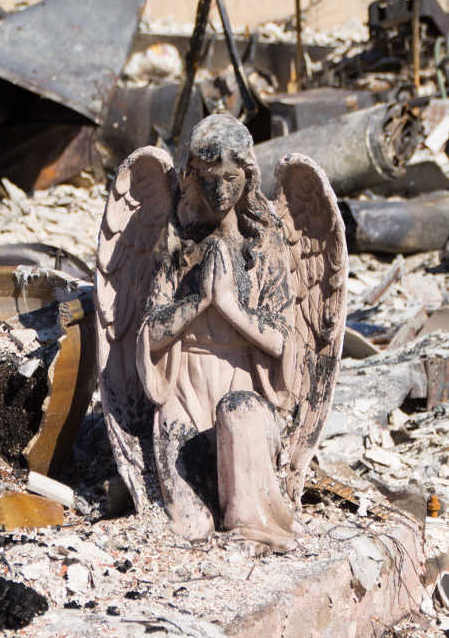
LAKE COUNTY, Calif. – On Tuesday afternoon, 24 days after it roared to life on Cobb, the Valley fire – one of the most damaging fires in California history – was finally, and fully, contained.
The 76,067-acre fire was reported to be at 100-percent containment in an early Tuesday evening report from Cal Fire.
The agency said 248 firefighters, 15 fire engines, 10 fire crews, three helicopters and two dozers remained assigned to the patrol, mop up and landscape rehabilitation activities expected to continue in the 118-square-mile fire area in the days to come.
Since it began on the afternoon of Saturday, Sept. 12, the fire has created a vast path of devastation that is still difficult for many to comprehend, leading local officials to dub it the worst disaster in Lake County's history.
Four deaths have been confirmed as a result of the fire. Additionally, there were four serious injuries when, within a short time of the fire's dispatch, Cal Fire firefighters on the Copter 104 crew were burned while responding to the incident.
Thousands of structures were threatened, approximately 1,958 structures were destroyed, of those just over 1,300 homes. Another 93 structures were damaged.
“If your home is still standing, you're one of the lucky ones,” Battalion Chief Mike Smith, a member of Cal Fire's Incident Management Team 3 – which had command of the fire for much of its life – told Lake County News in a recent interview.
At its height, close to 20,000 people – roughly a third of Lake County's population – were evacuated from the communities of Anderson Springs, Clear Lake Riviera, Cobb, Hidden Valley Lake, Loch Lomond, Twin Lakes and Middletown. It also burned into Napa and Sonoma counties, sparking evacuations there as well.
Among the thousands who lost their homes were more than two dozen firefighters who were engaged in battling the blaze. Several sheriff's deputies and county employees also were reported to have lost homes while working to help others.
The fire's sheer speed also appeared to have confounded the county's emergency warning system and the technology on which it's based.
Sheriff Brian Martin said authorities used phone calls, Nixle messages and door-to-door contacts to notify community members of the need to evacuate.
He said that, in some cases, phone lines burned before the messages could be delivered, and spotty cell service in areas like Cobb also delayed or prevented the messages from being delivered in time.
On a given Saturday, Martin said his agency has about half a dozen deputies on duty countywide. That was the case on the Saturday the fire started, when his staff mobilized as quickly as they could to begin evacuations.
“I don't think people understand how rapid and how violent this fire was,” Martin said.
Add to all of that the fact that the Valley fire followed by a little over a month two other devastating wildland fires – the Rocky, which began July 29, near Lower Lake and burned 69,438 acres; and the Jerusalem, sparked near Lower Lake on Aug. 9, burning 25,118 acres.
Cal Fire has listed the Valley fire as No. 3 in its top 20 list of the most destructive fires in the state's history, behind the 1991 Oakland Hills fire and the 2003 Cedar fire. Among that top 20, the Valley fire ties for the sixth deadliest.
As for Lake County's history, the Valley fire is second in size only to the 1996 Fork fire, which burned more than 83,000 acres. It burned primarily in the Mendocino National Forest, where it destroyed about 40 structures, many of those reported to be hunting cabins.
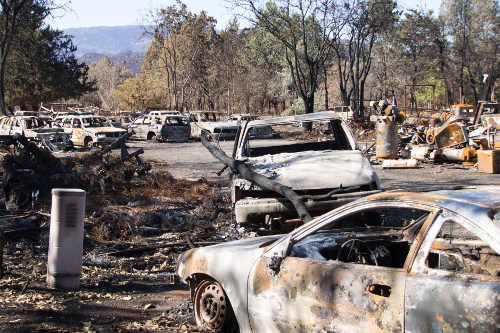
Understanding 'megafires'
On Sept. 13, Gov. Jerry Brown's declared a state of emergency due to the Valley fire.
On Sept. 21, Brown appealed to President Barack Obama for a presidential major disaster declaration, which Obama granted the following day, opening up federal aid to fire victims.
Congressman Mike Thompson, who was on the ground for the first week of the fire, also wrote to Obama to ask for federal assistance.
In his letter to the president, Thompson wrote, “I've been on the ground and seen the lives and livelihoods destroyed. People have lost everything – houses, possessions, family items that can never be replaced. A once beautiful land has been decimated. Fields turned black. Cars are melted to pavement. Houses have been reduced to piles of ash. Farmers and ranchers have seen untold losses of livestock, grazing areas and vineyards. Our community has been left heartbroken and many families have been left with nothing.”
He added, “I committed to the impacted families that I would help them recover and rebuild. I hope you will join me in keeping that promise. It is our government's responsibility.”
In his letter to the president, Brown noted, “Given this fire's rate of spread, size, and intensity, scientists consider it to be a 'megafire,' which behaves differently than typical wildfires. Megafires expand quickly and unpredictably, thriving on dead trees, dry vegetation, and wind conditions. Winds propel burning embers far ahead of the existing fire, accelerating fire growth at a pace that is very difficult to control. Four years of extreme drought conditions have parched our landscapes and created millions of dead trees that have increased California's vulnerability to these types of fires.”
Smith said “megafire” is a relatively new term used to describe the much larger, faster, more destructive wildfires that have been occurring more often in recent years.
He said megafires are influenced by a number of factors, from the fourth year of drought conditions cited by the governor to a greater number of people moving into what's called the “wildland interface,” primarily more remote, forested areas.
“This is creating some complications for firefighters,” who as they try to protect people and homes are dealing with a changing environment, Smith said.
Until this year, Lake County didn't have many of these larger fires, he said.
Smith explained that the majority of the larger wildland fires have burned in heavier fuels – the term the fire service uses to describe vegetation such as trees, brush and grass.
Seasonal shifts also are occurring. As an example, Smith, who hails from Southern California, said the state's southern portion has had to deal with heavy winds in September and October for many years, but now those winds are kicking up later – in December and January.
“We are faced by a year-round fire season as a result of the changes we're seeing on the ground in California's historically Mediterranean climate,” Smith said.
He encouraged people to continue to keep defensible space around their homes. “We know defensible space works,” he said, referring people to www.readyforwildfire.org for more information.
During a visit to Lake County in September, Cal Fire Chief Ken Pimlott said his agency had been talking about the potential for such big, destructive fires for some time.
Even so, Pimlott said no one has seen rates of spread like that seen in the Valley fire, which in the first 24 hours burned 50,000 acres.
He said Cal Fire's No. 1 message to state residents is to heed evacuation orders and leave when officials say it's necessary to do so.
In the case of the Valley fire, he said it spread miles in just a few hours, and firefighters had to be diverted from the work of fighting the fire to getting people out of the fire's path.
Todd Derum of Cal Fire, who was the Valley fire's operations chief in its early hours, also reported at a recent community gathering that the fire moved so fast that the focus turned to evacuations, not firefighting.
“We're not out of fire season yet,” said Derum, who added that he's not sure the 2012 fire season ever ended.
From response to recovery
With the firefighting response now coming to an end, the recovery phase is getting into full swing, and is a mixture of the efforts of local, state and federal government officials and programs.
Some key parts of the rebuilding already has taken place or is well under way.
Almost immediately after the fire began, utility companies led by Pacific Gas and Electric and AT&T were involved in the response.
They began rebuilding the utility infrastructure the fire damaged or destroyed, placing several hundred new poles and more than 100 miles of new transmission lines in the effort to restore power to thousands of south county customers.
State officials also are beginning the massive debris removal process. California Office of Emergency Services Director Mark Ghilarducci last week asked FEMA for assistance to pay for the cleanup for both the Valley and the Butte fires. He estimated that $66 million in costs for both fires are eligible for federal help.
As Smith noted, all major fires start and end local, and many of the major decisions going forward will be in the hands of local leaders who must grapple with the challenges of rebuilding communities – with a goal of rebuilding them better – with available resources and in light of residents' expectations.
At its Tuesday meeting, the Board of Supervisors approved a resolution to take more stringent action – in the form of a fine of up to $20,000 – for landlords who raise rents more than the 10-percent allowed during an emergency or evict tenants in order to rent to fire victims at higher rental costs.
As a result of a gubernatorial executive order issued last week expediting placement and processing of temporary housing for Valley fire victims, action that the board had planned to consider on Tuesday regarding an interim urgency ordinance deferring provisions for permitting new RV parks to be used specifically for housing people who lost their homes in the fire became a moot point.
The board also put off deciding on rules for allowing fire victims to live in RVs on properties one acre or larger during the rebuilding phases.
Also on Tuesday, the Lakeport City Council voted to waive for 90 days the maximum 30-day stay allowance for transient housing at local hotels and other similar establishments, as well as the initial service and deposit fees for new sewer and water connections for fire victims seeking temporary rental housing in the city.
Email Elizabeth Larson at
LAKE COUNTY, Calif. – The director of the California Governor's Office of Emergency Services Director is asking the federal government for millions of dollars in assistance to pay for the debris cleanup in the wake of the Valley and Butte fires.
Director Mark Ghilarducci made the request Oct. 1 in a letter to Elizabeth Zimmerman, associate administrator for the Federal Emergency Management Agency's Office of Response and Recovery, in an effort to expedite the economic recovery of the counties primarily impacted by the fires, particularly Lake and Calaveras counties.
In his letter, Ghilarducci said it's important to the economies of the two counties that debris removal take place so rebuilding can start, with the state having to be involved in the cleanup process because both counties have determined the volume of debris is beyond their capabilities to manage and remove.
Citing predictions by the National Weather Service for inclement weather that could begin by mid-October in Northern California, Ghilarducci said of federal assistance, “time is of the essence.”
The Valley fire, which began Sept. 12 in Cobb, has burned 76,067 acres, destroyed 1,958 structures – of which more than 1,300 are homes – and left thousands displaced in Lake County. Four people also lost their lives in the fire.
Cal Fire reported that the Valley fire is the third most damaging fire in California history, behind the 1991 Oakland Hills fire and the 2003 Cedar fire.
The Butte fire, which began Sept. 9, has burned 70,868 acres in Amador and Calaveras counties, destroyed 475 homes and claimed two lives. It is listed as the seventh most damaging fire in California's history.
Gov. Jerry Brown proclaimed a state of emergency for Calaveras County on Sept. 11 and for Lake County on Sept. 13 because of the fires.
On Oct. 2, Gov. Brown also issued an executive order to accelerate the process of installing emergency housing in Lake and Calaveras counties for fire victims, as Lake County News has reported.
In his letter to FEMA's Zimmerman, Ghilarducci made a request for federal Public Assistance funds, which are designed to support the recovery of public infrastructure and clearance of fire debris that poses a threat to public health and safety and to the environment, according to Cal OES.
Ghilarducci's office said the funds build on other federal assistance already provided to assist individuals and families who have suffered losses.
On Sept. 21, the governor asked President Barack Obama for presidential major disaster declarations for the fires, which Obama granted for Lake County on the following day, with the Butte fire added to the declaration on Sept. 23.
That declaration has triggered Individual Assistance through FEMA, which is in Lake County to register fire victims to begin the process of determining their eligibility for help to repair and replace housing, and other personal property not covered by insurance.
In just a matter of days after the president's declaration, FEMA had more than 2,300 registrations for both the Butte and Valley fires, as Lake County News has reported. The deadline to register is Nov. 23. For more information visit www.disasterassistance.gov .
Ghilarducci said in his letter that a preliminary damage assessment found an estimated impact to the state of $97,913,559 from the two fires. The majority of that figure is associated with debris removal, including debris on private property.
After deducting from that $97.9 million figure the debris removal costs that are not eligible for federal consideration, Ghilarducci said the assessed eligible costs for federal Public Assistance are $66,670,344, which he said amounts to a $657.96 per capita impact in Lake County and a $164.72 per capita impact in Calaveras County.
“The State of California understands that typically private property owners are responsible for removal of debris after a disaster,” Ghilarducci said. “However, where the magnitude of the disaster creates an enormous amount of debris, it is in the public's interest to remove this debris expeditiously in order to eliminate threats to life, public health, and safety and to ensure economic recovery of the affected community.”
The potential impacts on public health have been a focus for local officials.
Lake County Health Officer Karen Tait declared a public health emergency in Lake County on Sept. 15, which was amended on Sept. 22 to reiterate the urgent nature of the hazardous debris.
The Board of Supervisors will consider extending Tait's proclamation when it meets on Tuesday.
Tait's report to the board notes that removal of hazardous materials and remediation of burned properties is currently under way, however, “it is early in the process, such that only a portion of ash and other hazardous, or potentially hazardous materials has been removed.”
She also noted, “Families have re-entered burned areas that may pose both acute and chronic health risks as well as threats to the environment if timely and appropriate clean-up efforts are not supported.”
On Sept. 22, Calaveras County also proclaimed a public health emergency due to hazardous debris.
Ghilarducci's letter stated that both the U.S. Environmental Protection Agency and the California Environmental Protection Agency have determined the ash and debris from burned residential structures contain hazardous materials – including concentrated amounts of heavy metals – that pose a health risk to the public and environment.
As such, he said the California Environmental Protection Agency is currently conducting random testing to determine the specific level of contamination in the debris.
Because many of the homes in the affected communities were constructed prior to 1980, officials anticipate the debris will contain toxic materials such as asbestos, which was a binding agent in building materials used at that time.
Ghilarducci said the California Department of Resources Recycling and Recovery, or CalRecycle, is managing the overall debris removal operations due to the two fires.
Todd Thalhamer, a CalRecycle engineer who created the debris removal program, grew up in Middletown and told community members at a meeting there on Sept. 24 that he would lead the local cleanup, with a goal of having it completed by Christmas.
However, that is expected to be a challenge due to the impact on state resources, based on Ghilarducci's letter.
Ghilarducci reported that the Valley and Butte fire represent the fifth and sixth debris operations, respectively, for CalRecycle in California within the last 12 months, beginning with last year's Boles Fire in Weed in Siskiyou County, the Round Fire in Mono County, the Rocky Fire in Lake County, and five fires in Trinity County – the Fork, Route, Mad River, South and River complexes.
“The cumulative impact of all the wildfires have depleted California's resources and are hindering its ability to effectively respond and recover,” Ghilarducci said.
Email Elizabeth Larson at
Saturday, Jan. 10, 2026
00:00 EXTRA PATROL 2601100001
Occurred at Lake County Law Library on 3D....
Friday, Jan. 9, 2026
00:00 EXTRA PATROL 2601090001
Occurred at Lake County Law Library on 3D....