 How to resolve AdBlock issue?
April designated 'Child Abuse Prevention Month'; Children's Festival planned to raise awareness
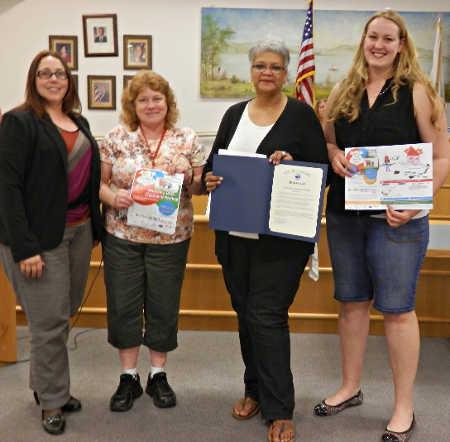
CLEARLAKE, Calif. – The Clearlake City Council has designated April as “Child Abuse Prevention Month” in the city of Clearlake.
The proclamation, presented at the council's March 26 meeting, encourages increased participation in efforts to prevent child abuse.
Vice Mayor Gina Fortino Dickson, in presenting the proclamation, cited child abuse as a community-wide problem in which finding solutions is dependent upon the involvement of all.
She stated effective child abuse prevention programs succeed because of partnerships created among social service agencies, schools, religious and civic organizations, law enforcement agencies and the business community.
The proclamation urges citizens to become more aware of the effects of child abuse and its prevention and more supportive of parents raising their children in safe and nurturing environments.
The Lake County Children's Council and the Lake County Office of Education will host the fifth annual Children's Festival and Advocacy Walk to raise awareness of the issue.
The event will be held from 10 a.m. to 3 p.m. Saturday, April 11, in Library Park in Lakeport.
It will feature musical entertainment along with an informational fair and activities for the children.
There also will be a selection of guest speakers and an opportunity to participate in an advocacy walk.
Agencies interested in participating in the informational fair should call at 707-994-5486 to sign up or email Mike Mix at
Email Denise Rockenstein at
- Details
- Written by: Denise Rockenstein
Clearlake City Council approves updated housing element
CLEARLAKE, Calif. – The city of Clearlake's housing element was updated by motion of the city council during its meeting last week.
The action on March 26 satisfies a state mandate for updating the housing element every five years.
The current update covers 2014 to 2019.
The housing element, which is part of the city's general plan, provides an assessment of housing characteristics and needs in the community and establishes programs to improve housing to meet those needs.
The update requires the approval of the California Department of Housing and Community Development, or HCD.
In the process to update the housing element, HCD – typically in association with the regional government – determines the number of projected housing units each jurisdiction is required to accommodate, in terms of land/zoning availability, for the projected household growth needs for all income levels.
According to Gary Price, the city's contracted planner, Clearlake is required to have 175 affordable units and 292 moderate to above moderate income housing units.
Affordable housing unit requirements include 54 extremely low income (less than 30 percent of the average median income, or AMI), 54 very low (30 percent to 50 percent AMI), and 67 low (51 percent to 80 percent AMI).
Moderate housing requirements include 87 moderate (81 percent to 120 percent AMI) units and 205 above moderate (more than 120 percent AMI) units.
Price said the HCD has determined that the draft housing element presented to the council complies with state law.
With the council's approval, the document will be resubmitted to the HCD for final certification.
Updating the document includes opportunities for public response. Price said two letters were received in relation to the update, neither of which dispute the negative declaration association with the document nor present cause for making any revisions to the draft as proposed.
A letter was received from the California Regional Water Quality Control Board concerning an actual construction project that is not a part of the housing element.
“But the letter does identify various related water quality laws that could relate to policies contained in the housing element update,” Price said. “Water quality impacts from implementation of the housing element update, however, have been adequately addressed in the environmental initial study so no response is necessary.”
The letter from the California Board of Forestry and Fire Protection identifies relevant information regarding SB 1241, which requires that the city update the general plan safety element to comply with current fire safe development guidelines.
Price said the Board of Forestry and Fire Protection has been given a second opportunity to comment on the city's draft 2040 general plan update, which Price said includes a completely updated safety element.
“The draft safety element update was developed to comply with SB 1241 and designed to comply with current state fire safe development guidelines,” Price said.
According to Price, the housing element was designed to be consistent with the current and proposed draft 2040 general plan update.
He said obtaining a certified housing element provides the city grant opportunities such as those awarded through the Community Development Block Grant program.
The current housing element update is available for public review at Clearlake City Hall, 14050 Olympic Drive in Clearlake, during regular business hours, 8 a.m. to 5 p.m. Monday through Thursday.
Email Denise Rockenstein at
- Details
- Written by: Denise Rockenstein
State Drought Task Force looks at next steps for mandatory water reductions
NORTHERN CALIFORNIA – State officials are preparing to roll out the first-ever statewide mandatory water reductions as part of a larger effort to deal with the ongoing drought and encourage Californians to adopt a conservation way of life.
Following a Wednesday morning snowpack survey that showed no snow on the ground in the Sierras, Gov. Jerry Brown issued an executive order requiring Californians to conserve 25 percent more water as the state heads into its fourth year of drought.
That follows an executive order Brown issued last year requiring 20-percent conservation.
Several state officials, members of the Governor's Drought Task Force, told reporters in a Wednesday afternoon teleconference that they're immediately beginning efforts to implement the new emergency drought conservation requirements.
Locally, Lake County Special Districts – which manages water and sewer facilities in several communities around Lake County – had already begun receiving communications from the state on the new rules.
Special Districts Compliance Manager Jan Coppinger told Lake County News on Wednesday that she was still going through the state messages, so it was too early to try to determine what the possible impacts would be for their local users.
Coppinger said mandatory conservation is in effect in several Special Districts-run systems – Bonanza Springs, Mount Hannah, Paradise Valley, Spring Valley and Starview – and has remained so since the Board of Supervisors approved those measures last year.
The rest of the water districts administered by the agency are under voluntary conservation, per the first stage of the Special Districts drought plan, she said.
Every one of Special Districts' water systems is showing at least 20-percent conservation compared to the same time last year, said Coppinger.
“Some of them are actually exceeding 40-percent conservation,” said Coppinger, recognizing the efforts of the agency's customers.
But that level of water conservation hasn't been the norm in the rest of the state, resulting in Gov. Brown's latest directive.
The Governor's Drought Task Force includes Chuck Bonham, director, California Department of Fish and Wildlife; Mark Cowin, director, California Department of Water Resources; Mark Ghilarducci, director, California Office of Emergency Services; Felicia Marcus, chair, State Water Resources Control Board; Karen Ross, secretary, California Department of Food and Agriculture; Robert B. Weisenmiller, chair, California Energy Commission.
Ghilarducci said the snowpack measurement confirmed what people already knew. “This really spells out the fact that the situation is unprecedented and critical,” and requires an “all-hands-on-deck approach.”
He said the drought has taken its toll on cities, farms and the natural environment, and the state has taken steps to make sure water is available for human health and safety, growing food, fire safety, and protecting fish and wildlife, while helping impacted families pay bills, buy food and have water to drink.
When the governor previously sought 20 percent conservation, people didn't step up. “This year has to be different,” said Ghilarducci. “We are at a critical state and conservation will be paramount.”
Cowin said that in normal years the Sierra snowpack accounts for about 15 million acre feet of storage. This year, it's at 6 percent of normal. “That big reservoir is nearly empty.”
That means the state is confined to the water it has in storage as well as continued reliance on groundwater. “The delicate balancing act that we have endeavored to pursue over the last few years continue and only gets harder over time,” Cowin said.
Cowin said efforts will include working to replace 50 million square feet of ornamental lawns statewide with drought tolerant landscaping, updating a model landscape ordinance for housing developments and strengthening the agricultural management planning process.
They also are considering the need for rock salinity barriers that would be installed in the Sacramento-San Joaquin Bay Delta to prevent salt water from getting into freshwater and limit upstream releases in order to manage salinity.
It was reported during the briefing that the state had considered installing the salinity barriers last year, but didn't go forward with it thanks to late spring rains. The barriers do come with impacts to fish, Cowin acknowledged, as well as to water users on the wrong side of the barriers.
He said the executive order will provide some “regulatory streamlining” for the salinity barriers. A decision on whether to install them will be made this month, with construction to go forward in May if the state decides they're needed.
Because of the state's extreme drought, Marcus said new actions are necessary. The voluntary measures in effect since last summer “haven't really provided us with the water savings that the situation now clearly warrants.”
The target, Marcus said, is 25 percent savings in urban water use. She said the state will be setting targets that take into consideration current per capita water use and coming up with a sliding scale so that those who already have been conserving and using less will have different requirements.
“A number of agencies are going to have to step up mightily compared to where they’ve been,” she said.
If it doesn't rain in the next year, Marcus said Californians may find themselves in a more “Australian-style millennium drought.”
She said water pricing is among the most important tools for water conservation, and the state will be working with water suppliers to direct water conservation rate structures. There will be some challenges, she said, based on Proposition 218, which sets certain requirements for raising utility rates.
Marcus said the state also is making permanent its existing rules on requiring urban water suppliers to report usage, rates and enforcement. That reporting, said Marcus, will help the state stay on track with its conservation goals.
Weisenmiller said the California Energy Commission is putting in place a statewide appliance rebate program, will help replace inefficient household water fixtures, implement a water energy technology program and consider mitigation measures as to where energy plants source their water.
Ross detailed the impacts on agriculture, including last year’s fallowing of 460,000 acres, primarily in the Central Valley, the loss of 17,000 farmworker jobs and $1.5 billion in losses.
With a zero allocation from the federal Central Valley Project and 20 percent from the State Water Project, Ross anticipated even more significant losses in the year to come, including hundreds of thousands of more acres to be fallowed and crops – primarily trees – to be pulled out.
“It's farm and wage income that is not going to be spent in these local, little communities that are especially dependent on the agriculture community,” said Ross.
She said the agriculture industry has made great strides water conservation, reducing water usage overall by 5 percent while seeing a 90-percent gain in economic activity and yields.
For that reason, Gov. Brown's emergency legislation last year and last week is making further investments in agricultural energy and water efficiency projects. The first round of funding is expected to save more than 317,000 acre feet of water over the life of the projects, Ross said.
Bonham pointed to the impact the drought is having across all agencies and industries.
“Drought is impacting all of us. It’s not about people or the environment, fish or the farmers. The task before us is, how do we make it through this together,” Bonham said.
The California Department of Fish and Wildlife has been conducting surveys of smelt in the Bay Delta for nearly 50 years. This fall and winter they found the smallest number of delta smelt they had ever seen, and the second-lowest number for longfin smelt, according to Bonham.
Then, this spring, they found the lowest number of delta smelt in a spring count – six. That's compared to 88 counted last year, Bonham said.
At the same time, Bonham said they saw in 2014 a 95-percent mortality rate in the winter Chinook salmon fishery on the upper Sacramento River, which means a potential collapse in the winter run spawning stock.
The drought also is impacting other wildlife. This year, as winter drew to a close, Fish and Wildlife received about 100 calls in a weeklong period and moved 10 bears out of downtown Bakersfield, Bonham said.
“If you care about fish and wildlife, every drop of water that we can save may be the drop of water that makes a difference and gives a fighting chance” to the species struggling to survive, Bonham said.
Ghilarducci said the California Office of Emergency Services will coordinate the state response in implementing the drought response strategies.
Among the measures the state is prepared to take is providing assistance for those who need to move from homes where the water source has gone dry, he said.
Email Elizabeth Larson at
- Details
- Written by: Elizabeth Larson
City of Clearlake gets clear audit report
CLEARLAKE, Calif. – The Clearlake City Council accepted its annual audit for fiscal year 2013-14 during its regular meeting on Thursday at City Hall.
The audit was performed by Terry Krieg, CPA, who is of the opinion that the city's financial statements are presented fairly and in accordance with accounting principles generally accepted in the United States of America.
“I had no particular problems in connecting the financial statements or working with staff,” Krieg said.
According to the audit report, there was a fund balance of $561,100 in the general fund at the end of the 2014 fiscal year, an increase of about 12-percent – or nearly $62,000 – over the previous fiscal year.
Krieg said this was mainly because of management restraints on operational spending.
Citywide, the audit cited a total net position increase of $936,943 over 2012-13 after conducting all operations and programs.
Krieg said the city's net position at year-end totaled $31.99 million, of which he said $1.9 million – the city's unrestricted net position – is mostly because of a long-term receivable from the redevelopment successor agency.
The audit showed an increase in revenues from governmental activities, grants and taxes compared to the previous year. Krieg said the increase is a result of higher revenues in sales taxes and capital grants.
In addition, Krieg said an increased fund balance of $8,168 in other non-major governmental funds is primarily the result of ordinary operations within the non-major funds.
The audit was accepted and filed by the council and is available for public review at Clearlake City Hall, 14050 Olympic Drive in Clearlake during normal office hours, 8 a.m. to 5 p.m. Monday through Thursday.
Email Denise Rockenstein at
- Details
- Written by: Denise Rockenstein