How to resolve AdBlock issue?
News
- Details
- Written by: Lake County News reports
The Regional Council of Rural Counties (RCRC) announced that it has selected former Assemblywoman Fiona Ma (D-San Francisco) as one of two recipients for the annual “Patti Mattingly Award” for 2012.
The Patti Mattingly Award is given to a policymaker who has demonstrated leadership on rural issues and an understanding of the unique challenges that rural communities face.
“It is with much appreciation that RCRC selects former Assemblywoman Ma for her important work in 2012 on behalf of rural counties in the State Assembly,” said Supervisor Kim Vann of Colusa County and chair of the Regional Council of Rural Counties. “Fiona’s efforts – particularly in the area of supporting our local fairs – reflect the public policy and budget challenges that rural areas face in California.”
RCRC’s Patti Mattingly Award was established in memory of former Supervisor Patti Mattingly of Siskiyou County who had tremendous courage, commitment, and ability to promote constructive solutions surrounding rural issues. The recipient is selected by the RCRC Board of Directors.
“The member counties of RCRC applaud former Assemblywoman Ma’s efforts this past year. Even though she did not represent a rural county, her work reflected a commitment to issues which impact the state as a whole,” said Tehama County Supervisor Bob Williams – a member of the RCRC Board of Directors – who worked closely with Assemblywoman Ma on a variety of issues of importance to RCRC.
During her tenure, Assemblywoman Ma’s important actions included working to address the concerns of rural counties over her AB 845/AB 1178, which addressed the disposal of solid waste, and authoring Assembly Bill 2345 to continue support for local fairs.
She also authored numerous bills to address and promote California’s agricultural industry.
During her time in the Legislature, Ma made a point of visiting rural communities around the state, including Lake County, where she attended one of a series of AgVenture events in 2010 sponsored by the Lake County chapter of the California Women for Agriculture.
In addition to Ma, Assemblywoman Kristin Olsen (R-Modesto) was selected to receive the Patti Mattingly Award for her efforts on behalf of rural counties.
RCRC is an association of 32 rural counties that advocates before the Legislature, Congress and state and federal government agencies on behalf of rural issues.
Headquartered in Sacramento, county supervisors comprise RCRC’s governing board.
- Details
- Written by: Lake County News reports
California is joining together with other states from across the country in recognition of National Amber Alert Awareness Day on Sunday, Jan. 13.
The occasion is a time to acknowledge the collaborative efforts and successes of the Amber Alert program in assisting in the recovery of abducted children.
In California, more than 200 Amber Alerts have been issued since the inception of the program in summer 2002.
These vital notifications have resulted in the safe recovery of more than 240 children.
The California Highway Patrol (CHP) serves as the statewide coordinator for the Amber Alert program and other emergency response activities associated with child abduction.
“When it comes to the swift, safe recovery of a child, Amber Alerts have proven time and time again to be a lifesaver,” said CHP Commissioner Joe Farrow. “Working together, law enforcement, the media, the public, and other government entities have been responsible for reuniting hundreds of children with their families.”
The Amber Alert program was created in 1996 after 9-year-old Amber Hagerman of Texas was abducted and later found murdered.
The program evolved from a local network of radio broadcasters to include programs in all 50 states.
During the past decade, California’s Amber Alert notification network has continued to grow.
In addition to the activation of the Emergency Alert System by the National Weather Service, there are now numerous ways to reach the public with critical information about a child’s abduction.
Through the use of the California Department of Transportation’s changeable message signs on freeways, Wireless Emergency Alerts, social media and the California State Lottery, Amber Alerts can now reach millions of people throughout the state within minutes.
“An Amber Alert is a tool we never want to have to use,” said Farrow. “However, when the circumstances arise, and thanks to the cooperative effort of many, the program has proven that it works and children’s lives are being saved.”
- Details
- Written by: Robert Sanders

Comets trailing wispy tails across the night sky are a beautiful byproduct of our solar system’s formation, icy leftovers from 4.6 billion years ago when the planets coalesced from rocky rubble.
The discovery by astronomers at the University of California, Berkeley, and Clarion University in Pennsylvania of six likely comets around distant stars suggests that comets – dubbed “exocomets” – are just as common in other stellar systems with planets.
Though only one of the 10 stars now thought to harbor comets is known to harbor planets, the fact that all these stars have massive surrounding disks of gas and dust – a signature of exoplanets – makes it highly likely they all do, said Barry Welsh, a research astronomer at UC Berkeley’s Space Sciences Laboratory.
“This is sort of the missing link in current planetary formation studies,” Welsh said. “We see dust disks – presumably the primordial planet-forming material – around a whole load of stars, and we see planets, but we don’t see much of the stuff in between: the asteroid-like planetesimals and the comets. Now, I think we have nailed it. These exocomets are more common and easier to detect than people previously thought.”
Welsh presented the findings on Monday, Jan. 7, during a meeting of the American Astronomical Society in Long Beach, Calif.
Three of the new exocomets were reported in the Oct. 2012 issue of the journal Publications of the Astronomical Society of the Pacific by Welsh and colleague Sharon L. Montgomery of the Department of Physics at Clarion University.
Welsh summarized the current theory of planet formation as “interstellar dust under the influence of gravity becomes blobs, and the blobs grow into rocks, the rocks coalesce and become bigger things – planetesimals and comets – and finally, you get planets.”
Many stars are known to be surrounded by disks of gas and dust, and one of the closest, beta-Pictoris (β-Pic), was reported to have comets in 1987. In 2009, astronomers found a large planet around β-Pic about 10 times larger than Jupiter.
Three other stars – one discovered by Welsh in 1998 – were subsequently found to have comets.
“But then, people just lost interest. They decided that exocomets were a done deal, and everybody switched to the more exciting thing, exoplanets,” Welsh said. “But I came back to it last year and thought, ‘Four exocomets is not all that many compared to the couple of thousand exoplanets known – perhaps I can improve on that.’”
Detecting comets may sound difficult – after all, the snowballs are typically only 5-20 kilometers (3-13 miles) in diameter. But Welsh said that once comets are knocked out of their parking orbit in the outer reaches of a stellar system and fall toward a star, they heat up and evaporate.
The evaporating comet, which is what we see with comets such as Halley and next year’s highly anticipated Comet ISON, creates a brief, telltale absorption line in the spectrum of a star.
The six new exocomet systems were discovered during three five-night-long observing runs between May 2010 and November 2012 using the 2.1-meter telescope of the McDonald Observatory in Texas.
The telescope’s high resolution spectrograph revealed weak absorption features that were found to vary from night to night, an outcome that Welsh and Montgomery attributed to large clouds of gas emanating from the nuclei of comets as they neared their central stars.
All of the newly discovered exocomets – 49 Ceti (HD 9672), 5 Vulpeculae (HD 182919), 2 Andromedae, HD 21620, HD 42111 and HD 110411 – are around very young type A stars, which are about 5 million years old, because Welsh’s detection technique works best with them.
With a higher resolution spectrograph, he might be able to detect comets around the older and yellower G and F stars around which most exoplanets have been found.
Nevertheless, all evidence suggests that these dusty A stars should have planets, and planets are the only thing that could knock a comet out of its orbit and make it fall toward its star.
“If it quacks, waddles and has feathers, then it’s probably a duck,” he said.
The work was supported by the National Aeronautics and Space Administration.
Robert Sanders writes for the UC Berkeley News Center.
- Details
- Written by: Elizabeth Larson
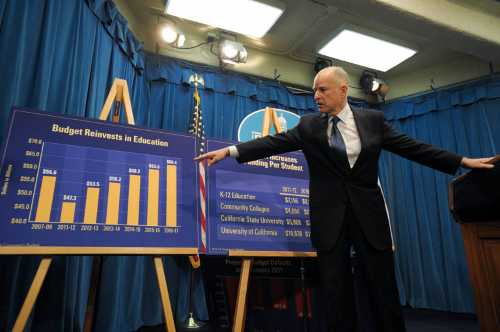
After several years of tight budgets, cut services and deficits, the governor on Thursday proposed a budget for 2013-14 that he said will be balanced while still making increased investments in key areas of California life.
Gov. Jerry Brown said his budget will boost funding for education, implement health care reform and keep California on a long-term path to fiscal stability, while building on the work of the last two years to eliminate the state’s deficit.
“The budget cuts made in the last two years and the passage of Proposition 30 make it possible to both live within our means and to increase funding for education,” Brown said.
The governor said that the budget will continue paying down the “wall of debt” – a term he uses to describe the debt accumulated through the state’s borrowing practices – which he suggested will be under $5 billion by the end of the 2016-17 fiscal year in order to maintain California’s fiscal stability.
“California came through probably 15 years of great fiscal difficulty, some of it by overspending, some of it by tax reductions that we really couldn’t afford and a lot of it by the Great Recession,” Brown told reporters on Thursday.
“Right now for the next four years, we’re talking about a balanced budget, we’re talking about living within our means. This is new. This is a breakthrough,” he said.
That doesn’t mean the state is in the clear, and he discussed risks, such as the federal government continuing to borrow 47 cents on the dollar, borrowing from China, printing money “out of thin air” or making cuts that roll down to the state.
It’s best to maintain a solid budget and a good reserve in order to meet those potential impacts, he said. “I’m determined to avoid the fiscal mess that the last few governors had to deal with.”
Other risks are an uncertain economic recovery and the federal government and courts blocking budget actions, he said. There also are potential increases in health care costs as the state implements the Affordable Care Act.
He said the state has achieved its improved fiscal position due to tough cuts and increased taxes. He said the cuts are about three times the amount of the taxes, which voters approved.
“It’s highly significant that we broke the logjam by going to the people,” Brown said.
One of Brown’s goals is to make education funding more flexible and to cautiously approach health care reform, where there are big costs and big unknowns, he said.
The state’s “wall of debt” – which he said is different than the deficit – is still $34 billion, but Brown believes it can be down to $4.3 billion by the 2016-17 fiscal year.
Brown said he wants to avoid the boom and bust, borrow and spend cycle. While he wants to advance the progressive agenda, he wants to do it within the state’s means.
He defended spending increases by saying the state must invest.
Republican leaders in the Legislature weren’t entirely sold on Brown’s proposal.
“It is good news for taxpayers that the state has made progress in getting our financial house in order. But we haven’t fully solved our budget problems just yet,” Assembly Republican Leader Connie Conway of Tulare said in response to the budget. “Assembly Republicans agree with the governor that a ‘live within our means’ budget is the most fiscally-responsible course for our state this year. Now is not the time to enact massive spending increases that will reverse the progress we’ve made in reducing the deficit.”
Senate Republican Leader Bob Huff (R-Diamond Bar) criticized the budget, which he said only seems to include $2.7 billion in new funding for K-12 schools and community colleges even though Proposition 30 taxes will generate $6 billion this year. “Californians should be disappointed.”
Huff also suggested that the budget is balanced by a $50 billion tax increase, “and Californians have yet to see any real, long-term plan to bring back jobs and help our struggling families.”
Lake County’s representatives in the state Legislature lauded parts of the budget but offered cautions on some key areas.
“Gov. Brown’s common sense budget signals continued restraint and prioritizes repayment and reinvestment in education as the pathway to a brighter future,” said Assemblymember Mariko Yamada (D-Davis).
“At the same time, we must not forget those at the other end of the age spectrum – the elderly and those with disabilities – whose lifelong sacrifices and contributions have made the down payment on our Golden State,” she said. “We are in an aging society and the cumulative effects of program cuts to services serving impoverished seniors and disabled adults must be integral to the budget discussion.”
Sen. Noreen Evans (D-Santa Rosa), who chairs the Senate Judiciary Committee, issued a joint statement with California Chief Justice Tani Cantil-Sakauye, both of them urging funding be restored to the judiciary.
While the trial courts will not suffer additional general fund reductions for the 2013-14 fiscal year, the state judicial branch’s immediate and critical needs account, which Cantil-Sakauye said is vital for court safety and compliance projects, stands to lose another $235 million, nearly eliminating meaningful upgrades for several years.
“Trial courts, courts of appeal, and the supreme court are already suffering from four consecutive years of on-going cuts, reductions in services, and delays in disposition of cases,” Cantil-Sakauye said.
She said the 2013-14 fiscal year will have “a devastating impact on injured victims, children, families, consumers, merchants, landlords and tenants, and many others who depend on the courts for relief and to resolve disputes.”
“Access to justice is a core tenant of our Democratic values,” Evans said. “The judicial branch has taken detrimental hits that have left local courts unable to meet the needs of millions of Californians. Although this budget proposal spares deeper cuts, the buildings which house justice are still crumbling and we have no further resources to rebalance the scales of justice.”
The California Department of Veterans Affairs is set to receive $27 million for the ongoing funding needed to open the Redding and Fresno Veterans Homes, in addition to the $9.4 million that was included for the current fiscal year to begin the hiring process for staff that will serve the veterans in the two new homes.
“This new budget shows the governor’s continued commitment to California veterans and their families,” said CalVet Secretary Peter J. Gravett. “We are proud to serve our military veterans statewide and thrilled that now we will be able to better serve those living in the Central Valley and North State.”
California Community Colleges Chancellor Brice W. Harris praised the budget, which provides $197 million more to the college system in 2013-14 and directs the California Community Colleges Board of governors to determine the best way to allocate the money to districts.
Harris’ office said the funding increase would allow colleges statewide to add back thousands of classes to serve some of the nearly 500,000 students turned away over the past four years during the state’s financial crisis and at the same time continue the system’s work to improve student success.
“Gov. Brown’s leadership in passing Proposition 30 means California community colleges can begin to make room for some of the hundreds of thousands of students who have been shut out of our system due to recent funding cuts,” Harris said. “This budget represents a good start toward financial recovery for our system. The governor and voters deserve credit for beginning this overdue reinvestment.”
Mack Jenkins, president of the Chief Probation Officers of California and San Diego County’s chief probation officer, said the group applauded the budget.
“Probation departments are in the midst of implementing the largest criminal justice reform in decades,” Jenkins said. “The governor has kept to his word by continuing to support resources to fund these major changes.”
Chris Hoene, executive director of the California Budget Project, a nonpartisan public policy research group, said California is turning the corner on years of serious budget challenges.
“The governor’s budget proposal shows that the significant new revenues approved by the state’s voters this past November have stabilized California’s finances,” Hoene said.
He called the proposed budget “a major step forward on many fronts,” including a new K-12 school funding formula that aims to increase funding for disadvantaged students and the expansion of Medi-Cal.
“But at the same time, state policymakers could do more to restore the severe cuts made in recent years to child care and other supports that help families struggling to find and keep jobs. And with an eye toward long-term fiscal stability, the state could scale back or end ineffective tax credits and incentives, such as the costly Enterprise Zone Program,” Hoene suggested.
Key points of the proposal
When Brown most recently took office, California faced a $26.6 billion budget deficit and estimated annual gaps of roughly $20 billion.
Brown’s last two budgets addressed those deficits through billions of dollars in cuts as well as temporary revenues; his office said the 2011-12 and 2012-13 budgets provided three dollars of spending cuts for every dollar in temporary tax revenues approved by the voters.
The governor’s office pointed to the following points as being key budget highlights.
- Maintains long-term fiscal stability: By aligning expenditures with revenues, paying down debt and creating a $1 billion reserve, this budget provides long-term fiscal stability on a level that California has not enjoyed in more than a decade.
- Invests in education and increases local control: After years of decline, this budget significantly increases state funding per student in K-12 schools – $2,700 by 2016-2017. Funding for K-12 and community colleges increases by $2.7 billion next year, and by $19 billion by 2016-2017. The budget increases flexibility at the local level so those closest to the students can make the decisions.
- Increases funding to strengthen higher education and increase affordability: This budget increases state funding for UC and CSU by an additional $250 million, 5 percent. It proposes a multi-year stable funding plan to strengthen the higher education system, ensure affordability and reduce student indebtedness.
- Implements federal health care reform: This budget expands access to health care for Californians by implementing federal health care reform. It expands coverage by simplifying Medi-Cal eligibility and extending coverage to childless adults and uninsured parents. It also recognizes that implementation of health care reform will require changes in the respective responsibilities of the state and the counties.
The full budget document can be found at www.dof.ca.gov .
Email Elizabeth Larson at