
 How to resolve AdBlock issue?
 Lucerne water rate case yet to be settled; judge extends current rates temporarily
LUCERNE, Calif. – A water rate case for the town of Lucerne still has not been settled, with current rates to continue until the matter is finalized in 2014.
In July 2012, California Water Service Co. – which serves Lucerne and 33 other districts – applied to the California Public Utilities Commission to raise rates, as Lake County News has reported.
Late this past October, Cal Water, the Office of Ratepayer Advocates, the county of Lake and other parties that had participated in settlement discussions in the general rate case reached a settlement agreement, which was filed with the administrative law judge overseeing the case.
However, the settlement agreement still has not been finalized by the judge, who on Dec. 19 issued a ruling granting Cal Water's motion for interim rates, according to Lake County Counsel Anita Grant.
Grant said the ruling gives Cal Water permission to continue existing rates as of Dec. 31 in its 23 districts as interim rates beginning Jan. 1, with a provision to “true up” the difference between current and new rates through a tariff and a retroactive credit via its Low-Income Rate Assistance – or LIRA – program.
In November 2012, the county of Lake and Supervisor Denise Rushing applied to become parties in the proceeding on behalf of Lucerne, which has seen its rates climb since Cal Water purchased the system in 1999.
Rushing told Lake County News that following a closed session at its meeting this past Nov. 12, the Board of Supervisors voted to sign onto the settlement agreement on behalf of Lucerne, which is one of more than half a dozen “Rate Support Fund” districts – meaning that its rates are so high that other districts pay into a fund to help cover high costs.
The board also issued a statement to the CPUC noting that while it approved the settlement agreement, “it should be noted that settlement on these issues does not directly address the general affordability concerns caused by the successive water rate increases on Lucerne residents.”
“We've done our best to make the case for Lucerne, and have held our own, but it is clear to me that real progress cannot happen in the context of a rate proceeding at the CPUC,” Rushing said.
Craig Bach, president of Lucerne Friends of Locally Owned Water, or FLOW, credited the work of Grant and one of her deputy county counsels, Lloyd Guintivano, for work in the case.
“Luckily we had county counsel on our side. I think that made a significant difference in our lives,” said Bach, adding, “Without it we would have been down the creek without a paddle.”
Rushing, who has worked on Lucerne's water issues since she took office in 2007, said she wished she had better news about the outcome of the proceeding. “It's just heartbreaking what people have to face in the way of water rates. It’s causing economic devastation of a whole community.”
Terms of proposed settlement
Lucerne is part of Cal Water’s Redwood Valley District, one of 34 districts across the state. The Redwood Valley District has 1,900 connections and serves a total of 3,600 people in Lucerne and parts of Duncans Mills, Guerneville, Dillon Beach, Noel Heights and Santa Rosa.
In its initial filing in 2012, Cal Water was seeking a 77-percent rate increase over three years, beginning in 2014, as Lake County News has reported.
Rushing said Lucerne's rates are among the highest in the Cal Water system. While not the highest of all the districts, Lucerne's rates are far higher than more affluent areas like Burlingame, which has rates of about $30 a month, Rushing said. That's about half of what an average Lucerne customer pays.
She said historically most jurisdictions fight hard to avoid paying into the Rate Support Fund, with the process essentially pitting one jurisdiction against another.
In the recent settlement hearings, that's just what happened, with other districts fighting “tooth and nail” against having to put any money into that fund, “and that’s what we were fighting for,” said Rushing.
Justin Skarb, Cal Water's government and community relations manager, said the corporation's LIRA, which provides qualified customers with a discount on their monthly service charge, currently has a maximum monthly benefit of $12, which if the settlement is approved will increase to $30 or half of the monthly service charge, whichever is less.
In addition, Skarb said the settlement agreement authorizes Cal Water to restructure the Rate Support Fund and increase the benefit customers in Lucerne receive.
Currently, customers are charged about $7.71 for each CCF – or 100 cubic feet – of water they use in a month. Under the revised program, customers would be charged $4.52 per CCF up to 10 CCFs, or 7,480 gallons, Skarb said.
He said the typical single-family residential customer in Lucerne uses 5 CCF, or approximately 3,740 gallons of water per month, and currently has monthly water utility charges totaling $61.11, which includes service charge plus quantity charges, minus a Rate Support Fund Credit of $24.
If the settlement agreement is adopted as submitted, that customer would have monthly water utility charges of $72.86, an increase of 19.2 percent, according to Skarb.
Currently, the same customer enrolled in Cal Water's LIRA program has monthly water utility charges (service charge plus quantity charges, minus a Rate Support Fund Credit of $24, minus a LIRA discount of $12) of $49.11, Skarb said. The settlement agreement would modify those charges to $47.73, a decrease of 2.81 percent.
According to the settlement's terms, Lucerne customers' monthly service charge will increase from $46.11 to $50.26. It's also anticipated that a CPUC fee calculated as a percentage of the total of the monthly service charge and quantity charge will increase due to the new rates, Skarb said.
As for the number of customers that would exceed the 10 CCF threshold, Skarb said that based on the consumption history from Cal Water's single-family, residential customers in Lucerne from November 1, 2012, to this past Oct. 31, about 107 of Cal Water's 1,151 customers in Lucerne – or approximately 9.3 percent – used, on average, more than 10 CCF per month.
Based on the new rates, there will be a charge per CCF for any usage over 10 CCF of $14.63, Skarb said.
The settlement agreement also covers several water system improvements, including the replacement of aging water mains and electrical equipment, installation of seismic upgrades at a storage tank and the construction of a tie-in to a neighboring water utility, Skarb said.
Gay Guidotti, the Lucerne District manager, said there are two capital improvement projects approved for Lucerne, including replacement of 1,080 feet of water line and two hydrants on Country Club Drive between 12th and 14th avenues, and an enhancement to the current treatment process to meet new monitoring standards to remove DBP, a disinfection byproduct cause when chlorine reacts with organics.
Explaining the settlement; options ahead
According to the proposed settlement, Cal Water was approved for a 51-percent revenue increase for the Lucerne District, the highest increase of any of the districts. Initially, Cal Water had sought a 57-percent revenue increase.
Pat Ma, a senior utilities engineer for the CPUC's Office of Ratepayer Advocates, Water Branch, told Lake County News that Cal Water was trying to make up for lost water sales in seeking the revenue hike.
“Customers are not going to see a 51-percent increase in their bill,” according to Ma.
As for who will pay for that increase ultimately, Ma said it's picked up by customers from other districts that do not have either the Rate Support Fund or aren't in the LIRA program, both of which are helping buffer Lucerne customers from the full impact of the revenue increase.
The settlement also will increase low income ratepayer assistance, she said.
While Cal Water is seeking to raise the LIRA cap from $12 to $30, the applicable monthly discount for Lucerne is $25.13, Ma said.
She said that without the Rate Support Fund, residential customers in Lucerne would pay $14.65 per CCF, while now they are paying $7.71. That will drop to $4.52 per CCF less than 10 CCF if the settlement is approved.
The lost revenue that Cal Water was seeking to recoup with the rate hike was due to inaccurate calculations in the last general rate case, Ma said.
“We overestimated sales. We set the rates too low,” said Ma. “So this general rate case is sort of a catch up.”
She said they attempt to provide the most accurate sales estimates, which in the case of Lucerne were based on the Office of Ratepayer Advocates' estimates. Around 2009, there was a conservation rate design that depressed sales. She said it was difficult to fault Cal Water in the process.
“Generally, it's just really difficult to forecast sales. We use historical data,” she said.
In projecting the anticipated sales for 2014, Ma said historical data for 2011 and 2012 were used.
“It's not an exact science. It's the best guess,” she said.
There also is a separate ratemaking effort under way at the CPUC in order to implement “postage stamp” rates; in other words it would make water rates like electricity rates, and even out rates across districts.
“It's an open proceeding,” said Ma, with no resolution yet, adding that it's unclear if costs actually would go down.
The county also is a participant in that proceeding. “The County hopes to address and resolve these general affordability concerns through this Rulemaking proceeding,” the board said in its November statement to the CPUC.
“I think there may be a lot of political pressure this year to make that happen,” Rushing said of the proceeding.
“As I see it, the underlying affordability issues need to be addressed both in the CPUC rulemaking procedures and through the California legislature with other mechanisms,” Rushing said.
Rushing said there have been other developments that might help address Lucerne's water rates in the future, including a new state law – which hasn't yet been used – that says all water must be affordable.
In addition, Gov. Jerry Brown has asked the Legislature to create a water infrastructure fund – which is “going to take some time to do,” according to Rushing – that would allow communities to form districts and purchase water systems.
Bach said Lucerne FLOW has been talking to the Local Agency Formation Commission about what would be required to form a new water district.
“We don't have any immediate solutions. We just know what we’re going to try to do,” he said.
Rushing pointed out that communities next door to Lucerne are paying half as much for water.
“It's it’s not fair, it’s not right, and it needs to change,” she said.
Email Elizabeth Larson at
- Details
- Written by: Elizabeth Larson
County to offer lakeside property in February tax sale
LAKEPORT, Calif. – A 104-acre lakeside property that has a large county tax bill will be put up for tax sale once again this coming February.
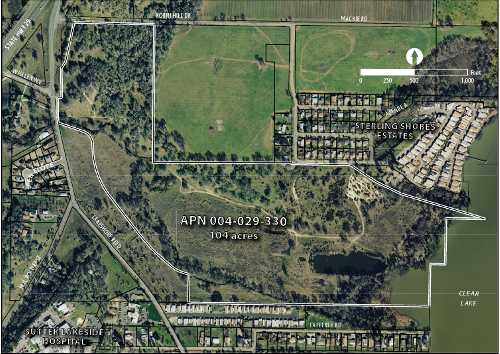
The Robin Hill property, located at 5880 Lakeshore Blvd. in Lakeport, will be available for bids from interested parties Feb. 7-10, according to the Lake County Administrative Office.
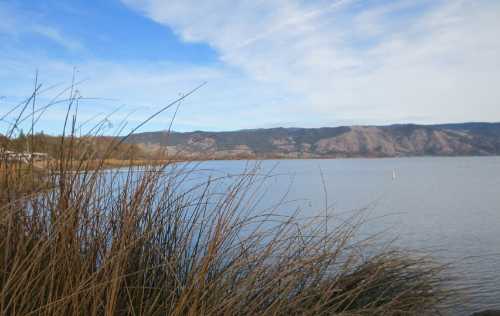
The property has more than 1,100 feet of lake frontage with views of Mount Konocti, with rolling hills and oaks meadows, wetlands and a private lagoon, as well as 73 domestic water connection entitlements.
It also has a hefty tax bill which county officials said resulted from bond assessments for the North Lakeport Water District.
Lake County Tax Collector Barbara Ringen told Lake County News that the amount of back taxes owed on the property changes monthly.
According to the figures she provided, the tax amount on the land increases by about $13,000 each month and nearly equals its assessed value of just over $2.6 million.
The current total owed is approximately $2,405,575.34. By the time the property is set to be auctioned off in February, $2,431,849.92 will be owed, Ringen said.
However, the county can allow the property to be sold for far less to recoup the back taxes. The opening bid in the February auction is $850,000.
The property currently is held by Westamerica Bank, which took the property in foreclosure from Boeger Land Investments LLC in 2011, as Lake County News has reported.
While as the landowner the taxes are now owed by Westamerica, Ringen said Westamerica has not made any attempt to redeem the property.
In fact, the land was slated to go up for an October 2011 tax sale.
However, Deputy County Administrative Officer Alan Flora said at that time there wasn't any interest, and the county received no bids.
“There has been some interest in the property here recently, which is why we decided to put it up for sale and see what happens,” Flora said.
The land was once intended to be developed into a facility called Marina at Lyons Creek, a residential and destination resort community.
Developers had envisioned connecting it via an easement to the Cristallago housing and resort development in the north Lakeport area, although the projects were never formally connected.
Developer Matt Boeger told Lake County News in a 2011 interview that the Robin Hill property includes an easement to provide water to Cristallago. He said the easement is held free and clear by North Lakeport Water System Inc. and wasn't affected by the foreclosure, nor would it be impacted by a tax sale.
The property's history includes bankruptcies and unpaid back taxes that date to 1987, according to county records.
Proceeds from the tax sale could be used for water system improvements in the County Service Area No. 21 in the north Lakeport area. The Board of Supervisors previously had indicated an interest in using the funds for that purpose.
Flora said it would be good to see the property put to a productive use.
More information about the property is available at http://www.co.lake.ca.us/Assets/Economic+Development/Docs/TaxSale.pdf .
Email Elizabeth Larson at
- Details
- Written by: Elizabeth Larson
Political action committee launches referendum on marijuana cultivation ordinance
LAKE COUNTY, Calif. – An effort to stop the Board of Supervisors' recently passed marijuana cultivation ordinance is under way, with signature gathering now taking place for a referendum.
A newly formed political action committee called Community Alliance to Ban Illegal Cannabis Cultivation, or CABICC, held a meeting about the ordinance this past weekend, as Lake County News has reported.
One of the group's organizers, Michael Horner, said in an email message to Lake County News that the referendum was presented at the meeting.
The group opposes the new marijuana cultivation ordinance accepted unanimously by the Board of Supervisors at its Dec. 17 meeting.
The ordinance goes into effect on Jan. 16 and applies only to the unincorporated areas of the county.
It bans outdoor cultivation in community growth boundaries; limits indoor grows to 100 square feet or less; keeps outdoor cultivation 1,000 feet from schools, parks or other facilities serving children; and 100 feet from water bodie; offers quicker abatement and makes the Lake County Sheriff's Office responsible for enforcement.
CABICC is part of the Emerald Unity Coalition, which includes the United Food and Commercial Workers, CANORML, Americans for Safe Access, Patients Rights Coalition, Emerald Growers and California Cannabis Industry Association, according to Horner.
It has filed for committee status with the state, according to the California Secretary of State's campaign finance Web site.
The group announced on its Facebook page Monday that signature gathering for a referendum has begun, with both professional signature gatherers and volunteers being employed in the effort.
Lake County Registrar of Voters Diane Fridley said the group doesn't need to get preapproval from her office before gathering signatures, but it does have to use a regular petition format.
She said they must collect approximately 2,115 signatures – 10 percent of the entire votes cast in Lake County for all candidates for governor in the November 2010 election – by Jan. 15, the day before the ordinance's effective date.
“Once it's effective, too late, they’d have to go through the initiative process,” Fridley said.
According to a calendar of key dates Fridley provided to Lake County News, her staff will have until Feb. 28 to determine if there is the required number of valid signatures, with Fridley required to certify the petition and present it to the Board of Supervisors early in March.
At that point the board can choose to withdraw the ordinance or submit the referendum to the voters for the June 3 primary election.
Previous ordinances instituted by the Board of Supervisors to govern medical marijuana cultivation and dispensaries – passed in August and October 2011, respectively – have been challenged by referenda.
The board rescinded the dispensaries ordinance in October 2011 and directed county staff to enforce the zoning ordinance, which currently contains no provisions allowing for dispensaries. That led to all dispensaries in the unincorporated county being shuttered.
In addition, the supervisors rescinded their previous cultivation ordinance in January 2012, with the Measure D initiative written by marijuana advocates defeated by a two-to-one margin in the June 2012 election.
The following month, the board approved the first reading of its interim urgency marijuana cultivation ordinance, which currently remains in effect.
The Lake County Citizens for Responsible Regulations and Lake County Green Farmers Association, which led the referendum effort against the previous cultivation ordinance and put forward Measure D, are listed as members of Community Alliance to Ban Illegal Cannabis Cultivation.
While the Board of Supervisors' response to past referenda has been to withdraw the challenged ordinances, comments by board members at the Dec. 17 meeting revealed that they expected the document to be challenged and were prepared to let the new ordinance stand.
Email Elizabeth Larson at
- Details
- Written by: Elizabeth Larson
Cliff Swetnam remembered for public service, dedication to community

LAKEPORT, Calif. – Joy Swetnam, whose husband for 18 years and five days, Cliff, died last week after a four-year illness, said it helped her through the grieving process to talk about him.
There was much to say about Cliff, who passed at age 66 on Dec. 14 after a full and productive life.
As an Alameda County Sheriff's Department deputy for 28 and a half years, he was on the side of law and order.
As a Lake County Superior Court bailiff employed by the Lake County Sheriff's Office for 10 and a half years, Cliff was on the side of justice.
As a leading member of the Lake County Planning Commission for 12 years and a Lake County resident since the late 1990s, he was on the side of seeing that fair and equitable decisions were made with respect to the county's future.
And whenever he had the time he was on the side of a lake somewhere in the U.S. fishing for bass.
Indeed, few anglers were better at reeling in the big ones than Swetnam, who fished competitively on the Tournament Bass Trails and won several awards.
“He was an incredible person,” said Joy. “It wasn't until I saw it in the newspaper that I realized all of his accomplishments and what he really meant.
“I've had a number of phone calls and messages on Facebook,” she added. “I thought I'd have to rent the Oakland Coliseum to hold them all.”
Perhaps because in life Swetnam was as steady as a rock, few people realized all that he did until he would no longer be here to do it.
But District 4 Lake County Supervisor Anthony Farrington, who appointed Swetnam to the Lake County Planning Commission in 2001, was one of those people who had knowledge of the ways and wisdom of the man.
“I went through a number of candidates. What struck me about Cliff was his ability to analyze and interpret the law,” Farrington recalled. “His background as a law enforcement and police officer gave him a set of tools that most commissioners didn't have in terms of serving as an adjudicator.
“He could make a decision insulated from politics. What I liked about Cliff were his years as a police officer and dedication as a Lake County Sheriff's deputy and as a bailiff. I wanted somebody who was truly a public servant and could make decisions that were consistent with the laws and the intent of the law and was able to separate the politics.
“He could make solid decisions based on his knowledge of what would be best for the community,” Farrington added.

Speaking of Swetnam's decade as a bailiff, retired Lake County Superior Court Judge Arthur Mann asserted: “Cliff was a long-time bailiff of mine and a personal friend as well, and he had a long and distinguished career in law enforcement both in Lake and Alameda counties. He was a professional and dedicated bailiff. I already miss him and I'm going to miss him in the future.”
Frieda Camotta, who was on the Lake County Planning Commission for a time with Swetnam, saw the application of the attributes that made Swetnam a cut above the average commissioner.
A Planning Commissioner of the Year award he received at the state level from the California Planning Commissioners Association spoke to that. Swetnam was a member of that organization.
“He had analytical skills,” Camotta said. “He knew how to separate truth from fiction and asked insightful questions that brought out information in a hearing that was important to all of us, plus the law enforcement background ... and he always did his homework.”
Joy Swetnam could speak to that.
“He loved being a planning commissioner,” was the way she put it. “Every Sunday he would spend all day going over all of the paperwork that was given to him by the commission. He would spend weeks making sure that the decisions he made were the right decisions.”
Swetnam played a pivotal role in several land issues that had a bearing on the county.
“He left his footprint on a high number of projects that have developed our community,” said Farrington. “He was able to bring a healthy perspective into his decisions.”
One of the more notable projects in which Swetnam assumed a leadership role was Rattlesnake Island.
“It was controversial because of the Native American community,” said Camotta. “They wanted us to give them their island back. But that was not in our purview to do. We asked for conditions, which were mostly archeological concerns.”
Ultimately, the owner was able to build a small home and a caretakers cabin there, “but we started without permits,” Camotta said.
No less controversial was the relocation of the an alcohol and drug rehabilitation facility, Camotta recalled, because of “NIMBY” (not-in-my-backyard) issues.
“It was difficult to find a place for it,” she said. “We tried a number of places and we finally found one up above Anderson Springs. We made a public site visit, one of the few that we ever made.”
Said Farrington: “Cliff helped me approve the facility up in the Anderson Springs area. We had a facility in my district in the northern Lakeport area where we had an old dilapidated hotel. He and I worked together with the planning commission and the Board of Supervisors in moving the facility to an area that was very serene and had cabins so (clients) had a better environment for treatment.”
Joy Swetnam recalled her husband's concern for habitual smokers, which he himself was and which may have contributed to his illness.
The lifelong smoker volunteered at Lake Family Resource Center, speaking to smoking cessation classes, his wife said.
“He would bring all his medications and drag his oxygen tank to the front of the room so everyone could see what smoking had done to him. He encouraged people to ask questions, no matter how personal they were and he would answer them honestly,” she said.
“A lot of people called him after his presentations to let him know that he was the reason they were able to quit smoking,” she added.
Farrington said he would remember the times when he and Swetnam would get together over a beer and talk about decisions made at the planning level and decisions Farrington made on the Board of Supervisors.
“There were times when he would try to influence me,” Farrington added. “That was his personality and I always cherished that.”
Said Camotta: “He cared about what Lake County was going to look like in the future. He used to say 'God's not making any more land, so we better take care of what we have.'”
One last comment by Joy.
“. . . And, oh my god, that man had more women admirers. Sometimes I pointed that out to him and said, 'Oh, honey, they're really coming on to you.' He was totally oblivious.”
Cliff Swetnam's obituary can be viewed at http://bit.ly/1l6aSnA .
Email John Lindblom at
- Details
Officials estimate county windstorm damage near $6 million
LAKE COUNTY, Calif. – County officials continue to tally the costs of property damage that resulted from a late November windstorm, with the estimate now in the range of several millions dollars.
The storm, caused by the meeting of high and low pressure systems, hit on the county on Nov. 21 and Nov. 22.
The Northshore – particularly Nice – and Clearlake took the brunt of the storm. Homes and businesses were damaged, and there were dozens of falling trees that took down power lines, leaving some people out of power for as long as two days and sparking several wildland fires.
The National Weather Service said there were sustained winds averaging around 40 miles per hour, with the highest gust reported to be 78 miles per hour in the Cow Mountain area near Lakeport, as Lake County News has reported.
Jill Ruzicka, the county's public information officer, said additional information on damage is continuing to come in on a daily basis.
She said the numbers the county has reported to the California Office of Emergency Services are for an operational area that covers all of Lake County, including the cities.
“Our initial assessment of privately owned buildings is estimated at approximately $5.3 million,” Ruzicka said. “We do not have an estimate of how much of this is covered by insurance.”
Ruzicka said the breakdown of damage to privately owned structures includes:
- Destroyed: one business and 20 outbuildings;
- Major damage: 19 residences and four businesses;
- Minor damage: 153 – combined total for residences, outbuildings and businesses;
- Affected: Approximately 29 more structures.
She added, “Our initial assessment of publicly owned buildings/facilities is estimated at approximately $650,000, with Holiday Harbor and Keeling Park suffering the most damage.”
Clearlake City Administrator Joan Phillipe said calls reporting damage are still coming in, and on Friday she didn't have a separate damage estimate available for the city.
She said she plans to present the Clearlake City Council with an update on the storm damage at its first meeting of the new year on Thursday, Jan. 9.
The Northshore Business Association continues to act as a clearinghouse for volunteers willing to help with storm damage cleanup and for those looking for assistance.
On the association Web site at http://www.northshorebusinessassociation.com/ there is a list of volunteers, information on how to volunteer or how to request assistance.
For more information on receiving help or volunteering, contact the association through its hotline at 707-739-6661.
Email Elizabeth Larson at
- Details
- Written by: Elizabeth Larson




