
 How to resolve AdBlock issue?
 Lake County CHP officer receive CPOA Award of Valor

LAKE COUNTY, Calif. – This past fall another honor was given to a local California Highway Patrol officer who risked his life last January to pull two injured people from a burning pickup.
Officer Adam Garcia traveled to Ontario in November where he received the California Peace Officers Association (CPOA) Award of Valor, according to the CHP's Clear Lake Area office.
The CPOA presents the award to individuals for outstanding acts of daring or bravery.
On Jan. 27, 2013, Officer Garcia came upon a pickup that had gone off of Highway 29 and went into a creek bed.
Trapped inside were Dow Walton and Regina Walton, with a third subject, Andy Hopper, having gotten out of the truck.
The vehicle caught fire and the pickup's doors were jammed shut. Despite the intense heat of the fire, Officer Garcia removed both people through the driver’s window and pulled them to safety. Garcia suffered some minor injuries, including smoke inhalation, back strain and exhaustion.
“All of us at the Clear Lake Area office are extremely proud of the brave and heroic life-saving efforts performed by Officer Garcia. It is wonderful to see the overwhelming support and recognition for his efforts,” said Clear Lake Area Commander Lieutenant Greg Baarts, who also was in attendance at the CPOA ceremony.
The November award was one of many honors Garcia received for his efforts, as Lake County News has reported.
He also was among the honorees at the American Red Cross, Sonoma, Mendocino and Lake Counties' 10th annual Real Heroes Breakfast in April.
In July, he received a commendation from the Lake County Board of Supervisors and in October he was presented with a Valor Award by the California State Firefighters’ Association.
- Details
- Written by: Lake County News reports
New county stray cat drop-off fee aims to expand services; community cat program reduces euthanasia
LAKEPORT, Calif. – County officials are hoping a newly accepted policy will complement a community cat program that has helped to significantly reduce the county's high feline euthanasia rate.
On Dec. 3, Lake County Animal Care and Control Director Bill Davidson went to the Board of Supervisors to ask for its support for a new stray cat intake policy.
As a result of the board's approval, beginning July 1, stray cats – which previously could be dropped off for free – will be accepted at the shelter for a drop-off fee of $15 per animal, Davidson said.
However, rather that simply paying the fee and dropping off the animal, there is an alternative already available – the free community cat program.
Any cat eligible for the county's community cat program – cats over 1 year of age typically qualify – may be left at no charge if the person bringing it in is willing to return it to the community once it has been spayed or neutered, had a rabies vaccination and an ear notch, Davidson said.
The charges are only for those people who don't want the animals back, said Davidson. For those animals, the shelter will hold them, and attempt to adopt them out or transfer them to rescue.
The supervisors gave unanimous support for the new policy based on a recommendation from the Lake County Animal Control Advisory Board, which submitted a letter in support of it.
While the supervisors don't like charging fees, Davidson said the new fee makes sense for a variety of reasons.
In the 2012-13 fiscal year the county took in 1,500 stray cats at a cost of almost $84,000 to taxpayers, which equals $55 per cat, Davidson said.
The new $15 fee that Animal Care and Control will collect will help to offset the county's costs and allow the agency to more properly care for the cats they do take in, Davidson said.
He expects to use some of that money to fund new part-time positions to help care for the cats.
Davidson said Animal Care and Control will continue to take in injured cats and cats responsible for bites at no charge.
Other areas have had small drop-off fees for cats for some time, including the nearby rural counties of Tehama, Glenn and Colusa, with other counties also going that direction, Davidson said.
“What to do with cats has kind of been a hot topic in the shelter world for the last few years,” said Davidson.
Because there is no state mandate to take in stray cats, many jurisdictions simply won't accept them any longer, Davidson said. In the case of Sonoma County, it partnered with a rescue group called Forgotten Felines and now only takes cats in to spay and neuter them as part of its own community cat program.
The SPCA of Clear Lake, which now is providing some animal control services for the city of Clearlake, will take in stray cats from Clearlake residents for a $10 per-cat fee, but only if space is available, Davidson said.
Davidson said he hopes that the new policy will help Animal Care and Control continue to reduce its euthanasia rates and lead to eventually getting control of the county's cat overpopulation problem.
Free program reduces euthanasia
The community cat program in Lake County began in April 2012 on a limited basis after Animal Care and Control opened its onsite veterinary clinic, Davidson said. Since then, about 2,000 cats have been altered through the program.
The altering services are included in the contract the county has with veterinarian Dr. Jennifer Bennett, who runs the clinic, he explained.
Lake County's community cat program is always free to any county resident who is willing to participate and who has an eligible cat, Davidson said.
It has the benefit of allowing cats which already are established in neighborhoods to live out their lives without contributing to the overpopulation problem or the county's high euthanasia rate, he explained.
Davidson said the bottom line is that the community cat program offers a more humane and cost effective way to deal with stray cats compared to continuing to collect and destroy them.
“We have done the latter for over 30 years and gotten nowhere,” Davidson said.
He said studies have shown that those areas that participate in active spaying and neutering of community cats have a steady decline in cat populations over time.
Davidson said the community cat program already has resulted in “a huge drop” in the county's euthanasia rates.
According to statistics Davidson compiled, for the 2011-12 fiscal year – during the last quarter of which the community cat program was implemented – the cat euthanasia rate was 85 percent, with an overall animal euthanasia rate of 64 percent. Thirty-one percent of animals were returned to the community.
In 2012-13, the cat euthanasia rate dropped to 50 percent, with the overall rate decreasing to 42 percent. The rate of animals returned to the community increased to 51 percent, based on Davidson's numbers.
The program also has resulted in Animal Care and Control taking in about 600 fewer cats in 2012-13 than it did the previous year, the numbers showed.
So far, Davidson said he hasn't seen a huge reduction in the number of kittens coming into the shelter during the spring and summer kitten season.
“I personally think it has diminished,” he said, adding that he believed he needed several more years of statistics to analyze what impact the spay and neuter effort is having on community cats.
Animal Care and Control doesn't currently work with any organizations that specifically transfer large numbers of cats for adoption.
“Most places have their own cats problem so they're not interested in taking any more,” he said.
However, the agency is receiving assistance from a Petaluma veterinarian who takes about a dozen cats a month, spays or neuters them, and finds them homes, as well as Anderson Valley Animal Rescue, which assists with cat adoptions, according to Davidson.
Animal Care and Control also has a “barn cat” adoption program just for finding homes for feral cats, but he said they've only found homes for about half a dozen cats that way.
Community cats are in neighborhoods for a reason, Davidson said. Studies show that one in 12 homes is putting out food for them.
Davidson said that cats are territorial and so will keep other cats out of an area, which he believes is another reason to return the altered and vaccinated community cats to their neighborhoods.
For those who don't want stray cats on their properties, Davidson said there are several steps they can take.
They include not leaving food on the property, as it attracts cats and other animals; own a dog, because cats don't frequent yards with dogs; get a motion detector sprinkler; and strategically place things like fresh orange or lemon peels as well as the scent of lavender and the herb rue.
For more information about the community cat program, call Lake County Animal Care and Control at 707-263-0278.
Email Elizabeth Larson at
- Details
- Written by: Elizabeth Larson
Lake County's top 10 stories for 2013
LAKE COUNTY, Calif. – Lake County had a busy, news-filled 2013.
The year was filled with accomplishments, tragedies, struggles and hope.
Some stories had a resolution, others may see their final chapter told in 2014.
The following 10 stories are presented chronologically, placed in the order they occurred during the year.
Forrest Seagrave murder
KELSEYVILLE, Calif. – On the night of Friday, Jan. 18, a masked and armed suspect entered the Mt. Konocti Gas and Mart in Kelseyville where 33-year-old Forrest Seagrave had worked for several years.
During the robbery, Seagrave was mortally wounded, dying a short time later at Sutter Lakeside Hospital.
Jonathan Mota, 31, who had a long criminal record including a 2006 Clearlake bank robbery, was arrested about a week and a half later on weapons charges.
In the spring Mota was transferred to federal custody, and the US Attorney's Office took over the case, indicting him in June on use or possession of a firearm in a murder, use or possession of a firearm during a crime of violence, robbery affecting interstate commerce and felon in possession of a firearm.
In April, a black 2008 Toyota Tacoma pickup that investigators believed was linked to the murder was found down an embankment off the side of the Hopland Grade. The pickup had been reported stolen from the Kelseyville area on the day Seagrave was murdered.
The Kelseyville community rallied to hold town halls and form a Neighborhood Watch group in an effort to reclaim the town from what residents said was a noticeable increase in crime.
Mota remains in federal custody and his trial has been set for October 2014.
So far, court records don't indicate if the federal prosecutors will seek the death penalty.
Lakeside Heights landslide
In March, the hillside at the 29-home Lakeside Heights subdivision off of Hill Road began to sink.
Large cracks began to appear in homes lining Lancaster Drive, with one home falling into a hole and others losing floors or cracking in half.
The cause of the landslide remains under dispute. Homeowners believe it is caused by the county's public water system, while the county points to longstanding earth stability issues in the subdivision, whose original developers were prosecuted for grand theft and other charges.
Ultimately, seven homes were red-tagged, according to Community Development Director Rick Coel.
In October, 46 property owners filed a lawsuit against the county of Lake after the county's third-party liability administrator denied their tort claims in August.
The property owners are alleging inverse condemnation, dangerous condition of public property and negligence, and are seeking an unspecified amount of damages.
Two of the homes were demolished by a county-hired contractor in October. At the same time, the contractor tarped the slide area.
Coel said a third unit collapsed in November. That same month, a windstorm ripped up much of the tarping, which the county contractor has since repaired.
In December, Lake County Special Districts was notified by the state water board that it will receive a $215,300 grant to permanently relocate the sewer system.
Special Districts also previously had received $30,356 in grant funds from the State Water Resource Control Board for geotechnical and engineering costs for the project, bringing the actual total combined grant award to $245,656. Currently a temporary system, including a portable pumping station, are being used.
County Counsel Anita Grant confirmed that the county responded to the lawsuit in December. She said the suit is being handled through the third-party administrator and the California State Association of Counties Excess Insurance Authority.
Homeowners association President Randall Fitzgerald said homeowners are feeling a little more stability with the promise of the state grant to rebuild the sewer infrastructure, as well as work Pacific Gas and Electric did to underground utilities.
Higher education institutions establish greater presence in Lake County
In May, Mendocino College celebrated the grand opening of its Lake Center campus on Parallel Drive in Lakeport. The $15 million campus was funded by the 2006 Measure W bond.
In 2013, Mendocino College, along with the Yuba College Clear Lake Campus – completed late in 2012 and offering more services and classes to students thanks to its new state-of-the-art facilities – and Marymount California University continued efforts to expand higher education opportunities to Lake County residents.
In March, Marymount hosted a group of students at the Lucerne campus and welcomed the community in to get an update on their plans, which include the process of opening up the campus in 2014.
In June, Marymount named Michelle Scully, a local educator, executive director of its Lakeside Campus in Lucerne.
The facility also has been used as a training and conference venue for local groups, including teachers getting up to speed on the new Common Core Standards which are going into effect in 2014.
The university recently received accreditation for classes beginning in fall 2014. There are plans to offer professional development and certificate-level courses this coming spring.
Officials expect to have most of the county's portion of the renovations required to complete the hotel's transformation into a campus completed by this March. Likely to take longer is the addition of a new elevator to the eight-decade-old edifice.
Mikaela Lynch disappearance and discovery
Nine-year-old Mikaela Lynch of San Francisco disappeared on Mother's Day, May 12, from the yard of her family vacation home in Clearlake.
Over the next several days a massive search involving local, regional and state resources, as well as countless community members, mobilized to find the missing child.
The girl, who had autism, had been spotted in a security camera video running up the street toward Cache Creek. That's where her body would eventually be found on May 15.
The search for the girl not only illustrated the community's compassion, it also raised awareness about the unique challenges faced by families who have autistic children.
The National Center for Missing and Exploited Children, which is funded by the US Department of Justice, had a member of its Team Adam – former and retired law enforcement officers with knowledge and expertise relating to missing children – available to offer knowledge, suggestions and best practices in the search for Mikaela.
Bob Lowery, executive director of the organization’s missing children division, told Lake County News there have been an increasing number of cases nationwide involving children with autism wandering from their homes.
They have been known to walk great distances and hide from search teams, and also often head for water, Lowery said.
The child's family also started a foundation in her memory called Mikaela's Village, http://mlvillage.org/ .
Men arrested for large marijuana grow; teen girl
In May, Ryan Balletto and Patrick Pearmain were arrested in connection to a large marijuana growing operation near Clearlake Oaks.
In addition to large amounts of marijuana, sheriff's investigators also discovered a very large cache of weapons.
The investigation led to another discovery – that for a month the men had held captive a 15-year-old Southern California runaway, having sex with her, making her trim marijuana and at times keeping her in a metal toolbox as a punishment.
The Lake County District Attorney's Office charged the men for drugs, weapons and human trafficking, but in July the US Attorney's Office took over the case, charging them with conspiracy to manufacture and distribute more than 1,000 marijuana plants and using a 15-year-old girl in a drug operation.
Balletto and Pearmain remain in federal custody in Alameda County. They were in court earlier in early December for a status conference, with the case continued until February to give counsel time to adequately prepare.
Sheriff recall fails following no confidence vote, Brady list placement
In September, the Lake County Registrar of Voters reported that an effort to recall Sheriff Frank Rivero fell short of succeeding by about 1,500 signatures.
Rivero became the target of recall in the spring, after the District Attorney’s Office in February placed him on a “Brady list” of officers with credibility issues.
District Attorney Don Anderson concluded that Rivero had not told the truth about his actions during a February 2008 incident in which Rivero – then a sheriff's deputy – had shot at an unarmed man. The man was not injured.
Rivero attempted to have the records of his Brady placement sealed and filed a lawsuit against Anderson. However, a visiting judge in March ruled that the documents should be open and released them.
Weeks later, Supervisors Anthony Farrington and Rob Brown asked the board to consider a no confidence vote, citing – among other things – the Brady decision, as well as conflicts with the deputy and correctional officers' associations, wrongful employee terminations, the blacklisting of Lake County News, lack of communication, lawsuits, disagreements about a proposed Clearlake Oaks substation, and Rivero's poor treatment of his staff and other county employees.
The board did take action, voting unanimously that it had no confidence in Rivero's leadership. The supervisors also sent Rivero a letter asking that he resign. He refused.
The following month, Rivero abruptly cut off access to a shared records information management system to Lakeport Police and Lake County Probation. Lakeport Police later would sue and be granted a restraining order and a temporary injunction restoring access.
In May, Mendocino County Judge Richard Henderson ruled that the county was not required to pay for Rivero's attorney's fees past his placement on the Brady list. Rivero has since appealed to the First District Court of Appeal. A decision has not yet been reached.
In June, visiting retired Judge J. Michael Byrne also granted Lake County News attorney's fees in its lawsuit with Rivero over his blacklisting of the news organization. Byrne called Lake County News' suit “absolutely necessary” in order to resolve the First Amendment matter with Rivero, and ordered the county pay nearly $111,000 in fees to attorney Paul Boylan of Davis.
In July, Judge Andrew Blum dismissed a marijuana cultivation case against Kelseyville resident Frank Frazza, ruling that Rivero violated Frazza's Miranda rights at the time he was arrested in August 2012.
While he wasn't recalled, Rivero – now in his first term – will be up for reelection in 2014. He has indicated he will run for reelection, and retired Clearlake Police Chief Bob Chalk and Lake County Probation Assistant Chief Brian Martin already have declared they will challenge Rivero for the sheriff's job.
Konocti Harbor under sales contract; planning commission approves permit applications
Since it closed in November 2009, Konocti Harbor's hoped-for reopening has been a constant source of speculation among county residents and visitors alike.
For decades it had been the county's premier resort, and had helped bring business to other resorts as well as to restaurants, and contributed large amounts of transient occupancy tax to the county's coffers.
On Aug. 1, San Francisco-based Resort Equities signed a sales contract to purchase the resort from the convalescent trust fund for Local 38 of the United Association of Plumbers, Pipefitters and Journeymen, which has owned Konocti Harbor since 1959.
In September, Resort Equities filed permit applications with Lake County Community Development to cover its plans for the site, including extensive renovations, demolition of some older structures and new building.
Planning officials worked to expedite the permits to assist the firm in meeting its due diligence deadlines under the contract.
At a special Dec. 5 meeting of the Lake County Planning Commission, Resort Equities' permit applications were unanimously approved.
Based on Resort Equities' current plans, at full buildout, the 90-acre property – of which about 58 acres is developed – will have 164 timeshare or fractional ownership units, a new waterside bar and grill, greater shoreline pedestrian access, more parking, 275 boat slips, five piers and docks will be repaired, there will be an expanded system of piers and docks, and the amphitheater will be renovated.
Grant Sedgwick, president of Resort Equities, told Lake County News that the firm is still in the process of raising between $50 million and $70 million to modernize and upgrade the resort.
If all goes well, escrow will close the first or second week of March 2014, Sedgwick said.
Crash with deputy kills Clearlake woman
Early on the morning of Oct. 3, 26-year-old Gabriela Rivas Garcia was driving along Highway 29 on her way to her job at a local vineyard when she was hit by an SUV driven by Lake County Sheriff's Deputy Scott Lewis.
Lewis was responding from the Kelseyville area to Lower Lake, where a home invasion robbery had just taken place.
Just north of Diener Drive Lewis' patrol vehicle – a Chevy Tahoe SUV – crossed into the northbound lane and collided head-on with Garcia's car. She was pronounced dead at the scene.
Lewis also was seriously injured, with a third driver, correctional officer Charles Eagleton of Lakeport, receiving minor injuries.
An immigrant from Mexico who had made her home in Clearlake, Garcia reportedly continued sending money home to her family. Community members helped raise money in order to send her body home to her family for burial.
As of the end of December, an attorney representing her family had filed public information requests with the county, but no tort claims had been filed, according to the Board of Supervisors Office.
District Attorney Don Anderson's office is conducting a joint investigation with the California Highway Patrol Northern Division's Multidisciplinary Accident Investigation Team, or MAIT, into the crash under the auspices of the county's critical incident protocol.
He said last week that he does not expect to receive MAIT's final report until sometime in March 2014.
That report will serve as a basis for Anderson's final decision as to whether or not Lewis has criminal liability in the case.
The November windstorm
On the night of Thursday, Nov. 21, and into Friday Nov. 22, a windstorm tore through Lake County, with the most serious damage occurring along the Northshore, particularly in Nice, as well as in Clearlake. Lakeport was unaffected.
A National Weather Service meteorologist told Lake County News that the storm was the result of the meeting of a high and a low pressure system, with Lake County right in the bull's eye.
Firefighters worked through the night in response to what longtime county resident and Northshore Fire Protection District Chief Jay Beristianos called an “unprecedented” event.
In a 51-hour period lasting from 12:01 a.m. Nov. 21 to 3:30 a.m. Nov. 23, Lake County Central Dispatch handled 1,660 calls regarding the storm, many of them to report downed trees and power lines, damage to homes and power outages.
The downed power lines also caused several fires along the Northshore and in Clearlake.
For some residents in the impacted areas, power was not restored until Sunday.
The highest wind speed was 78 miles per hour, recorded on Cow Mountain, while other areas of the county had sustained winds averaging 40 miles per hour, the National Weather Service reported.
County and city of Clearlake officials would declare local emergencies due to the damage.
County officials said Tuesday that the total damage for publicly and privately held property remains at close to $6 million.
Marijuana: Continuing battles
Marijuana – how to govern its use and growing it for medicinal purposes – remains a complex and divisive issue in the county.
In May the California Supreme Court issued a decision in the City of Riverside v. Inland Empire Patients Health and Wellness Center Inc., which upheld the land use planning powers of local governments.
A month after that decision, Don Merrill – who had sued the county over the interim ordinance it implemented in July 2011 – dropped his lawsuit against the county. Early in December, a judge denied Merrill's request for attorney's fees.
As a result of the Riverside decision many jurisdictions – including the county of Lake – moved forward with implementing more stringent regulations.
The Board of Supervisors on Dec. 17 passed a new ordinance that prohibits outdoor grows in community growth boundaries, vacant parcels and on parcels under one acre outside of community growth boundaries. It limits the size of indoor grows to 100 square feet.
The county produced the new tightened restrictions citing issues including the environmental damage from the grows as well as the rise in crime and nuisance reports.
A newly formed group calling itself “Community Alliance to Ban Illegal Cannabis Cultivation” – a coalition of marijuana advocacy groups – has launched a signature gathering campaign to hold a referendum on the new ordinance.
They have until Jan. 15 to collect at least 2,115 valid signatures, according to the Lake County Registrar of Voters Office.
Email Elizabeth Larson at
- Details
- Written by: Elizabeth Larson
Transformation of Lucerne Hotel into college campus continues; supervisors approve next steps
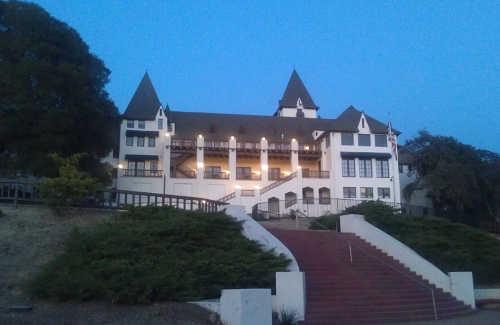
LAKE COUNTY, Calif. – The work to prepare the Lucerne Hotel for its new use as a college campus is continuing, with the county moving forward with plans to make the building fully compliant with federal accessibility laws in time for fall classes to begin.
Last year the county of Lake – which owns the hotel, known locally as “The Castle” – and Southern California-based Marymount California University entered into a lease agreement for the building.
Marymount recently received accreditation for the new “Lakeside Campus” – its third, along with campuses in Rancho Palos Verdes and San Pedro – to begin offering courses in fall 2014, Deputy County Administrative Officer Alan Flora told Lake County News.
The university's Web site said bachelor's degrees in business and liberal arts – with an emphasis in business and psychology – will be offered at the Lakeside Campus, as well as master's degree programs in business administration, leadership and global development, and community psychology.
“The development of The Castle/campus is a huge vision for the county. We're excited to be partners with you in that,” campus Executive Director Michelle Scully told the Board of Supervisors at its Dec. 17 meeting.
Scully said the university was looking forward to being able to open up the campus as a “vibrant learning center.”
In order to be ready to host students, the building has to be made fully compliant with the Americans with Disabilities Act, which is an expensive and complex process given the fact that the Lucerne Hotel was built in the 1920s.
County administrative staff went to the Board of Supervisors Dec. 17 to seek approval on an update on the lease with Marymount, as well as to update a county ADA transition plan and approve a contract amendment with Kappe+Du Architects for design of a new elevator.
The elevator is one of the big items on the county's to do list of renovations for the building.
County Administrative Officer Matt Perry said most of the items the county is responsible for completing in the building's renovation will be done by March. “The big exception is the elevator,” he said.
A year ago the county issued two separate requests for proposals for a firm to install an elevator. Perry said one of the bids that came in was for more than $800,000. That bid came in from Dream Ride Elevator of Benicia, the firm that currently maintains the county of Lake's elevators.
Since then, Perry said the county has explored a variety of alternatives, including a limited use/limited application elevator, which would have been a fraction of the cost of a full-scale elevator.
However, after talking with two ADA consultants, “We've concluded that we have no other option other than a full-scale elevator,” Perry said.
Currently, estimates to install an elevator in the building range between $80,000 and $500,000, according to Perry. “We want to move forward with that and ask for your board’s support.”
Earlier this month, Perry signed a $10,000 contract with the San Rafael firm Kappe+Du Architects for design of the elevator, and asked for the board's approval to add another $7,850 to the total contract amount.
That design work is expected to be finished in January, clearing the way for a construction contract to be implemented by early February, according to Perry.
A written report from Perry to the board on the elevator issue explained that demolition of the elevator shaft was nearly complete and excavation of the elevator pit was set to begin.
Perry told the board that County Administrative Office staff is exploring options on the bidding process and considering a Bay Area firm that works with the architect.
Being able to use a no bid process is expected to save two months, time that would be used going out for a request for bids, Perry said.
With elevator installation expected to take three months, saving time on the bid process would allow the county to have the work complete by the time Marymount wants to start classes in August, he said.
However, Perry said staff wasn't prepared to present no bid process that as a final option, and would come back to the board with a formal recommendation.
Flora noted that once the county had the design documents in hand from Kappe+Du – which designed the Middletown Library and Senior Center – it can get a more competitive price on the elevator installation.
Perry added of the Lucerne Hotel's elevator, “It's essentially a four-stop elevator, and that's one of the factors that makes it so costly.”
While the county continues to work on the elevator, Perry said Marymount wants to begin holding professional development and other certificate-level courses beginning in March. In order to allow that, the board had to take action to add the hotel to the county's ADA transition plan.
Flora said the countywide ADA transition plan identifies deficiencies in facilities, noting the law allows entities like the county to upgrade in a “reasonable” amount of time.
The ADA consultant's report on the building, completed by Ashdown Architecture Inc., identifies solutions and projected costs, and suggests fixes from basic signage, handrails and threshold heights, to the changes needed in ramps, and proposals for a pool lift and the elevator.
After discussing the building and its ADA issues with County Counsel Anita Grant, Flora said they decided they should solicit public input on the best solutions.
In the meantime, while the ADA improvements and elevator are being worked out, the county has several alternatives identified to make the classes more accessible if Marymount goes forward with offering the professional courses in March, Flora said.
They include offering classes online, providing program space on the building's second floor, where an elevator isn't necessary, or offering space in the county's Behavioral Health and Social Services facilities, he said.
Grant emphasized those alternatives were short-term solutions only. “This is just simply a temporary measure and the elevator will be installed well before the regular classes of Marymount start up.”
Perry also asked for the board's approval of a change to the lease agreement with Marymount for the building.
The lease signed last year initially called for the county to prepare four classrooms on the building's third floor and a fifth on the main floor. However, Perry said the lease didn't address the responsibility for making the parking lot ADA compliant.
He said the county has proposed to Marymount that the requirement for the fifth classroom be removed from the lease, with the money reallocated to the parking lot. “We've come to agreement on that.”
Other changes to the lease language included better definition of responsibility for paying utilities during the period which renovations are being completed and Marymount is holding classes, as well as Marymount's request that the county indemnify it from any issues arising from the county's implementation of the ADA transition plan.
In three separate votes, with all of the motions offered by Supervisor Denise Rushing, the board unanimously approved the amendments to the transition plan, the lease and the contract with Kappe+Du.
Email Elizabeth Larson at
- Details
- Written by: Elizabeth Larson
Registrar of voters reports on county, state and federal offices on 2014 ballot
LAKE COUNTY, Calif. – It's not yet 2014 but the county's election office already is gearing up for a busy election season in the new year.
Registrar of Voters Diane Fridley on Friday reported on the deadlines for candidates in the June 3 statewide direct primary election, which will include not just local candidates but also candidates for state and federal offices.
The local offices up for election this year include county superintendent of schools, assessor-recorder, county clerk-auditor-controller, sheriff-coroner, treasurer-tax collector, District 2 county supervisor and District 3 county supervisor, Fridley said.
Rounding out their first terms are Lake County Superintendent of Schools Wally Holbrook, District Attorney Don Anderson and Sheriff Frank Rivero.
Longtime Assessor-Recorder Doug Wacker also will be back up for reelection, and appearing on the ballot for the first time will be County Clerk-Auditor-Controller Cathy Saderlund and Treasurer-Tax Collector Barbara Ringen.
Both Saderlund and Ringen – longtime employees of their respective departments – were appointed by the Board of Supervisors when the offices became open due to retirement and resignation, respectively.
Saderlund was appointed in October 2011 to succeed Pam Cochrane, who retired, and Ringen was appointed just last month to finish the term of Sandra Shaul, who left for a job in Marin in March, as Lake County New has reported.
Of those offices, so far only Rivero has challengers who have indicated they will run against him in his bid for reelection – retired Clearlake Police Chief Bob Chalk and Lake County Probation Assistant Chief Brian Martin.
The seats of District 2 Supervisor Jeff Smith and District 3 Supervisor Denise Rushing will be up for election in 2014.
Smith has indicated he will seek reelection but Rushing has said she will not seek a third term.
Earlier this month, Clearlake City Council member Jeri Spittler announced on social media that she would seek the District 2 seat on the Board of Supervisors.
As for the open District 3 seat, a large field already has formed to run for it. Candidates that have indicated plans to run so far include Upper Lake contractor John Brosnan; Clearlake Oaks resident Marvin Butler, a well-known businessman and former county planning commissioner; Mark Currier of Spring Valley, who chairs the County Service Area No. 2 Spring Valley Advisory Board; Clearlake Oaks resident Herb Gura, founder of the Self Help Law Center and currently a member of the Konocti Unified Board of Trustees; and Jim Steele, a retired California Department of Fish and Game biologist and ecologist who lives in Clearlake Oaks.
Fridley said candidates for the local elective offices listed above may submit “in-lieu-of-filing fee petitions” – containing signatures of registered voters in the jurisdiction in which he or she is seeking nomination – to offset all or part of the cost of the filing fee.
The in-lieu-of-filing fee petitions are available to candidates during regular office hours of 8 a.m. to 5 p.m., Fridley said.
She said the deadline to file the in-lieu-of-filing fee petitions with the Lake County Registrar of
Voters’ Office is Feb. 20.
On Friday, sheriff's candidates Brian Martin and Bob Chalk said they took out their in-lieu-of-filing fee petitions.
All candidates for elective office also must file within the nomination period of Feb. 10 through March 7 a declaration of candidacy form and nomination papers in order for their name to be printed on the June 3 Statewide Direct Primary Election ballot, Fridley said.
In addition to the local offices coming up for election this June, voters will be deciding on statewide offices, including governor, lieutenant governor, secretary of state, controller, treasurer, attorney general, insurance commissioner, superintendent of public instruction and Board of Equalization member District 2, Fridley reported.
Fridley said the state legislative seats representing Lake County, Senate District 2 and Assembly District 4, will be on the ballot as well.
Both seats are open this year, with Sen. Noreen Evans announcing her retirement and Assemblymember Mariko Yamada being termed out.
Seeking Evans' seat are Sonoma County Supervisor Mike McGuire; longtime state Senate staffer and Arcata resident Chris Lehman; and Novato Mayor Eric Lucan.
The field so far in the Assembly District 4 race includes Napa County Supervisor Bill Dodd, Davis Mayor Joe Krovoza, Napa County Planning Commissioner Matt Pope and Davis City Councilman Dan Wolk, as Lake County News has reported.
Congressman John Garamendi and Mike Thompson, representing congressional districts 3 and 5, respectively, also will be up for reelection, according to Fridley's office.
Voters desiring information regarding filing for any of the local elective offices may visit the Registrar of Voters Office in person at the Lake County Courthouse, 255 N. Forbes St., Room 209, Lakeport, or call 707-263-2372.
Email Elizabeth Larson at
- Details
- Written by: Elizabeth Larson




