 How to resolve AdBlock issue?
 Lakeport Police logs: Saturday, Jan. 10
Saturday, Jan. 10, 2026
00:00 EXTRA PATROL 2601100001
Occurred at Lake County Law Library on 3D....

CLEARLAKE, Calif. – A new speed zone report and an updated loan agreement with the former redevelopment agency's board will go before the Clearlake City Council this week.
The council will meet beginning at 6 p.m. Thursday, Jan. 23, in the chambers at Clearlake City Hall, 14050 Olympic Drive.
During presentations, Clearlake Police Chief Craig Clausen will give a certificate of appreciation to Dale Valentine for his $5,000 donation to the Police Department K-9 Fund.
Under council business, the council will consider adopting a resolution to approve the 2013 Speed Zone Study, completed for the city by Phil Dow of the Lake County/City Area Planning Council.
A report to the council from City Engineer Bob Galusha explains that cities and counties are required to perform the speed zone studies every five years. The city's last study was completed in 2008, and also was done by Dow.
Galusha reported that due to new state guidelines, six city streets are recommended for speed increases.
The proposed changes include raising the speed from 30 to 35 miles per hour for 40th Avenue from Highway 53 to Wilkinson, Austin Road from Redwood to Old Highway 53, Burns Valley Road from Rumsey to Arrowhead, and Moss Avenue from 40th to Davis; from 35 to 40 miles per hour for Dam Road from Dam Road Extension to Lake; and from 25 to 30 miles per hour for Lakeshore Drive from Olympic to Old Highway 53, according to Galusha's report.
In his report, Galusha raised concerns with the increases for 40th Avenue, which is narrow, has steep vertical curvature and no shoulders, as well as Dam Road, where the city has just completed class two bicycle lanes.
He said that while the Lakeshore Drive segment may raise concerns for the council, “prevailing speeds on this segment have not changed over the years,” and he doubts that the change will have any influence over travel speeds on that portion of the street.
In other business, the city council will consider an amended loan agreement with the successor agency to the former Clearlake Redevelopment Agency.
The former agency is continuing to pay off loans to the city totaling just under $1.7 million.
Items on the consent agenda – considered to be noncontroversial and accepted as a slate with one vote – include warrant registers; minutes of the Jan. 9 council meeting; second reading of Ordinance No. 2014-166, amending city's purchasing system Ordinance No. 121-2006 to provide for local vendor preference; and quarterly reports from the Clearlake Police Department, Public Works, Engineering, City Clerk and the Finance Department.
Email Elizabeth Larson at
LAKEPORT, Calif. – The Lakeport City Council this week will discuss the general plan, the dog park and maintenance of the Westshore Pool.
The council will meet beginning at 6 p.m. Tuesday, Jan. 21, in the council chambers at Lakeport City Hall, 225 Park St.
Lakeport Police Chief Brad Rasmussen will give the council a report on police volunteer hours for 2013 at the start of the meeting.
Under council business, Planning Services Manager Andrew Britton will introduce an ordinance to amend Title 17 of the Lakeport Municipal Code to establish provisions for implementing density bonuses and affordable housing incentives in accordance with state law. A date for a public hearing also will be set.
He'll also take to the council a recommendation from the city’s consultant selection board to negotiate a professional services contract with De Novo Planning Group to prepare the state-mandated update to the Lakeport General Plan's housing element.
Public Works Director Mark Brannigan will present to the council a recommendation from the Lakeport Parks and Recreation Commission to provide fencing and gates to separate the large dogs from the small ones at the city's dog park, located at Westside Community Park.
The council also will be asked to direct staff regarding possible funding if they accept the commission's dog park proposal.
City Manager Margaret Silveira will give the council an update on the Westshore Pool and request direction on maintaining the pool pump, which the council previously had agreed to replace.
Silveira also will present to the council a resolution to initiate the 2014 review, update and amendment of the Lakeport General Plan.
On the meeting's consent agenda – items considered noncontroversial and usually accepted as a slate on one vote – are ordinances, minutes of the council's Jan. 7 meeting and the Jan. 8 warrant register.
Email Elizabeth Larson at
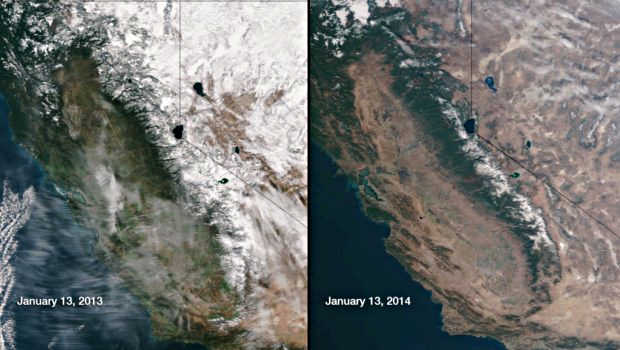
LAKE COUNTY, Calif. – With California's governor having declared a state of emergency due to the state's drought conditions, officials in Lake County are continuing their efforts to plan for how to respond to anticipated water shortages and lack of rain.
With the US Drought Monitoring reporting that 63 percent of California is now in the midst of “extreme drought” conditions, Gov. Jerry Brown on Friday proclaimed a state of emergency.
Brown directed state officials to take all necessary actions to prepare for drought conditions, including assisting farmers and communities, and making preparations to ensure the state can deal with any drinking water shortages that may result.
The governor's declaration came earlier than anticipated. State officials had indicated at a State Board of Food and Agriculture meeting last week that Brown might wait until after the second manual snow survey early in February.
But with no rain and a dwindling snowpack – it's at 17 percent of normal for this time of year – Brown went forward with making the declaration on Friday.
In Lake County, Special Districts already has sent out letters to customers in the 10 water districts it serves – Mt. Hannah, Paradise Valley, Kono Tayee, Starview, Bonanza Springs, Finley/Lands End, Spring Valley, Soda Bay, Kelseyville and north Lakeport – asking for voluntary conservation.
Seeking voluntary water cutbacks by customers is the first in the agency's four-step drought plan that, as conditions warrant, implements more stringent conservation measures, as Lake County News has reported.
Special Districts Administrator Mark Dellinger presented the plan as part of an update on the water situation to the Board of Supervisors Jan. 7.
“I am working on customized contingency plans as needed for each of the 10 water systems we manage,” Dellinger told Lake County News on Friday. “This is to supplement the advance stages of our Drought Management Plan.”
The California Department of Public Health has asked all water purveyors they regulate – which include all 10 of Special Districts' systems – for updates on drought conditions as they change, information that Dellinger said is being forwarded to Gov. Brown's office.
Special Districts Compliance Coordinator Jan Coppinger, who is taking the lead on the agency's drought plan, has implemented a Facebook page to help update the community on the water situation. That page can be found at https://www.facebook.com/LakeCountySpecialDistricts .
County Administrative Officer Matt Perry said he doesn't anticipate the county doing any kind of an emergency drought declaration – such as that passed Jan. 7 by the Mendocino County Board of Supervisors – any time soon.
He said he expects to see proposals on what actions to take next in a report from county Water Resources Director Scott De Leon, who the board directed on Jan. 7 to create a larger drought management plan.
“What the board's asked me to do is kind of new ground,” De Leon said on Friday.
De Leon is reaching out to the agriculture community, Mendocino National Forest, Bureau of Land Management and other agencies to ask what measures they're taking.
“We'll be reviewing what the governor came up with and if there's a way to incorporate that into our report, we would certainly do that,” he said.
De Leon said his report's completion is still some weeks out.
In the city of Lakeport which, unlike Clearlake, manages its own water and sewer systems, officials have had no formal notice from the state regarding what mandates they may be subject to at this time, according to City Manager Margaret Silveira.
“As far as the Lakeport water supply, we are not at an immediate threat, but do advise voluntary water conservation measure, which we have had posted on our Web site,” Silveira said. The city's Web site is www.cityoflakeport.com .
Silveira said that if the drought continues and aquifers are not replenished, then the city would have to follow the adopted protocols for conservation.
“If the governor establishes conservation mandates, we will have to wait and see what those mandates are and how it will impact Lakeport,” she said.
Clearlake City Hall is closed on Fridays, so officials there couldn't be reached regarding potential conservation actions on the part of the city.
In other reaction to the governor's Friday declaration, California Farm Bureau Federation President Paul Wenger said he hopes the governor’s action will bring increased attention to the longer-term water supply crisis California faces, which is compounded by population growth, environmental regulations and, now, by drought.
“We don’t know if this is year three of a three-year drought or year three of a longer drought,” he said. “We do know that long droughts can be a feature of the California climate – and we know one way to insulate ourselves from droughts is to store more water when we can.”
Wenger said California must commit to improve its water system. New storage, both aboveground and underground, “provides more flexibility to respond to more volatile weather patterns.”
In responding to the governor's Friday declaration, legislators at the state and federal level also used the opportunity to call for increased efforts at addressing the state water system's insufficient capacity.
“Today’s declaration by the governor represents what many in the environmental and agricultural communities in my district have long feared: California’s water system is insufficient and conservation alone is not enough,” said Sen. Noreen Evans (D-Santa Rosa).
Citing data that points to California facing the lowest rainfall levels in its 153-year history as a state, the California Congressional Delegation – including John Garamendi (CA-3), George Miller (CA-11), Mike Thompson (CA-5), Doris Matsui (CA-6), Jerry McNerney (CA-9), Jackie Speier (CA-14) and Ami Bera (CA-7) – thanked Brown for declaring the drought emergency.
“We can’t think of a clearer reason why the state and nation must invest in water recycling, conservation, and storage,” the group said in a Friday statement. “These investments can create millions of gallons of new water for the state while creating good jobs. We urge the governor to focus on creating new water through recycling, conservation, and storage in order to protect the state, family farms and businesses, and local municipalities that depend on a reliable water supply for their communities.”
Email Elizabeth Larson at
LAKE COUNTY, Calif. – The county of Lake has received $20 million in construction funding from the state to upgrade the Hill Road Correctional Facility.
This funding will allow for the improvement of the Lake County jail to meet the standards set forth in California’s new public safety realignment goals, county officials said in a Friday report.
Lake County will use the money to fund a new type II, 40-bed women’s jail with a new standalone 39-bed medical/mental health services building with program space, a new administration building, and renovations so that existing space can accommodate rehabilitative programs, according to the County Administrative Office.
Presentations were made to a steering committee of the Board of State and Community Corrections in Sacramento this past Dec. 4 and 5, the county reported.
Thirty-six counties applied for a total of $500 million in funding, and on Thursday the Board of State and Community Corrections announced it was making awards to 15 of those counties.
“The winning proposal was created through a truly collaborative effort of a diverse team, with participation from members of the Lake County Sheriff’s Office, Administrative Office, Public Works Department, Community Development Department, County Counsel’s Office, and Assessor-Recorder’s Office,” said Denise Rushing, chair of the Lake County Board of Supervisors.
The funding is the result of SB 1022, which provided for the issuance of lease revenue bonds to help finance jail modifications to deal with the influx of nonserious, nonviolent, non-sex
offenders.
These offenders are being sentenced to the county jail instead of state prison pursuant to AB 109, the Public Safety Realignment bill, which took effect in October 2011.
The local impact of AB 109 on the Hill Road Correctional Facility has caused a significant strain on the average daily population at the jail, with nearly 30 percent of monthly bookings being convicted and
sentenced offenders, the county reported.
“The strain on our local jail from Public Safety Realignment will continue to grow, and financing the necessary upgrades just would not have happened with only local dollars,” said Rushing. “The SB 1022 funding will provide the opportunity for local rehabilitation through the new program space to be built.”
Receipt of SB 1022 funding requires a 10-percent local match, although Lake County received authorization for a reduction to a 5-percent match due to its status as a “small county,” according to county officials. This match includes cash and in-kind contributions such as existing land value.
The Lake County Board of Supervisors has appropriated $650,000 of local matching funds towards the project from the Rural and Small Counties Sheriff’s Fund.
The county does not expect to spend any local general fund dollars on the project.
A key component of AB 109 is the rehabilitation of offenders in an effort to reduce recidivism. The state is investing hundreds of millions of dollars in local rehabilitation and crime-preventing programs to continue to improve public safety in local communities, according to the Board of State and Community Corrections.
Other counties receiving Board of State and Community Corrections awards in this round of funding included Napa County, $13,474,000; Tuolumne County, $20 million; Kings County, $20 million; Shasta County, $20 million; Tehama County, $6.5 million; Santa Cruz County, $24,635,000; Santa Barbara County, $38,976,000; Solano County, $23 million; Tulare County, $40 million; San Joaquin County, $33.3 million; San Mateo County, $24,374,000; Fresno County, $79,194,000; Orange County, $80 million; Sacramento County, $56.4 million.
Saturday, Jan. 10, 2026
00:00 EXTRA PATROL 2601100001
Occurred at Lake County Law Library on 3D....
Friday, Jan. 9, 2026
00:00 EXTRA PATROL 2601090001
Occurred at Lake County Law Library on 3D....