 How to resolve AdBlock issue?
 Lakeport Police logs: Saturday, Jan. 10
Saturday, Jan. 10, 2026
00:00 EXTRA PATROL 2601100001
Occurred at Lake County Law Library on 3D....

LAKE COUNTY, Calif. – County officials continue to tally the costs of property damage that resulted from a late November windstorm, with the estimate now in the range of several millions dollars.
The storm, caused by the meeting of high and low pressure systems, hit on the county on Nov. 21 and Nov. 22.
The Northshore – particularly Nice – and Clearlake took the brunt of the storm. Homes and businesses were damaged, and there were dozens of falling trees that took down power lines, leaving some people out of power for as long as two days and sparking several wildland fires.
The National Weather Service said there were sustained winds averaging around 40 miles per hour, with the highest gust reported to be 78 miles per hour in the Cow Mountain area near Lakeport, as Lake County News has reported.
Jill Ruzicka, the county's public information officer, said additional information on damage is continuing to come in on a daily basis.
She said the numbers the county has reported to the California Office of Emergency Services are for an operational area that covers all of Lake County, including the cities.
“Our initial assessment of privately owned buildings is estimated at approximately $5.3 million,” Ruzicka said. “We do not have an estimate of how much of this is covered by insurance.”
Ruzicka said the breakdown of damage to privately owned structures includes:
She added, “Our initial assessment of publicly owned buildings/facilities is estimated at approximately $650,000, with Holiday Harbor and Keeling Park suffering the most damage.”
Clearlake City Administrator Joan Phillipe said calls reporting damage are still coming in, and on Friday she didn't have a separate damage estimate available for the city.
She said she plans to present the Clearlake City Council with an update on the storm damage at its first meeting of the new year on Thursday, Jan. 9.
The Northshore Business Association continues to act as a clearinghouse for volunteers willing to help with storm damage cleanup and for those looking for assistance.
On the association Web site at http://www.northshorebusinessassociation.com/ there is a list of volunteers, information on how to volunteer or how to request assistance.
For more information on receiving help or volunteering, contact the association through its hotline at 707-739-6661.
Email Elizabeth Larson at
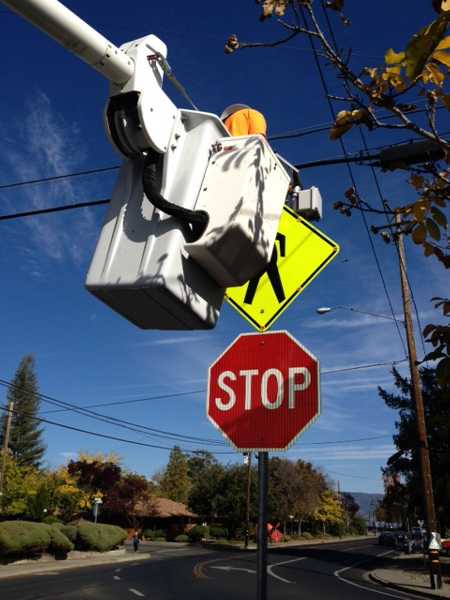
LAKEPORT, Calif. – A project completed this fall has increased safety at one of the city of Lakeport's intersections.
The 20th Street crosswalk project introduced lights and a radio-controlled system to make the crossing safer where 20th and High streets meet.
The area, a few blocks over from the Lakeport Unified School District campus, is frequented by children walking to and from school.
The Lakeport City Council had been concerned about the site, said city Public Works Director Mark Brannigan.
“It was one of the council's projects that they wanted to see done,” he said.
Brannigan explained that the intersection has a sweep which reduces visibility. High Street goes around a corner where it meets 20th Street – which has a stop sign – before turning into Lakeshore Boulevard.
The council in May approved the project, and authorized the purchase of the push button-activated, solar-powered blinking pedestrian warning sign.
Particularly of concern to the council was the increase in children walking to school. That's the result of new district rules requiring that children live at least two miles away from school to qualify for bus service.
Initially, the sign was to be hard-wired, which would have required digging up the street and sidewalks in order to install the utilities for it, Brannigan said.
However, once school began this fall, Brannigan said the city didn't want to take on such a project and tear up the streets and sidewalks.
“It just turned out to be too much of a project,” he said.
As a result, Brannigan said the council authorized additional funds to make it a radio-controlled system, so no digging was necessary.
City Public Works staff installed the equipment to save money, with Brannigan reporting that the total cost came out to $6,200, which was paid for by the city's general fund. No grant funds were used.
The project was finished around mid-October, and so far appears to be working well, Brannigan said.
“It's brighter than I thought it would be,” he said, noting that the system uses LED lights.
In the early morning when children are walking in the area to get to school, “That's really when you want to get people’s attention,” Brannigan said.
Council members appear pleased with the outcome of the project.
Councilman Tom Engstrom noted at this week's city council meeting that the crosswalk lights can be seen from a half-mile away.
“That is a real lifesaver,” he said.
Email Elizabeth Larson at
CLEARLAKE, Calif. – The Clearlake City Council at its Dec. 12 meeting received a detailed presentation on the recently completed Lakeshore Drive Downtown Corridor Plan, which looks at a host of options to improve the city's safety, appearance and accessibility.
The plan, which is to be brought back to the council at a later date, identifies specific improvements to improve access, pedestrian safety, economic vitality and circulation with the corridor, which is designated on Lakeshore Drive between Olympic Drive and Old Highway 53.
Josh Meyer of the Local Government Commission said the plan identifies seven prominent points of interest; seeks to manage speed on Lakeshore Drive; provides safe places to walk, bike, catch the bus and cross the street; fixes problem intersections; organizes parking; improves the corridor's look; develops points of interest; and enhances waterfront views and access.
Meyer provided the council with a PowerPoint presentation that identified the process, goals and recommendations for the plan. Conceptual drawings illustrated ideas for beautifying city parks, developing business fronts and curb, gutter and sidewalk options.
Illustrations also depicted recommendations for mitigating parking concerns, public safety and managing speed such as narrowing travel lanes, roundabouts, bicycle lanes and raised, extended and high-visibility pedestrian crosswalk options.
Establishing back-in parking to allow the driver better visibility while entering traffic was also among the suggestions.
Meyer said there exists about 40 feet of right-of-way to work with in mitigating traffic safety concerns.
He said standard freeway lanes are built to 12 feet, which is the current width of lanes on Lakeshore Drive. He said research shows city lanes can be reduced to 11 feet safely.
Councilwoman Gina Fortino Dickson mentioned findings of a current traffic study conducted by City Engineer Bob Galusha and Phil Dow, traffic engineer for the Area Planning Council, that indicate narrower lanes of travel create a perception that typically results in slower traffic speeds.
The intersection on Lakeshore Drive at Mullen Avenue, which presents a blind corner, was identified as a priority among traffic safety concerns.
Mitigation recommendations included restricting lefthand turns, installing curb extensions and narrowing lanes.
Councilwoman Jeri Spittler said she has owned a business at that intersection for more than 20 years and has witnessed every traffic collision scenario possible.
She said that people sometimes travel at speeds up to 50 miles per hour in the morning and that she doesn't think narrowing lanes and other mitigations will fully address the situation.
“As long as that blind curve exists, we have a problem,” she said.
Mayor Joyce Overton opposed the recommendation for a roundabout at the Olympic Drive intersection but said she supported the ideas of narrowing travel lanes and back-in parking.
She also said she appreciates the inclusion of an implementation plan in the document. “I love the tree (beautification plan) and that is something we can implement right away,” she said.
City resident Lisa Wilson said she participated in the plan development process, which included public workshops and discussions. She urged the council's immediate action on parts of the plan that can be easily accomplished.
“I am really energized by this,” she said, adding that she hopes the council gets started.
Citizen Mike Vandiver voiced concern regarding back-in parking, suggesting people have difficulties pulling forward to a parking spot now. He also questioned the need for traffic to stop to allow vehicles to back into parking spots.
Councilman Joey Luiz recognized Vandiver's concern, however, said he has seen the option succeed in other cities.
Resident Rick Mayo said he supports the idea of back-in parking in that it may make people using mobile medical devices more visible to motorists.
However, he said he wanted to see attention given to the Americans with Disabilities Act in the plan. Meyer said the plan is ADA compliant; however, he apologized for not including a specific report, which he said will be added.
Hiram Dukes asked if narrower streets will impact emergency service vehicles. Police Chief Craig Clausen said it was his understanding that it would not be an issue.
The plan was developed through a Community Based Transportation Planning Grant the city was awarded in partnership with the Area Planning Council. The Local Government Commission is a nonprofit organization that works with California communities to develop community plans through extensive community involvement.
Meyer said the project's existing framework is ideal with the lake on one side, hills on the other, three parks and three activity areas that are easy to walk.
The plan describes how it was developed and specific design recommendations and potential projects for Lakeshore Drive. It provides demographic information, the project area and discusses key issues and opportunities including the need for a cohesive identity, lack of pedestrian and bicycle infrastructure, deteriorated properties and natural environment.
Design proposals are the core of the plan, Meyer said. Four goals are identified that form the guiding principles for a cohesive design approach, which is presented for both the overall corridor and by segments along the corridor, centered primarily on the three community parks.
Specific recommendations are presented and include parking options, intersection improvements, pedestrian and bicycle improvements, landscaping and signage, designs for enhancing parks and ideas for infill development.
The implementation plan is presented in three phases: one to three years, four to 10 years and 10 to 20 years. Each phase includes specific recommendations and policies and programs to support the recommendation.
The plan also identifies potential federal, state and local funding resources.
The council commended Meyer, the public, staff and all who contributed to the development of the plan.
“I think this addresses a lot of our concerns and gives us a pleasurable picture to look at,” Fortino Dickson said.
According to City Manager Joan Phillipe, acceptance of the plan does not commit the city to constructing any of the projects identified.
The plan is available for public review at Clearlake City Hall, 14050 Olympic Drive.
Email Denise Rockenstein at
NORTHERN CALIFORNIA – In an action supported by California NORML, medical marijuana patient James Maral will file a petition with the California Supreme Court to review the recent Third District Appellate Court decision upholding the city of Live Oak’s ban on medical marijuana cultivation.
San Francisco Attorney Joe Elford will draft and file the petition.
“If you ban dispensaries and you ban cultivation, you’re ripping the heart out of California's medical marijuana laws,” said Elford. “This decision conflicts with the intent of the electorate and Legislature and should not be allowed to stand.”
The announcement comes a day after Fresno County took steps to enact a total cultivation ban on first reading at its Board of Supervisors meeting. A second reading on the ordinance will take place on Jan. 7.
Also on Tuesday, the Lake County Board of Supervisors unanimously passed a medical marijuana cultivation ordinance prohibiting outdoor grows in residential neighborhoods but allowing them on larger parcels, with small indoor grows allowed, as Lake County News has reported.
Maral, 42, suffers from compartment syndrome, a painful life- and limb-threatening condition caused by insufficient blood supply to muscles and nerves.
In addition, he has six damaged discs in his back, the result of his work as a heavy equipment driver. He and his family have lived in Live Oak for 15 years.
Maral is also a caretaker for his mother Donneda Maral, who has severe diverticulitis and Crohn's disease, for which she is frequently hospitalized.
“The only thing I'm fighting for is the patients who just want a couple of plants in their backyard,” said Maral. “I'm not willing to let my mother die or live out the rest of her time in a hospital.”
The Marals live at least two hours away from any medical marijuana dispensary.
Cultivation is exempted from state law for medical marijuana patients by Proposition 215, passed by the voters in 1996.
State law SB420 established a “floor” of six mature or 12 immature plants as allowable per patient, permitting cities and counties to pass ordinances allowing for greater, not lesser, amounts.
The California Supreme Court threw out SB420's limits in People v. Kelly (2010), opting instead for allowing whatever a patient needs to grow. That decision can be seen at http://www.canorml.org/news/supremekelly.html .
Live Oak’s ban on medical marijuana cultivation took effect in January 2012, over the objections of local citizens. The only other known jurisdiction currently banning all medical marijuana cultivation is Tracy.
Sacramento County has passed an ordinance zoning out anything federally illegal, and Sacramento sheriffs were out this year enforcing it by taking out gardens.
The city of Selma rolled back their cultivation ban on Oct. 16, voting to allow permitted, indoor gardens.
Prop. 215 co-author and CalNORML director Dale Gieringer, who sat on the state committee that wrote SB420, said, “The right of patients to grow their own medicine is fundamental to Prop. 215's stated purpose of ensuring that 'seriously ill Californians have the right to obtain and use marijuana for medical purposes.' The city of Live Oak has no legitimate business prohibiting Mr. Maral from growing the medicine he needs at his own private residence.”
Saturday, Jan. 10, 2026
00:00 EXTRA PATROL 2601100001
Occurred at Lake County Law Library on 3D....
Friday, Jan. 9, 2026
00:00 EXTRA PATROL 2601090001
Occurred at Lake County Law Library on 3D....