
 How to resolve AdBlock issue?
 Planning for the future: Graduate students introduce elements for new Clearlake General Plan
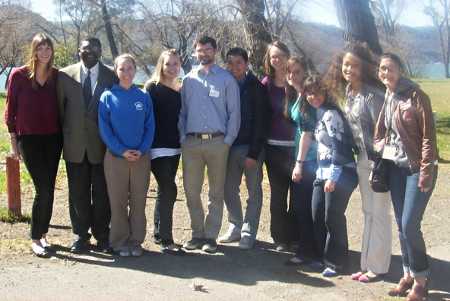
CLEARLAKE, Calif. – A preview of the document that will help shape the future of the city of Clearlake was introduced to the community this past weekend.
On Saturday, March 9, the fourth and final meeting for the city of Clearlake’s General Plan Project was held by the Cal Poly San Luis Obispo and the city of Clearlake at Clearlake City Hall.
The meeting presented the preferred growth plan, generated from both community feedback gathered from the last community meeting, and background research on the city’s current conditions.
The general plan project is a partnership between the city and Cal Poly San Luis Obispo. Together, they are working to review and renew the existing general plan, placing strong emphasis on the public’s involvement.
The team is made up of second-year graduate students in the City and Regional Planning master’s program, under the leadership of Dr. Cornelius Nuworsoo.
The presentation began with describing the process of the general plan’s three stages.
The first stage was describing what the city is currently like.
The Cal Poly San Luis Obispo students conducted an inventory of all land uses and researched the background of available documents.
In the second stage, preferences for the vision of Clearlake were explored.
In the third stage, the students put together what they thought were ways to get to the vision that was expressed in the previous two stages.
All of the information from the three stages and Saturday’s meeting are to be compiled into the draft general plan, with a target date of this month.
The general plan provides a city with guidelines for future planning decisions. California law requires that cities and counties prepare a general plan to guide planning decisions.
The city of Clearlake currently has the same general plan as it did when the city incorporated in 1980. This project is to review and renew this plan.
The general plan is required by law to address seven elements: land use, circulation, housing, safety, open space, noise and conservation.
Four other elements – economic development, public facilities, community design and health – are optional and have been included by the Cal Poly Graduate students to provide further depth.
At the last workshop meeting, the students looked at three plans for growth development: business as usual, infill/redevelopment and clustered growth.
The participants responded to a series of questions regarding each plan, telling the students what the community desired.
The feedback from that meeting included:
- Emphasis on mixed-use housing options;
- A commercial development that focused on tourism and the waterfront;
- Slowing down traffic and creating more pedestrian options with addition of sidewalks;
- Light industry supported in Ogulin Canyon;
- Pocket parks in residential neighborhoods;
- All weather road options for emergency service access for unpaved roads;
- Traffic calming measures and safe routes to school for Pomo Elementary.
The background research for the Cal Poly students helped them to identify Clearlake’s strengths as well as where improvements are needed.
That background research included a land use inventory and analysis of the existing conditions in the city, which included economic and demographic data provided by the U.S. Census and other government agencies.
To develop the background report, background research was combined with community input.
A variety of mediums were utilized in hearing the community’s opinions, preferences and feedback to the process.

The Plan Clearlake Web site, http://planclearlake.weebly.com , has been populated with all documents and presentations to the community.
Residents not able to make the meetings took advantage of the site and sent in their comments via email.
As a part of the process, three community meetings were conducted preceding last Saturday’s presentation.
Meeting one recognized the community’s thoughts on what is holding the community back and what aspects have the potential to reinvent and reinvigorate the area.
Meeting two took the concerns and ideas of the community and presented emerging directions from community input.
Meeting three the planning team presented three growth plans based on projected population, job, and housing projections.
After the feedback of preferences by element and by plan, the Cal Poly Graduate students developed a preferred plan for review at Saturday’s meeting.
All recommendations were made in accordance with state and federal standards as well as local input.
The students then presented the city’s land use inventory, 2010 employment trends, income comparison and housing types.
Next was to review some of the opportunities and constraints to development and the growth that is expected to occur in the city between now and 2040 in terms of population, housing, employment, land opportunities, land constraints, population growth, 2040 employment target and housing need.
Then, under the preferred scenario process, the students presented assumptions, land use map, redevelopment map, Lakeshore Drive, Austin Park, the Avenues, Gateway at Lakeshore and Highway 53, public parks, regional shopping center and circulation maps.
Finally, the students presented how this plan is likely to affect the elements included in Clearlake’s general plan.
They covered housing, circulation, conservation, open space, noise, economic development, safety, public facilities, police and fire, community design and health.
After the Cal Poly students finalize the draft of the general plan, they will submit a draft plan to the city of Clearlake for editing.
Once the draft of the general plan is approved, a review of the environmental impacts of the plan will be conducted.
Once everything is approved by the Clearlake City Council, policy implementation will begin.
The zoning code can then be updated and specific plans envisioned.
Special thanks to Professor Cornelius Nuworsoo and his Cal Poly San Luis Obispo Planning graduate students for their help with excerpts of their presentation for this article.
Email Nathalie V. Antus at
- Details
- Written by: Nathalie V. Antus
Supervisors vote to seek court guidance on paying Rivero attorney fees; total costs now estimated at $52,000
LAKEPORT, Calif. – The Board of Supervisors on Tuesday discussed what actions to take next in the legal battle between the sheriff and district attorney, with the legal costs the county has been forced to undertake for the sheriff quickly escalating.
In the end, the board voted to defer a $29,600 bill from the Southern California-based Jones and Mayer law firm.
The supervisors also directed County Counsel Anita Grant to ask a judge for clarification on how much more money the county must spend as Sheriff Frank Rivero fights District Attorney Don Anderson’s determination that he be placed on a list of officers with credibility issues.
Last month, at the end of a lengthy investigation, Anderson concluded that Rivero had lied about his actions during a February 2008 incident in which he shot at – but missed – a man holding a can of pepper spray, a violation of sheriff’s department policy, as Lake County News has reported.
Anderson is required under the 1963 US Supreme Court decision to release any such potentially exculpatory evidence – including information about credibility issues of officers involved in cases – to criminal defendants.
Last year a visiting Mendocino County judge ordered the county to pay for outside counsel for Rivero after determining that a conflict of interest for County Counsel Anita Grant’s office couldn’t be overcome with an ethical wall.
After Anderson made his finding on Feb. 19, Rivero filed an application for a restraining order against Anderson and also filed to seek a writ of mandate and preliminary injunction to prevent him from releasing the findings either publicly or to criminal defendants.
In a March 4 hearing, retired Butte County Superior Court Judge William Lamb denied the restraining order application, ordered the documents relating to the finding to be unsealed and the court hearing to remain open to the public after Rivero sought to have the matter taken out of the public view.
However, Lamb allowed that Rivero could continue to pursue a temporary injunction. Anderson told Lake County News on Tuesday that he was not aware of a date yet being set for that proceeding.
On Tuesday Grant updated the board on the situation. Rivero, who was in the courthouse on an unrelated private matter, was not present for the discussion.
In her memo, Grant explained that the judge’s order for legal representation required the county to provide the counsel and advice to Rivero in his deliberations with Anderson concerning the Brady investigation.
“The bottom line here is that the sheriff and his counsel contend that that further representation is required pursuant to the court order and that failure to do so would result in your board being in contempt of court,” said Grant.
She offered the board three options: paying the bill, denying it, or paying it under protest and directing staff to initiate legal proceedings to get clarification on the scope of the court ruling and whether it extends beyond Anderson to encompass Rivero’s current suit.
“I have been receiving calls from citizens that are absolutely tired of this situation, that they are absolutely fed up with it, and I would say that this board is, too,” said Supervisor Denise Rushing. “It’s too bad that this is what we’re working on. It’s too bad that we have to spend any time on this at all.”
Rushing supported paying the bill under protest and having Grant get clarification from the court, seeing no other workable options.
Supervisor Rob Brown said he also didn’t like the options, and appreciated that Grant was being cautious.
“Just like you, Denise, I’m sick and tired of this guy and his problems, and all of his whining about being a victim on everything,” Brown said. “I’ve just had a belly full of it.”
Supervisor Jim Comstock, who from the beginning has, like Brown, opposed paying any legal fees for Rivero, wanted to deny payment.
Brown pointed to all of the effort and taxpayer expense that has gone into the situation. “The sheriff is upstairs right now in court on a personal matter with his girlfriend. He’s not even doing his job and we’re still paying this guy, plus dealing with all of his problems down here. I think the folks in Lake County deserve better than that and I think they’ve had a belly full of it.”
“Totally agree,” said Comstock.
Board Chair Jeff Smith said he felt they needed to deny payment, but also wanted to have Grant get guidance from a judge.
Regarding the Brady determination, Smith said, “From what I’ve heard and understand, it’s something that’s not appealable, the district attorney has the last say.”
If it’s not appealable, he questioned why the county should have to continue to pay Rivero’s legal fees.
Supervisor Anthony Farrington asked Grant to explain the total amount the county has spent so far.
The county, she said, had to pay about $14,000 after the judge ordered payment for Rivero’s legal counsel last year. With an additional $6,500 contract with Jones and Mayer reached last fall, that brought it up to about $21,000. On Feb. 19, the board added another $2,000 to the Jones and Mayer contract to cover an overrun of less than $200, bringing the total to $23,000.
Then Jones and Mayer submitted the latest bill for an additional $29,600. If the county pays it, Grant said it will bring the total paid so far in the Rivero matter to $52,000.
The board sat silent for a moment, then Farrington suddenly laughed. “That jumped real quick,” he said.
“We can hire a deputy for a year for that,” said Brown.
Farrington asked Grant if the money came from the general fund. She said the board would have to identify the source of the funds, but it was not covered by insurance.
Smith suggested a fourth option, holding off on payment until getting an order from the court.
Given the threat from Rivero and his counsel, “You may risk a concurrent contempt proceeding,” said Grant.
She said they could consider that fourth option. Smith said otherwise, if they paid the money, it was gone and how could they get it back later.
“You’d be looking at getting it back from, most likely, the sheriff,” Grant replied.
“Good luck with that,” said Comstock.
Rushing added, “That would be interesting.”
“That would probably end up looking like discrimination or something by the time he got done with it,” Brown said of Rivero. “That’s the way he looks at everything.”
Grant said they could apply as soon as humanly possible for the court clarification.
“Here’s the other risk that we have. We approve this, there’s going to be another bill coming soon. I mean, it’s not going to end here,” said Brown.
He said that Rivero has indicated that he’s prepared to go all the way to the United States Supreme Court “because it’s about him.”
Brown said they were dealing with a guy who blatantly committed a felony in court last week by appearing armed before a judge in a matter to which he was a party, which violates Penal Code Section 171(b), which applies to law enforcement officers. Brown said when he notified Rivero of that fact, Rivero replied with an email that said he was exempt from the law.
“He doesn’t believe the rules apply to him, and that’s what we’re dealing with,” Brown said.
Comstock asked about the sanction the board would face if the court found it in contempt. Grant said it would be monetary.
Grant suggested they had some time before having to pay the latest bill – which came in on Monday – and that would give her the opportunity to seek the court’s clarification.
Farrington said there comes a point where one has to stand firm; he said he could see the costs reaching into the hundreds of thousands of dollars.
Rushing said they were navigating difficult waters. “It could cost us a lot of money if we do it wrong.”
“I support that we defer payment at this time until we get clarification,” said Comstock, which Brown seconded.
Finley resident Phil Murphy said he hated seeing taxpayer dollars wasted, and suggested that Anderson was at fault for pursuing the matter.
He acknowledged that the Brady list of officers with credibility issues has an important purpose, but as he attempted to continue discussing the Brady matter specifically, the board told him that was not the matter at hand.
Brown said whether Murphy agreed with Anderson or not, Anderson had a job to do, and the board was not there to decide if Anderson did his job right.
The Brady list does have a purpose, said Brown, and there is a very easy way to avoid being on it, “and that is to not be a liar.”
“Well …,” Murphy said before Grant warned they were straying off the agenda topic.
Former sheriff’s detective Tom Andrews asked for clarification on whether the Brady determination was appealable.
Grant said that issue is now being tested by Rivero’s legal action, and should be decided by a court.
She said some legislation has been proffered by the Peace Officers Research Association of California – or PORAC – and others to offer some due process rights to officers in the deliberations, but an appeal so far has been untested.
Andrews said it seemed that the county had carried out its responsibilities ordered by the court, and he encouraged them not to pay another dime until the court orders it.
Smith said there are many interested parties like PORAC and sheriff’s associations, and he said he would think they would jump on board to help defend Rivero if the matter were appealable.
“I think there’s other alternatives out there to get to the end of this,” Smith said.
The board voted 5-0 to support Comstock’s motion to defer payment until the court offers guidance on the limit of the board’s requirements to provide Rivero with counsel.
Email Elizabeth Larson at
- Details
- Written by: Elizabeth Larson
Clearlake City Council to discuss setting special meeting for selecting planning commissioners
CLEARLAKE, Calif. – The Clearlake City Council this week will discuss holding a special meeting to select three planning commissioners, get an update on Smart Meters and consider Pomo Road safety issues.
The meeting will begin at 6 p.m. Thursday, March 14, in the council chambers at Clearlake City Hall, 14050 Olympic Drive.
Consent agenda items – usually accepted as a slate with one vote – include consideration of adopting a resolution authorizing the elimination of the entry level police officer salary range, and receipt and filing of the recognized obligations payment schedule for the first half of the fiscal year 2013-14 as approved by the oversight board for the city's former redevelopment agency.
At the start of the meeting, Police Chief Craig Clausen will present the Employee of the Year Award and introduce new department members.
Council members will consider setting a special meeting for the purpose of selecting three planning commission members.
The terms for commissioners Carl Webb and Bill Perkins are expiring, and one seat is vacant since Gina Fortino-Dickson was elected to the council last fall.
In her report to the council, City Manager Joan Phillipe said the city has received 11 applications for the three seats, including from Perkins and Webb, who are seeking reappointment.
Applications also were submitted by Robert Coker, Cheryl Hutchinson, Charles O’Neill Jones, William Morgan, Karen Priest, Bruno Sabatier, Dirk Slooten, Jason Tapia and Michael Vandiver, Phillipe reported.
Phillipe said staff suggests holding a special meeting March 21 to make the selection.
Also on Thursday, at Mayor Jeri Spittler's request, the council will get an informational update on Pacific Gas & Electric Smart Meters. The council passed a temporary moratorium on the meters, which expired at the end of 2011.
In other council business, there will be a discussion and presentation regarding concerns voiced at the Feb. 28 council meeting about safety issues on Pomo Road as it relates to Pomo Elementary School, the council will consider awarding a bid for building a Web site for the city and appointing a city delegate to the Redwood Empire Division of the League of California Cities.
Email Elizabeth Larson at
- Details
- Written by: Elizabeth Larson
Local senior centers celebrate 'Meals on Wheels Month'
LAKE COUNTY, Calif. – March has been designated as a time to recognize the important contribution that Lake County's senior centers make to meeting the nutritional needs of seniors.
“Meals on Wheels Month” proclamations were given at the Clearlake City Council Feb. 28 and also at the Board of Supervisors on Tuesday.
Lakeport Senior Center Executive Director Jonathan Crooks said that 116,000 meals are delivered annually to seniors in Lake County, a service which helps them live independently in their homes for as long as possible.
He said another 59,000 congregate meals are served annually at the centers.
The Meals on Wheels programs around Lake County wouldn't be possible without many reliable volunteers, who not only deliver the meals but use that interaction as an opportunity to check on the welfare of their senior clients.
“The community we share is amazing. I am reminded daily how generous people are as they come to fundraisers, and volunteer time,” Crooks told the Board of Supervisors on Tuesday. “They do not do it for praise or recognition; they do it because they have compassion.”
He thanked everyone who plays a part in helping take care of the community's parents and grandparents. “Together we will continue our services, despite any funding cuts that may come. We are asked to keep doing more with less, and with you we can.”
Crooks encouraged community members to visit their local senior center in March, donate to and shop at their thrift stores, and see if there's a need that has to be met.
Marching for meals
Another way to help – participate in one of the upcoming March for Meals events at the senior centers which provide Meals on Wheels services.
On Friday, March 22, the Highlands Senior Service Center in Clearlake invites the community to tie on their sneakers and come join the fun during their third annual March for Meals and Open House.
March a mile for Meals on Wheels; registration begins at 8:30 a.m. at the center, located at 3245 Bowers Road.
The walk, which begins at 9 a.m., will go from the center to the Burns Valley Shopping Center in an effort to raise awareness of senior hunger and encourage action on a local level.
Other March for Meals events will take place at the Lakeport Senior Center, Live Oak Senior Center in Clearlake Oaks and Middletown Senior Center on Friday, March 29.
At the Middletown Senior Center, Executive Director Jacque Spiker said they’ve been rained out of their marches for the last two years, so they’ve switched gears and decided to hold a bingo bash instead.
From 1 p.m. to 5 p.m. Friday, March 29, the bingo bash will take place at the Middletown Senior Center, located at 21256 Washington St.
Bingo cards will cost $1 each, with all proceeds going to Meals on Wheels. There will be prizes but no cash awards, she said. There also will be hot dogs and soft drinks offered, and an open house.
Spiker said they moved into the new center on Nov. 26. It will share space with the new Middletown Library, which has not yet opened.
“It’s fabulous,” said Spiker.
The old center only held 46 people for lunch; on Monday the center hosted 72 for lunch, she said.
In addition to more space for food service, they also have activities including bridge and line dancing.
“We’re really excited,” she said.
At the Live Oaks Senior Center, located at 12519 Foothill Blvd. in Clearlake Oaks, the March 29 March on Meals will take place beginning at 12:30 p.m., after lunch, and will circle the nearby park, said Executive Director Pat Grabham.
Grabham said the center delivers 10,000 meals a month to homebound seniors.
They also do a brisk service at the center for daily lunches, with 105 people there to dine on Wednesday, she said.
“They just love to come and socialize,” said Grabham.
A grant-funded busing service helps bring people from Spring Valley, Glenhaven and Clearlake Oaks to and from the center for lunch, according to Grabham, who emphasized the importance of being able to socialize.
Grabham’s center is due to get a new building, which she said is tentatively scheduled to break ground in May and be completed by Christmas.
While they’ve already waited through several years of delays, “I think it will happen this time,” Grabham said.
In Lakeport, Crooks said the center’s March 29 March for Meals will begin at 11 a.m. at the center, 527 Konocti Ave., and goes down to the thrift store at 120 N. Main St. and back to the center.
He said it will be followed by some presentations and regular lunch at noon. Sponsorship forms for participating in the march can be obtained at the senior center from 8 a.m. to 1:30 p.m., Monday through Friday.
For more information on how to get involved and help your local senior center with its Meals on Wheels efforts stop by or call. The centers can be reached at the following numbers: Lakeport, 707-263-4218; Live Oaks Senior Center, 707-998-1950; Highlands Senior Center, 707-994-3051; Middletown, 707-987-3113.
Editor’s note: The Lucerne Alpine Senior Center is not listed as it lost its contract for nutrition services, including Meals on Wheels, late in February, with services set to terminate by the end of March.
Email Elizabeth Larson at
- Details
- Written by: Elizabeth Larson
Lakeport Planning Commission to meet March 13
LAKEPORT, Calif. – The Lakeport Planning Commission will hold its next regular meeting on Wednesday, March 13.
The commission will meet beginning at 5 p.m. in the council chambers at Lakeport City Hall, 225 Park St.
On the agenda are several planning-related updates.
Planning Services Manager Andrew Britton will report to the commission about pending land use applications, including one from AT&T seeking to modify its existing antennas on the top of the Lake County Courthouse. That application will be considered at the April 10 commission meeting.
The city also has received an application from the Lakeport Senior Apartments development at 1075 Martin St. to modify the carport design to install solar panels.
The Lake County Vector Control District has a pending application for a zone change, general plan amendment and voluntary merger of parcels that it owns, according to Britton’s report to the commission.
Other issues that the commissioners will be updated on at the meeting include the Lake County Blueprint 2030, work on a proposed marijuana cultivation ordinance, and mobile vending and secondary accessory dwelling unit ordinances recently approved by the Lakeport City Council.
Commission members include Tom Gayner, Suzanne Russell, Ross Kauper, Harold Taylor and Ken Wicks Jr.
Email Elizabeth Larson at
- Details
- Written by: Elizabeth Larson




