
 How to resolve AdBlock issue?
 Effort to build a new Lake County courthouse takes unexpected turn
LAKEPORT, Calif. – The seven-year effort to build a new and safer courthouse for Lake County encountered another delay last week when a state committee voted to reevaluate the Lakeport site where the facility is proposed to be built.
In a 13-3 vote – with two abstentions – the Court Facilities Advisory Committee, which met in San Francisco on Thursday, ordered state Judicial Council staff to take a closer look at the six-acre site, located at 675 Lakeport Blvd.
The committee's action suspends all work on the project's working drawings except to study alternatives and project costs. Judicial Council staff must prepare a report in six months or less for review by the Court Facilities Advisory Committee and its Courthouse Cost Reduction Subcommittee on all options to reduce costs.
“We were surprised by the result,” Lake County Superior Court Presiding Judge Andrew Blum told Lake County News. “We had been led to believe that they understood where we were and the need to go forward.”
“We are extremely disappointed and frustrated with the process,” said Lake County Superior Court Executive Officer Krista LeVier, who attended the meeting.
During the Thursday discussion, one committee member suggested reducing the number of courtrooms from four to three, which would have given the new facility less courtrooms than the current cramped facility has.
“It doesn't make sense to make a nonfunctional building to save pennies,” said LeVier.
Deepika Padam, senior project manager of the capital program, told the committee that a six-month delay equates to an additional $500,000 in costs.
The project is in the working drawings – or final phase – of design. However, it came in for additional scrutiny due to being $6 million – or 12 percent – over the state’s target budget due to increased design and environmental costs.
The Judicial Council gives $49.984 million as the current authorized project budget.
The project cost has gone through a series of cost reductions totaling 30 percent, down from an original estimated $35.3 million for construction of the two-story, L-shaped building to $23.8 million. The Courthouse Cost Reduction Subcommittee wanted the construction costs dropped to $20 million or below.
The design-to-budget is $27.8 million, which is $4.7 million less than the project’s design is expected to cost, according to meeting documents.
Projected budget overruns are as a result, in part, of the need to meet environmental requirements on the property, including nearly half a million dollars to protect and restore sensitive plants, besides managing the land's unusual topography and building the necessary access road.
State officials have acknowledged that the site – selected because it was one of the few areas out of the floodplain – will be difficult to build on.
It was pointed out during the meeting that the site – purchased by the state in 2011 for $1.1 million – was less expensive than the required mitigations to comply with the California Environmental Quality Act, or CEQA, which total $1.4 million.
State staff argued in the documents presented at the meeting that, “If the schedule slips, construction inflation will likewise eliminate any savings.”
The project already is several years behind the original projections of a late 2014 completion. In that time, it has been reevaluated, with a smaller size proposed to save money.
The most recent projected opening for the new 45,300-square-foot building – reduced from an original estimated footprint of 50,158 square feet – was June 2019.
That, said Blum, was the projected date had the project gotten the green light on March 3, which it didn't.
With the latest decision by the committee, Blum said the opening date will be pushed back by at least six months – more if the state were to decide to start from scratch with a new site.
The effort to build a new courthouse began in earnest in 2009 after the Lakeport Courthouse – the top floor of which is owned by the state and houses the Lake County Superior Court – was ranked in the Trial Court Capital Outlay Plan's “Immediate Need Project Priority Group.”
That report found the fourth floor facilities were overcrowded, had structural and accessibility issues, poorly served the court's growing needs, lacked basic security and were, overall, unsafe.
“The project is very much needed,” said Blum, noting that the Lakeport courthouse was rated as one of the worst in the state.
Then the recession hit, which resulted in $1.5 billion in court construction funds being borrowed by the Legislature, swept to the general fund or redirected to court operations, said Teresa Ruano, spokeswoman for the Judicial Council of California.
“As a result, many court construction projects throughout the state had to be delayed indefinitely, and all others that are proceeding have undergone cost reductions. So any request for a budget increase on court construction projects requires stringent oversight and approvals,” said Ruano.
At the same time, the situation has only worsened as the local courts' caseload has continued to grow.
“Our courthouse is outdated and not capable of accommodating our county's current needs,” said Angela Carter, head of the county's public defender contract. “Every [criminal] case in the county is heard on the fourth floor of that building and it is becoming unmanageable.”
A smaller courthouse facility in Clearlake now is used primarily for small claims cases.
Before the committee
Ahead of the meeting, letters from the Board of Supervisors, Lakeport City Council and state Sen. Mike McGuire and Assemblyman Bill Dodd had been sent to the committee, expressing support for the courthouse and a need to move forward.
Armed with that support, Blum – accompanied by Judge Stephen Hedstrom, Judge Mike Lunas and Court Executive Officer Krista LeVier – made the trip to San Francisco for the afternoon meeting.
Originally, the Lakeport project was to have been the second the committee was to consider that day, behind a new Santa Barbara courthouse project that is $10 million over budget. Instead, when the Lake County delegation arrived, they found they had been moved to the top of the agenda.
Judicial Council staff made presentations ahead of Blum on the budget history of the Lakeport courthouse project, the funding for which originally was authorized in fiscal year 2009-10, according to Pearl Freeman, manager of design and construction for the capital program.
Freeman said that there were a series of cost-cutting actions taken beginning in 2010-11, which continued after the courthouse plans were first presented to the Courthouse Cost Reduction Subcommittee in December 2012.
Padam explained the series of measures taken to further reduce costs, including looking at different designs, such as a more compact, rectangular building, rather than the L-shaped construction originally proposed.
Padam said the work also included additional geotechnical analysis and negotiations with the city of Lakeport to do one bus stop instead of two as part of the CEQA requirements.
Next it was Blum's turn to speak, offering a presentation he said he spent months preparing, writing and rewriting it.
He told the group that the current courthouse is unsafe and overcrowded, with jurors having to stand out in the hallway along with witnesses, and inmates being walked through public corridors.
“We are a very, very busy court,” he said, explaining it is rated for five and a half judge positions but has only four. Visiting judges from the Bay Area have told him they've never seen court calendars as large as those at the Lake County Superior Court, he said.
“You're not being asked to build a courthouse that is going to sit idle. It's going to be heavily used,” said Blum.
He said the project – which went back to the drawing board for the third or fourth time last year due to being over budget – is “far from extravagant.”
Blum continued, “We’ve seen some of the new courthouses that have come online recently. They’re beautiful. And they should be beautiful. A courthouse shouldn't look like a strip mall. This building however – there’s no granite, there’s no marble, there's no columns, there’s not even tile on the floors. It's stucco, it's concrete floors, it's drywall.”
He said the Lakeport design is for a decent, functional, safe building, which is all they’ve ever asked for. “We simply don’t have that in our county.”
The county court was told that an elevated site, out of the floodplain, was needed. “That's why we ended up with the site we have,” Blum said.
He said the county is the poorest in the state, with 25 percent of the population living below the poverty level. There were a dozen homicides last year, most related to marijuana, and a severe methamphetamine problem. He also referenced last year's devastating wildland fires.
Blum asked for the committee to fund the project so it could finally get going.
Committee members agreed that a need certain existed, and went on to question the site selection, alternative locations and CEQA mitigations.
One alternative site mentioned during the meeting is the Vista Point Shopping Center property, located across from the proposed building site. Blum said the landowner wanted about $3 million for the property, which he said had a fair market value of about $800,000, and the state wouldn't pursue the purchase.
During the discussion, one board member brought up the possibility of pursuing eminent domain to acquire the land, an avenue Blum said the state hasn't been willing to pursue.
Blum also was questioned about possibly locating the facility next to the Hill Road Correctional Facility. He said that option has been considered repeatedly, but there is no land available there, especially now that the sheriff's office has received a $20 million grant to expand the jail.
“This is in the sticks of the sticks,” replied Blum of the jail location. “There's nothing but rattlesnakes out there.”
Blum said that the shopping center was among the 35 or so sites originally considered, most of them eliminated due to being in the floodplain. The shopping center was dropped due to cost.
“It's an eyesore,” Blum said of the shopping center. However, “Many of us would have preferred that site years ago,” explaining a new courthouse would have turned the eyesore into an asset.
Committee member Jeffrey Johnson, an associate justice on the Second Appellate District Court of Appeal, suggested that creativity is important when dealing with a $6 million shortfall. He suggested space reduction – specifically, eliminating the fourth courtroom and staggering schedules.
Don Byrd, presiding judge of the Glenn County Superior Court and an ex-officio, nonvoting member of the committee, advocated for the courthouse project, having seen the need firsthand during a visit.
Byrd – whose 122-year-old courthouse in Willows is slated for a $40 million renovation – was concerned that the committee's proposed action to reevaluate the site would put the Lakeport project a minimum of seven years behind where it should be.
“I don't know how much longer that they can last in this building that they have,” he said, citing the current building's numerous safety concerns and questioning if the delay would save money.
David Power, a retired Solano County Superior Court judge, said there was no question about the need, and he didn't think reducing the building size would work. His focused on the money needed specifically to deal with the site's topography and poor soils. He was very concerned that once construction activities on the site started, the cost would turn out to be much higher.
“I know of no other site that has CEQA costs like this,” said Power.
Steve Jahr, a retired Shasta County Superior Court judge, said he had visited all the courts working for the council, with one of the most memorable visits being to Lakeport, where the judges gave him a tour. They showed him the sorry state of the facility and the fullness of the calendars.
They also took him to the proposed site. “It was a site that was troubling to me,” Jahr said.
He said the court hasn't made mistakes, but has been cooperative and flexible. He said the architects made the mistakes.
“My impression at this juncture is one of enormous disappointment,” he said, adding that changing course will be costly.
Jahr said he would reluctantly support the additional costs, and he voted against the motion to reevaluate the site, joining Siskiyou County Superior Court Presiding Judge Laura Masunaga and Stephan Castellanos, FAIA, the former California state architect who is now principal architect for Derivi Castellanos Architects in voting no.
Byrd and Los Angeles County Superior Court Judge William Highberger, both ex-officio members, abstained because they are chair and vice-chair, respectively, of the Trial Court Facility Modification Advisory Committee.
Chair Brad Hill, administrative presiding justice of the Fifth Appellate District Court of Appeal, said the committee's action did not mean the door was being closed on the project.
“We want this project to succeed, we want it to move forward. We just don't want to shut down another project in the process,” he said, adding that working together they could hopefully get the Lake County courthouse project on track and built for the county's citizens.
Following the Lakeport courthouse discussion, the committee gave the Santa Barbara courthouse project a similar outcome.
Blum said that, after the presentation, Johnson approached him to tell him he was touched by the presentation.
“I touched their heart, not their pocketbook,” said Blum. “I hit the wrong target.”
Blum spoke with state Judicial Council staff on Friday, who were getting started with the site reconsideration process. He said Lakeport is the first project with a site to be told to go back for reevaluation.
The process has been slow for Blum, who during his three years as attorney general on Micronesia saw a new courthouse project built.
LeVier recounted the lengthy process that the local court had gone through to get the Lakeport Boulevard site.
She said that, hopefully, once this new review is completed, the project can move forward.
“We just want a functional, safe building – that's all we're asking for,” she said.
Email Elizabeth Larson at
- Details
- Written by: Elizabeth Larson
Clearlake Police Department to host 'Coffee with a Cop' March 25
CLEARLAKE, Calif. – On Friday, March 25, officers from the Clearlake Police Department and community members will come together in an informal, neutral space to discuss community issues, build relationships and drink coffee.
The “Coffee with a Cop” event begins at 2:30 p.m. at the Main Street Bar & Grill, 14084 Lakeshore Drive.
All community members are invited to attend.
“Coffee with a Cop” provides a unique opportunity for community members to ask questions and learn more about the department’s work in Clearlake.
The majority of contacts law enforcement has with the public happen during emergencies, or emotional situations.
Those situations are not always the most effective times for relationship building with the community, and some community members may feel that officers are unapproachable on the street.
“Coffee with a Cop” is mean to break down barriers and allows for a relaxed, one-on-one interaction.
“We hope that community members will feel comfortable to ask questions, bring concerns, or simply get to know our Officers,” said Chief Craig Clausen. “These interactions are the foundation of community partnerships.”
“This is a fantastic opportunity to take time and meet with citizen's, listen to their concerns and together find resolution.” said Lt. Tim Celli.
The mission of “Coffee with a Cop” is to break down the barriers between police officers and the citizens they serve by removing agendas and allowing opportunities to ask questions, voice concerns, and get to know the officers in your neighborhood.
The program aims to advance the practice of community policing through improving relationships between police officers and community members one cup of coffee at a time.
For more information, contact Officer Mark Harden at 707-994-8251, Extension 503, or
- Details
- Written by: Lake County News reports
Woman who had worked for Social Services and sheriff's office arrested for welfare fraud

LAKE COUNTY, Calif. – A Hidden Valley Lake woman was arrested this week on charges that she fraudulently obtained tens of thousands of dollars in welfare benefits during a period of time in which she also was working for the county of Lake.
April Melissa Wilson, 38, was taken into custody on Tuesday morning and booked for felony grand theft, with bail set at $15,000. Jail records show she later posted the required portion of bail and was released.
Lake County Probation officials arrested Wilson, according to her booking records.
Probation is contracted with the Lake County Department of Social Services to conduct welfare fraud investigation services for programs including In-Home Supportive Services.
IHSS is one of the programs from which Wilson is accused of illegally receiving funds, according to Chief Deputy District Attorney Richard Hinchcliff.
In addition to IHSS, Hinchcliff said Wilson wrongfully obtained benefits from North Coast Opportunities' Rural Communities Child Care program.
North Coast Opportunities Web site explains that the Rural Communities Child Care program “provides childcare for low-income families and continuing education for childcare providers.” The program was established in 1975 and is funded through the California Department of Education's Child Development Division.
Hinchcliff said the case against Wilson – which originally was two separate cases – arrived at the District Attorney's Office in December and was just filed.
He said Wilson is charged with 21 counts involving grand theft, welfare fraud, perjury, and making false claims to a public board or officer over a period of time beginning in January 2011 and continuing through November 2015.
During that time, Wilson obtained $33,000 in welfare benefits to which she was not entitled, according to Hinchcliff.
Hinchcliff said there is a co-defendant in the case, Brian Noel Jones, 34, a handyman who also is from Hidden Valley Lake.
Jail records showed that Jones was arrested for grand theft on Tuesday, the same day as Wilson. He also was booked on $15,000 bail and later released.
Wilson's booking sheet lists her occupation as social worker. However, Lake County News was able to confirm that she is not working in that capacity for the county of Lake.
In response to a Public Records Act request from Lake County News, Lake County Human Resources Director Kathy Ferguson confirmed that Wilson is a former county employee.
The dates Ferguson gave for Wilson's employment correspond with the period of time during which Wilson is alleged to have perpetrated the welfare fraud.
Ferguson said Wilson was an office assistant in Social Services from October of 2012 to April of 2013, and began working as a correctional aide for the Lake County Sheriff's Office from June 2014 to April 2015.
In April 2015, she began working as a correctional officer, staying in that position just over a month, going back to the correctional aide position on May 18, 2015, and leaving the county's employment 10 days later, according to Ferguson.
Wilson's arrest records show she is tentatively scheduled for a May 3 court appearance.
Email Elizabeth Larson at
- Details
- Written by: Elizabeth Larson
Lakeport Police to receive traffic enforcement help from CHP
LAKEPORT, Calif. – The Lakeport Police Department, currently dealing with low staffing levels, is getting some additional help from an allied agency.
The Lakeport Police Department and the California Highway Patrol's Clear Lake Area office have reached an agreement in which the CHP will handle traffic enforcement within the city on a limited basis.
Lakeport Police Chief Brad Rasmussen announced the agreement to the Lakeport City Council at its Tuesday evening meeting.
Rasmussen was accompanied at the meeting by Lt. Hector Paredes, the commander for the CHP's Clear Lake Area office.
“As you know, we’re in short staffing times right now for various reasons,” said Rasmussen, who has been reaching out to various local law enforcement agencies to get assistance while staffing is low.
He said the CHP is willing to help.
Beginning on Wednesday – and continuing on a temporary basis for an undetermined amount of time – the CHP will handle traffic law enforcement in the city, which will help alleviate some of the load on Lakeport Police officers, according to Rasmussen.
Rasmussen said the CHP will be available from 6 a.m. to 10 p.m. each day of the week to respond to calls involving vehicle collisions, driving under the influence, reckless driving and related complaints.
He said CHP officers also will conduct traffic enforcement related to vehicle code violations.
Rasmussen thanked Paredes and the CHP for being willing to assist the Lakeport Police Department in difficult times.
Mayor Marc Spillman also thanked Paredes.
“We're always looking for ways to partner in our communities and serve our communities,” said Paredes.
He said the agreement is another opportunity for the CHP to serve Lakeport and its citizens.
Paredes, who has been in his post for close to a year and a half, said he has a great relationship with Rasmussen and his agency.
“We're looking forward to partnering and doing what we can to maintain public safety in the city,” Paredes said.
He said they will help with traffic law enforcement and anything that leads from that, including acting as backup to Lakeport Police officers on calls.
Councilman Martin Scheel said he had worked alongside Paredes during last year's wildland fires. “His staff was impeccable out on the mountain and within Lake County, in really what seemed like an insurmountable task during the fires and what had to happen up there.”
He added, “It would have been impossible to achieve what we did during the fires without the California Highway Patrol. I’m happy to have them here in the city of Lakeport.”
“It's a privilege to serve all of you,” Paredes said.
Rasmussen also thanked the Lake County Sheriff's Office, which regularly backs up Lakeport's officers, who also help back up the deputies in calls outside the city.
“We all have a vested interest in doing this together,” Rasmussen said.
Scheel said law enforcement in Lake County is a collective effort, with agencies working together.
The council thanked Paredes for his agency's assistance.
In February, the Lakeport City Council approved temporarily restoring a 12th officer position for the police department, as Lake County News has reported.
Rasmussen told Lake County News after the meeting that his department currently has seven officers on duty, with the equivalent of 2.5 other positions off on medical leave and the rest of the positions open.
He’s anticipating an upcoming resignation, and is currently recruiting for a new officer and preparing to finalize offers to two officer trainees whose police academy training will be paid for by the city.
Rasmussen said he had spoken to Paredes for a few weeks about receiving temporary assistance before reaching the informal, verbal agreement.
The partnership that Lakeport Police and the CHP are pursuing is different from what took place in the city of Clearlake during the 1990s, when the CHP had a formal agreement with the city to assist with all types of law enforcement activities, Rasmussen said.
Rasmussen said his department and the CHP will reevaluate the need for the agreement in three months.
He said he also is speaking with other law enforcement agencies in Lake County and beyond as he explores the possibility of contracting with one or more of them to cover shifts rather than having his officers work more overtime.
There are some agencies interested in offering those services, he said.
Email Elizabeth Larson at
- Details
- Written by: Elizabeth Larson
Sheriff's office celebrates award of GED certificates to jail inmates
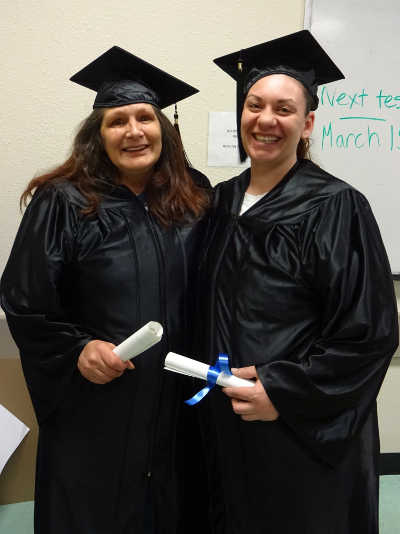
LAKEPORT, Calif. – On Tuesday, two women earned their General Education Development Certificates after successfully completing the GED program while housed as inmates at the Lake County Sheriff’s Office Hill Road Correctional Facility.
Shannon Flores and Jeanne Pizzagrani are the first two female students to earn diplomas since the GED program started in the jail approximately two years ago, according to Lt. Steve Brooks.
The GED program is one of several programs implemented following criminal justice realignment to serve the needs of inmates who are serving increasingly longer multi-year sentences in the local jail.
Programs such as these are provided with the hope that inmates can acquire skills and qualifications to help them succeed upon their release from custody, and live a crime-free, productive life.
Hill Road Correctional Facility Capt. Greg Hosman said that providing inmates who lack a high school diploma with a High School Equivalency diploma helps them qualify for more jobs upon their release.
“The participants in this program feel a sense of pride and accomplishment, and they see that they are capable of meeting goals when they put their minds and efforts into the program,” said Capt. Hosman.
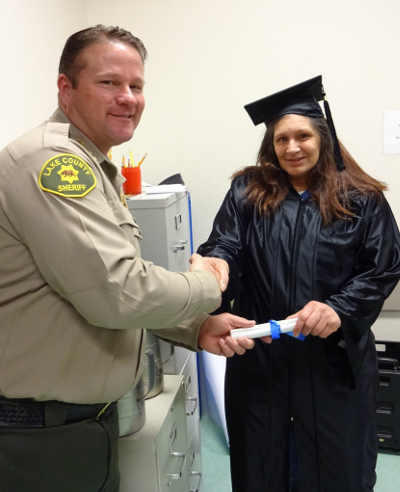
The classes were taught by Virginia Jordan and covered multiple subject areas including social studies, mathematics, spelling and science.
Students are eligible to take the California State High School Equivalency Test, or HiSet, upon completing the program. A successful student will be awarded a High School Equivalency diploma.
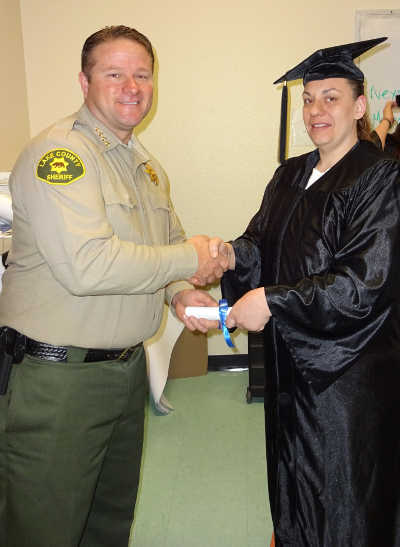
Sheriff Brian Martin expressed his pride for Flores and Pizzagrani for earning their diplomas. He encouraged the remaining participants in the program to continue their efforts.
“Possession of a High School Equivalency certificate opens up many doors that were previously closed for the people in this program,” Martin said. “Our hope is for offenders to be able remain free after serving their sentences, and become contributing members of society.”
- Details
- Written by: Lake County News reports




