How to resolve AdBlock issue?
 Arts & Life
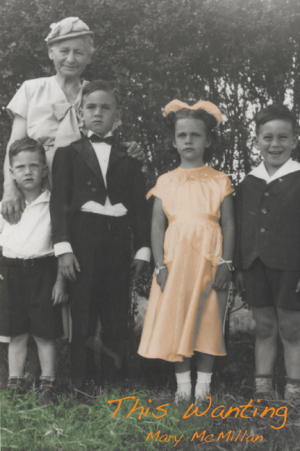
CLEARLAKE – Wild About Books is planning one fabulous afternoon with two great authors on Saturday, Nov. 8.
Lake County Poet Laureate Mary McMillan and RV Schmidt will read their latest works beginning at 2 p.m
McMillan's latest collection of poetry, “This Wanting, has been in the making for sometime and includes recovery, spirituality and feminism. McMillan is a shining light for the creative word in our county and her book “This Wanting” is a great example of the kaleidoscope of talent she has in writing.
Schmidt will read from his latest work, “Single Tree.”
Clive Matson, author of “Let the Crazy Child Write,” says Schmidt “is a born storyteller of the outdoors, wild animals, road trips, heartwarming coincidences and salt-of-the-earth relationships, all set in layer upon layer of natural western beauty, carefully observed and beautifully described.”
“At root is deep wisdom evolved from our rough and penchant frontier ethos plus Schmidt's boundless acceptance of life. All you need is a quiet evening, a comfortable chair, and a fire in the hearth. Hard to come by nowadays, but 'Single Tree' will create that wool blanket and those warm crackling logs in your heart."
Join Wild About Books in welcoming these two great authors. Listen to them read their stories and poems in their own words, a treat for the mind and soul. A book signing will follow.
For an updated list of times and dates for upcoming events, stop by Wild About Books or call 994-WILD (9453).
Wild About Books is located at 14290 Olympic Drive in Clearlake, next door to Lisa's clothing store.
{mos_sb_discuss:5}
- Details
- Written by: Editor
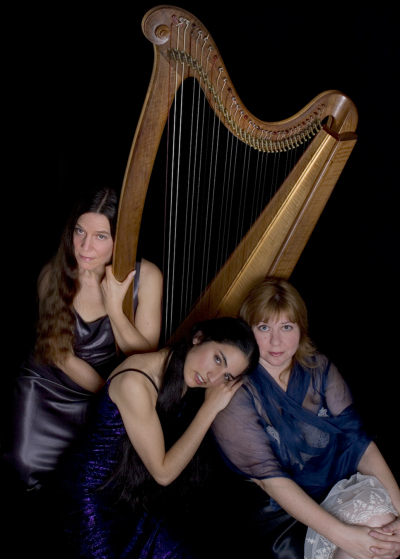
LAKEPORT – The Soper-Reese Community Theater was the setting for a dazzling show Saturday night put on by the Bay Area harp trio Triskela.
The three women – Diana Stork, Portia Diwa and Shawna Spiteri – combine fantastic musical skills on not just harps but flutes, tin whistles and bodhran (an Irish drum), along with their own fine voices. Spiteri does much of the singing, using her full, lush voice to perfectly match the harpsong.
During the performance they were accompanied on a few of the songs by Bert Hutt, the Soper-Reese's artistic director, who sang and played the bodhran.
Spiteri, the group's gregarious emcee, introduced most of the songs and noted that they had last performed in Lake County 10 years ago, when they appeared in Lower Lake.
She voiced appreciation for the Soper-Reese as a venue. It was Triskela's first performance there, and my first time hearing a concern in the theater, which has been a community labor of love for many years.
At once both spacious and intimate, the Soper-Reese was a great setting for the harp trio and their music, with its delicate, intimate qualities.
The women write and perform many of their own songs, and they started off the evening with a medley that included Stork's composition, the brisk and sparkling “Wedding Bells.”
Stork said the song, which appears on their “Voice of Tara” CD (which I purchased in the lobby following the performance), will be used in an upcoming documentary called “Reclaiming the Blade” about the art of swordfighting. The film will feature narration by John Rhys-Davies, who played Gimli in the “Lord of the Rings” film trilogy, as well as an appearance by actor Viggo Mortensen, who played Aragorn in the films.
All three women are Tolkien fans, so Tolkien-inspired songs appeared throughout the evening, including another of Stork's songs, “Aragorn's Dark Horse.” It instrumentalizes the part of the Tolkien trilogy where Aragorn, Gimli and the elf Legolas are pursuing Saruman's forces to free the hobbits Merry and Pippin.
Each of the harps in the song represents a difference character; Diwa's rapid fingerwork symbolized Legolas, while Stork played for Aragon and Spiteri for Gimli. The song emphasized the different sounds of the harps, whose voices became characters with different tones and tempos that separated and danced before weaving together.
The three women then played their harps individually so the audience could hear the instruments' particular voices. All three were exquisite; I found my ear particularly fond of Diwa's Hummingbird harp.
One of my favorite songs of the evening and on the CD, “Voice of Tara,” is Spiteri's composition, is the lush “For the Ladies,” an uplifting and splendid song. They also performed “Distant Star,” a song Stork wrote for Diwa who, like Spiteri, was one of her harp students.
In addition to their own work and traditional Irish, Scottish and English songs, the group also are students of other harp traditions. On Saturday they played some very upbeat and exotic Venezuelan harp music. In South America, Spiteri explained, the harp is an instrument played commonly by men, whereas in other parts of the world the instrument's main players are women.
One song that wasn't their own, the Black brothers' “The Willow Tree,” was performed by the trio for the first time in public on Saturday. They had performed at an event with the Blacks and, after hearing the song, decided they wanted to perform the haunting work themselves.
Celtic music is known for its heartbreaking stories and melancholy tunes, a few of which were among the performances. They included the haunting “Eleanor Plunkett,” the tale of an Irishwoman is the last member of her family, most of whom were wiped out under the British oppression.
They also took the traditional Irish tune “An Buachaillin Ban” ‒ translated from Irish Gaelic, it means “The Sheperdess” ‒ and turned it into a Tolkien-inspired lament for the dying rowan trees in the Lord of the Rings Trilogy.
Still, Spiteri said not all Celtic songs are tragic love songs ending in death, failed crops or the cow getting loose. Such was the case in the upbeat “Star of the County Down,” where the young man wins the young lass who becomes, at a look, the object of his heart. The trio's repertoire also featured some catchy Irish jigs and waltzes.
Watching the three women at the instruments reminded me of watching weavers at loom, as the threads of melody wrapped in and out and around each other.
One of my favorite parts of the evening was the performance of the 14th century medieval pilgrim's song, “Stella Splendens,” (“Brilliant Star”) sung in Latin – another of my favorite things. Diwa played a smaller medieval harp, whose bright, sharp sound was accompanied by Spiteri's singing,
The concert finished with one of my favorite songs of the evening, “Great Ocean,” another of Stork's compositions, a song marked by a hypnotic, wave-like melody which the trio used as their encore performance.
Afterward the musicians welcomed audience members to come up and see their harps and even play them. I couldn't help but take the chance to get closer to the harps, which outside of their musical beauty are handcrafted works of art. The harp I got to see up close had carved Celtic knotwork down its delicate sides.
Diwa patiently explained the Celtic harp and its colored strings – reds are the “C” – and asked if I wanted to try it. She pulled up a stool, and had me sit down and lean the harp against my right shoulder.
I've never played a harp before, but the instrument isn't just beautiful – it's generous. Any note you pluck sounds lovely. Diwa agreed that the harp is a very satisfying instrument to play.
Triskela will next be appearing on Tuesday at the World Festival of Harps in Lancaster, the 19th Annual Festival of Harps at St. Mary's Cathedral in San Francisco and the Nov. 8 Festival of Harps and Dance at Spreckels Performing Arts Center in Rohnert Park.
For more on Triskela, including CD ordering and upcoming concert information, visit their Web site at www.elefunt.com/triskela/ or their MySpace page, www.myspace.com/triskelacelticharptrio.
E-mail Elizabeth Larson at
{mos_sb_discuss:5}
- Details
- Written by: Elizabeth Larson