 How to resolve AdBlock issue?
Arts & Life
- Details
- Written by: Middletown Art Center
MIDDLETOWN, Calif. – The Middletown Art Center is welcoming the community back to engage with the arts and culture.
The ECO Zoology Summer Camp begins Monday, June 22.
Marcus Maria Jung is busy teaching sculptural woodworking on site on Rabbit Hill, and the MAC Art Garden at the junction of highways 175 and 29 is getting a facelift.
The MAC gallery is now open Saturday from 11 a.m. to 5 p.m. or by appointment, (with a private tour), and the current exhibit, “Dreams,” is accessible online.
ECO Zoology Summer Camp will be held Monday, June 22, through Friday, June 26, from 9:30 a.m. to 12:30 p.m. at MAC, with teaching artists Laura Kennedy, Emma Wakefield and Darina Simeonova.
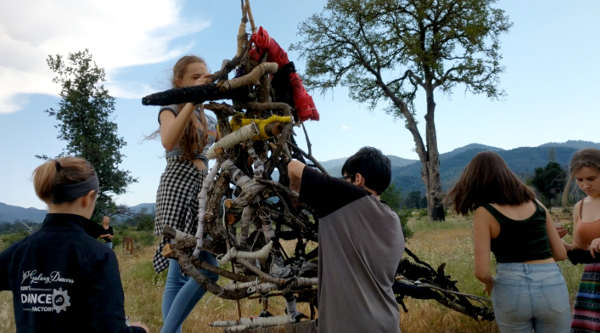
Activities will include collaborative creation of an owl sculpture to install at the EcoArts Sculpture Walk at Trailside Park, animal and nature explorations, drawing, painting, collage making, and more. The first day will include painting and tie-dying bandana masks.
”We’ve learned that birds and raptors are the biggest missing pieces of the ecosystem at Trailside Park because there are so few trees left. I chose the Owl for our collaborative sculpture to call attention to the animals that are busy at night,” explained Artist and Instructor Laura Kennedy. “As a team, campers will select an owl species native to Lake County, then we’ll use wood collected from the park and jute string to lash, tie, and bind wood together to create our sculpture.”
Children and youth ages 5 to 15 are welcome to join. Current health and safety standards will be observed.
“We’ll have creative fun in smaller groupings by age inside and outside spread throughout the studio, gallery, and Art Garden. Each child will also have their own supplies,” added Programs Director Lisa Kaplan.
Learn more and sign up at www.Middletownartcenter.org/classes . Space is limited so be sure to pre-register.
A second camp session, “Art for Art’s Sake,” will take place at MAC July 13 to 24.
The MAC’s reopening has been filled with artistic activity. Marcus Maria Jung has been working with community members on Animate Earth (working title), a new sculpture on the western slope of Rabbit Hill.
The public is invited to join him and learn the art of natural wood sculpture through the making of this site-specific installation.
Work takes place most days between 8 a.m. and 1 p.m. through June 26, with a few exceptions.
Please email
Work beautifying the Art Garden is being done by Frankie White and local youth. Community service hours are available for Middletown High School students who wish to earn their hours engaging in art-making while learning practical skills for working with natural wood or rocks.
The MAC Gallery has reopened and will gradually open for additional hours in the weeks to come. This week MAC will be open Saturday 11 a.m. to 5 p.m., next week Saturday and Sunday from 11 a.m. to 5 p.m., and other days by appointment.
Call 707-809-8118 a day in advance to schedule your visit. You can even request a guided tour.
In addition, the current show “Dreams” can be viewed in 3D online at https://my.matterport.com/show/?m=pMxYvxv5tAZ . The virtual gallery was created by Third Eye Visuals and presents an excellent option for enjoying the exhibit from home.
Calls for work and proposals can be found at www.middletownartcenter.org/artist s. For the time being, all new exhibits will also be available as virtual tours.
There’s lots happening at the MAC. Find out more about programs, opportunities, and ways to support the MAC’s efforts to weave the arts and culture into the fabric of life in Lake County at www.middletownartcenter.org .
- Details
- Written by: Lake County News Reports

LAKEPORT, Calif. – Lakeport Auto Movies will be among 300 drive-in theaters to feature a special concert by country music superstar Garth Brooks on Saturday, June 27.
The concert will be created exclusively for this event, making this a once in a lifetime experience. The concert will be the largest ever one-night show to play at outdoor theaters across the United States and Canada.
The event will be produced by Encore Live, a leading event production company.
“I am so excited to get to play again. I have missed it so much and want to get back to it,” said Brooks. “This drive-in concert allows us all to get back to playing live music without the uncertainty of what would be the result to us as a community. This is old school, new school, and perfect for the time we are in.”
“Families need safe entertainment options that they can enjoy together this summer,” said Encore Live Founder and CEO Walter Kinzie. “We’re excited to partner with Garth, who’s already done so much to help the entertainment industry during these tough times, to provide a truly unique and incredible concert that will do a whole lot of good for local businesses and communities.”
Tickets will be on sale Friday, June 19, at 9 a.m. Pacific time. They will be on sale at www.ticketmaster.com/garthbrooks . There, you will also be able to review the drive-in theaters available in your area.
Tickets are general admission and of limited availability. They will cost $100, all-inclusive. Each ticket will admit one passenger car/truck. The event will take place rain or shine and will begin at dusk.
The show will adhere to guidelines recommended by the Centers for Disease Control and Prevention as well as all state and local health mandates. Encore Live has partnered with leading health experts to establish procedures for staff and fans.
These will include maintaining at least 6 feet of space between vehicles, the use of personal protective equipment by staff, leveraging contactless payment and ticketing systems, and limiting capacity in restrooms. Guidelines around concessions will also be enforced to abide by individual state regulations.
- Details
- Written by: Ted Kooser

Here’s a delightful poem you can almost smell.
Don’t we all know that old-shoe-plus-shoe-polish odor? I don’t remember oxblood smelling different from plain old black or brown, but Andy Roberts, writing so vividly of his father, makes us feel that it does.
He’s from Columbus, Ohio, and his most recent book of poetry is “Leaning Toward Greenland,” (Night Ballet Press, 2020).
We found this poem in Atlanta Review, edited by Karen Head, one of our former colleagues here in Nebraska.
Oxblood
I squeeze into nine pounds of my dead father’s
Brooks Brothers wingtips,
heels worn down from running between women.
Slip on his herringbone suit coat, flash on him
snapping his fingers, popping his Dentyne,
swinging along to “The Great Pretender.”
The suit’s too big, it can go to Goodwill.
But they don’t make shoes like these anymore.
The old tin of oxblood I prize open,
shift to my nose and remember
all he ever needed was Nat King Cole,
a slice of phosphorescent moon
and a blonde in the passenger seat
down Wainwright Road to the quarry.
American Life in Poetry does not accept unsolicited manuscripts. It is made possible by The Poetry Foundation, publisher of Poetry magazine. It is also supported by the Department of English at the University of Nebraska, Lincoln. Poem copyright ©2017 by Andy Roberts, "Oxblood," from Atlanta Review, (Vol. XXIV, no. 1, 2017). Poem reprinted by permission of Andy Roberts and the publisher. Introduction copyright @2020 by The Poetry Foundation. The introduction’s author, Ted Kooser, served as United States Poet Laureate Consultant in Poetry to the Library of Congress from 2004-2006.
- Details
- Written by: Tim Riley
Readers of this column may recall past references to the television press tours that occur during the winter and summer to preview upcoming series in panel discussions with cast and production crew.
The Television Critics Association canceled the 2020 summer tour that was scheduled to start at the end of July due to the uncertainty that attends the public gathering restrictions which remain unabated.
An equal concern is that film and television production of new films and series, which have been on hold during the pandemic, may not be ready for the fall season.
First out of the box, the FOX network has already announced new series for the upcoming season, if such a thing is remotely possible at this moment. Savvier folks are betting that January 2021 is a likelier scenario for the networks.
Nevertheless, FOX may have an opportunity for new series only because some series were expected earlier this year as mid-season replacements or the product was already in the can or in the case of “L.A.’s Finest” it ran elsewhere.
From the universe of the Jerry Bruckheimer “Bad Boys” franchise, the one-hour series “L.A.’s Finest” has been a Spectrum Original, which means it probably hasn’t tapped into the wider audience available on a network.
This series looks to be the female version of “Bad Boys,” with Gabriel Union’s Syd Burnett, moving on from taking down drug cartels in Miami to become an LAPD detective, and then pairing up with Jessica Alba’s Nancy McKenna, a working mom with a complex history.
“Filthy Rich,” a southern Gothic family soap in which wealth, power and religion collide, was thought to be a mid-season replacement. When the patriarch (Gerald McRaney) dies in a plane crash, his wife and family are stunned to learn he fathered three illegitimate children.
A thriller about rogue artificial intelligence, “NeXT” stars John Slattery as a Silicon Valley pioneer, who discovers one of his A.I. creations might spell global catastrophe, leading to teaming up with a cybercrime agent to fight a villain unlike anything seen before.
‘GOLIATH’ ON AMAZON PRIME
Recommendations from friends certainly come in handy to choose a streaming series to fill the void. This is the case with Amazon Prime’s “Goliath,” which is now in its third season. As with “Bosch,” I have some catching up to do with this series.
As a legal drama, “Goliath” may not break any new ground in courtroom scenes, except when you have Billy Bob Thornton’s Billy McBride pulling tricks in a courtroom, where his exchanges startle with a gut punch.
Abundantly clear from the start, McBride is the David of this linear series, a once stellar lawyer who co-founded a major firm before descending to his present status of conducting business from a Santa Monica motel room across from the bar when he spends a great deal of time.
The Goliath is the Cooperman McBride law firm, to which the down-but-not-quite out lawyer’s name is still attached and where his aggressively assertive ex-wife Michelle (Maria Bello) fits perfectly in a toxic corporate culture.
Arranging plea deals for petty criminals, McBride’s low-rent legal practice allows him to spend more time at the Chez Jay bar or parking himself on the beach with a bottle in a paper bag.
The persons closest to McBride’s orbit turn out to be his estranged teenage daughter Denise (Diana Hopper), who now hopes to set him straight, and his off-and-on legal assistant Brittany (Tania Raymonde), an attractive sex worker plying her trade on the side.
A big case comes McBride’s way when the excitable, motor-mouthed Patty Solis-Papagian (Nina Arianda), a defense lawyer for DUI clients and real estate agent in the Valley, seeks to help her neighbor Rachel Kennedy (Ever Carradine) to sue for the wrongful death of her brother.
Not interested at first in the case, McBride changes his tune when learning Rachel’s brother died in a boat explosion and the target for the wrongful death lawsuit is Borns Tech, a major client of the Cooperman McBride firm.
That there is plenty of ill will between McBride and his former partner Daniel Cooperman (William Hurt) turns out to be enough motivation for the David vs. Goliath legal battle to play out for the entire first season.
Cooperman, disfigured from facial burns, is an odd fellow and recluse hiding in his darkened office where he spies on his employees and monitors depositions and courtroom proceedings on surveillance cameras.
Taking a look at the Cooperman firm’s legal team defending Borns Tech is all one needs to know about which side to root for, though that’s hardly a challenge because Thornton’s flawed McBride is the underdog that draws sympathy.
Rooting for McBride is easy when compared to Cooperman’s lead attorney, Callie Senate (Molly Parker), an ice queen yet brilliant lawyer eager to skewer anyone in her path, even fellow colleagues.
“Goliath” rises above the conventional with the basic construct of Thornton and Arianda bringing quirkiness to adversarial courtroom theatrics.
Tim Riley writes film and television reviews for Lake County News.