 How to resolve AdBlock issue?
Business News
- Details
- Written by: California Insurance Commissioner’s Office
This action by Commissioner Lara allows those businesses unable to secure insurance coverage in the normal insurance market with access to insurance they need to operate and continue the state’s economic recovery from the COVID-19 pandemic, especially in high wildfire risk areas.
“Businesses have been struggling. These increases in the limits of coverage will help youth camps reopen and businesses of all kinds keep serving their customers,” said Insurance Commissioner Ricardo Lara. “The FAIR Plan has not kept pace with rising costs for more than two decades, which my action addresses for the first time. Offering expanded coverage to businesses will help as our state continues its economic recovery from the pandemic.”
The increases approved today by Commissioner Lara expand the combined coverage limits for the FAIR Plan, under its Division I Commercial Property Program, from $4.5 million to $8.4 million, and, under its Division II Businessowners Program, from $3.6 million to $7.2 million.
Over the past two years, Commissioner Lara and Department of Insurance representatives have met with many businesses and nonprofit entities across the state regarding their commercial insurance availability challenges.
“Commissioner Lara’s swift action will ensure that camps and non-profit youth serving organizations can keep their doors open and offer a safe and enriching experience for children and young adults,” said Gabe Valencia, chair of the California Collaboration for Youth, which represents California’s recreational and youth camps. “We commend Commissioner Lara for continuing to hold the FAIR Plan and insurance companies accountable. Being assured of coverage at more reasonable rates will allow us to get back to what we do best: helping children make lifelong memories at camp.”
Groups such as farms, ranchers, agricultural operators and processors, wineries and vintners, residential care facilities, affordable housing entities, homeowners associations, and recreational/summer camps, among others, have informed Commissioner Lara about the continued lack of availability of commercial property insurance coverage in the traditional insurance market.
Many of these businesses also noted that the FAIR Plan’s current commercial property coverage and business owners’ coverage limits have been insufficient to meet their coverage needs today.
“We thank Commissioner Lara for compelling the FAIR Plan to increase its coverage limits, which will help be a lifeline to farm owners and agricultural processing facilities in fire-prone areas that have lost coverage through the insurance market,” said Roger Isom, president and CEO of the California Cotton Ginners and Growers Association and Western Agricultural Processors Association. “Our growers will be able to expand their coverage and in turn continue to grow an essential sector of the state’s economy.”
Thursday’s action is a direct result of Commissioner Lara previously ordering the FAIR Plan to increase its own coverage limits. The plan failed to meet the commissioner’s deadline for a response describing how it would increase its commercial property coverage limits in response to his order.
These coverage limits have not been raised since at least 1997 and 1994 respectively, despite the Consumer Price Index showing costs have nearly doubled during that time in California.
“This is a long-overdue step to help business owners in our state. We will continue to listen to the concerns of business owners and ensure the FAIR Plan truly takes all comers and meets consumers’ evolving needs,” said Lara.
- Details
- Written by: Editor

MIDDLETOWN, Calif. — Westamerica Bank recently named Angela Herman as a Star Performer for 2021.
The Star Performer Award is the highest award for individual achievement, recognizing top performers for the previous calendar year.
Herman is the customer service manager of the bank’s Middletown branch and has more than eight years of banking experience.
“During a challenging year, we depended on Angela to continue to provide the level of service our customers in Lake County have come to expect. Her level of dedication and professionalism was unwavering and we knew we could depend on her,” said Eric Stacey, RVP/Northern Banking Division manager.
Sierra Marquez, VP/Regional Service manager, added, “Angela’s dedication to our customers in Lake County as well as her kind and friendly attitude does not go unnoticed by customers or her peers. We are fortunate to have Angela as part of the Westamerica team!”
Herman lives in Middletown on a small farm with her husband Jonathan and their daughter.
Outside of work, she enjoys the outdoors, reading, practicing yoga and spending time with her family.
- Details
- Written by: Community First
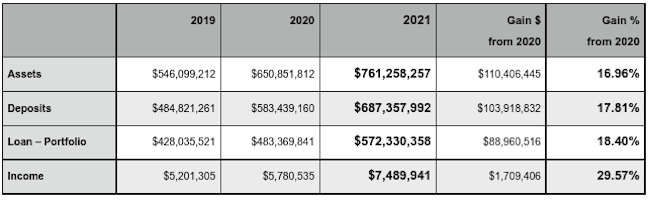
It also originated more loans than in any previous year, $356.2 million.
“It was the best of times financially and yet, in some ways, it was the worst of times because COVID made everything so difficult,” said Scott Johnson, CEO of Community First Credit Union.
To help people through the pandemic, Community First waived fees for, among others, late payments and last-minute payments over the phone, helping members by more than $52,000 a month.
It wasn’t until July 1, at mid-year, and with the COVID vaccine finally widely available, that Community First reinstated such fees.
It also wound down the deferral of monthly payments for more than 4,000 consumer loans throughout 2021.
“Additionally, despite a near zero-interest-rate environment on the deposit side, we kept our rates higher than nearly all other local competitors so that Members could continue to earn more,” added Scott.
Members rewarded the cooperative with a nearly $104 million gain in deposits, $89 million jump in loans owned by the credit union, and a $110.4 million rise in assets.
With $761.23 million in assets, Community First now ranks among the top 10% of credit unions by size nationally.
- Details
- Written by: California Insurance Commissioner’s Office
The legislation would help victims recover their losses from sellers of insurance not licensed by the California Department of Insurance to transact insurance.
It addresses common scams such as illegally telemarketed sales of automobile extended warranties to consumers and illegally collected premiums for workers’ compensation insurance from businesses, among other unscrupulous acts on unsuspecting consumers.
SB 1040 would give the Insurance Commissioner the ability to order restitution to consumers from unlicensed sellers of insurance who are breaking California laws, leading to greater repayments to consumers.
The Department of Insurance estimates that unlicensed activity costs Californians millions of dollars every year.
For example, hardworking Californians have paid thousands of dollars for illegally sold extended warranties from unlicensed companies, only to have their claims improperly denied and then having to pay again for expensive repairs. Individual losses of several thousand dollars per victim can add up to massive fraud.
Under current law, the Insurance Commissioner can order unlicensed sellers of insurance to cease and desist and pay a fine of no more than $5,000 per day, but cannot order those unlicensed sellers to repay consumers for losses that they caused, such as direct premium they misappropriated and financial losses that the consumer suffered when they believed they were otherwise covered by insurance.
“We have all gotten robocalls trying to illegally sell us automobile extended warranties but until now my Department’s hands have been tied in trying to order repayment to victims of these illegal insurance scams,” said Insurance Commissioner Ricardo Lara. “SB 1040 will give my Department the ability to order restitution to seniors, consumers, and small businesses who fall prey to unlicensed sellers of insurance, especially during this pandemic.”
“We need to make it easier for victims of insurance scams to get back the money they lost,” said Senator Rubio. “My top priority as chair of the Senate Committee on Insurance is to protect consumers, and insurance fraud can be disastrous for individuals and small businesses. Meanwhile, these scams are constantly getting more sophisticated. I’m proud to work with Insurance Commissioner Lara on SB 1040 to give Californians more power to recover their losses.”
Investigations by the Department of Insurance have revealed numerous instances of insurance premium theft, embezzlement and fraud by unlicensed sellers of insurance specifically targeting vulnerable communities, such as seniors, immigrants and historically underrepresented communities. In many cases, small businesses were left without insurance coverage and business owners’ livelihoods were put at risk.
Some examples of illegal acts by unlicensed sellers of insurance leading to fraud include:
In 2021, a Department of Insurance investigation led to the arrest of an unlicensed insurance agent who provided falsified workers’ compensation certificates and pocketed the premiums, leaving businesses without coverage for worker injuries.
In 2020, the Department of Insurance issued a cease and desist against an unlicensed company that illegally sold automobile extended warranties (also known as “vehicle service contracts”) to more than 1,000 California drivers -- many of them seniors -- for over $2 million.
In 2020, the Department of Insurance issued a cease and desist against an unlicensed Southern California agent after a consumer who thought they had coverage suffered an uninsured $100,000 residential loss.
In 2019, a Department of Insurance investigation led to the arrest of an unlicensed insurance agent for allegedly stealing $174,000 in premiums from truck drivers and charter bus companies.
The Department of Insurance has obtained restitution in some cases, but only through legal settlements. Because, in most cases, consumers must pursue recovery on their own and the obstacles to doing so can be great, most money illegally stolen in unlicensed insurance fraud is never repaid to the aggrieved consumers.