 How to resolve AdBlock issue?
Business News
- Details
- Written by: Editor
“We are now in our fourth year of enforcing this standard, which was enacted to protect outdoor employees from the hazard of heat illness,” said DIR Director John C. Duncan. “We have found from our enforcement activities that there is a need for the standard to be clarified so that more employers will comply fully and effectively with its provisions.”
Cal/OSHA enforcement statistics collected from the brief periods of hot weather experienced in the state this year have demonstrated that substantive changes to clarify the regulation are necessary to ensure that employers have the guidance they need to protect employees working outdoors from exposure to heat.
“California is home to sunshine and heat, as well as thousands of workers whose make their living under it,” said Gov. Arnold Schwarzenegger. “Since taking office I have worked to protect California’s outdoor workers and I will continue to improve and strengthen those standards to protect these men and woman and help their employers better comply with California’s standards.”
Public awareness of the heat illness prevention regulations has increased as a result of education and outreach efforts by Cal/OSHA in partnership with labor, industry and community partners. However, Cal/OSHA is requesting that the OSHSB adopt the emergency amendments to the standard in order to bring more specificity and enforceability to the standard.
The proposed amendment will:
Clarify the provisions that govern when and how to provide shade, drinking water and employee training;
Add tiered procedures to be followed when temperatures are above 85 and 95 degrees Fahrenheit;
Add related requirements to implement feasible and effective measures for the protection of employees working outdoors, and;
Eliminate the definition of “preventative recovery period.”
“Although most employers of outdoor worksites are now on board with the need to provide safeguards to their workers, some employers still fail to comply,” said Cal/OSHA Chief Len Welsh. “Last month in a two-week period we required eight employers to cease their operations because their failure to provide the most basic protection to their workers from heat far in excess of 90 degrees exposed them to an imminent hazard.”
A public hearing to discuss the proposed amendment to the heat illness prevention regulation, Section 3395 of the Title 8 California Code of Regulations has been scheduled by the OSHSB to take place at their next meeting on June 18 in Oakland.
If the emergency amendments are adopted, they will be sent to the State Office of Administrative Law for approval and then to the Secretary of State for filing. A 120 day standard rulemaking process will follow to develop permanent amendments to the heat illness prevention regulations.
In July 2006, the heat illness prevention regulation became permanent, making California the first state in the nation to adopt a comprehensive heat illness prevention standard for outdoor workers.
For more information on OSHSB’s public meeting details and agenda, visit the OSHSB Web site at www.dir.ca.gov/oshsb/agendaJune09.html .
For more information on heat illness prevention and training materials, visit the Cal/OSHA Web site at www.dir.ca.gov/heatillness .
Employees with work-related questions or complaints, including heat illness, may call the California Workers’ Information Hotline at 1-866-924-9757.
- Details
- Written by: Editor
Existing law allows a customer of a utility provider (such as PG & E or SMUD) to sell solar power to the utility provider to offset the cost of his/her electric bill. This is referred to as “net-energy metering.”
If the customer produces enough solar power to cover their electrical use, the customer owes nothing on their bill at the end of the year. If the customer produces less solar power than the electricity consumed, at the end of the year the customer owes the utility provider money.
The problem, Wiggins said, is that a utility customer can also produce more solar power than they use, but the utility provider doesn't have to pay the customer anything at the end of the year.
While some will argue that was the deal made under the net-energy metering statutes, others will argue that it's not fair because the customer produced solar power when their utility company agreed to buy the power, but in the end, the customer/solar producer believes he/she didn't get paid.
“This is kind of like having frequent flyer miles that you can never cash out or use,” Wiggins said. “And it sends the wrong message to consumers about the importance of energy conservation.”
Her legislation, Senate Bill 7, requires utility providers to allow customers who produce their own solar power to roll over unused energy credits for up to two years.
Senate approval of SB 7 means the bill next heads to the Assembly for further consideration.
The measure is supported by, among others, Recolte Energy, California Farm Bureau Federation, City of Calistoga, City of Oakland, David Arthur Vineyards, Family Winemakers of California, Far Niente, Napa Valley Vintners, Peter A. & Vernice H. Gasser Foundation, Redwood Empire Chapter of the U.S. Green Building Council, Schramsberg, Sustainable Napa County, The Wine Institute and Vintage High School.
Also on June 3, the California Senate voted 26-7 to approve SB 542, another Wiggins bill,to encourage solar power installations and energy efficiency in apartments, commercial buildings, and manufactured homes, from which solar power opportunities have historically been excluded.
Senate approval means SB 542 next heads to the Assembly for further consideration. The bill is co-authored by Senator Tony Strickland (R-Thousand Oaks).
Since the 2000-2001 energy crisis, state policy has elevated energy efficiency measures as the highest priority activity for meeting California's energy needs. Energy efficiency is often cost effective, cheap, clean, and relatively quick to implement.
The California Public Utilities Commission (PUC) authorized substantial energy efficiency programs for the major investor-owned utilities for the period 2006-2008. This program was expected to produce $2.7 billion in net benefits, reducing customer bills. Moreover, these savings are the equivalent of avoiding three large power plants over the next three years, eliminating 3.4 million tons of carbon dioxide in 2008, equivalent to taking 650,000 cars off the road. For the 2009-2011 period, the PUC has adopted slightly more ambitious goals.
Renters make up about 43 percent of California households. As a consequence, Wiggins said, “the incentives for energy efficiency, and solar power, aren’t cost effective for either the tenant, or the landlord, in many instances.”
Her bill requires the PUC to address these issues and barriers, so that all ratepayers who pay into the state’s solar initiative and energy efficiency programs can benefit from the programs. SB 542 also seeks to eliminate barriers for installation of solar on manufactured homes by requiring the PUC to inform installers about permitting processes.
- Details
- Written by: Editor
This tax credit will be calculated at a rate of 6.2 percent of earned income and will phase out for taxpayers with modified adjusted gross income in excess of $75,000, or $150,000 for married couples filing jointly.
For people who receive a paycheck and are subject to withholding, the credit will typically be handled by their employers through automated withholding changes in early spring.
These changes may result in an increase in take-home pay. The amount of the credit will be computed on the employee's 2009 income tax return filed in 2010. Taxpayers who do not have taxes withheld by an employer during the year can also claim the credit on their 2009 tax return.
It is not necessary to submit a Form W-4 to get the automatic withholding change. However, an employee with multiple jobs or a married couple whose combined income places it in a higher tax bracket should consult the IRS withholding calculator and, if necessary, submit a revised Form W-4 to ensure enough tax is withheld.
Publication 919 provides additional guidance for tax withholding including a special Making Work Pay worksheet.
Visit www.irs.gov .
- Details
- Written by: Editor

LAKE COUNTY – Lake County Wine Studio is hosting a wine tasting event with Cleavage Creek Cellars on Saturday, June 6, from 4 p.m. to 7 p.m.
Cleavage Creek Cellars is a producer of world-class wines and contributor of 10-percent of gross sales to fight breast cancer and fund research.
Since the time of Cleavage Creek Cellars’ first release of varietals in the autumn of 2007, a total of $55,800 has been contributed. Most recently, owner Budge Brown and Cleavage Creek made a major contribution to Bastyr University, a national leader in natural health arts and sciences education and research, for the establishment of the Integrative Oncology Research Clinic.
To date, Cleavage Creek has donated $30,000 to Bastyr University. With this grant from Cleavage Creek, the Bastyr University Integrative Oncology Research Clinic opened earlier this year on the University’s Kenmore, Washington campus. This outpatient facility provides state-of-the-science and state-of-the-art naturopathic and traditional Chinese medicine treatment and integrative management of cancer patients.
In January of this year, five of the varietals won medals at the S.F. Chronicle Wine Competition, and most recently, the 2007 Reserve Chardonnay earned a Gold Medal at the Lodi Wine Competition. Each bottle of Cleavage Creek wine honors a breast cancer survivor with their picture on the label and their story is told on the Cleavage Creek website www.CleavageCreek.com .
Lake County Wine Studio will be pouring a $10 sampler of the Cleavage Creek wines paired with appetizers. Cleavage Creek Cellars Merlot and the Merlot-Shiraz blend (a LCWS customer favorite!) will be offered for sale at 30 percent off. A portion of proceeds will be donated to the Cleavage Creek Cellars philanthropic fund.
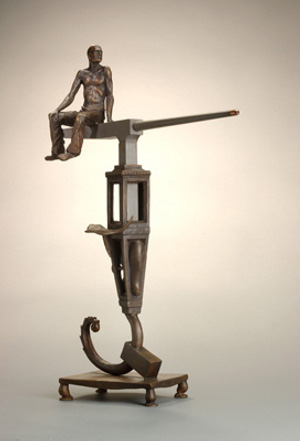
Rolf Kriken, bronze memorial sculptor, is our featured artist for the months of June-August.
Kriken is intensely familiar with battles of another sobering kind, having served our country in the U.S. Army from 1962-1965. Resuming his education in 1965 and from 1973 actively working as an artist, sculptor and foundryman at the same time, Kriken graduated with his M.A. in Fine Arts in 1975.
Following a position as an instructor at the Richmond Art Center, Rolf became the director at the Berkeley Art Foundry. A career including more than 40 exhibitions, numerous private, state, city and federal commissions and lectures continues.
In 1979, Kriken established Nordhammer Foundry in Kelseyville. Kriken created the three-dimensional, life-size sculptures and did the bronze fabrication and art work for the California Vietnam Memorial in Sacramento, which was dedicated in 1988. While viewing his works may be personally difficult for some people, the intention is to raise consciousness, honor those who have served our country, promote discussion and education to prevent and bring an end to a devastating form of conflict resolution.
Another concurrent showing of some of his works will be available for viewing during the Moving Wall display at the Lake County Fairgrounds June 11 through 16. The wine studio is honored to show some of his fine thought-provoking works for a three-month run at the wine studio and to have Kriken present at the monthly reception events.
Lake County Wine Studio is located on the corner of First and Main Streets in historic Upper Lake, across from the famous Tallman Hotel and Blue Wing Saloon & Café.
To RSVP, or for more information, call Susan Feiler at 707-275-8030 or 707-293-8752.