 How to resolve AdBlock issue?
Business News
- Details
- Written by: Elizabeth Larson
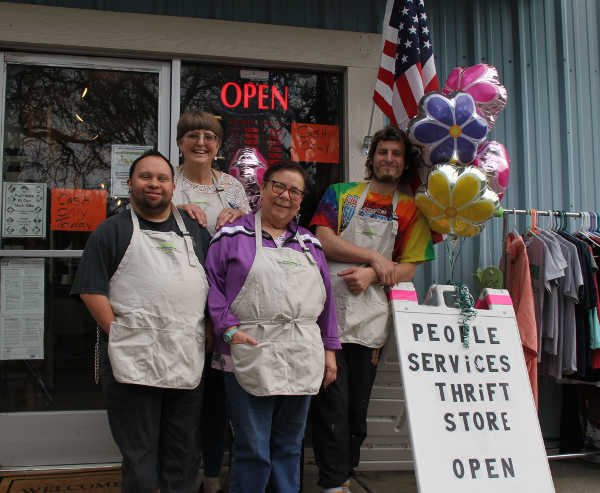
CLEARLAKE, Calif. – The People Services Clearlake Thrift Store will celebrate its new store front opening with a ribbon-cutting ceremony sponsored by the Clear Lake Chamber of Commerce on Tuesday, April 23.
The ceremony begins at 1 p.m. Refreshments will be served.
The thrift store’s new location at 5100 Old Highway 53 marks nine years of enabling workers with developmental disabilities meaningful paid employment.
People Services will celebrate with a ribbon cutting and great discounts on all items sold.
The new location across the street from Mendo Mill offers customers a fresh new look and ample parking for their shopping experience.
Hours of operation will be Monday through Friday, 10 a.m. to 4 p.m.
For more information please contact the thrift store staff at 707-350-5422 or Clearlake People Services at 707-994-1560.
- Details
- Written by: California Department of Food and Agriculture
CNIP was established to encourage the purchase and consumption of fresh California grown fruits, vegetables, and nuts by nutrition benefit clients.
Authority for CNIP is derived from Assembly Bill 1321 (Chapter 442, Statutes of 2015) authored by Assemblymember Phil Ting.
The program is administered by the Office of Farm to Fork, which leads CDFA’s food access work.
For the 2020 CNIP request for proposals, or RFP, CDFA is seeking project proposals from eligible entities to distribute nutrition incentives to CalFresh shoppers using their benefits to purchase fresh, California grown fruits and vegetables at direct marketing outlets (Certified Farmers’ Markets, Community Supported Agriculture programs and farm stands) and small businesses in California.
CalFresh shoppers should be able to receive the incentive at the time of purchase.
Projects that reach underserved populations, particularly communities where a large proportion of the population is eligible for CalFresh and communities with high rates of diet-related disease, will be prioritized.
The intent of this RFP is to select project proposals to combine into one unified state application for CDFA submission to the federal Gus Schumacher Nutrition Incentive Grant Program (also known as the Food Insecurity Nutrition Incentive grant program, FINI).
Through CNIP and the Healthy Stores Refrigeration Grant Program competition also currently open, CDFA strives to increase value and access to fresh, CA-grown produce for shoppers with low incomes in a variety of retail settings.
CNIP proposals are due Tuesday, May 28, by 6 p.m. More information including the request for proposals and application template, can be found at http://cafarmtofork.com/cnip.html .
- Details
- Written by: Elizabeth Larson
North of Cape Falcon, a large increase in hatchery coho over last year will provide a welcome increase in both recreational and commercial fishing opportunities.
Season recommendations will be forwarded to the National Marine Fisheries Service, NMFS, for approval.
“Although some salmon stocks are returning in stronger numbers than last year, balancing fishing opportunities with conservation is always a challenge for the Council, its advisors, fishery stakeholders, and the public,” said Council Executive Director Chuck Tracy. “The seasons this year continue to protect stocks of concern, including Puget Sound Chinook, Washington natural coho, and Sacramento River fall Chinook.”
In addition to recommending salmon regulations for 2019, the Council developed a plan to work collaboratively with NMFS on Southern Resident killer whales, which are listed under the Endangered Species Act.
“This year’s package was adopted after careful consideration and analysis in order to meet our conservation objectives, consider impacts on the prey base important to Southern Resident killer whales, and consider in-river and Puget Sound fisheries,” said Council Chair Phil Anderson. “The Council also established a workgroup that will be working closely with National Marine Fisheries Service to assess on a longer term basis the ocean salmon fisheries effect to the prey base of Southern Resident killer whales,” Anderson said.
Washington and Northern Oregon (North of Cape Falcon)
Fisheries north of Cape Falcon (which is just north of Manzanita, Oregon) depend largely on Columbia River Chinook and coho stocks. Overall, Columbia River fall Chinook forecasts are generally considered low to moderate compared to the recent 10-year average. Hatchery coho stocks originating from the Columbia River are expected to return in high numbers, but some natural stocks originating from the Washington coast and Puget Sound are expected to return at low to moderate levels in 2019.
The overall non-Indian total allowable catch north of Cape Falcon is 52,500 Chinook (compared to 55,000 last year) and 190,000 marked hatchery coho (compared to 47,600 last year). Fisheries are designed to provide harvest opportunity on healthy Chinook and coho returns primarily destined for the Columbia River, while avoiding Washington natural Chinook and coho.
Commercial fisheries
Non-Indian ocean commercial fisheries north of Cape Falcon include traditional Chinook seasons in the spring (May-June) and summer season (July through September). Non-Indian ocean commercial fisheries in this area will have access to a total of 26,250 Chinook (compared to 27,500 Chinook last year), and a marked coho quota of 30,400 (compared to 5,600 coho last year).
Tribal ocean fisheries north of Cape Falcon are similar in structure to past years, with quotas that include 35,000 Chinook and 55,000 coho (compared to 40,000 Chinook and 12,500 coho last year).
Recreational fisheries
The recreational fishery north of Cape Falcon opens to all salmon on June 22 in all areas, and ends September 30 or when Chinook or coho quotas are reached. In addition, a small area of the La Push subarea will be open October 1 to 13 with Chinook and coho quotas. Recreational fisheries north of Cape Falcon will have access to a total of 26,250 Chinook (compared to 27,500 Chinook last year), and a marked coho quota of 159,600 (compared to 42,000 coho last year).
California and Oregon South of Cape Falcon, Oregon
South of Cape Falcon, fisheries target Sacramento and Klamath fall Chinook and hatchery coho from Oregon and the Columbia River. California coastal Chinook and Oregon coast natural coho stocks are the primary constraints to fisheries in this area. Most areas are seeing improved opportunity over last year.
Commercial fisheries
The commercial fishery consists of modest Chinook fishing opportunity in both states. Most areas south of Cape Falcon are seeing improved opportunity over the last two years, and include seasons in the Klamath Management Zone in southern Oregon and northern California.
Commercial fisheries from Cape Falcon to Humbug Mt. will be open on April 20 to 30, May 6 to 30, then reopen June 1 and continue through Aug. 29. This area will also be open continuously in September and October with weekly landing limits in place.
Fisheries from Humbug Mtn., Oregon to the Oregon/California border will be open in late April and for much of May. Monthly quotas for June through August will be in place for the both the Oregon and California portions of the Klamath Management Zone. All quotas feature landing and possession limits, and the California portion of this area will be open five days a week, similar to 2018.
Between Horse Mountain and Point Arena (Fort Bragg), the area will be open June 4 to 30, July 11 to 31, and Aug. 1 to 28. From Point Arena to Pigeon Point (San Francisco), the area will be open May 16 to 31, June 4 to 30, July 11 to 31, Aug. 1 to 28, and Sept. 1 to 30. From Pigeon Point to the Mexico border (Monterey), the area will be open all of May, June 4 to 30, and July 11 to 31. There will also be a season from Point Reyes to Point San Pedro, a subset of the San Francisco area, on October 1 to 4, 7 to 11 and 14 to 15.
Recreational fisheries
Recreational opportunity is generally improved over last year. Recreational fisheries in Oregon provide opportunities for both Chinook and coho, including both mark-selective and non-mark-selective coho fisheries. California recreational fisheries provide moderate opportunity for Chinook.
Recreational fisheries from Cape Falcon to Humbug Mtn. will allow Chinook retention from now through October. Coho fisheries consist of a mark-selective quota fishery of 90,000 in mid-summer (compared to 35,000 last year) and a non-mark-selective quota fishery of 9,000 in September (compared to 3,500 last year).
Fisheries from Humbug Mtn., Oregon to Horse Mtn., California will be open from May 25 through Sept. 2. The Oregon area also includes a mark-selective coho fishery opportunity in mid-summer.
Fisheries from Horse Mtn. to Pigeon Point (Fort Bragg and San Francisco areas) will be open from April 13 through 30, then re-open May 18 and continue through October. The area from Pigeon Point to the U.S./Mexico border (Monterey area) is open now through Aug. 28.
For details on all seasons, please see the season descriptions on the council Web site.
Management process
The council developed three management alternatives in early March for public review and further analysis. The review process included input from federal, state and tribal fishery scientists and fishing industry members; public testimony, and public hearings in Westport, Wa.; Coos Bay, Or.; and Ukiah, Ca.
The council received additional scientific information and took public testimony at its April meeting in Rohnert Park before taking final action. The decision will be forwarded to NMFS for their review and regulatory action.
In addition, the coastal states will independently adopt fishery regulations that are compatible with the Council’s actions.
The Pacific Fishery Management Council is one of eight regional fishery management councils established by the Magnuson Fishery Conservation and Management Act of 1976 for the purpose of managing fisheries three to 200 miles offshore of the United States of America coastline.
The Pacific Council recommends management measures for fisheries off the coasts of California, Oregon and Washington.
- Details
- Written by: Elizabeth Larson
"This far-sighted program helps California compete in a fiercely competitive global economy," said Ma. "It helps us retain and create high-paying manufacturing jobs that benefit our economy by providing carefully targeted tax benefits to companies that are investing in our state, creating jobs, and helping our environment."
The California Alternative Energy and Advanced Transportation Finance Authority, or CAEATFA, awarded up to $17.7 million in sales tax exclusions to Northrup Grumman Systems Corp. on the purchase of up to $211.9 million in equipment that will be used to expand and upgrade its existing Aerospace Manufacturing facility in Palmdale.
The facility makes a variety of aircraft systems, including the F-35 Lightning II fuselage, the Trion and EuroHawk.
The project is anticipated to support 4,417 production-related jobs and 469 construction jobs. It is also estimated to benefit the environment by reducing greenhouse gas emissions by 30 percent, solid waste production by 70 percent, and water consumption by 20 percent.
CAEATFA also awarded up to $6.8 million in sales tax exclusions to Tesla, one of the largest manufacturers in California, on the purchase of $81 million of machinery and equipment to expand its Fremont factory.
The investments will finish its expansion of its body shop, stamping line, vehicle assembly, plastics shop, production control, tooling and prototyping to design and manufacture its Model 3 electric vehicle.
The award is anticipated to support 4,113 production-related jobs and convey $925,345 in environmental benefits through reduced fossil fuel consumption and greenhouse gas emissions. Last month, the board heard testimony from Tesla and a variety of other speakers about health and safety issues.
As part of the award agreement, Tesla will continue to update the CAEATFA board on its progress toward production goals and improving the health and safety at its facilities every four months.
CAEATFA was established to provide an alternative method of financing to promote and advance the state’s goals of reducing greenhouse gas emissions, promoting renewable energy, and creating and retaining jobs. The sales and use tax exclusion program was created by Senate Bill 71, sponsored by then-State Senator Alex Padilla. It was approved by the Legislature in 2010.
It is not a broad or typical tax incentive. To win a tax benefit, each project has to demonstrate that the anticipated fiscal and environmental benefits of the project are greater than the foregone sales tax. Once approved, applicants have three years to purchase the approved equipment.
To date more than 50 percent of the projects have been awarded in areas with unemployment higher than the state average. The program can make up to $100 million in awards each year. A majority of awards have been under $1 million.