
Business News
WALNUT CREEK, Calif. – Gas prices across the country are finally dropping after months of unseasonal increases, which were driven by stock market speculation over how U.S. sanctions against Iran would impact the global oil supply.
But oil prices have held steady since the sanctions took effect on Monday, surprising some analysts who predicted Iran's reduced exports would cause oil prices – and subsequently gas prices – to rise even further to end the year.
That hasn't happened, in part because oil prices on the stock market had been increasing all year as traders anticipated the Iran sanctions, mitigating potential sticker shock.
"Crude oil prices have been rising all year in anticipation of sanctions against Iran, which means motorists likely already experienced the worst effects of these sanctions on the price of gasoline," said Michael Blasky, spokesman for AAA Northern California. "If these oil prices continue to hold, we could see another 10-cent price drop in retail prices before Christmas."
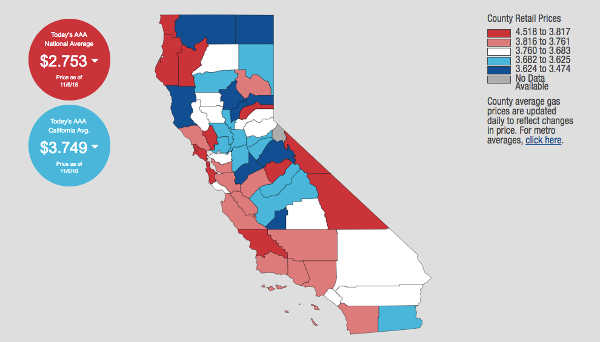
California gasoline prices have dropped nearly 8 cents since reaching a 2018-high of $3.82 on Oct. 16. Most of the recent decrease can be attributed to California gas stations beginning to sell the state's winter blend of gasoline this month, which is cheaper for refineries to produce and costs about 6-10 cents less per gallon.
California's average price for unleaded gasoline on Tuesday was $3.74, according to AAA. Nationally, the average price for gasoline has dropped from $2.91 to $2.75 in just a few weeks.
Analysts predict the full impact of Iran sanctions may not be felt until next summer, when the travel season increases market demand for fuel. The Iran sanctions, as currently enforced, will remove about 2 percent of the global oil supply from the market, and it remains to be seen whether other oil producers can make up the difference.
- Details
- Written by: Elizabeth Larson
SACRAMENTO – The California Department of Food and Agriculture's Fertilizer Research and Education Program is pleased to announce the award of over $1.1 million in grant funds to agricultural organizations and universities.
These grants will fund six projects that will improve the efficiency and reduce the environmental impact of fertilizer use in California agriculture and will advance farmers' understanding and implementation of best management practices for fertilizer and irrigation management.
This year, CDFA's Fertilizer Inspection Advisory Board approved the following proposals for funding:
1. Understanding Influences on Grower Decision-Making and Adoption of Improved Nitrogen Management Practices in the Southern San Joaquin Valley - University of California Davis, Department of Plant Sciences and Department of Environmental Science and Policy. Adoption of improved nitrogen management practices is paramount to reducing nitrogen loading to California groundwater. Currently, there is a limited understanding of how growers decide to employ or reject best management practices. This project aims to quantify the current use of improved practices and characterize the barriers and incentives that drive grower behavior. Expanding on previous work conducted in the Sacramento and northern San Joaquin Valleys, the findings will help guide future research, policy, investment, and incentives necessary to meet agricultural and environmental challenges in California.
2. Improving Nitrate and Salinity Management Strategies for Almonds Grown under Micro-irrigation - University of California Davis, Department of Plant Sciences. The accumulation of salts in the root zone is a threat to irrigated agriculture. With the widespread conversion from surface irrigation to drip and micro-irrigation, new methods are needed to effectively reduce salt accumulation. The primary goal of this project is to develop best management practices that allow California almond growers with micro-irrigation to effectively leach salts while minimizing nitrate losses below the root zone. Additionally, to accommodate the change in irrigation practices from surface to low volume systems, this research will re-evaluate the dynamics of root growth, root activity, nutrient and salt movement, and crop response to saline conditions under micro-irrigation.
3. Assessing Drip Irrigation and Nitrogen Management of Fresh Onions Produced in California Low Desert - University of California Desert Research and Extension Center, Universidad Autonoma de Baja California. California is the largest producer of onions in the nation, and a majority are grown in California's low desert region. The Imperial Valley is prone to soil salinization due to irrigation with saline water from the Colorado River. Grower adoption of improved irrigation and nutrient management practices is needed to mitigate salinization and reduce water pollution from excess nutrients in California's low desert region. This project will evaluate the effects of irrigation management and nitrogen fertilization rates on the yield and quality of fresh onion bulb production in arid regions using saline water to help growers make well-informed crop management decisions.
4. Promoting the Adoption of Soil Nitrogen Quick Tests by Spanish-Speaking Operators on Strawberry Ranches in Santa Cruz and Monterey Counties - Santa Cruz County Resource Conservation District (SCCRCD). Over-application of nitrogen fertilizer in strawberry production on the Central Coast reduces the profitability of the crop and results in nitrate leaching to groundwater. This project will promote improved management practices to optimize nitrogen fertilization in strawberry production. SCCRCD will produce printed guidelines in Spanish and English to educate local growers on how to collect and process soil samples and perform Nitrate Quick Tests. This project will also encourage best management practice adoption through one-on-one field assistance, leveraging the longstanding relationships that the SCCRCD has developed with the Spanish-speaking agricultural community of the Pajaro Valley.
5. Efficient Water and Nitrogen Management Practices for Mixed Leafy Baby Green Vegetables in the Desert - University of Arizona, Department of Soil, Water, and Environmental Sciences. Over the past decade, the production of leafy baby green vegetables, including baby lettuce, baby brassica, and baby spinach, has increased dramatically. These crops are grown at a higher density than full-season leafy greens and have a shorter season compared to full season crops. Limited information is available on how these factors affect fertilizer needs. This research will evaluate various nitrogen management practices for mixed conventional and organic baby vegetable production systems to gain a better understanding of the production differences. The studies will take place in grower fields to hasten technology transfer.
6. Pima Cotton Nitrogen Management, Uptake, Removal - Impacts of Varieties, Subsurface Drip and Furrow Irrigation - University of California West Side Research and Extension Center, University of California Davis, Department of Plant Sciences. Over the past three decades, California cotton production has shifted from specialized Upland cotton varieties to Pima cotton. Because of this change, nitrogen and irrigation management recommendations must be developed for Pima cotton varieties in California's semi-arid climate. This project will show whether the current guidelines for Upland cotton are applicable to Pima cultivars by evaluating the impact of nitrogen application rates and irrigation methods on total plant nitrogen uptake and yield potential. Multiple Pima varieties and soil types will be studied to better understand the overall nitrogen requirements of Pima cotton.
Since 1990, FREP has funded more than 220 projects focusing on California's environmentally sensitive cropping systems.
A database of completed research is available at: www.cdfa.ca.gov/go/FREPresearch. For more information, please visit the FREP Web site at http://www.cdfa.ca.gov/go/FREP.
These grants will fund six projects that will improve the efficiency and reduce the environmental impact of fertilizer use in California agriculture and will advance farmers' understanding and implementation of best management practices for fertilizer and irrigation management.
This year, CDFA's Fertilizer Inspection Advisory Board approved the following proposals for funding:
1. Understanding Influences on Grower Decision-Making and Adoption of Improved Nitrogen Management Practices in the Southern San Joaquin Valley - University of California Davis, Department of Plant Sciences and Department of Environmental Science and Policy. Adoption of improved nitrogen management practices is paramount to reducing nitrogen loading to California groundwater. Currently, there is a limited understanding of how growers decide to employ or reject best management practices. This project aims to quantify the current use of improved practices and characterize the barriers and incentives that drive grower behavior. Expanding on previous work conducted in the Sacramento and northern San Joaquin Valleys, the findings will help guide future research, policy, investment, and incentives necessary to meet agricultural and environmental challenges in California.
2. Improving Nitrate and Salinity Management Strategies for Almonds Grown under Micro-irrigation - University of California Davis, Department of Plant Sciences. The accumulation of salts in the root zone is a threat to irrigated agriculture. With the widespread conversion from surface irrigation to drip and micro-irrigation, new methods are needed to effectively reduce salt accumulation. The primary goal of this project is to develop best management practices that allow California almond growers with micro-irrigation to effectively leach salts while minimizing nitrate losses below the root zone. Additionally, to accommodate the change in irrigation practices from surface to low volume systems, this research will re-evaluate the dynamics of root growth, root activity, nutrient and salt movement, and crop response to saline conditions under micro-irrigation.
3. Assessing Drip Irrigation and Nitrogen Management of Fresh Onions Produced in California Low Desert - University of California Desert Research and Extension Center, Universidad Autonoma de Baja California. California is the largest producer of onions in the nation, and a majority are grown in California's low desert region. The Imperial Valley is prone to soil salinization due to irrigation with saline water from the Colorado River. Grower adoption of improved irrigation and nutrient management practices is needed to mitigate salinization and reduce water pollution from excess nutrients in California's low desert region. This project will evaluate the effects of irrigation management and nitrogen fertilization rates on the yield and quality of fresh onion bulb production in arid regions using saline water to help growers make well-informed crop management decisions.
4. Promoting the Adoption of Soil Nitrogen Quick Tests by Spanish-Speaking Operators on Strawberry Ranches in Santa Cruz and Monterey Counties - Santa Cruz County Resource Conservation District (SCCRCD). Over-application of nitrogen fertilizer in strawberry production on the Central Coast reduces the profitability of the crop and results in nitrate leaching to groundwater. This project will promote improved management practices to optimize nitrogen fertilization in strawberry production. SCCRCD will produce printed guidelines in Spanish and English to educate local growers on how to collect and process soil samples and perform Nitrate Quick Tests. This project will also encourage best management practice adoption through one-on-one field assistance, leveraging the longstanding relationships that the SCCRCD has developed with the Spanish-speaking agricultural community of the Pajaro Valley.
5. Efficient Water and Nitrogen Management Practices for Mixed Leafy Baby Green Vegetables in the Desert - University of Arizona, Department of Soil, Water, and Environmental Sciences. Over the past decade, the production of leafy baby green vegetables, including baby lettuce, baby brassica, and baby spinach, has increased dramatically. These crops are grown at a higher density than full-season leafy greens and have a shorter season compared to full season crops. Limited information is available on how these factors affect fertilizer needs. This research will evaluate various nitrogen management practices for mixed conventional and organic baby vegetable production systems to gain a better understanding of the production differences. The studies will take place in grower fields to hasten technology transfer.
6. Pima Cotton Nitrogen Management, Uptake, Removal - Impacts of Varieties, Subsurface Drip and Furrow Irrigation - University of California West Side Research and Extension Center, University of California Davis, Department of Plant Sciences. Over the past three decades, California cotton production has shifted from specialized Upland cotton varieties to Pima cotton. Because of this change, nitrogen and irrigation management recommendations must be developed for Pima cotton varieties in California's semi-arid climate. This project will show whether the current guidelines for Upland cotton are applicable to Pima cultivars by evaluating the impact of nitrogen application rates and irrigation methods on total plant nitrogen uptake and yield potential. Multiple Pima varieties and soil types will be studied to better understand the overall nitrogen requirements of Pima cotton.
Since 1990, FREP has funded more than 220 projects focusing on California's environmentally sensitive cropping systems.
A database of completed research is available at: www.cdfa.ca.gov/go/FREPresearch. For more information, please visit the FREP Web site at http://www.cdfa.ca.gov/go/FREP.
- Details
- Written by: California Department of Food and Agriculture





 How to resolve AdBlock issue?