 How to resolve AdBlock issue?
Opinion
- Details
- Written by: Lenny Matthews
It is my belief, as a lesbian, that the current heart of marriage prohibition is an attempt to keep homosexuals inferior. You might not like that but look closely at the information I present to you today. Change starts with you.
Marriage is a “fundamental right of free men,” wrote Justice Traynor. “Legislation infringing such rights must be based on more than prejudice.” As such this is in direct violation of the equal protection laws. A marriage license is a legal document, not a sacred one. The marriage is not sacred through the government but through the individuals themselves.
Marriage triggers 150 to 250 laws in every US state and, on a federal level, more than 1,040. These civil laws to be just and fair should apply to ALL citizens equally. In America there is NO state church and NO religious body has the right to dictate state policy. And would someone please remind our president of this!
Again, a state marriage license is not a religious one. Quoting Joan Ryan from the SF Chronicle, “If preserving the sanctity of marriage were truly the impetus behind Bush’s campaign to ban gay marriage, he also would be championing a constitutional amendment against Elvis wedding chapels and drive-through ceremonies. He’d be calling for a ban against 20-year-olds marrying 85-year-old billionaires, and a ban against Hugh Hefner ever walking down the aisle again.”
Let me share with you a few of the rights triggered by a legal marriage that are difficult or impossible to duplicate by other legal documents:
Automatic assumption of spouse’s pension
Automatic inheritance
Automatic housing lease transfer
Bereavement leave
Burial determination
Property rights
Child custody
Crime victim recovery benefits
Domestic violence protection (most cities don’t cover same sex abuse)
Exemption from property tax on partner's death
Immigration access for the foreign spouse of a US citizen
Immunity from testifying against spouse
Insurance breaks
Joint adoption
Joint bankruptcy
Joint parenting
Medical decisions on behalf of partner
Name change if desired
Visitation rights hospital and prison
Wrongful death benefits.
Domestic partners, however, provide a second-class status that is legally and socially restrictive. It offers few benefits and those that it does can be removed quickly by attorney generals, such is the case in Hawaii and Texas. It is not portable from state to state. Some have suggested that making some kind of parallel structure to marriage, and of course calling it something other than marriage would satisfy all. Many others and I strongly disagree. Again a division would be established and full equality would not prevail.
Throughout our globe change is happening. Lesbian and gay people have had a history of being under attack in this country. State and federal courts have examined civil rights cases for severity of discrimination by different groups and concluded, that sexual minorities do require the same level of constitutional protection.
I celebrate in our California Supreme Court's decision for if this is truly a country of freedom and rights the public should not have the ability just vote away the rights of others! Please remember this in November, for this battle is not over.
Lenny Matthews lives in Lucerne.
{mos_sb_discuss:4}
- Details
- Written by: Lake County News Reports
First, two directors (Alan Siegal and Sid Donnell) are not members in good standing. They're violating Article VI, Section 1of Riviera rules that establishes term limits: “Directors shall be elected for terms of two years and shall serve until their successors are elected and qualified, and not be eligible for reelection after serving a two-year term until they shall have not been a director for at least one year …” Also , Article VI, Section 5 of the By-Laws says, “The board may fill a vacancy by calling for a special election to choose a new director.” Al and Sid have not done that. They offer lame excuses for clinging to power. “Absolute power corrupts absolutely,” political scientists say, and this board shows, by breaking this law (and others, see below), they've been corrupted by power. Apparently, board members, Boone Bridges and Sandra Orchid, go along to get along.
Second, the board is entertaining an ugly idea of doing away with Proposition 13 for people living in the Riviera. Proposition 13 will no longer protect Rivierians from the 1-percent-of-purchase-price tax limitation. This board wants Rivierians to pay for road improvements through a special tax organized by the association. That’s an increase in property tax. Lake County tax collectors have finally found a way around Proposition 13. Incredibly, some people on some streets won’t have to pay the extra tax.
The county, state, and federal governments are already responsible for road improvements. Rivierians are already paying high taxes for roads. Unfortunately, government officials aren't spending the money properly. They're wasting it. They're bloating up bureaucracies and buying fancy new vehicles for government employees. Now, of course, they want more money.
Third, the board has recently decided to enforce a farcical 20-year-old, 100-foot fire ordinance (Rivierians must cut natural brush 100 feet from any building, no exceptions). Using everyone's fear of fire, they've stampeded some Rivierians into compliance. There are many, many reasons Rivierians should reject this board’s ludicrous 100 foot-from-every-building-fire-yell and get them out of office, quick.
First, the real fire threat to Riverians comes from outside the Riviera, according to Kelseyville Fire Chief Howard Strickler (on the phone 4/29/08 to this writer). Fire departments can handle small brush fires but have no control over wildland firestorms that build up outside developed areas. He also said, no home in the Riviera has ever been destroyed by brush fire originating from within. Board members are aiming their anti-fire guns in the wrong direction. Common sense tells them to spend their limited resources on fire breaks around the Riviera like Buckingham residents did, recently. Chemise, manzanita and other native chaparral are all gorgeous plants. Most Riviera lots are small and by the time owners build houses, garages, driveways and septic systems, there isn't much natural habitat left, anyway. Thirty feet is reasonable. One hundred feet is harebrained idiotic.
Second, Lake County supervisors, after public input, recently disagreed with the board’s 100 foot law unless the fire chief, “ ...determines that extra hazardous conditions requires a firebreak of more than 30 feet ...” (Ordinance 2861 Section 5-4f2c). The 30-foot ordinance was passed recently in March. The Riviera board is in conflict with county supervisors. They must go.
Third, the preposterous 100 foot law has made some Riviera streets look like a war zone or strip mining operation. Now, bare hillside lots are subject to erosion and instability. During heavy rains, old septic systems (installed without curtain drains) fail and sewage is washing into the streets where kids play. Engineered septic systems also fail when filters aren't timely changed and again, kids walk through sewage on their way to school. Some wide-eyed followers are even spraying herb poisons on their lots to keep them completely bare or using chemical fertilizers trying to make non-native plants grow. Herb poisons and chemical fertilizers make their way into ground water and eventually the lake. Yet, this board continues to yell fire in a crowded theater when the real danger is outside the theater.
Fourth, most Rivierians love natural habitat and wildlife and are willing to accept a reasonable fire risk to be close. They enjoy live oak, chemise, manzanita and other chaparral plants. Some moved here to see deer, quail, doves and all the Riviera bird species. Wildlife needs cover. For centuries now, Americans have traded reasonable fire risk for the enjoyment of natural settings. They also know chaparral between roads and homes provide privacy and noise reduction better than evergreens some silly people plant. Evergreens burn hotter and faster than natural vegetation. Out-of-control board members are on a campaign to destroy the Riviera in attempt to save it. They must go!
Fifth, the board’s crazy 100 foot law places financial hardship on the elderly, soccer moms, widows, people who live far away and those on fixed incomes. Some Rivierians have more than one lot or a large lot and can't, of course, use a weed-whacker to cut down chemise. Some unscrupulous contractors are making a fortune cutting and chipping those areas that homeowners should keep. Also, the No. 1 cause of home loss in wildfires is flammable roofs. If people could afford it, they’d install tile roofs and nonflammable decking.
Sixth, the board is not enforcing their crazy new 100 foot law uniformly. Americans love democracy and democracy demands everyone be treated equally under every law. If the board fines one home owner $250 they must fine every homeowner who has the same or worse condition. Selective enforcement of a moonstruck rule leaves the door wide open for all sorts of nasty discrimination. Some people are saying enforcement is selective because uniform fining would cause an outcry heard around the world. Board members might have to leave the country.
Finally, the board is illegally enforcing their 100 foot law. Article 12 of the by-laws say “violators” must receive a letter of the violation (The association is fining owners who have not received letters of violation). Article 12 also says legal action will be taken to enforce correction of a violation (homeowners can defend themselves when the board follows this law). A tyrannical association is fining members without due process. They’re skipping the legal process. They're also saying they have the right to inspect every inch of homeowners property without a search warrant. Like Taliban beard inspectors of Afghanistan, they’ll regularly inspect your bushes.
If it hasn't already happened, some widow or other disadvantaged homeowner will meet the right attorney, one day soon, and sue the pants off Clearlake Riviera Community Association. Any one of the above reasons is enough. One little old lady was recently seen, on Monte Cristo, in the hot sun, cutting bushes and putting them in her station wagon. She got a threatening letter from the association. One heat stroke or one heart attack caused by an illegal board, illegally enforcing lunatic laws, is a considerably greater danger of financial loss than brush fire.
These board members must go far, go fast and stay long. A new board must follow the rules and stop the scorched-earth, slash-and-burn-policy.
Darrell Watkins has lived in Clearlake Riviera 22 years. An early-retirement teacher, he’s a successful businessman in Clearlake and running for election to the board.
{mos_sb_discuss:4}
- Details
- Written by: Richard Birk
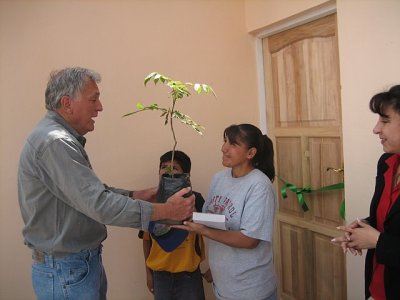
I have just returned from a journey to Bolivia, where I participated in a Habitat for Humanity project to build homes in that impoverished country.
Bolivia is a landlocked country in South America, the poorest country on that continent. Although blessed with the majestic mountains of the Andes and Lake Titicaca, a large portion of the population of 10 million lives in substandard conditions.
Most of those affected are the indigenous Indians who make up 60 percent of the population. Many have to live in unhealthy adobe huts with dirt floors, no water, no sanitation services, no electricity, and many families are forced to live in only one room.
For two weeks I and other volunteers carried bricks and rocks up a steep hill, hand mixed concrete, dug trenches – all at an elevation of 9,000 feet, sometimes in the rain. The work was very strenuous, but working alongside the future homeowners made the work so much more rewarding.
Did I sweat? Yes. Did I have a sore body? Yes. Was I tired? For sure, but the personal rewards were priceless.
The local Bolivian people were very grateful and motivated to improve their living conditions as exemplified in how hard they worked on building their homes. Something else that was apparent was that by being there we renewed the idea that others do care and we were a messenger of hope.

Just before departing on the last day of work, I said to the grandfather of one of the future homeowners whom I had been working alongside for several days, “Hasta luego” (see you later). His face grew a big smile and he grabbed me and gave me a big hug. With that he was saying “thank you” for not forgetting them in the future, and thereby giving hope for a better life.
I knew then that I could never forget the plight of those less fortunate in this world and in particular the people of Cochabamba, Bolivia.
The travel to Bolivia is via a long flight to La Paz, where the airport is at an elevation of more than 12,000 feet.
As an American I was very proud to find so many people from our country assisting in making a better life for the people of Bolivia. On the flight to La Paz I sat next to a fellow who had made it his mission to help the poor rural natives find a better way to grow and store potatoes, which is one of their major staples, without which they could starve. Also, on the same airplane were a group of American volunteers associated with the nonprofit Operation Smile, who specialize in surgically correcting children born with cleft palates and other facial deformities.
In the town where we worked, Cochabamba, I met another American, a professional civil engineer, who has dedicated his life to serving the poor by helping bring drinking water to many of the small villages located in the high plateau regions. This is what America is really about.
Regarding Habitat for Humanity, we operate in Bolivia and in more than 90 other countries. Most of the funding needed for these efforts comes from the individual Habitat affiliates in the United States.
We here at Habitat for Humanity Lake County have funded to our international operations enough money to support the purchase of materials for five homes, which average $4,500 each.
If you are interested in volunteering/donating here in Lake County and/or in our international work please call us at 994-1100.
Richard Birk is president of Habitat for Humanity Lake County.
{mos_sb_discuss:4}
- Details
- Written by: Gale Tompkins
My son will not be attending public school as of May 8. I will be home-schooling him for the rest of the year. What follows are my reasons for pulling him out.
My son has enjoyed much of his time in his kindergarten class; especially the precious though limited time spent on art, music and playtime. After observing “stations” however, and my son's (and other students’) demeanor during that period, I am gravely concerned about the continued academic emphasis that is still being wrought upon these young children.
As an experienced, credentialed teacher myself with a background in child and language development, I am sad to see that the irresponsible pattern of shoving academics onto young children has gotten worse than it was even a few years ago.
Not only is it developmentally inappropriate to expect 5- and 6-year-olds to sit still daily for three, 30-minute periods doing worksheets and copying sentences off the chalkboard, it is educationally unsound. When my son was sick last weekend he told me he hoped he wouldn’t get well by Monday because he didn’t want to go to school. What adult alive today remembers hating kindergarten?
I know I’m not the only one who sees the danger here. Remediation rates are starting to increase in the fourth grades when students have to start actually reading to learn – not just sound out words to please the teacher. Public schools are sacrificing the development of the right brain to make their immediate test scores look good, but hobbling students’ overall brain and academic development by focusing so exclusively on the left brain.
Very young students are also “misbehaving” in class at alarming rates – not surprising since it’s not natural for them to do the things they are being expected to do. Why are we surprised when children act like children? Do we also argue with water because it’s wet or criticize a dog because it can’t meow nicely like a cat does?
My son resents having to miss recess if he can’t finish his “work” and has learned to copy from the children sitting next to him because he’s afraid the classroom aide will get mad if he circles the wrong answer. He dreads this endless “circling and crossing out” that pervades his school day and follows him home as homework.
I know that finger-painting, Play-Doh, blocks and dress-ups are not tested in the later grades, but real academics are; academics that now have no foundation to build on since they are taught in isolation, through endless drill, mindless copying, and parroting back answers that the Education Testing Service has decided students need to know to make their schools look good for the newspapers and local Realtors.
I feel for the excellent teachers, my son's included, who are caught up in a system that determines the direction of education by the current whim of the public and government officials. These days it shouldn’t even be necessary to go to college and study brain development, child development or developmentally appropriate educational programming. Teachers are reduced to classroom managers who can photocopy nice workbook pages and hand out glue and scissors for the exciting cut and paste activities.
Gale Tompkins lives in Kelseyville.
{mos_sb_discuss:4}