
Opinion
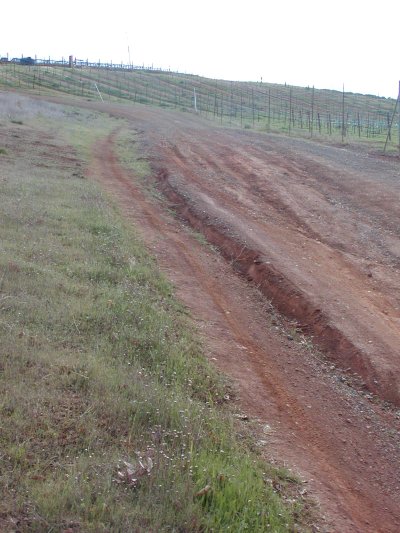
On Tuesday, May 22, at 1:30 p.m. in the supervisors’ chambers in Lakeport, the Board of Supervisors will consider the adoption of a completely revised Grading Ordinance for the County of Lake. The document is 85 pages long. To the uninitiated, it is dry and intimidating. What is new, and what is important, in this revised proposed ordinance?
The genesis of the new Grading Ordinance was the high profile debacle of Snows Lake Vineyard. This carnage captured the Lake County public’s attention in the spring and summer of 2001, when more than 700 acres atop Perini Hill were bulldozed by a Central Valley-style agribusiness invader named George Myers without any form of grading permit or environmental review.
The entire hillside landscape, a sacred Pomo site, was devastated. Local wildlife was slaughtered. The waters of Siegler Creek literally ran red with eroding soil, after hundreds of acres of native oaks were toppled. Blue line streams were obliterated to the point that they could not be located, even with the aid of prior aerial photos and maps. Wells dug to irrigate the new construction sucked up and exhausted spring water supplies that had been used by neighboring residents for 100 years.
In subsequent court proceedings and Board of Supervisor hearings, it was revealed that the entire project had passed completely under the radar screen because it has been labeled as “exempt.” The county failed to apply any permit requirement because Myers told the Lake County Community Development Department that he simply planned to replant an old walnut orchard.
Myers seems to have been advised by CDD personnel that if he characterized the project as a walnut orchard conversion it would avoid any public scrutiny or environmental review. Because of this quasi-official imprimatur of prior approval, the county proved reluctant to crack down hard on Myers.
In the aftermath of the Snows Lake scandal, and with new vineyard clearings erupting seemingly everywhere during the grape boom of 2001-02, the supervisors took action by constituting a citizens advisory committee to tackle the issue of whether or not to rewrite the county’s grading ordinance.
The committee was hand-selected to include representatives of many different interest groups – representatives of agriculture, heavy construction, real estate brokers, environmental groups, citizen groups, and Native American tribes were all included.
Additionally, the committee benefited from the participation of numerous county planners and staff having experience dealing with grading projects and related issues. The committee was well aware from the start that similar efforts in neighboring Mendocino County had broken down into squabbling, and failed to reach any tangible result.
The committee’s initial confusion cleared when Peter Windrem, a Lake County native, real estate attorney, Sierra Club member and vineyard owner, took over as the committee chair. Windrem ruled the committee with a diplomatic but firm hand. He refused to tolerate any filibustering or divisiveness. Instead, he made the extra effort needed to build consensus at every possible turn. The fact that in the end, the committee actually produced a consensus document that is pending a hearing before the Supervisors is, more than anything, a testament to Windrem’s founding father-like skills.
Over a four year period, the committee reviewed the entire planning process as it relates to grading projects. Before doing any drafting, the committee worked through a whole series of real world situations, carefully combing through the process to consider as fully as possible how the ordinance should take effect, how it should work, and where it should back off to allow people to proceed unhindered by red tape. Staff were helpfully involved as well, pointing out their real world issues, difficulties and enforcement concerns.
In the end, the new ordinance was hammered out, section by section, and was approved by consensus of the entire committee, with minimal dissent. Although the ordinance is indeed lengthy, most of the text is devoted to definitions and procedures. The substance is relatively simple.
The goals of the new ordinance are actually two-fold. First, the ordinance seeks to prevent a repetition of a fiasco such as Snows Lake, where a huge earth moving project, causing a great deal of harm to the neighbors and the environment, passed totally under the radar screen of any prior review. At the same time, however, the new ordinance is intended to streamline the permit process for people who are doing small projects having no consequential effects on anyone.
To carry out these goals, the new ordinance divides all grading into three basic categories: “simple,” “standard” and “complex.”
Simple grading is small-scale work on flat land that does not involve watercourses. Simple grading is exempt from any form of environmental review.
Standard grading is grading that is substantial enough to warrant some consideration of the possible need for scrutiny of collateral environmental effects. The company or person doing the grading is required to submit a complete description of the project to the county, so that a planners can determine whether the project requires closer review. Notice is provided to the owners of neighboring properties, in case there are undisclosed problems with the project.
Complex grading, in general, applies to projects that involve major earth moving, or earth moving within watercourse areas. Complex grading requires full review of the environmental implications of the project. In most cases, it also requires stamped drawings from a licensed engineer.
What are the strengths of the new ordinance?
In this author’s opinion, the new ordinance is most beneficial because it reduces the availability of ambiguities and loopholes that can be exploited to allow big agriculture and big land developers to rape and pillage with impunity.
Every project requires basic information to be submitted. The absolute magnitude thresholds triggering complex grading, coupled with improved information submission requirements, go far toward preventing a future Snows Lake type situation from ever being characterized as “exempt” from any review.
The new ordinance now also explicitly takes into consideration the erosion hazard rating – derived from a combination of slope and soils type – involved in any particular project.
What are the new ordinance’s weaknesses?
”Exemptions,” meaning activities totally outside the scope of any review, still exist in Section 30-16 of the new ordinance.
The most troublesome of these is probably the “ongoing agriculture” issue. Such potentially large and erosion causing projects as “Agricultural Roads, Ponds and Reservoirs” are deemed exempt. The new ordinance, as proposed, applies whenever walnut trees or other plants having established stable root systems are removed, but advocates of agriculture interests made a last-minute push in the committee to exempt the ripping out of old orchards from any form of review.
“Exempt” means no information at all is ever submitted, as happened with Snows Lake. The public can anticipate that these efforts to water down the ordinance will be renewed before the full Board of Supervisors.
Also, efforts are now in progress to eliminate the requirement of neighbor notification about “standard” grading projects. This is one of the most significant safeguards of the new ordinance. All too often, land developers provide incomplete or misleading information, which does not come to light until the damage has already been done.
Even though the new ordinance does beef up the county’s enforcement powers, history has demonstrated that county officials and employees can all too often be induced to look the other way and disregard real problems when big business interests are involved.
In the staff report recommending the deletion of the notice requirement, the bogeyman of “NIMBY” – not in my backyard – neighbors is overly stressed in an effort to do away with what is a very workable and modern notification provision, one that is accepted as standard operating procedure in most if not all of the more civilized California counties.
The ordinance represents the product of four years of hard work by the citizens advisory committee, in which each provision has been vetted very thoughtfully and carefully.
The public should read the ordinance carefully, comment thoroughly and speak out accordingly, but should beware of any last-minute changes that can throw the entire scheme out of balance.
Robert Riggs, a Lake County attorney and Board Chair of the Lake County Citizens Coalition, has served on the citizens’ advisory committee on the Lake County grading ordinance from its inception in December, 2002 to the present.
{mos_sb_discuss:4}
- Details
- Written by: Lake County News Reports
What is the purpose of the yearly ceremony and prayer at Bloody Island, why remember 100 to 150 innocent Pomo men, women, children and infants who died there on May 15, 1850 at the hand of dragoons under Captain Lyon and of a militia?
The world has known, and continues to perpetuate, countless atrocities.
The pages of history are soaked with blood. Why focus on what could, in the light of such global and massive barbarism, appear almost irrelevant in scope and in the perspective of time?
No human life is ever irrelevant.
All victims are first dehumanized. In the case of California Indians, they were widely described to stand, on the ladder of evolution, scarcely above animals, so they could be murdered, raped, enslaved, dispossessed, wiped out without disturbing the conscience of those who perpetuated these crimes, the nation that condoned it, the identity of the religion that was said to lead and inspire this nation, and the idea of civilization itself.
For the dominant culture to remember the Native people who were butchered on Bloody Island is to honor their humanity. This is a process that is absolutely necessary in spiritual as well as human terms, even though contemporary members of the dominant culture did not commit these crimes.
Lucy Moore was a survivor of the Bloody Island massacre, we know her Native name, Ni’ka, it is important. How many of those who were buried in a mass grave are remembered today? How many still have a name? How sad that the name of a child, of a mother would vanish from the earth for all times.
The dominant culture still benefits from the outcome of these crimes, which are stolen lands and resources; the very wealth and power of this nation originated from the gold extracted from Indian lands at a price that was no less than attempted genocide.
This nation claims to be a moral leader. It claims to have been divinely inspired to settle this continent and to ultimately lead the world as a beacon of human rights and freedom. It assumes these positions at the cost of the denial or distortion of its own history, still refusing to acknowledge that its basement is flooded with the blood and the tears of the Native victims whose only fault was to be living in their own country, and therefore stand in the way of invasion.
The rationalization of such historical crimes, the denial of the fact that invasion is morally indefensible in all circumstances and at all times, the still prevalent belief that the march of what is called progress somehow validates cultural and even physical genocides, which are then said to be regrettable but unavoidable, has allowed the world to stand in approval or to bow in cowardly submission in the face of the destruction of many indigenous cultures and people.
By refusing to acknowledge and learn from the past, the world is ensuring that it will keep repeating the same mistakes. The point of acknowledging a disease is not guilt but healing. When pathology is rationalized, when a flag, a nation, a government, a religion, a civilization or any cause, concept or ideology are presented as institutions, achievements or goals worthy of any means of implementation or preservation, human beings are tortured, enslaved, raped, humiliated, exploited, killed in the name of the highest aspirations and ideals, and the world itself sinks in ever deeper despair and hopelessness, for freedom becomes tyranny, war is said to be the greatest tool for peace, hate and prejudice replace love, compassion and forgiveness, inequity is confused with justice, and the only distinction between punishable crimes and those that are not is in the position and power of the person, institution or nation that commits these crimes.
Raphael Montoliu lives in Lakeport.
{mos_sb_discuss:4}
- Details





 How to resolve AdBlock issue?