 How to resolve AdBlock issue?
Education
- Details
- Written by: Rachel Leven
The college will develop, implement and share high-quality, ethics-oriented and accessible curricula, educating a diverse student body in data science, computing and statistics. It will also create new fields, applications and solutions to societal problems through groundbreaking, multidisciplinary research that capitalizes on Berkeley’s excellence across campus.
“We are thrilled to announce a new college at Berkeley that connects our excellent research and education in computing, data science and statistics with the many data-intensive disciplines across our campus,” said Carol T. Christ, Berkeley’s chancellor. “Infusing the power of data science across multiple disciplines, from basic and applied sciences to the arts and humanities, will help us to fully realize its potential to benefit society, help address our world’s most intractable problems, and achieve our most visionary goals. At Berkeley, we have the opportunity and responsibility to educate data science students from diverse backgrounds to become the ethical leaders we need in private industry, the public service sector, and education.”
The vote culminates a three-year process by Berkeley and the UC system to transform the Division of Computing, Data Science, and Society into a college. Now, the college can more effectively form new programs and partnerships, support instruction and research and foster identity and community among faculty, students and alumni.
It's been since the late 1960s that Berkeley added a college to the campus. The journalism school was added in 1968. The public policy school was established in 1969. The College of Computing, Data Science, and Society approval comes as artificial intelligence and other technologies are changing how we teach, learn, connect and understand our world. The Regents’ vote affirms Berkeley’s track record and value as a leader in using scientific and human-centered disciplines to understand and act in this moment of change.
“Artificial intelligence, computing and data science are lenses through which we now experience the world,” said CDSS Associate Provost and Dean Jennifer Chayes. “This college provides Berkeley with opportunities to innovate and incubate new fields of inquiry at the intersection of computing and data science with other data-intensive fields. These interdisciplinary areas are often the most active areas of research, leading to some of the most exciting breakthroughs.”
The college includes the Data Science Undergraduate Studies program, the Department of Statistics, the Berkeley Institute for Data Science, the Center for Computational Biology and the Bakar Institute of Digital Materials for the Planet.
It shares the Department of Electrical Engineering and Computer Sciences with the College of Engineering, the Social Science Data Lab (D-Lab) with the Social Sciences division and the Computational Precision Health program with UC San Francisco (UCSF).
Computing, Data Science, and Society celebrated becoming a college at the data science undergraduate commencement ceremony on Thursday evening at the Hearst Greek Theatre in Berkeley. Google Senior Vice President Prabhakar Raghavan was the keynote speaker.
Built on a foundation of excellence
As a division, Computing, Data Science, and Society has already been working with campus partners to meet skyrocketing demand from Berkeley students for computing and data science training and from employers in need of employees with these skills. The data science and computer science majors are among the five most popular majors at Berkeley. Many students pursuing other majors also take courses in data science and computer science.
As a top university sending students to nearby Silicon Valley as the next generation of technology leaders, Berkeley has made sure its data and computer science curriculum is interdisciplinary, high quality and society-centered. Its students take courses on how to consider the human context and ethics of their work. Berkeley programs in computer science, data science and statistics are top-ranked by U.S. News & World Report.
Computing, Data Science, and Society has prioritized inclusivity and accessibility for all students. For example, it has shared its data science curriculum with California community colleges to make this lucrative field more accessible to students from non-traditional backgrounds. It’s also partnered with institutions like Tuskegee University to develop programs that build strong data and social science foundations and connections. And it’s built initiatives to support and accelerate the academic growth of students from all backgrounds.
This pattern of excellence extends across Berkeley, making the college well-situated to partner with pioneers in data-intensive disciplines to launch groundbreaking interdisciplinary initiatives and fields. Computing, Data Science, and Society has created an institute to use machine learning to develop cost-efficient, easily deployable, ultra-porous materials to help combat climate change.
It’s established the field of computational precision health to improve the quality and equity of health care and has developed a research center to help tackle environmental problems.
Looking forward
With the Regents’ vote on Thursday, the college will now develop its administrative and financial structures to operate similarly to other colleges on campus. Colleges can hire their own faculty, for example, and award degrees to students.
As part of this transformation, the undergraduate data science major and computer science major that are currently within the College of Letters & Science will eventually move to the College of Computing, Data Science, and Society once academic and student support systems are created. The new college will also develop new graduate programs with other Berkeley departments, schools and entities.
The entities that have been part of the division are currently distributed in buildings across campus but will ultimately unite in the 367,270-foot Gateway building, which is under construction on Hearst Avenue at Arch Street. The Gateway is scheduled to open during the 2025-2026 academic year.
Board of Regents members expressed enthusiasm for Computing, Data Science, and Society at the Academic and Student Affairs Committee meeting on May 17. Regent Lark Park, the committee’s chair, noted the importance of the college to California, society and “our future.”
“It really is so impressive to see how this has grown organically – the growth, the interest, the popularity,” said Park. “You have acted to make your destiny and that will change the destiny of others.”
Rachel Leven writes for the UC Berkeley News Center.
- Details
- Written by: Goodwill ~ Redwood Empire
This professional certification program helps learners build skills to advance their career and is offered at no cost.
This 20-week program is a self-paced course on the Coursera platform, with hands-on, project-based training in social media marketing.
It is a fully virtual course with a two-hour study session on Zoom every Wednesday evening. Upon completion of the course, learners have the opportunity to test for an industry-recognized professional certificate that can be used to apply for entry-level social media marketing roles.
Goodwill is partnering with Meta Elevate and Coursera to offer this course which enables learners to gain foundational advertising concepts across platforms and get the tools they need to build a successful digital marketing career.
Meta Elevate is funding the scholarships and Goodwill provides wraparound services including the weekly study group session, career planning, resume building, and offers extra support as needed.
Those interested can apply by visiting https://gire.org/programs/.
- Details
- Written by: Elizabeth Larson
This program is offered at no cost to youth aged 15 to 20 who are interested in joining the workforce.
Good4Youth is a five-week program that prepares learners with the necessary skills to enter the workforce.
This program is held on Tuesdays and Thursdays from 4 to 5 p.m. and gives learners the chance to gain skills in career exploration, resume building, acing an interview, employer expectations, interpersonal skills, and social media etiquette.
Upon completion of the course, learners will receive a Work Readiness for Youth certification and the opportunity to participate in a three-month paid internship at Goodwill.
This paid internship will allow participants to gain work readiness skills on the job and add great experience to a resume.
One parent of a recent learner shared their experience with Good4Youth saying, “Our son has grown in many ways as a result of the Good4Youth program. He gained confidence and strengthened his social interaction skills. He has recognized that he can be successful … it has been a priceless experience for our family.”
Goodwill ~ Redwood Empire is excited to give youth the opportunity to gain skills to succeed in the workforce. Those interested can apply by visiting visit https://gire.org/programs/.
- Details
- Written by: Elizabeth Larson
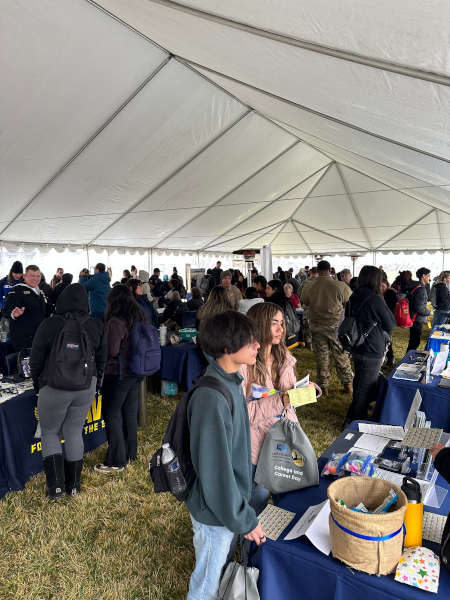
UKIAH, Calif. — The Mendocino College Career Hub will host its Spring Career Fair on Wednesday, April 26, from 11 a.m. to 1 p.m. and 4 to 6 p.m. in Pomo Plaza of the Ukiah Campus at Mendocino College.
This event will provide opportunities to network, recruit, and interview candidates for potential internships, seasonal work, part-time jobs, and full-time employment. It is open to all residents living in Lake & Mendocino County and attendance is free of charge.
Employers interested in hosting a recruitment table at the event should register before April 12, 2023.
To register, visit https://forms.office.com/r/vGz7g0ampn or email the Career Hub at
Job seekers are encouraged to bring copies of their resumes and come prepared to network and/or interview.
Mendocino College students can schedule time with the Mendocino College Career Hub in preparation for the Career Fair by stopping by Room 1250 in MacMillan Hall or emailing
Community members should connect with CareerPoint Mendocino by emailing
The growing list of organizations in attendance includes:
Savings Bank of Mendocino County
GRID Alternatives
City of Ukiah
US Cellular
Mendocino College - HR Department
Mendocino County Youth Project
Special Education Department, SSU
C&S Waste Solutions
Mendocino County Office of Education
The Works Inc.
Adventist Health
CareerPoint North Bay - Mendocino
MCHC Health Centers
DripWorks
METALfx
Mendocino County Human Resources
CHP – Ukiah
COPE Health Scholars
NCO Head Start Child Development Program
Geiger’s Markets
Redwood Valley Calpella Fire District
Compass SLS & ILS
Mendocino County Sheriff's Office
Scotts Valley Tribal TANF
Lake County Behavioral Health Services
Sherwood Valley Casino
Rocky Point Care Center
Mendocino Coast Clinics
Granite Construction
Lakeport Post Acute
County of Lake Human Resources
California Mentor Network
Coyote Valley Education Center
Mendocino County Dept. of Social Services
US Forest Service Mendocino National Forest
Mendocino Forest Products LLC
Lake County Tribal Health Consortium Child Development Center
US NAVY
U.S. AIR FORCE