 How to resolve AdBlock issue?
Education
- Details
- Written by: Editor
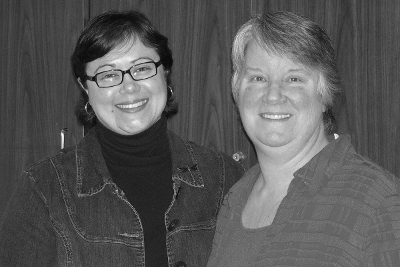
UKIAH – Mendocino College Admission and Records Technician Anastasia Simpson-Logg was selected in February as recipient of the quarterly award for classified staff.
“Mendocino College has very much a family atmosphere. From my first day at work there’s been a good vibe” she said.
Simpson-Logg has worked at Mendocino College since late 2001.
She started in the Admissions and Records Department and particularly enjoys being involved in the commencement ceremony each spring.
Simpson-Logg said that “students are so grateful at graduation time” and frequently thank her for helping them achieve their academic goals.
“Anastasia is deeply engaged with Mendocino College,” said her supervisor, Kristie Anderson. “The best story that clearly shows her dedication to us and to the department was her adding just a few more moments to the day – to clear up a couple more items for training the new person and for processing student’s transfer work – and then delivering her daughter Anya a few hours later.”
The Mendocino College Foundation has allocated $2,000 for 2009-10 for the first year of the classified staff recognition program, with one recipient selected for each quarter on Sept. 1, Nov. 16, Feb. 1 and April 16.
The recipients are selected by the Mendocino College superintendent/president, two vice-presidents and director of human resources based on supervisor nominations, contributions to the college and longevity.
The winner has the opportunity to choose a college program to receive $500 which can be used by that program in support of the college’s strategic goals.
Simpson-Logg requested that the $500 from the foundation be given to the Mendocino College English program for the purchase of library materials that will augment the current English curriculum and assist students in their English studies.
For more information about Mendocino College, visit www.mendocino.edu .
- Details
- Written by: Editor
MENDOCINO COUNTY – Attorney General Edmund G. Brown Jr. recently announced a settlement with James L. Harrison, 62, of Ukiah, after he "looted college scholarship funds" from a trust intended to benefit female graduates of Ukiah High School pursuing careers in medicine.
Brown's office, working with the Federal Deposit Insurance Corporation (FDIC) and the California Department of Financial Institutions, recovered both the principal and the interest-totaling over $650,000-owed to the trust.
In the settlement, Harrison agreed to a lifetime ban from serving as a charitable trustee or officer of a public benefit corporation.
"Harrison looted college scholarship funds intended to help women graduating from high school achieve their dreams," Brown said, adding that the agreement makes sure that Harrison is never in a position to steal from a nonprofit again.
In 1993, Ukiah residents Viola and Oscar Allen established a living trust. It was their wish that upon their deaths, funds from the trust would be administered as scholarships for female graduates of Ukiah High School interested in pursuing further education in the medical field.
Harrison, who was then vice president of Savings Bank in Mendocino County, became trustee in 1993. Instead of funding scholarships for students, he began spending the money for his own benefit. He invested in real-estate ventures and loaned money to friends and family.
In 2005, the FDIC was notified of suspicious activity involving the trust. The Attorney General's Office began its own investigation and found that Harrison had diverted hundreds of thousands of the approximately $474,000 in the original trust.
In February 2007, Brown's office filed a civil lawsuit against Harrison seeking to remove him from the Trustee position. Brown's office also filed criminal charges against Harrison in 2008.
In February 2009, Harrison entered no contest pleas to misappropriation of trust assets, filing willfully false tax returns and admittedly taking in excess of $200,000.
Harrison was sentenced to one year in county jail and three years probation.
As a result of the civil action, a new trustee was appointed to administer the Viola and Oscar Allen Trust and scholarships have been distributed for the last two years to female graduates of Ukiah High School.
- Details
- Written by: Andrea McMullen

We are coming to the halfway point of the third grading period, which means our students will get credit checks to make sure they are achieving and moving positively forward to graduation.
We are now a little over halfway done with the 2009-10 school year!
Getting towards spring means that prom is coming up before we know it. Carlé High did a fundraiser on Saturday, Feb. 13, at Foods Etc. in Clearlake and sold hot dogs, soda and chips to help offset the expense of putting on prom. The list of students volunteering will follow next week. We would like to thank Foods Etc. and our principal, Mr. Zander, for their generosity.
Odyssey Of the Mind went to Lower Lake Elementary School Thursday, Feb. 11, to perform a play they have been working very hard on since the beginning of the school year and we heard everything went great!
We would like to acknowledge our new students: Daniel Alvarez, Holly Brumback, Jake Brumback, Richard Iniguez, Brittany Krumsiek, Ricardo Olmedo, Raylon Ray and Alejandra Guitierrez. We hope you all feel welcome and comfortable here and do great things both for yourselves and this wonderful
community.
A very big thank you to Ryan Cumpston and Ellie Hackler for taking over the school recycling duties from Geneva Hudson and Brooke Robb who have been doing it since the last year.
This is a very important job because it helps our school look better and benefits everyone. All money raised through the recycling goes to buy blank media that the students use for various video and audio projects.
We really appreciate all the hard work Geneva and Brooke put in all year and Ryan and Ellie for taking over.
Due to the fact that Carlé students usually are only here for a year, two at most, all positions at this school such as Web site person, yearbook designer, business designers, TV editor of our morning bulletin, etc., have to constantly be trained by those who previously held the jobs and change is a constant here.
More portfolios are coming up! We have Vince Copas and Chris Clark on Feb. 25.
We would like to thank Michelle Larue for doing birthday cards on her own time, out of class, for all the students in our school. She makes sure that even if no one else is looking out for our kids, we are. Thanks very much for your kindness, Michelle.
There are many students and teachers who are hoping we get our tree replaced; it was the only tree in the quad and had to be cut down because it was dead. We would really enjoy having shade in the quad this spring.
Carlé recently hosted a meeting with the Gang Task Force on Feb. 10. Officer Ryan Peterson from Clearlake Police Department and Deputy Gary Frace of the Lake County Sheriff's Office were very helpful in raising awareness about gang activity in Lake County. The goal is to keep all of the students safe, whether they are at school or out in the community.
“I really appreciate the officers' time spent at Carlé, talking about the increased gang activity in the county and their down-to-earth responses to the students questions,” said Principal Ed Zander. “I also think it was a positive experience for the students to see that police officers truly care about the community and youth in Clearlake.”
Carlé teachers will give the model curriculum standards and talking more with them about how lessons are tied in with the standards. This is so students can better get an idea of what they're being taught and tested on and why.
There is already a good grasp on lessons and students involvement, but this will help everyone to be on the same page with everything so there is no question unanswered by students or the staff.
See you next week.
Andrea McMullen is a student at Carlé Continuation High School in Lower Lake.
- Details
- Written by: Lake County News Reports
Deadline for the applications is 5 p.m. Monday, March 1, administrators have announced.
Scholarship information including application packets, application criteria, awards and donors, and awards ceremony details can be found on the Mendocino College Web site, www.mendocino.edu , in the “For Students” section.
For more information about the application process, contact the scholarship office by calling 707-468-3105.
Students may submit their applications at any time before the deadline, and early submission is recommended.
Useful tips for completing the application packets are available online and from the college scholarship office.
Following instructions for completing the application packet is crucial, said Mendocino College Scholarship Coordinator Lana Eberhard.
Many students jeopardize their eligibility by incorrectly completing or forgetting to complete all requirements of the application, says Eberhard.
For that reason, she recommends reading through the tips offered by the scholarship office.
A student completing a scholarship application becomes eligible for all scholarships offered, according to Eberhard. These include Mendocino College Foundation scholarships and other local donor-sponsored awards offered through the college.
The number of scholarships available varies each year as donations from individuals and groups change, she added.
This year’s pool of scholarships includes two from outside agencies who have designated the awards for students who plan to transfer from Mendocino College in fall 2010, said Eberhard.
“We are encouraging anybody planning to attend Mendocino College and anyone who is currently enrolled and applying to transfer in the fall to apply,” she said.
Eberhard reported that only 140 applications were received last year. Of the 140 people who applied, 72 percent of the applicants received scholarships; and of that 72 percent, 81 people received scholarships totaling more than $1,000 per person.
Records show that $184,215 was awarded last year, representing a combined total of 79 Mendocino College Foundation scholarships and 69 outside scholarships.
Students should keep in mind that committees review the applications and that the essay is the most important part, Eberhard said.
Emphasizing the need to write a “compelling essay,” Eberhard said she offers workshops when she can. Scheduled workshops are listed on the Web site’s scholarships information page.
Two letters of recommendation are also required. The application tips offered by the scholarship office specifically focus on essay writing and obtaining letters of recommendation.
For groups interested in providing scholarships, donor applications are available from the scholarship office. This year’s scholarship awards ceremony is scheduled for May 7.
The Mendocino College Foundation presents its awards during a separate ceremony, also tentatively slated for May. People and groups who provide scholarships are invited to participate in the spring ceremonies.
For more information regarding making a donation, contact Eberhard at 707-468-3105.