 How to resolve AdBlock issue?
Education
- Details
- Written by: Lake County News Reports
Designed by Karen Adair of DG Creative, Ukiah, and programmed by Marc Carson, the Web site incorporates pages to assist Mendocino College students, foundation donors and prospective supporters, and past and present foundation directors.
Wanting to create a more viable, current presence on the Internet, the foundation’s marketing committee sought assistance from the graphics designer and website programmer to develop an appealing website with easy-to-navigate, informative pages.
Individuals interested in the foundation’s fundraising events and gift giving opportunities, student scholarships, and helpful publications will find resources on the new Web site.
“The Foundation is happy to see the product developed by Adair and Carson,” said marketing committee chair Wilda Shock of Lakeport. “Our committee members were impressed with the design ideas shared by Adair and with the manner in which Carson addressed concerns about the Web site’s functionality.”
Adair presented three different design proposals to the committee, and subsequent recommendations from Adair and Carson were reviewed during the marketing committee’s regular meetings. Work was done to outline the website “architecture” and identify elements desired for the various pages of the site. A web hosting account was activated with pair networks, and the domain name was obtained.
In presenting the designs, Adair told the marketing committee she wanted to deliver something “efficient and cool.” Her designs were aimed at students and people interested in the foundation, she noted.
“My goal was to provide a design that gave the Foundation an inviting, user-friendly, resource-rich, productive, and long-lasting web-presence,” said Adair. “There is a lot of behind-the-scenes development and work that goes into doing it right.”
Carson programmed the site to work with Adair’s design for the website. In addition, he recently presented a “front-end” preview to the entire board of directors.
“I'm excited to be working with the foundation on this Web site. It is very feature-rich and useful,” said Carson, a former computer graphics instructor at Mendocino College. “We've included features that essentially future-proof the website; its design allows us to add in neat features that may be important down the road. The Web changes often, and this (site planning) means that future work will be made a great deal easier.”
The Web site is also being developed for ease of use by staff, allowing individuals to learn and operate portions of the site to keep it current. In preparation of the Web site Carson, who has his own web design and programming business, created and provided a selection of tutorial videos to train staff who will maintain the site.
For more information about the foundation, visit the website at http://foundation.mendocino.edu or call the Foundation office at 707-467-1018.
- Details
- Written by: Carolynn Jarrett
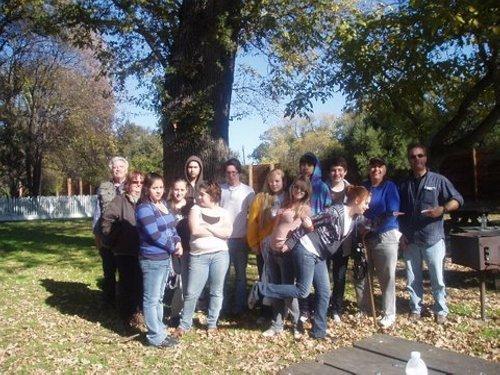
LOWER LAKE – Ten teenagers from Lower Lake High School and Carle Continuation High School spent three hours on Saturday, Nov. 14, training to become group leaders for nature walks and ranch house tours at Anderson Marsh State Historic Park.
Students who attended the training Saturday included Hallie Sullivan, Michelle La Rue, Aldo Rodriguez, Sarah Bye, Jonathan Duncan, Sheila Smires, Phoenix King, Shelby Saldana, Cierrah Tripp and Eduardo Pineda. Adults at the training included Tova Fry, Rory Sullivan and Carolynn Jarrett.
Adult volunteers from the Children's Museum of Art and Science (CMAS) and the Anderson Marsh Interpretive Association (AMIA) presented the training.
Billy Gear, an official state park docent and CMAS member, began the morning by telling the students about the importance of the next generation being good stewards of this incredible natural and cultural resource.
Students received handouts explaining the history of the ranch house and a descriptions of the various trails at the park.
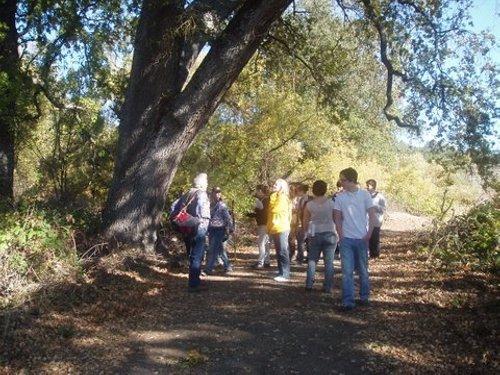
The group followed the Cache Creek trail to the end of the boardwalk, noting wild animal scat, different birds both seen and heard, two types of oaks, characteristics of riparian and grassland habitat, tules and other native and non-native plants.
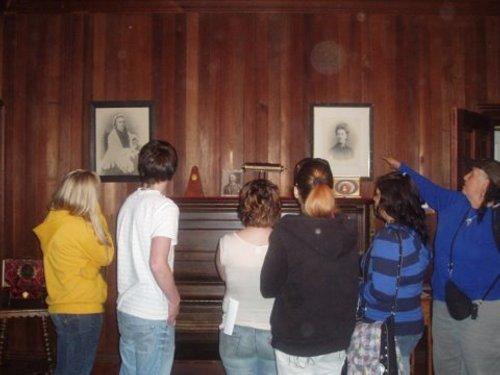
AMIA Secretary Gae Henry led the tour of the ranch house explaining to students how the house was built in three stages. Students were amazed to learn that all 10 of Grigsby's children (the original owner) slept in one bedroom upstairs.
CMAS and AMIA plan to offer two camps for fourth to sixth graders in May and October of 2010, and will be working with these teens to be group leaders at those camps.
- Details
- Written by: Yuba Community College District
These dollars have provided $1,000 scholarships to three students at Yuba College, one student at Woodland Community College (WCC), and one student at the Clear Lake Campus (CLC).
Next year, the Foundation for California Community Colleges will provide a minimum of 15 Osher Scholarships to colleges and campuses within YCCD, with the opportunity for the colleges to receive as many as 35 permanent $1,000 Osher Scholarships. This will be achieved through a matching gifts campaign of $345,000 toward which YCCD employees and friends have already donated $118,500 in support.
Earlier this semester, $625,000 in scholarship money was provided to the state’s 110 community colleges by the Foundation for California Community Colleges, fulfilling an ambitious pledge to provide swift benefit from a fund created in May 2008 with a $50 million commitment from the
Bernard Osher Foundation.
Thanks to this funding, 1,250 scholarships were distributed at community colleges across the state this semester, helping students pay for educational expenses such as text books, lab fees, uniforms and transportation. A second installment of the same amount will be distributed to colleges for the Spring 2010 semester, providing a total of $1.25 million in scholarship funding this academic year alone.
The California Community Colleges Scholarship Endowment is a permanent fund that provides scholarships of up to $1,000 annually to students who have already completed 24 units of study, are enrolled in at least six units for the current semester, and who qualify for a Board of Governors fee waiver. It combines the historic $50 million commitment – including an upfront gift of $25 million - from the Osher Foundation with a three-year match fundraising campaign that involves all 110 California Community Colleges. Through this campaign, the Endowment will ultimately grow to $100 million and provide scholarships for thousands of California students annually.
“The fact that our students are receiving additional resources during these tough financial times is a true blessing,” said YCCD Chancellor Dr. Nicki Harrington. “These scholarships will help make higher education a reality for many of our students at a time when attaining such an education is becoming a much more daunting task due to the financial crisis of the state.”
The scholarships come at a critical time, indeed. A record-high unemployment rate, coupled with enrollment caps at the University of California and California State University, is sending unprecedented numbers of students to the community colleges seeking a degree, certificate or job training.
At the same time, recent legislation has increased California Community College fees from $20 to $26 per unit. While California Community Colleges continue to remain affordable compared to other systems, non-tuition costs of college enrollment have grown much faster than the state’s general cost of living in recent years, according to “California Community Colleges: Making Them Stronger and More Affordable” by William Zumeta and Deborah Frankle.
“Thanks to the Osher Foundation, Yuba College has been able to provide more financial support to its students at a time when they most need it,” said Dr. Kay Adkins, Yuba College President. “These scholarships are assisting some of our neediest students continue with their education, which will in turn prepare more of our students to enter the local workforce and revitalize the economy.”
“This scholarship has helped me out tremendously, allowing me to purchase books and other school materials,” said Samira Timury, a second year Yuba College student studying to be a registered nurse. “As a single parent working and studying in these difficult times, any little bit helps. The Osher Scholarship has enabled me to continue my education, and for that I am very grateful.”
In addition to the financial hardships students face, community colleges across the state, including YCCD, are dealing with budget challenges of their own. With more than 2.9 million students enrolled last year, 18,129 of which attended YCCD, California Community Colleges are seeing their highest attendance levels in the history of the system. Despite such rapid enrollment growth, $830 million in budget cuts to community colleges have forced campuses to reduce course offerings. YCCD has been no exception, compressing its schedules for the fall, spring and summer semesters.
“Our community colleges are facing extremely difficult economic challenges due to state budget cuts and the national recession, yet we must do everything we can to continue to serve our students and provide them with a quality and affordable education in order meet the workforce needs of the region and throughout the state of California,” said Dr. Angela Fairchilds, WCC President. “These scholarships are a positive step in that direction, easing the financial burden on our students while simultaneously assisting the colleges that serve them.”
The Yuba Community College District spans eight counties and nearly 4,200 square miles of territory in rural, north-central California. It has colleges in Marysville and Woodland, an educational center in Clearlake, and will be adding outreach facilities in Sutter and Colusa Counties as part of the Measure J facilities bond.
For more information on the Osher Scholarship and how to contribute to the YCCD Foundation, please visit the foundation’s Web site at www.yccd.edu/foundation .
- Details
- Written by: Andrea McMullen

Carlé High would like to send our condolences to the family of John Wellman who recently passed away.
Mr. Wellman was the director of the Konocti Adult School. John worked very closely with Carlé and many other students and adults in the community, teaching them about art and many other subjects. John will be greatly missed and all of the hard work he has done that has benefited the community over the years will always be remembered.
This week is Thanksgiving break and we hope everyone here has a safe and fun turkey day!
Friday, Nov. 20, is the end of the second out of six of grading periods, and we are now one third of the way through our school year. All of the students at Carlé work very hard to maintain their grades and are substantially rewarded for maintaining their high grades.
Bianca Frias, Tyler Gillam and Alex Von Rekowski are filming for TV8, which student Ryan Cumpston is Carlé's liaison. This group will be filming the Clearlake City Council meetings two Tuesdays and two Thursdays a month, there are still sign-ups available for those interested.
Our CHILY prize winner this week was Chantelle Clemons! Congratulations to Chantelle.
Our student of the week was Ryan Cumpston who our principal Ed Zander nominated for helping our school whenever he can and having excellent attendance, being serious about his grades and having an over-all great attitude. Congratulations Ryan and keep up the hard work!
Carlé's birthdays last week were Nyieelaah X-Tate on Nov. 12 and Jonnathan Truax on Nov. 11.
We have the names of the annual Harvest Fest winners from Angie's advisory. They are: Kara Boyce, Stephani Conner, Tyler Gillam, Geneva Hudson, Michelle Larue, Paul Larue, Joe Maggio, Christine McQuown, Michelle Perry-Alden, Brooke Robb, Shelby Saldana, Stephanie Skeen, Kaitlyn Sliger, Alex Von Rekowski and Ashley Weibusch. Congratulations to Angie's advisory!
Andrea McMullen is a student at Carlé Continuation High School in Lower Lake.