It’s easier than ever to repair or recycle electronic devices. Elisa Schu/picture alliance via Getty ImagesElectronic gifts are very popular, and in recent years, retailers have been offering significant discounts on smartphones, e-readers and other electronics labeled as “pre-owned.” Research I have co-led finds that these pre-owned options are becoming increasingly viable, thanks in part to laws and policies that encourage recycling and reuse of devices that might previously have been thrown away.
Amazon, Walmart and Best Buy have dedicated pages on their websites for pre-owned devices. Manufacturers like Apple and Dell, as well as mobile service providers like AT&T and Verizon, offer their own options for customers to buy used items. Their sales rely on the availability of a large volume of used products, which are supplied by the emergence of an entire line of businesses that process used, discarded or returned electronics.
Originally intended to reduce the amount of electronic waste flowing into the state’s landfills, California’s law did far more, unleashing a wave of innovation, our analysis found.
We analyzed the patent-filing activity of hundreds of electronics firms over a 17-year time span from 1996 to 2012. We found that the passage of California’s law not only prompted electronics manufacturers to engage in sustainability-focused innovation, but it also sparked a surge in general innovation around products, processes and techniques.
Faced with new regulations, electronics manufacturers and suppliers didn’t just make small adjustments, such as tweaking their packaging to ensure compliance. They fundamentally rethought their design and manufacturing processes, to create products that use recycled materials and that are easily recyclable themselves.
For example, Samsung’s Galaxy S25smartphone is a new product that, when released in May 2025, was made of eight different recycled materials, including aluminum, neodymium, steel, plastics and fiber.
Combined with advanced recycling technologies and processes, these materials can be recovered and reused several times in new devices and products. For example, Apple invented the Daisy Robot, which disassembles old iPhones in a matter of seconds and recovers a variety of precious metals, including copper and gold. These materials, which would otherwise have to be mined from rock, are reused in Apple’s manufacturing process for new iPhones and iPads.
How do consumers benefit?
In the past two decades, 25 U.S. states and Washington D.C. have passed laws requiring electronics recycling and refurbishing, the process of restoring a pre-owned electronic device so that it can function like new.
The establishment of industry guidelines and standards also means that all pre-owned devices are thoroughly tested for functionality and cosmetic appearance before resale.
Companies’ deeper engagement with innovation appears to have created organizational momentum that carried over into other areas of product development. For example, in our study, we found that the passage of California’s law directly resulted in a flurry of patents related to semiconductor materials, data storage and battery technology, among others. These scientific advances have made devices more durable, repairable and recyclable.
For the average consumer, the recycling laws and the resulting industry responses mean used electronics are available with similar reliability, warranties and return policies as new devices – and at prices as much as 50% lower.
This artist’s rendering shows the ESCAPADE probes near Mars. NASA
After a yearslong series of setbacks, NASA’s Escape and Plasma Acceleration and Dynamics Explorers, or ESCAPADE, mission has finally begun its roundabout journey to Mars.
Launched on Nov. 13, 2025, aboard Blue Origin’s New Glenn rocket, ESCAPADE’s twin probes will map the planet’s magnetic field and study how the solar wind – the stream of charged particles released from the Sun – has stripped away the Martian atmosphere over billions of years.
But this low-cost mission is still only getting started, and it’s taking bigger risks than typical big-ticket NASA missions.
ESCAPADE is part of NASA’s Small Innovative Missions for Planetary Exploration, or SIMPLEx, program that funds low‑cost, higher‑risk projects. Of the five SIMPLEx missions selected so far, three have failed after launch due to equipment problems that might have been caught in more traditional, tightly managed programs. A fourth sits in indefinite storage.
ESCAPADE will not begin returning science data for about 30 months, and the program’s history suggests the odds are not entirely in its favor. Nonetheless, the calculus goes that if enough of these missions are successful, NASA can achieve valuable science at a reduced cost – even with some losses along the way.
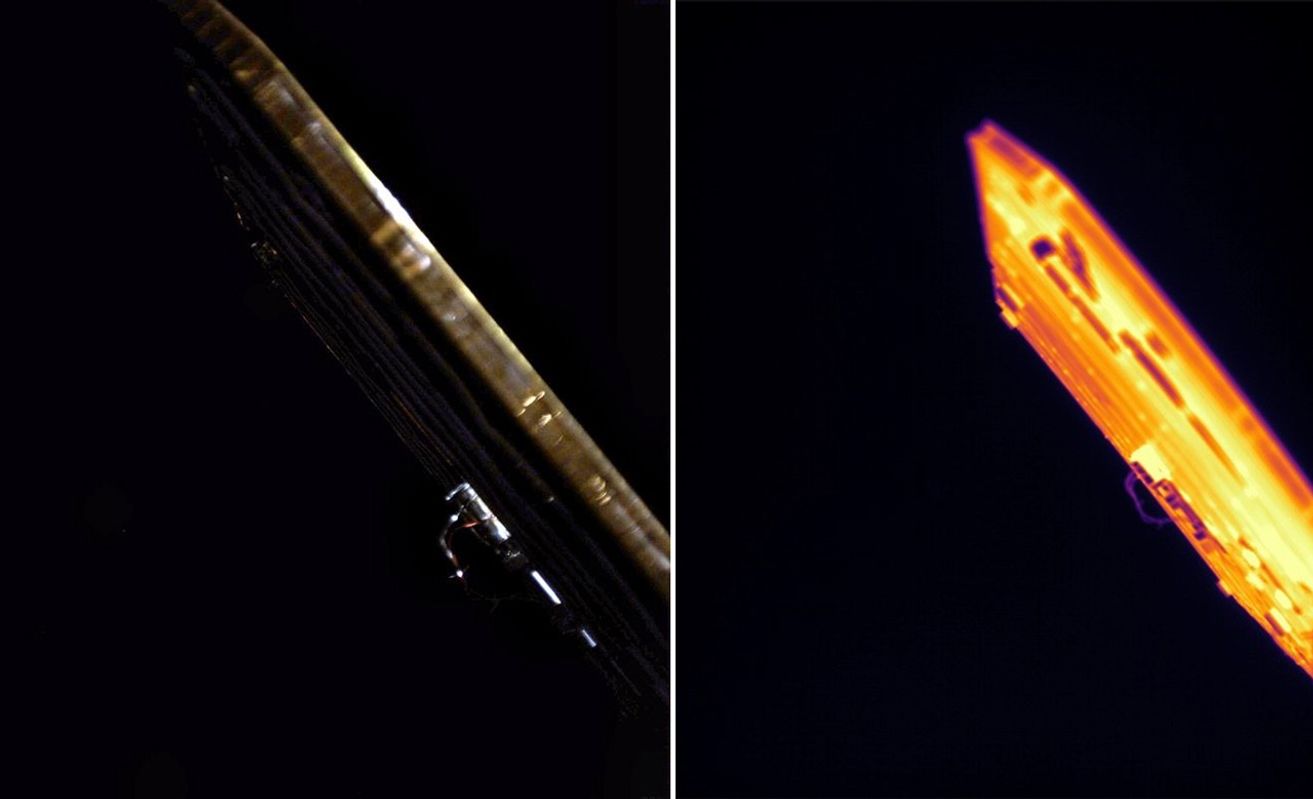
First light taken Nov. 21, 2025, from the VISIONS camera aboard Gold, one of NASA’s ESCAPADE spacecraft, showing the side of a solar panel. The left image is the visible-light camera, sensitive enough to image Mars’ green aurora. The right image is from an infrared camera and shows temperature differences, from warmer (yellow and orange) to cooler (purple and black), that can distinguish geologic features on Mars.NASA/UCB-SSL/RL/NAU-Radiant/Lucint
ESCAPADE is at the other end. It’s a class D mission, defined as having “high risk tolerance” and “medium to low complexity.”
Of the 21 class D missions that have launched since the designation was first applied in 2009, NASA has not had a single class D mission launch on schedule. Only four remained under budget. Four were canceled outright prior to launch.
ESCAPADE, which will have cost an estimated US$94.2 million by the end of its science operations in 2029, has stayed under the $100 million mark through a series of cost‑saving choices. It has a small set of key instruments, a low spacecraft mass to reduce launch costs, and extensively uses generic commercial components instead of custom hardware.
NASA also outsourced to private companies: Much of the spacecraft development went to Rocket Lab and the trajectory design to Advanced Space LLC, with tight contract limits to make sure the contractors didn’t go over budget.
Additional savings came from creative arrangements, including the university‑funded VISIONS camera package and a discounted ride on New Glenn, which Blue Origin wanted to fly anyway for its own testing objectives.
Commercial space
ESCAPADE launched at a moment of transition in space science.
That boom has, in part, led to a resurgence in NASA’s “faster, better, cheaper” push that originated in the 1980s and ‘90s – and which largely faded after the 2003 Columbia disaster.
In theory, leaner NASA oversight, greater use of off‑the‑shelf hardware and narrower science goals can cut costs while launching more missions and increasing the total science return. If ESCAPADE succeeds in delivering important science, it will be held up as evidence that this more commercial, risk-tolerant template can deliver.
The trade-offs
A concept put forward by Jared Isaacman, the Trump administration’s nominee to lead NASA, is that 10 $100 million missions would be better than one $1 billion flagship – or top-tier – mission. This approach could encourage faster mission development and would diversify the types of missions heading out into the solar system.
But that reorganization comes with trade-offs. For example, low‑cost missions rarely match flagship missions in scope, and they typically do less to advance the technology necessary for doing innovative science.
Early in ESCAPADE’s development, my role was to help create a planning document for the VISIONS cameras called the Science Traceability Matrix, which defines an instrument’s scientific goals and translates them into concrete measurement requirements.
My colleagues and I systematically asked: What do we want to learn? What observations prove it? And, critically, how precisely does the instrument need to work to be “good enough,” given the budget? Loftier goals usually demand more complex instruments and operations, which drive up costs.
ESCAPADE’s broader goals are to create a clearer picture of Mars’ magnetic field, how the solar wind interacts with it, and figure out what that process does to Mars’ atmosphere. That is valuable science. But it is more modest than the $583 million predecessor mission MAVEN’s more extensive scope and richer suite of instruments. It was MAVEN that determined how and when Mars lost its once-dense atmosphere in the first place.
Both ESCAPADE and MAVEN are dwarfed again by the open‑ended potential of an operation like the James Webb Space Telescope, which observes a limitless slate of astronomical objects in the infrared light spectrum with a higher resolution than any combination of prior smaller telescopes.
Flagship missions like the James Webb Space Telescope push the state of the art in new technologies and materials. These innovations then filter into both future missions and everyday life. For example, the Webb telescope advanced the medical tools used in eye exams. Smaller missions rely more heavily on existing, mature technologies.
And when systems are built by private companies rather than NASA, those companies keep tight control over the patents rather than openly spreading the technology across the scientific community.
A tense road to launch
ESCAPADE’s principal investigator, Rob Lillis, has joked that it is the mission with 11 lives, having survived 11 near‑cancellations. Problems ranged from being late in reaching the technology readiness levels that helped ensure the probes wouldn’t malfunction after launch, to the loss of its original free ride, with NASA’s Psyche mission.
In 2024, ESCAPADE received support from NASA to ride on New Glenn’s maiden flight, only to face delays as Blue Origin worked through technical hurdles. At last, in October 2025, ESCAPADE reached the launchpad.
I traveled to Cape Canaveral for the launch and felt the tension firsthand. The first window was scrubbed by bad weather and issues with ground equipment. Then a strong solar storm — ironically, a key driver of the very processes ESCAPADE will study — shut down the second window.
Finally, on Nov. 13, after repeated setbacks, New Glenn lifted off to cheers around the country. ESCAPADE reached orbit, and after a nervous few hours of receiver misalignment, mission controllers established communication with the spacecraft.
What’s next
While in Florida, I also watched another milestone in commercial spaceflight: the record-breaking 94th launch from Cape Canaveral in 2025, marking the most launches from Florida in a single year. It was a SpaceX Falcon 9 carrying Starlink satellites.
Like New Glenn, SpaceX’s Falcon 9 saves money by landing and reusing rockets. If multiple providers like SpaceX and Blue Origin compete to keep launch prices low, the economics of small science missions will only improve.
On Nov. 10, SpaceX launched a Falcon 9 rocket from Cape Canaveral, the record-breaking 94th launch of 2025.SpaceX
If ESCAPADE’s twin spacecraft reach Mars and deliver new insights as planned, they will demonstrate how minimalist, commercial-forward approaches can expand the planetary knowledge base.
But even then, a string of future SIMPLEx successes would likely not be a substitute for the uniquely capable, technology‑advancing flagship missions that answer the most far‑reaching questions. ESCAPADE can instead help test whether a broader mix of small missions – leaning on commercial partners and a few big, ambitious flagships – can together sustain planetary science in an era of tight budgets.
For now, that balance remains an open experiment, and only time will tell whether ESCAPADE is a lone bright spot or the start of a real shift.
















 How to resolve AdBlock issue?