 How to resolve AdBlock issue?
News
- Details
- Written by: Elizabeth Larson
The California Department of Finance's report on state population numbers shows that 409,000 residents came to California in 2008, raising the state's population to 38,293,000 as of Jan. 1 of this year.
Of California's 480 cities, 453 showed populations gains, five experienced no change and 20 lost population, according to the report.
In Lake County, the county as a whole posted a modest population gain in 2008 of 0.3 percent, with population rising from 63,805 to 64,025.
Outside of the incorporated areas of Lakeport and Clearlake, population actually declined by 0.2, dropping from 44,592 to 44,489, according to the report.
Lakeport posted the largest growth numbers in the county, with the number of residents rising from 5,024 to 5,146, for a 2.4 percent increase.
In Clearlake, the percentage population growth was smaller, at 1.4 percent. In 2008 the city's number of residents grew from 14,189 to 14,390.
Other California population facts from the report:
• The city of Los Angeles, California's largest city, has reached a population of 4,065,585. Los Angeles grew by over 43,000 persons during the year.
• San Diego, the state's second-largest city, has a population of 1,353,993 and added over 20,000 persons in 2008.
• The city of San Jose exceeded 1 million in population in 2008, adding 21,585 new residents during the year to reach 1,006,892, making it the 10th city in the United States to exceed 1 million persons.
• The city of Riverside became the 12th California city to exceed 300,000 (it's current population is 300,430).
• Fresno has replaced Long Beach as the state's fifth largest city. Fresno was estimated to have 495,913 residents, while Long Beach came in with a population of 492,682.
• There are now 69 cities in California with a population exceeding 100,000.
• Sand City in Monterey County (population 312) was the state's fastest growing city on a percentage basis, increasing by 4.7 percent. The next four fastest growing cities were Albany in Alameda County (4.5 percent), Calipatria in Imperial County (4.5 percent), Tehachapi in Kern County (4.4 percent), and Woodlake in Tulare County (4.1 percent).
• The biggest numeric increases typically occurred in some of the state's largest cities – Los Angeles (43,135), San Jose (21,585), San Diego (20,376), Fresno (10,578) and San Francisco (10,195).
• Since the April 1, 2000 census, the top four fastest growing California cities all have more than doubled in size, including Lincoln in Placer County (258 percent), Beaumont and Murrieta in Riverside County (185 percent and 127 percent respectively), and Brentwood in Contra Costa County (123 percent).
• Two new incorporations occurred in Riverside County in 2008: Wildomar and Menifee.
• California's housing growth continued a recent trend by declining once again from the previous year. Since peaking in 2005, when the state was estimated to have added 197,707 new housing units, there has been a steady reduction in residential construction. In 2006, the state added 172,604 units; in 2007, there were 131,912 units built, then last year only 86,745 were constructed – the smallest change since 1998.
• The 2008 relocation of California's prison population among various facilities within California, and to other states, resulted in the overall number of incarcerated persons declining for the second year in a row, down by 5,081 to 185,153 inmates statewide. The largest prison declines occurred in Vacaville (-1,033) in Solano County, Avenal (-807) in Kings County, Chino (-571) in San Bernardino County and Blythe (-495) in Riverside County. Tehachapi (+273) in Kern County, Ione (+259) in Amador County, and Victorville (+187) in San Bernardino County gained prison population.
E-mail Elizabeth Larson at
- Details
- Written by: Lake County News Reports
In the 1920s “The Plaza” was a gathering place for all with outdoor dances, music and other events. In the 1990s “The Plaza” fell into disrepair and a large part of history for Clearlake Oaks was covered with pavement and used as a parking lot.
On Friday, the County of Lake and the Lake County Redevelopment Agency will celebrate the grand opening of the newly resurrected Clearlake Oaks Plaza.
The grand opening event will begin at 1 p.m. with an acoustical guitar performance by Dave Hendrick, special guest speakers including Assemblyman Wes Chesbro, District 3 Supervisor Denise Rushing, Pastor Ken Young, Margaret Medeiros of the Clearlake Oaks-Glenhaven Business Association, other dignitaries and a vocal performance by the United Methodist Community Church Choir.
Join the county of Lake and the Lake County Redevelopment Agency on Friday to celebrate The Plaza's grand opening and be a part of the new history of Clearlake Oaks.
- Details
- Written by: Elizabeth Larson
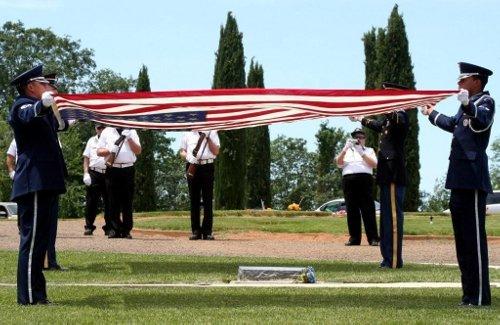
LAKEPORT – In Lakeport's Hartley Cemetery there is a special spot reserved for local veterans.
It's known as Veterans Circle.
In 2006, the United Veterans Council Military Funeral Honors Team – a devoted band of military brothers and sisters who offer funerary honors for local veterans – created the space.
Originally, its aim was for indigent veterans. While it's since been opened up to all veterans, those without means or family still comprise most of those laid to rest there.
It's also a place of commemoration for all veterans. Flag-raising ceremonies are held there on Memorial Day and Veterans Day, and memorial wreaths are laid there in December as part of the annual “Wreaths Across America” commemoration.
Just this past week, two more veterans were honored at the circle.
The Military Funeral Honors Team reported that Chris R. Erickson, a veteran of the U.S. Army, and Kenneth W. J. Evans, a veteran of the U.S. Air Force, were laid to rest in Veterans Circle on May 18.
The men's family weren't present, but they did have many friends – many of whom they may never have met.
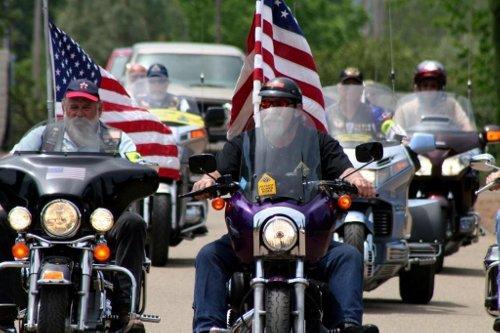
Those friends included the county's many veterans organizations, the Missing in America Program, Patriot Guard Riders, Operation Tango Mike and the Lake County Veterans Service Office who were present to pay their respects.
The Military Funeral Honors Team provided the eulogy, three volley rifle salute and the playing of “Taps.”
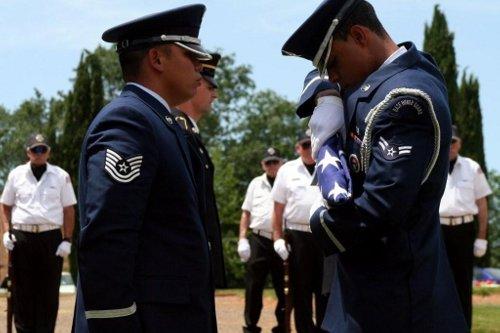
The California State Honor Guard and the Travis Air Force Base Honor guard were on hand to fold the veterans' US flags.
Those flags were then presented to the Avenue of Flags, and will fly over Hartley as part of the annual display on Memorial Day on Monday.
Erickson and Evans join fellow veterans including George Elder, Lawrence Quinn and Robert Kincaid.
Elder, who died May 26, 2008, was buried a month later, on June 24. He served in the US Air Force from 1957 to 1961, and his friend and neighbor, Terre Logsdon, accepted his flag.
Quinn and Kincaid, both Navy vets laid to rest in the circle on Oct. 11, 2008.
Quinn served during the Korean War and died Sept. 11, 2008. The ashes of Kincaid, who died in 2003, were unclaimed for five years before the Missing in America Project assisted with obtaining his cremains for burial, as Lake County News has reported.
Since their burials, the families of Elder and Kincaid discovered the men's whereabouts.
In the case of Kincaid, his son, Texas resident Ron Simpson, who was separated from his father in childhood, credited the Missing in America Project for its efforts on behalf of vets. An Internet search led him to the story, posted last fall, of his father's burial.
Hartley Cemetery is located at 2552 Hill Road, Lakeport.
E-mail Elizabeth Larson at
- Details
- Written by: Elizabeth Larson
Republican Congressman Howard “Buck” McKeon and North Coast Congressman Mike Thompson (D-St. Helena) worked together across the aisle to introduce the Veterans Educational Equity Act, HR 2474, which has since won overwhelming support from the California delegation. The bill has a total of 36 co-sponsors.
McKeon and Thompson told reporters late last week that they're trying to get the legislation through to prevent California veterans from facing an unfair reduction in benefits under the post-9/11 GI Bill.
“I'm hoping that we don't have to go through the whole legislative fix,” said Thompson, who called the situation “no more than a bureaucratic snafu.”
The Post-9/11 GI Bill – which becomes effective this summer – requires that the US Department of Veterans Affairs (VA) pay each veteran's private university tuition based on the highest in-state undergraduate tuition rate at a state operated school in the state of enrollment.
Thompson, chair of the Military Veterans Caucus, said the bill was passed to provide educational opportunities for veterans of the wars in Iraq and Afghanistan.
The issue, as Thompson explained in a letter to VA Secretary Eric Shinseki – which McKeon co-signed – is that California is constitutionally barred from using the word “tuition” and instead uses the word “fees” to describe the cost of matriculation at public universities.
While the VA has determined the maximum tuition benefit for California veterans to be $0, the maximum fee benefit can equal up to $6,586.54, according to the congressmen.
McKeon said the president of Pepperdine University, Andrew K. Benton, brought the issue to his attention. Benton told McKeon that veterans who wanted to attend Pepperdine, a private university in Malibu, were told they wouldn't be reimbursed.
“It is reasonable to assume that these two words are interchangeable,” wrote Thompson. “Unfortunately, based on this simple semantic difference, the VA has determined that since California does not use the literal term 'tuition,' the state has a $0.00 level of reimbursement for tuition claims at private universities. As such, our veterans will be denied these critical benefits, and put at a great disadvantage in comparison to veterans in other states.”
Veterans applying for the benefits have so far been denied, while they've been granted to veterans in every other state, McKeon and Thompson explained.
It's an especially critical issue, since – as Thompson told Shinseki – “the denial of such benefits to California veterans was most certainly not the intent of Congress when passing this landmark legislation.”
As well, there are more veterans reside in California than any other state in the country – more than two million in all, said McKeon.
Last Tuesday, Pepperdine's Benton was in Washington and he worked with McKeon's staff to quickly draft the bill.
The following day, McKeon – the top Republican on the Education & Labor Committee and a senior member of the House Armed Services Committee – personally brought the issue to the attention of Education Secretary Arne Duncan, who called fixing the problem a “no brainer.”
“Everybody's pulling together to try to make this happen,” said McKeon.
McKeon explained that time is of the essence – the VA needs to get checks out to student-veterans by Aug. 1; that's when the Post-9/11 GI Bill officially goes into effect. The VA has reported that it is notifying 500,000 veterans about the new GI Bill benefits.
Meanwhile, HR 2474 has been referred to the House Committee on Veterans' Affairs.
E-mail Elizabeth Larson at




