 How to resolve AdBlock issue?
News
- Details
- Written by: Lake County News Reports
NORTH COAST – With salmon populations still showing troubling declines, the federal government announced Thursday that it is extending fishing restrictions to protect the fish.
US Commerce Secretary Gary Locke said Thursday he was extending the 2008 West Coast salmon disaster declaration for California and Oregon in response to expected poor salmon returns to the Sacramento River, which have led to management reducing commercial salmon fishing off southern Oregon and California to near zero.
Locke also announced that he would release $53.1 million in disaster funds to aid fishing communities.
“Salmon returns are expected to be near record lows again this year. The extension of the disaster declaration will ensure that aid will be available to affected fisherman and their families to help offset the economic impact of the closure of the commercial fisheries,” said Secretary Locke. “These funds can also aid fishing-related businesses, such as ice and bait suppliers, who may struggle with the financial effects of the closure.”
Locke’s announcement followed the Pacific Fishery Management Council’s April 8 recommendation that California’s commercial salmon fisheries be closed for the 2009 season. Following its recommendations, California's Fish and Game Commission took action to close recreational ocean fishing.
The National Oceanic and Atmospheric Administration (NOAA) will formally adopt the Pacific Fishery Management Council’s full recommendations, made in April, halting virtually all commercial salmon harvests off the West Coast south of Cape Falcon, Ore. A recreational coho fishery and a limited commercial fishery will be allowed off Oregon. Salmon season formally begins May 1.
On April 21, Gov. Arnold Schwarzenegger and Oregon Governor Theodore Kulongoski sent a letter to Locke, requesting the disaster declaration extension of additional federal aid for those impacted by the closure. Schwarzenegger also declared a state of emergency in California in response to the salmon situation.
On Thursday, Schwarzenegger thanked Locke for taking the action. “California’s salmon are not only a vital part of our state’s overall economy, they directly affect the livelihoods of thousands of California fisherman and their families.”
NOAA’s National Marine Fisheries Service will work with the states and the Pacific States Marine Fisheries Commission to distribute the $53 million in remaining salmon aid from last year’s $170 million Congressional appropriation to help fishing communities affected by the poor returns.
Based on the economic impact, of the remaining $53 million, Locke has allocated approximately $46.4 million to California and $6.7 million to Oregon.
Sacramento River Fall-run Chinook are the foundation of the West Coast’s commercial salmon harvest and in typical years 400,000 to 600,000 of them return to spawn. Under current federally approved rules for managing the ocean salmon fishery, a minimum of 122,000 Sacramento River Fall Chinook must be predicted to return to the Sacramento-San Joaquin River system before any harvest can take place.
Last year, barely 66,000 Fall Chinook returned to their spawning grounds in the system. This year, a greater number of Chinook are expected, but only marginally more than the 122,000 needed to maintain the health of the fishery. Agency biologists said the 2008 collapse was triggered primarily by climatic conditions that produced little food in the ocean, compounded by too much reliance on fish produced in hatcheries instead of the wild.
“NOAA will continue to work with the states and our partners in the region on habitat and hatchery issues that may be contributing to the difficult fishery management problems that the Sacramento River system has been experiencing,” said Jane Lubchenco, Ph.D., Under Secretary of Commerce for Oceans and Atmosphere and NOAA Administrator.
Earlier this week, three bills by Sen. Patricia Wiggins (D-Santa Rosa) aimed at helping salmon and the industry based on them cleared a key legislative hurdle.
On Tuesday, the Senate Committee on Natural Resources & Water voted to approve Senate Bills 539, 670 and 778, which now move to the Senate Appropriations Committee.
Senate Bill 539, which the committee approved 7-4, directs the state Ocean Protection Council (OPC) to give the Legislature a report that ranks the solutions to reversing the alarming decline of salmon and steelhead populations and lists the costs to implement those actions. The OPC is the state arm that coordinates state agencies’ efforts to protect and conserve coastal and oceanic ecosystems.
In her testimony before the committee, Wiggins said that the OPC’s mission “is to ensure California maintains healthy, resilient, and productive ocean and coastal ecosystems for the benefit of current and future generations. SB 539 enlists the OPC in restoration efforts by authorizing it to engage in the full range of activities needed to bring back salmon and steelhead.”
Senate Bill 670, which the committee approved on a bipartisan vote of 8-3, prohibits the use of suction dredge mining equipment in rivers and streams that provide critical habitat to spawning salmon until the state Department of Fish and Game (DFG) completes its court-ordered overhaul of regulations governing the controversial recreational activity.
In presenting SB 670, Wiggins noted that “the salmon numbers are so low that the National Marine Fisheries Service has placed a ban on all salmon fishing along the coast of California and Oregon. This ban affects the livelihoods of thousands of commercial fishermen, fish processors, and charter boat operators. Yet while fishermen are being told to stop fishing, suction dredge mining is allowed to continue. SB 670 is about equity. We simply cannot ask an entire fishing industry to stop their work while a small group of hobbyists are allowed to continue.”
Senate Bill 778, which the committee approved on a bipartisan vote of 9-1, requires the state DFG to provide a thorough accounting of funds generated from commercial salmon fishing permits, known as “salmon stamps.” The self-taxation funds paid by fishermen are required to be spent on fisheries and habitat restoration.
There is growing concern in the fishing industry that the money is not getting to top priority projects. SB 778 would incorporate measures, based on an audit, to strengthen the program and, with agreement from fishermen, will increase the price of the “stamp” in order to ramp up protection efforts during the ongoing salmon crisis.
In her testimony, Wiggins said SB 778 “continues the tradition of commercial fishermen dedicating a portion of their permit fees to help restore the salmon fisheries that sustain their industry. The dedicated portion of the fee is managed by the DFG for salmon regeneration. Because of the salmon crisis, fishermen are volunteering to raise the cost of salmon permit to $350. The bill also seeks to require the DFG to provide a better accounting for the expenditures of this fund. This will ensure that the funding goes directly to priority projects, in a timely manner.”
Wiggins, who chairs the Joint Legislative Committee on Fisheries and Aquaculture, said that it’s imperative that the Legislature and the responsible state agencies do all that they can to protect the invaluable salmon populations.
“Salmon are not just trophy and sport fish. They form the backbone of California ecosystems, tribal cultures, local economies, a commercial fishing industry and a once-plentiful, wonderful food. We must work together to give these magnificent fish a chance to recover,” Wiggins said.
.
- Details
- Written by: Elizabeth Larson
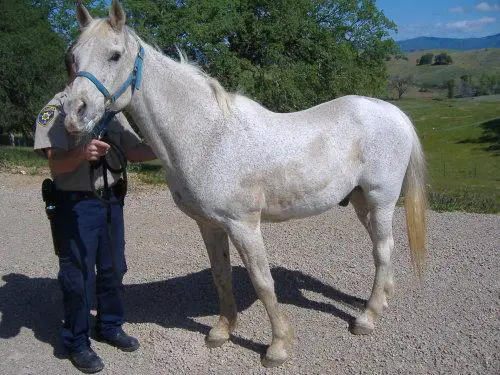
LAKEPORT – A horse who – when he was rescued earlier this year – was severely underweight and in bad condition has made a big recovery, and Lake County Animal Care and Control officials are hoping to find him a new home.
Animal Care and Control took the 25-year-old Arab gelding into custody due to neglect, according to Deputy Director Bill Davidson.
He said on Feb. 4 Officer Nehemiah White responded to a neglected horse call off of Highway 29 near Lower Lake.
Davidson said Animal Care and Control immediately called Dr. Jeff Smith of Middletown Vet Hospital, who estimated that the horse was approximately 150 pounds underweight, had parasites, long hooves and severe dental disease.
On Wednesday Davidson said that they've passed the two-month mark in the horse's recovery, and the veterinarian has given the all clear on the horse's condition.
The difference in the horse, said Davidson, is incredible.
When he was first brought in, the gelding's ribs and hip bones jutted out under his ragged, “flea-bitten” – denoting small flecks of color – gray hide.
Now, however, he's looking much healthier, with added weight and alert eyes.
“We did some dental work, parasite control, supplied the proper nutrition, and that's all it took,” said Davidson. “Following Dr. Smith's regimen of care we now have ourselves a healthy, energetic and potentially rideable horse.”
Davidson said Animal Care and Control will submit a case to the District Attorney's Office sometime next week, seeking animal cruelty charges against the horse's former owner.
They also have the happier work of looking for a loving, forever home for the gelding.
Davidson said they are accepting sealed bids from interested horse lovers through 5 p.m. May 18.
The minimum bid is $250, said Davidson. The highest bidder with an approved application will get to take home a new four-legged friend.
For more information, contact Lake County Animal Care and Control, 707-263-0278.
E-mail Elizabeth Larson at

- Details
- Written by: Elizabeth Larson
LUCERNE – A longtime Northshore festival is having a revival this weekend.
On Saturday, the Lucerne Booster Club and North Shore Business Association will presented the return of the Alpine Arts Festival from 10 a.m. to 4 p.m. at Harbor Village Artists, 6197 Highway 20, Lucerne.
The event will feature the music of David Neft beginning at 10 a.m., a Youth Writes poetry showcase at 11 a.m., two skits from “Charlie and the Chocolate Factory” by the Lucerne Elementary Drama Club, performances by the Upper Lake High School Band, an open mike, 50/50 raffle by Lucerne Elementary’s eighth grade class, vendor booths, game booths, eight art booths with activities for children, lots of food and fun.
Spearheading the festival’s return is the Lucerne Booster Club, led by President Lani Urquiza and Vice President Jim Hankins.
The festivals began in the 1930s, and originally were hosted by the local fire department auxiliary as a way to raise funds for Lucerne’s fire department, said Urquiza.
Later, the festival was turned over the booster club, but the festivals had stopped in recent years, she said.
Urquiza said Lucerne Elementary Principal/Superintendent Mike Brown asked her to begin putting the festival back together, a process which began last December, when Urquiza was elected the club’s president.
She said the experience has been a positive one, with a group of about 25 parents getting involved to get the new festival off the ground. Urquiza credited Hankins for also being a big inspiration, since he remember the original festival and had been involved with organizing them. Numerous businesses also have pledged their support.
The North Shore Business Association is partnering with the booster club in sponsoring the event, which Urquiza said is being held at the artists’ colony to put the spotlight on the area’s redevelopment. The Northshore Fire Protection District also is taking part.
She said it’s going to be a great event for the community’s children. “That was the main goal, to get our children involved in a positive, creative way, and bring our community together.”
Urquiza said Upper Lake High School’s art teacher will have a booth where children can enjoy art activities, while the Upper Lake Town Council will host suncatcher painting for children. There also will be face painting and activities for little children, including making bubbles and butterflies.
She said her husband will have a booth where children can build toolboxes, with Friedman’s donating numerous little tape measures to be included. Foster’s Freeze is donating ice cream prices.
“It’s very heartfelt,” said Urquiza. “So many people in the community have really pulled together to bring this event back.”
With local schools facing greater and greater budget challenges, booster clubs and the funds they raise are becoming crucial. “All of our schools are suffering big budget cuts,” she said. “We all are feeling it.”
Urquiza said this year the club raised around $5,000 to send the school’s fifth and six graders to science camp for the first time. The club also furnishes young author and citizenship awards, and is helping the eighth grade with its graduation.
Anyone who wishes to make a donation to the club can send checks to Lucerne Booster Club, P.O. Box 537, Lucerne, CA 95458.
For more information, contact Urquiza at 707-349-5457 or e-mail the booster club at
E-mail Elizabeth Larson at
- Details
- Written by: Lake County News Reports
LAKE COUNTY – A sobriety checkpoint is in the works for the end of the week, according to a Wednesday report from the California Highway Patrol.
CHP, Clearlake Police Department, Lakeport Police Department, and the Lake County Sheriff’s Office are planning the checkpoint at some point in the next few days at an unspecified location.
“Traffic volume permitting, all vehicles will be checked and drivers who are under the influence of alcohol and/or drugs, or unlicensed, can be expected to be arrested,” said CHP Commander Lt. Mark Loveless.
He added, “Our goal is to ensure the safe passage of each and every motorist. DUI enforcement patrols as well as sobriety checkpoints are effective tools for achieving this goal and are designed to augment existing patrol operations.”
The agencies reported that they take a zero tolerance approach to impaired drivers on local roadways.
Each agency has received funding from the Office of Traffic Safety, and working together they have developed a plan to deploy DUI enforcement patrol teams and sobriety checkpoints through December of 2009.
The coalitions’ desired result is to save lives and make everyone’s family summer excursion, for both our community residents and those visiting our beautiful county, a safe and pleasurable memory.
Sobriety checkpoints will be staffed by officers and deputies from each department who are trained in the detection of alcohol and/or drug impaired drivers. Drug Recognition Experts, certified by the National Highway Traffic Safety Administration, will be on site to provide on the spot assessments of drivers suspected of drug use.
The officers and deputies will also be equipped with state of the art hand-held breath analyzing devices which provide an accurate measure of blood alcohol concentrations of suspected drunk drivers.
Cal-Trans employees will be on site providing traffic control in order to ensure the safety of officers and motorists alike.




