How to resolve AdBlock issue?
News
- Details
- Written by: Elizabeth Larson
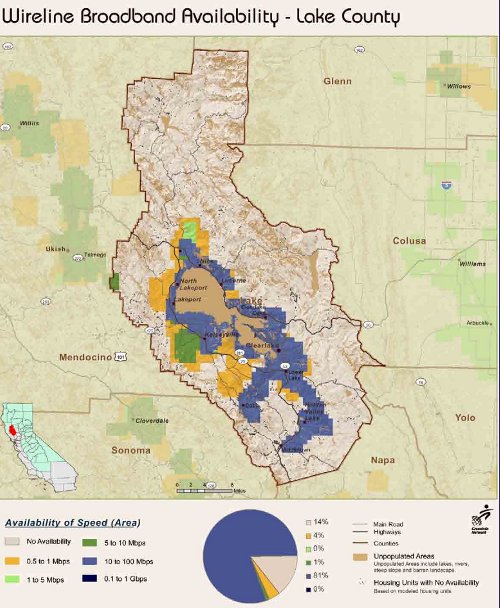
LAKEPORT – Local residents, businesses and officials gathered Friday afternoon to hear an update on the effort to map broadband access across Lake County.
The county of Lake hosted the afternoon meeting at the courthouse in Lakeport, where members of California State University, Chico's Center for Economic Development (CED) explained the Upstate California Connect regional broadband demand aggregation project.
“Upstate California Connect” is a group of five counties – Lake, Colusa, Glenn, Sutter and Yuba – that partnered with CED last year to propose a work plan to the California Emerging Technology Fund (CETF), a nonprofit organization established by the California Public Utilities Commission to improve access to broadband in underserved communities across California.
In late 2007, a group of North Coast counties received a CETF grant to expand broadband in rural areas, but Lake County wasn't included in that effort, as Lake County News has reported.
So County Administrator Kelly Cox approached Sunne McPeak, CETF's chief executive officer, to see if Lake County could be included. Instead, McPeak suggested Lake County become the lead agency in a new study. CETF gave the county $10,000 to cover preparing the grant application.
On Friday, CED officials Margaret Schmidt and Don Krysakowski explained the methodology behind the survey that will be used to gather input across the five-county region. Lake's meeting is the last of the public meetings CED has held on the survey, which is being conducted by phone.
Representatives of education, health care, small business and the Office of Emergency Services were among those present, all of them explaining the importance of broadband for everything from curriculum to expanding local business opportunities, including clean industry and telecommuting.
Krysakowski said the CETF provided initial funding for CED to conduct an initial feasibility study of broadband demand in 12 Northern California counties between July and September of 2008. That information ultimately will be used for a larger study effort. He said CED originally was tasked to do a demand survey.
This survey, expected to go out to 1,500 people across the five-county area, will be conducted in May, with results expected at the end of June, said Krysakowski. It will look at broadband's footprint in Lake and its partner counties. In three months CED hopes to return and update the community on the survey's findings.
Krysakowski noted that satellite Internet service does not count as broadband in the survey, due to speed issues.
Ultimately, the broadband demand information the survey is supposed to measure will be collected and put into a Web site so it can be queried, and will allow Internet service providers (ISPs) to use the information to make business decisions.
Krysakowski said the American Recovery and Reinvestment Act (ARRA) – or the stimulus bill – has $7.5 billion to expand broadband infrastructure in rural areas. He said ARRA funding will go to shovel-ready broadband projects, but the guidelines are still being written.
The ARRA also includes $350 million for broadband mapping. Krysakowski said CEFT and the California Public Utilities Commission are the bodies responsible for overseeing those funds.
Several individuals who attended the meeting wanted to know if the survey would result in more information about who provides what services. CED officials provided contradicting information to that question: One stated that the survey results would show the services but Schmidt said it was proprietary information.
She added, “The scope for this project is small.”
Cox told the group that he feels the project is important for economic development purposes, as well as helping preserve the environment.
“I look at this as one phase of the project,” Cox said.
Krysakowski told Lake County News that the definitions of shovel-ready broadband projects aren't yet clear, but they could lead to public, private or public-private partnerships to carry out infrastructure projects that expand broadband penetration.
The stimulus money is meant to help connect rural communities. He said a business model is being examined that was used during the 1930s to help bring electricity to rural areas.
In that instance, rural cooperatives were formed to support the nation's electrification goals in the 1930s and 1940s.
The ARRA funds won't result in full broadband buildout, Krysakowski said. “This is not a panacea.”
E-mail Elizabeth Larson at
- Details
- Written by: Lake County News Reports
This week, Congressman Mike Thompson (D-St. Helena) launched an interactive Google map on his web site (http://mikethompson.house.gov/) to highlight the American Recovery and Reinvestment Act of 2009 (ARRA) at work in our district. The map reflects funding that has been announced to date, and it will be updated continuously.
The listing Thompson's site provides shows that Lake County is expected to receive as much as $9,388,380.
“This is a great way to track where the stimulus money is making a difference in our communities,” said Congressman Thompson. “So far, we’ve learned of nearly $80 million that will go to important projects all across our district, and we’ll continue to update our web site to keep everyone informed. By making the funding process as open and transparent as possible, we can all track how the American people’s money is being spent to jumpstart our economy and put folks back to work.”
Thompson helped draft key energy tax provisions of the bill and voted in favor of the legislation.
It's estimated that the ARRA will create 3.5 million new jobs, give 95 percent of working families an immediate tax cut, shore up the nation’s aging infrastructure and help our country shift to green energy technology.
The stimulus measure is expected to provide $31-35 billion for California to build roads and bridges, and upgrade schools, and is expected to create or save create nearly 400,000 jobs in our state, the most in the country, and 8,000 jobs in our district.
Lake County is expected to receive the following funds.
Hazardous waste cleanup:
– Sulphur Bank Mercury Mine: Up to $5 million in new recovery funds for the cleanup of hazardous waste (Superfund) site at the Sulphur Bank Mercury Mine in Clearlake Oaks, provided by the Environmental Protection Agency (EPA). The Superfund Program, administered under the Comprehensive Environmental Response, Compensation, and Liability Act (CERCLA) is an EPA Program to locate, investigate, and clean up the worst hazardous waste sites throughout the United States.
Schools
– Kelseyville Unified School District: $532,000 in recovery funds is estimated for Kelseyville Unified, including $154,000 for Title 1-A and $378,000 for implementing provisions of the Individuals with Disabilities Education Act.
– Konocti Unified School District: $1,907,000 in recovery funds is estimated for Konocti Unified, including $1,139,000 for Title 1-A and $768,000 for implementing provisions of the Individuals with Disabilities Education Act.
– Lakeport Unified School District: $735,000 in recovery funds is estimated for Lakeport Unified, including $343,000 for Title 1-A and $393,000 for implementing provisions of the Individuals with Disabilities Education Act.
– Lucerne Elementary School District: $80,000 in recovery funds is estimated for Lucerne Elementary, including $21,000 for Title 1-A and $59,000 for implementing provisions of the Individuals with Disabilities Education Act.
– Middletown Unified School District: $439,000 in recovery funds is estimated for Middletown Unified, including $128,000 for Title 1-A and $312,000 for implementing provisions of the Individuals with Disabilities Education Act.
– Upper Lake Union Elementary School District: $302,000 in recovery funds is estimated for Upper Lake Union Elementary, including $165,000 for Title 1-A and $138,000 for implementing provisions of the Individuals with Disabilities Education Act.
– Upper Lake Union High School District: $111,000 in recovery funds is estimated for Upper Lake Union High, including $43,000 for Title 1-A and $67,000 for implementing provisions of the Individuals with Disabilities Education Act.
Tribes:
– Robinson Rancheria of Pomo Indians: $37,100 for energy efficiency and conservation projects; $15,457 in recovery funds for crucial health and human services programs that help to provide care for children and prevent disease. These funds will also support child care services for more families whose children require care while they are working, seeking employment or receiving job training or education.
– Middletown Rancheria of Pomo Indians: $25,000 for energy efficiency and conservation projects;
$5,109 for child health care services.
– Big Valley Band of Pomo Indians of the Big Valley Rancheria: $25,000 for energy efficiency and conservation projects.
– Lower Lake Rancheria: $25,000 for energy efficiency and conservation projects.
Law enforcement:
– Clearlake Police Department: $30,746 of Recovery Act 2009 funding is available through the Edward Byrne Justice Assistance Grant (JAG) Program. This funding will be used to help communities keep their neighborhoods safer with more cops, prosecutors, and probation officers; an increase in radios and equipment; and help for crime victims and more crime prevention programs for youth.
– Lake County: $89,385 of Recovery Act 2009 funding is available for Lake County law enforcement and criminal justice assistance through the Edward Byrne Justice Assistance Grant (JAG) Program.
Other agencies:
– Emergency Food and Shelter Program: $29,583 of recovery funds is available to Lake County for the Emergency Food and Shelter Program, provided through a Federal Emergency Management Agency grant.
Thompson has also created a guide to grants that are available from the American Recovery and Reinvestment Act for local government agencies and non-profits that is available on his website at: http://mikethompson.house.gov/issues/ARRA%20Guidebook%20Custom.pdf.
This guide will also be continuously updated as more information becomes available.
- Details
- Written by: Editor
The Grand Jury serves as the public’s “watchdog” by investigating and reporting upon the affairs of local government. The term of service runs from July 1, 2009 to June 30, 2010, and may entail from 10 to 20 hours of work per week attending committee and general meetings, responding to citizens’ complaints, performing research, and investigating the operations of governmental agencies and allegations of wrongdoing by public officials or employees.
The court is looking for applicants in good health who are interested in community affairs, are objective, and are able to work cooperatively with others. Experience in researching, interviewing, writing and editing, and/or auditing is desirable and having a general knowledge of the responsibilities and functions of governmental and other public entities is helpful.
A Grand Juror must be a U.S. citizen, age 18 or older, speak English, be a resident of California and Lake County for at least one year prior to selection, and not hold an elected office or have any felony convictions.
Applications may be obtained by mailing a letter with a self-addressed, stamped envelope to the Grand Jury Coordinator, 255 N. Forbes, 4th Floor, Lakeport, CA 95453. Applications are also available at each Superior Court Clerk’s Office; located at 255 N. Forbes, 4th Floor, in Lakeport, or at 7000 A South Center Drive, in Clearlake.
Further information may be obtained by calling the Grand Jury Coordinator at 263-2282. Applications must be received by May 30. Personal interviews will be scheduled prior to final selection.
If you are interested, please apply. If you are not interested, but know someone who may be, please let them know of this opportunity.
- Details
- Written by: Lake County News Reports

KELSEYVILLE – One of the signs that it's truly spring in Lake County is the California poppy.
Blooming in profusion along roadsides and across fields, the bright orange poppies are more than a symbol of spring – they're also California's state flower.
On Thursday, Kelseyville resident and acclaimed artist Gail Salituri turned her camera on the local poppies, capturing these pictures near Kelseyville.