How to resolve AdBlock issue?
News
- Details
- Written by: Lake County News Reports
This year’s theme of “Building the Foundation for a Healthy America” calls attention the importance of Public Health in building healthy communities.
Although huge strides have been made over the last century to improve overall health, there is still much to be done, according to a statement from the office of Dr. Karen Tait, the county's public health officer.
Just a few examples of successful public health measures are vaccinations, sanitation and clean water programs, reduction of tobacco use, and improved dental health.
Despite these successes, many challenges remain.
Although the United States is one of the wealthiest countries in the world, it has one of the lowest life expectancy rates among developed nations.
Babies born in America are three times more likely to die than those born in some developing countries.
Obesity rates are up 36 percent in the past 20 years. Despite some successes in reducing tobacco use, one of two young people who start and continue to smoke will be killed by tobacco-related illness.
Statistics for the period of 2004-08 show that Lake County falls short of national objectives and behind the majority of other California counties in a number of areas.
Out of 58 counties in California, Lake County ranks between 53 and 57 in a variety of categories, including death from all causes, all cancers, chronic lower respiratory disease, chronic liver disease and cirrhosis, unintentional injuries, motor vehicle crashes, suicide and drug-induced deaths.
On the positive side, Lake County statistics rank much better in comparison with many other California counties in the categories of diabetes, Alzheimer’s disease, influenza/pneumonia and infant mortality.
Officials report that Public Health is everywhere you look, but often goes unrecognized. Its work is done quietly and often confidentially.
Communicable disease investigators work to prevent the spread of tuberculosis, sexually transmitted diseases, meningitis, and other serious infections.
Public Health nurses and health educators work with health professionals and the community to assure that vaccinations are completed on schedule, to promote sound nutrition practices, and assist with prevention of dental decay.
Public Health promotes a lifetime of age-appropriate health screenings for anemia, cancer, heart disease, and other health conditions.
Environmental health inspectors work to keep retail food safe, maintain good sanitation systems, and prevent hazardous exposures.
Public health professionals plan together with hospitals, emergency responders, and community members to prepare for an influenza pandemic and other public health emergencies.
These activities and more are the core of Public Health. They are essential to keeping the community safe and healthy.
Moving ahead, the country faces continuing and changing health challenges. Public Health officials want to build communities in a way that promotes healthy lifestyles and is in balance with the environment. The goal is to help people avoid preventable disease, be emotionally well, and live full and productive lives.
National Public Health Week is an opportunity to appreciate the important foundation that Public Health services provide and to recognize the continuing and new health challenges that we face in the future.
- Details
- Written by: Elizabeth Larson
The audits will be the focus of a special meeting on April 9 at the Lake Village Estates Clubhouse, 400 Sulphur Bank Road. The meeting starts at 6 p.m.
The water board directors approved the audits late last year in the face of the district's financial problems coming to a head.
District Board President Mike Benjamin said he and other board members can't comment on the specifics of the audits until the April 9 meeting.
The full audits can be downloaded at the district's Web site, www.clocwd.org/.
El Dorado Hills-based auditor Larry Bain, a certified public accountant, looked at fiscal years ending in June of 2006, 2007 and 2008, and issued findings that target internal controls and financial management.
District board members at the time of the first two audits were Pat Shaver, June Green, Glenn Rowe, Bob White and Harry Chase.
In November 2007, Green, Rowe and White were voted out of office in favor of Mike Anisman, Helen Locke and Frank Toney. Last August, Shaver resigned, to be followed the following month by Anisman and Locke. They have since been succeeded by Mike Benjamin, Judy Heeszel and Dena Barron.
Bain's report contained an “adverse opinion” on the district's financial procedures because they failed to follow Governmental Accounting Standards Board guidelines. The audit further identified numerous “significant deficiencies” in internal controls that prevent the district from being able to properly and reliably handle its financial data.
The district had not completed an audit since June 30, 2005. Bain's findings point out that government code requires the district to complete audits within one year of the end of a fiscal year.
New financial controls suggested
Among Bain's recommendations were a list of new financial controls, including putting measures in place “to segregate duties so that one employee cannot override controls, without being detected. We also recommend the District have controls in place to perform internal audit checks designed to detect irregularities.”
Bain's audit found that the district was not making all required payroll tax payment to the Internal Revenue Service, the Employment Development Department and the Public Employee Retirement System. The audit found that in June of 2007, $67,366 was owed to the IRS, $8,086 was owed to the EDD and $30,309 was owed to PERS.
In February of 2008, the IRS levied the district's bank account for $48,990, which included $2,081 in penalties and the $46,809 unpaid balance.
The audit also pointed to issues with missing statements for the Local Agency Investment Fund (LAIF) investment account from December 2005 to May 2006. During that time they noted the LAIF balance, was reduced by $165,000, funds which appeared to have been transferred to other district accounts.
Significant issues arose from the district's failure to reconcile its general ledger on a regular basis during the 2006-07 fiscal year. At one point, more than $254,000 in outstanding checks had not been reconciled. That resulted in the general ledger's cash balance being overstated by $121,951. Bain's recommendation is that the district reconcile its bank account on a monthly basis.
Bain's audit found that the district was making infrequent bank deposits in 2007, with staff holding more than $61,000 in the district safe. “Infrequent deposits increase the risk of kiting, theft or other types of fraud,” Bain noted, recommending the district make the deposits more frequently.
Other findings included a $1,500 interest-free loan in January of 2006 that was made to an employee, who was not identified. The district's records revealed no supporting loan agreement or purchase order for the loan.
Bain said a review of the books found the loan had been repaid, but he suggested the district not loan money to employees. “This could be construed as a misuse of public funds,” the audit stated.
The findings also showed that the district's investment pool funds plummeted from more than $350,000 at the end of fiscal year 2005-06 to just over $13,000 at the end of July 2008.
Other issues Bain found included: A check for more than $48,000 reported as outstanding was voided and had actually been written for half of that amount; a staffer was allowed to drive to deliver vendor checks, which resulted in mileage reimbursement; lack of inventory counts; no district board minutes prepared from January 2007 through to the date of the audit's field work; schedules of capital assets weren't maintained; numerous disbursement checks that had no documentation; and the district's water and sewer fund activities were not reported as separate major funds.
Bain's findings noted that the district's current auditor/bookkeeper, Jana Saccato, has begun the process of cleaning up employee files and organizing records. Because Saccato is new to governmental accounting, Bains suggests the district should provide her with training, and should cross-train employees so there is more than one employee knowledgeable in each of the districts accounting procedures.
The audit found that the district didn't have a written financial and accounting policy that included internal control procedures. It suggested the district needed to create such policies.
District board member Frank Toney said the district will be able to discuss publicly at the April 9 meeting the measures it's taking to come into compliance with the audit's recommendations.
Questions over overtime, personal charges on credit cards
The audits covered a period of time during the tenure of previous general manager, Ellen Pearson, who was replaced by the district's current general manager, Darin McCosker, in January of 2008. She left the district in March of 2008, receiving severance pay of approximately $31,623.21, which she was entitled to under the district's personnel rules, according to McCosker.
Pearson's attorney, Tom Quinn, said Pearson was still reviewing the audits and was not prepared to comment on them.
During the 2007-08 fiscal year, Pearson collected nearly $30,000 in overtime, the audit reported. She billed 863 hours of overtime during that time frame, with nearly 75 overtime hours logged in September of 2007 alone.
“According to the personnel policy, the general manager position is an exempt position and should not be paid overtime,” the audit notes.
Rowe, however, said the board had allowed Pearson to draw overtime, and even bought her a computer so she could work at home.
When the district lost its bookkeeper, Pearson also took over those duties, said Rowe.
“She was doing too much, had too big a load and that became a real problem,” Rowe said.
Rowe said the previous boards had gotten along well with Pearson and supported her.
The audits found that while Pearson was general manager of the district she made thousands of dollars in personal charges – or charges without any supporting documentation to show they were for district supplies – on a district credit card.
The district's former auditor/bookkeeper, who was not named, also used the credit card for personal charges, according to the audit.
“We calculated the auditor/bookkeeper charged $5,769 in personal charges and the general manager charged $8,572 in personal charges,” the audit noted.
Both Pearson and the former auditor/bookkeeper were reimbursing the district for the expenses, according to the audit.
However, the audit found some expenditures for which the district didn't appear to have been reimbursed, including a $169 charge for a veterinarian in the 2006 fiscal year.
In several cases, Bain noted there were missing credit card statements and lack of supporting documentation on the specifics of the charges.
In July of 2007, Pearson charged $718.83, and Bain couldn't locate supporting documentation for $445.91 she spent at Cabela's Inc. No statement could be located for October of 2007, and no invoices supported November 2007 charges of $1,343.72. In December of 2007, Pearson charged $241.61 at Wal-Mart as a district expense, but Bain found no invoice to support the charge.
“We did not observe any credit card reimbursements for personal charges during the 2007/2008 fiscal year, nor could we determine if any of the charges were for personal use because of incomplete documentation,” Bain wrote.
Both Pearson and the former auditor/bookkeeper appeared to be the only employees using the credit cards for personal use, the audit found. “They also were the employees charged with monitoring compliance with the program,” the document stated.
The findings also included notations that many of Pearson's paychecks did not include state or federal income tax withholdings, including her final March 2008 check.
The audit found Pearson was allowed to sell back vacation and sick time to the district, despite the fact that she did not have the requisite amount of time in reserve, according to district protocols.
District's financial picture becoming better
Last year, the district's financial situation came to a head, with McCosker at one point in a public meeting estimating the district was in a $250,000 deficit. The precise numbers of how deep the district was in the hole are still not entirely clear.
He said when he started as general manager in early 2008 he was facing an uphill battle due to few rate increases having been implemented in recent years. From 1999 to 2004, rates were either frozen or rolled back. Then in 2005, there was a small increase that he said amounted to less than 3 percent.
“That's not enough,” he said. “It was too little, too late.”
Rowe agreed with that estimate, explaining that during his four years on the board only one rate increase went through. “We didn't increase the rate fast enough,” he said. “We ran into a hell of a problem.”
He said the government regulations on the district kept increasing and the result was that the district lost more money to government and was able to put less money toward its own needs.
Last fall, after making rate increase proposals that included one of nearly 40 percent – which resulted in significant community outcry last summer – the board went through resignations and new additions, and a small, more palatable rate increase went into effect in November, as Lake County News has reported.
“Things have turned around,” said Toney.
McCosker said the increase amounted to a total of 17.7 percent on sewer and water bills, or about $9.95 per customer per month.
They also dealt with major rate inequities, such as charges on mobile and manufactured homes and some sewer charges, which McCosker included among the district's major accomplishments.
He estimates the district is now about $70,000 in the black.
“I'm ecstatic,” McCosker said of how the district has been able to resolve some of its problems.
The adjusted rates also are going to allow the district to start rebuilding its reserves, he said.
Those reserves – which the audits noted had been depleted from about $350,000 down to about $13,000 between 2006 and 2008 – were eaten away because the district's rates weren't sufficient to meet its financial needs, said McCosker.
Having strong reserves in the district's LAIF account will be necessary to carry out future capital projects, such as replacing the High Valley water tank. McCosker said that project is likely to cost about $600,000.
McCosker said he'll wait for the district board to discuss on April 9 how it's implementing Bain's recommendations. However, he did note some changes already in place, such as careful handling of the district's bank accounts to avoid overdraft charges. In 2007, he said the district paid almost $6,000 in overdraft charges, but they haven't had a single one since he took over.
He credits Benjamin's leadership and administrative experience – Benjamin has served on numerous councils and boards in other communities over the years – in helping put the district on a firmer footing and making sure meetings are run correctly.
With the audits now in hand, McCosker said he can craft a good budget. He said he intends to have a proposed budget for the 2009-2010 fiscal year by the middle of June.
It's been an exhausting process, but McCosker said the district has done everything it can to put things right. “I'm damn proud.”
E-mail Elizabeth Larson at
- Details
- Written by: Glen Erspamer Jr.
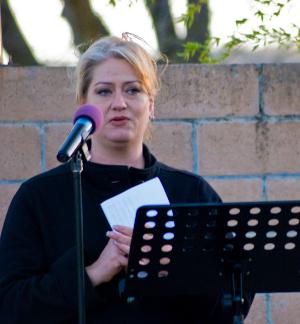
CLEARLAKE – Community members and officials gathered at Clearlake's Austin Park Thursday night to remember the victims of drunk driving crashes.
The evening vigil – where candles weren't possible due to windy conditions – was led by Larry Fanning, pastor of Clearlake's First Baptist Church and a member of Team DUI, the event's host.
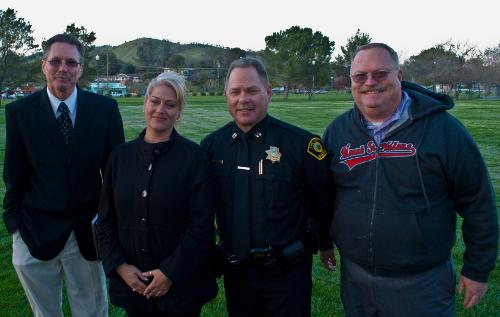
Those speaking during the evening included Dr. Bill MacDougall, Chris Tyner, Lake County Sheriff's Capt. Russ Perdock, Wendy Jensen and Leslie Thomas.
It was an emotional evening as the speakers recalled situations where DUI had taken some lives and shattered others.
Perdock told a very emotional story about a crash 20 years ago on Dam Road that claimed the lives of three teens. He said the crash was forever burned into his memory, and affected not just him but the entire community.
Jensen shared a different perspective – she had been the drunk driver in a DUI crash, and almost killed a man when she ran into his car. She has since become an active member of Team DUI, and works to raise awareness of the consequences of drunk driving.
Leslie Thompson was hit by a drunk driver while coming home from a work-related reception with co-workers. She broke both of her legs, and watched the passenger of the drunk driver's vehicle die on the hood of her car.
The vigil ended with a moment of silence for all that have been lost or affected by drunk driving, with Fanning saying a prayer afterward. Local high schoolers also offered songs during the remembrance.

- Details
- Written by: Lake County News Reports
The district board conducted a budget workshop at its March 25 meeting to begin the development of the budget for the coming fiscal year, said Superintendent Korby Olson.
Olson presented the current state of the budget and a list of reductions that the board could consider.
He said the bottom line is $1,030,000 in cuts are needed due to reductions in state funding and declining enrollment.
On the list of possible reductions is bus transportation for students, which Olson said he wasn't recommending because it would be a very “drastic” step.
He reported to the board that it costs $275,000 to bus students from home to school.
The district's board has considered charging for busing in the past, including a discussion held last year, as Lake County News has reported. However, the district board has so far chosen not to pursue that step.
Olson said a charge of $1 per day would likely generate $45,000, and the board agreed that it is something to be considered.
Setting up a system to charge for bus ridership would require the district to create a specific infrastructure, Olson told Lake County News.
He suggested that charging for busing likely would need to be tied to benefiting a program, rather than just seeking district savings.
Other possible reductions to help the district meet its needed savings include reducing energy use. Olson said a 10-percent reduction in electrical use amounts to a savings of $20,000. Simple steps like removing classroom refrigerators, and turning computers and monitors completely off would also reduce costs, he said.
The district's current remodeling projects have energy savings included, Olson added.
Other items on the list of possible reductions include mailings, travel and conference expense, and reduced copying expense. The list of reductions totaled $153,000, Olson said.
Because of the March 15 deadline for notifying teachers, the board had already taken action to eliminate teaching and administrative positions totaling $730,000 in savings. These savings come at the expense of programs that have a positive impact on students.
In other action the board considered a first reading of the school calendar. The proposed calendars both included a school start date prior to Labor Day. The first version has school beginning on Aug. 25, with two student holidays on the Thursday and Friday Prior to Labor Day to accommodate student participation in the Lake County Fair.
This calendar includes a week off at Thanksgiving, two weeks at winter break in December and one week at spring break in April. School would let out on June 11. The second version begins one week later and ends one week later. The board will gather additional input from parents and select a calendar at its next meeting.
The board also approved a master plan for the high school stadium area. The design was created by the district’s architectural firm TLCD. The plans include a complete complex for football, track and tennis in the existing space.
Olson said the master plan includes everything that might be included, but the current budget for the project will only support the replacement of the bleachers, a snack bar and restroom facility and improvements to the parking and entrance areas.
The designs for this first phase are currently being prepared for submission to the Division of the State Architect for approval. The construction is slated to begin following the football season in December.
The next board meeting is scheduled for 7 p.m. Wednesday, April 22, in the Cobb Mountain Elementary School multi-use building, 15895 Highway 175, Cobb.