 How to resolve AdBlock issue?
News
- Details
- Written by: Lake County News Reports
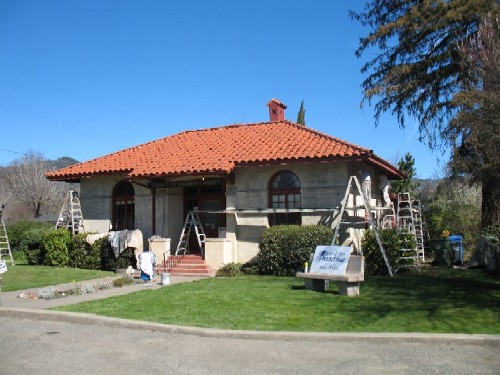
UPPER LAKE – People passing Upper Lake’s historic Harriet Lee Hammond Library and seeing the forest of ladders around the building might wonder what’s happening there.
The library is undergoing a much-needed facelift.
Dewey & Sons Painting of Lakeport is repairing and sealing the stucco exterior and painting the 92-year-old library.
Major cracks and holes in the stucco had impaired its beauty. The repairs, sealing and painting will protect the exterior many years to come. The library is open during the repair work, which library
officials expect to be finished early in April, weather permitting.
Librarian Linda Bushta is delighted with the progress and describes the new look as amazing. A new sign in front of the library completes the refurbished look for the building that has served local readers for so many years.
Upper Lake has had library service since 1914 when the Upper Lake Women’s Protective Club and other interested citizens set up a library in J.N. League’s store downtown.
In 1916 Lottie Mendenhall and Amy Murdock donated the land at Main and Second Streets for a library in memory of Charles Mifflin Hammond.
Harriet Lee Hammond donated the money for the building and hired a well-known Boston architect, A. W. Longfellow, to design the building.
The Hammonds came from Massachusetts to Lake County in the late 19th century to farm. They were active in civic affairs in Lake County, donating time and money to support local causes.
After Mr. Hammond died in 1915, Mrs. Hammond returned to Massachusetts, but her interest in,
and support for, the library lasted until her death in 1936.
The ULWPC ran the library until a library tax district was formed in 1941. In 1975 Upper Lake joined the newly-formed Lake County Library and continues to function as a branch of the county system.
The Upper Lake Library, 310 Second St., is open Tuesday, Thursday and Friday from 1 p.m. to 6 pm, and Wednesday and Saturday, 10 a.m. to 3 p.m. The phone number is 275-2049.
The Lake County Library Web site is www.library.co.lake.ca.us.
{mos_sb_discuss:2}
- Details
- Written by: Elizabeth Larson
Over the last two decades the Lakeport fireworks display has been a major draw at the lake's north end.
“For all of these years the chamber has done the fireworks – we signed the contract, we did the whole things,” said Chamber Chief Executive Officer Melissa Fulton.
Fulton said the chamber has funded the fireworks through the annual “add a dollar” campaign, assisted through local merchants, as well as large donations to the effort by the city of Lakeport.
But last year the city didn't budget the more than $13,000 of the total $18,000 bill that it usually pays toward the event. After discussing the issue over several meetings, the council agreed in March to give the chamber $5,000 toward the total costs from the city's redevelopment budget, as Lake County News has reported.
The chamber previously had projected an $11,000 deficit for this year. Fulton said the financial picture has since improved slightly, due to laying off one staffer and cutting back on expenses. “I'm hoping we come out in the black.”
Still, Fulton said that, due to its financial constraints, the chamber can't fund this year's fireworks display, so they're going to the community to ask for assistance.
“If the community feels that the fireworks are important, then they'll help us,” said Fulton. “It will be a community fireworks program.”
She said she will once again seek a monetary contribution from the city. The chamber and the city haven't discussed whether or not the city will restore full funding in the future.
Fulton said, so far, the support and enthusiasm appears to be there, despite the economic issues everyone is facing. This year's display also is estimated to draw larger crowds in the wake of the city's recent decision to deny the applications of four nonprofit groups seeking to sell safe and sane fireworks.
The chamber formed a fireworks committee which began meeting in February, Fulton said.
The committee includes Lakeport Mayor Ron Bertsch, who also represents the Early Lake Lions; Ross Kauper, Lakeport Kiwanis; Kevin Burke, Lakeport's police chief and interim city manager; Leslie Firth, Lakeport Main Street Association president and a chamber director; Armand Pauly, a chamber director; Barbara Breunig, Lakeport Main Street Association treasurer; and Richard Knoll, Lakeport Redevelopment Agency director.
Fulton said the group has met three times so far, and will hold another meeting at 3 p.m. Tuesday, April 7, at Lakeport City Hall, 225 Park St. The public is invited to attend.
The committee has looked at ways to cut back on the estimated $17,300 that the display will cost this year – an amount which doesn't include the cost for sound system rental for the boat parade, said Fulton. The celebration won't feature the coordination of fireworks and music as it has in the past.
To keep costs down, Fulton said the committee considered having the fireworks fired off from land, specifically Natural High School's campus on Main Street.
Fulton said the fireworks company representative visited Lakeport earlier this year and determined they could do the firing from land, but they wouldn't be able to use the largest fireworks, which are 6-inch shells.
The committee decided it wanted to have the same size show as in previous years, so they chose to have the display fired from barges the chamber purchased several years ago for the fireworks display, Fulton said.
The committee has created several corporate sponsorship levels to support this year's fireworks display, including Betsy Ross, $50; Ben Franklin, $75; Abraham Lincoln, $100; George Washington, $500; and Uncle Sam, $1,000.
For more information on the committee or to make a donation, contact Fulton at 707-263-5092 or via e-mail at
E-mail Elizabeth Larson at
- Details
- Written by: Lake County News Reports
Congressman Mike Thompson (D-Napa Valley) introduced the bill, which will permanently allow landowners to get significant tax deductions if they place a conservation easement on their property.
These conservation easements allow property owners to continue using the land, while protecting the land from future development.
“We’ve seen a 50-percent increase in conservation easements since Congress passed my provisions to enhance these tax benefits on a temporary basis in 2006,” said Congressman Thompson.
If current development trends continue in California, another two million acres will be paved over by 2050, Thompson said. “It’s time we made these protections permanent. By making sure that landowners can count on this program, we’ll take a big step forward in preserving our agricultural lands and open spaces.”
When landowners donate a conservation easement, they maintain ownership and management of the land and can pass the land on to their heirs, while forgoing their rights to develop the land in the future.
Conservation easements have historically been an effective tool for protecting farmland and open space, and Thompson anticipates this bill will enable more farmers and other property owners to conserve their land. The bill enjoys broad support from a grassroots coalition of farmers, and conservationists.
The tax provisions allow property owners to get a deduction of up to 100 percent of their adjusted gross income for 15 years.
These tax provisions have a long record of success. In August 2006, Congress passed provisions written by Thompson that enhanced the tax incentive for the donation of conservation easements by allowing landowners to deduct a larger share of their income over a longer period of time.
With these enhanced tax provisions, 535,000 more acres were put into trusts in the last two years, according to a survey by the Land Trust Alliance.
The first land protected by Thompson’s provisions were in California’s 1st District, which includes Lake County.
Andy Beckstoffer of Beckstoffer Vineyards gave a conservation easement on 89 acres of the historic To Kalon vineyard in Oakville just five days after the measure was signed into law.
The new bill currently has 93 cosponsors. Thompson is a member of the Ways and Means Committee, which has jurisdiction over all tax measures in Congress.
- Details
- Written by: Dennis Fordham
For example, consider an elderly person aged 65 years or older, or a disabled non-elderly person, who makes a large gift to an unrelated person who provides care by driving them to the hospital, preparing their meals, assisting them with their other personal needs – taking medicine, bathing – and so on.
This scenario frequently applies to elderly persons who are neglected by their natural family while alive.
Public awareness of this nettlesome rule is important because the proposed transfer, when legitimate, can be validated if independently reviewed in advance by a disinterested (unbiased) attorney who issues a certificate of independent review. Obviously, this must occur while the “dependent adult” is still alive. This review requires proactive action.
Now, let’s examine Probate Code section 21350.
In order to prevent abuse and fraud being perpetrated by caregivers upon their presumably vulnerable dependent persons, section 21350 of the Probate Code presumptively invalidates transfers (or gifts) made by dependent persons to these unrelated care custodians unless the transfer is reviewed by an independent attorney who issues a “certificate of independent review.”
The certificate validates the transfer. Knowing when a transfer might later on become susceptible to being subsequently characterized by an adverse party, such as the dependent’s heirs who lost out, as being an invalid transfer is important.
Recognition should prompt a certificate of independent review being obtained out of prudence. Often the certificate of independent review is requested of the dependent adult’s own attorney when drafting their will or trust, which includes the substantial gift. The drafting attorney will then usually advise their client to see a second neutral attorney to review the matter and issue a certificate.
When might the rule apply to invalidate a gift? First you need a “dependent person”. That means anyone age 65 or older and younger persons with significant disabilities.
Second, you need a transfer whose value exceeds $3,000 in the case of a person whose estate is greater than $100,000 or a transfer of any amount in estates under $100,000.
Third, you need an unrelated care giver – that is someone who is unrelated by blood or marriage to the dependent person.
Fourth you need a “care custodian,” also known as a “caregiver.” Whether the recipient is a “care giver” is where the litigation controversy abounds (usually after the dependent person is dead).
The concept of “caregiver” is broadly defined and includes, “persons providing care or services for elders or dependent adults."
If the foregoing pattern appears relevant to a situation then a certificate of independent review should be obtained, and, in some other instances a court ordered “substituted judgment” order approving the proposed gratuitous transfer (involving conservatorships).
The attorney drafting that certificate must be someone who is so entirely disassociated from the transaction and the care giver as to be able to independently and confidentially advise the dependent adult who is their client as to the nature and consequences of the proposed transfer.
The whole purpose of the second attorney’s independent review is to ensure that the proposed transfer is not, “the product of fraud, menace, duress, or undue influence.”
Presumably, if the certificate itself were to be challenged as being a “rubber stamp” issued by the reviewing attorney then the certificate itself will likely only be as good as the second attorney’s underlying independent review upon critical examination.
Dennis A. Fordham is an attorney licensed to practice law in California and New York. He earned his BA at Columbia University, his JD at the State University of New York at Buffalo,and his LL.M in Taxation at New York University. He concentrates his practice in the areas of estate planning and aspects of elder law. He can be reached at dennis@dennisfordhamlaw, by phone at 263-3235 or at his office at 55 First St., Lakeport.




