 How to resolve AdBlock issue?
News
- Details
- Written by: Elizabeth Larson
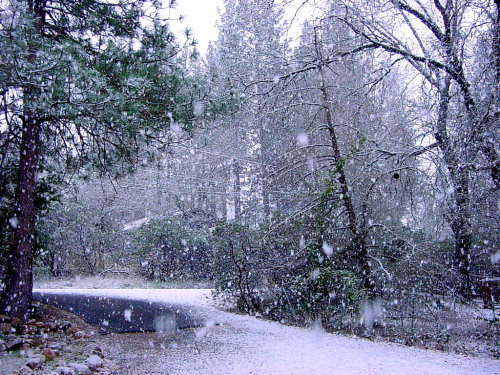
LAKE COUNTY – Areas of Lake County got their first snow of the winter season on Sunday, which caused headaches and dangers for local drivers.
The CHP reported at about 8:30 a.m. Sunday snow was falling in the Kelseyville area but not yet sticking. By Sunday afternoon, snow could be seen along the hills that edge Clear Lake's Northshore.
The Cobb area, in particular, got a healthy dose of snow, which began shortly before 8:35 a.m., according to Roger Kinney, whose home is located in an area of Cobb at an elevation of around 3,000 feet.
He said fat, light snowflakes began to fall, with 1 inch of snow accumulating within 25 minutes.
The snow later stopped but started again at about 11:30 a.m., and continued until 3:45 p.m., during which time Kinney said another 2 inches of snow fell. Snow continued later in the day, he said.
The winter weather played havoc for some drivers.
Throughout the afternoon and evening, the California Highway Patrol reported responding to vehicles off the road and in ditches or otherwise stuck in the snow in the Adam Springs area, Bottle Rock and Red Hills roads, on Highway 29 near Diener Road and in the area of the Glasgow Grade near Lower Lake.
Calls were put out to Caltrans to plow and sand Highway 29 from Lower Lake to north of the Glasgow Grade, according to radio reports. The Lake County Road Department, which works to clear county roads in winter weather, also was called out in response to the weather conditions.
Kinney ventured out for a trip to Clearlake in the early afternoon, and said he encountered snow falling in the Siegler Canyon Road area not far off of Highway 29, as well as three cars pulled off the road at the Middletown turnoff.
Between Loch Lomond and Cobb he said there were at least five additional vehicles that had spun out and were either being helped or waiting for assistance.
Just after 8:30 p.m. Sunday CHP reported snow was appearing in the Blue Lakes area. Snow also was reported to be falling in areas of Mendocino County.
Caltrans and CHP reported late Sunday that area roads remained open.
To keep safe on area roads, the CHP instructs drivers to slow down and give themselves extra time to travel. When encountering fog, slow down and use low beams.
Drivers also should make sure their headlights and windshield wipers are in good condition, and to remember to keep vehicle’s headlights on anytime windshield wipers are on continuously, because it’s the law.
CHP urges drivers to travel with a cell phone and backup power source, tire chains and tighteners, flashlight and batteries, flares, small shovel, windshield scraper, waterproof clothing that’s warm, blankets, snacks and drinking water.
Taking care in winter weather is critical. CHP reported that last year in California 106 people were killed in collisions that occurred either in rainy, snowy or foggy conditions. More than 7,696 people were injured in crashes under similar weather conditions.
The National Weather Services has issued a winter weather advisory for the Lake County area that warns of snow. The advisory remains in effect until 4 p.m. Monday.
The forecast predicts 3 to 6 inches of snow above 1,500 feet, with snow also possible down to the 1,000-foot elevation mark. Winds from the southwest also are expected.
For the latest road conditions call the Caltrans Road Conditions Hotline at 1-800-427-ROAD (1-800-427-7623) or visit them online at www.dot.ca.gov.
E-mail Elizabeth Larson at
{mos_sb_discuss:2}
- Details
- Written by: Elizabeth Larson
The 3.1-magnitude earthquake occurred at 8:24 p.m. at a depth of 1.4 miles, as was centered two miles north of The Geysers, four miles west of Cobb and seven miles west northwest of Anderson Springs, according to the US Geological Survey.
A second earthquake, measuring 2.6 in magnitude, occurred 25 seconds later, to be followed by a third 10 seconds later that measured 1.8, US Geological Survey records showed.
Cobb resident Roger Kinney reported that the second earthquake felt near as big as the first and lasted longer.
Three more small quakes, two measuring 1.1 and one measuring 1.3, followed over the following three minutes. In all, 16 shakers followed the main one between 8:24 p.m. and midnight.
Besides several Cobb, the US Geological Survey reported that the 3.1-magnitude earthquake was reportedly felt in Kelseyville and as far away as Cloverdale.
Kinney said earthquakes in the seismically active area usually drop off in November and pick up again in April, so the quakes were a surprise, especially coming as closely apart as they did.
The last earthquake measuring 3.0 or above reported in Cobb, The Geysers or Anderson Springs took place Dec. 1 and measured 3.2 in magnitude.
E-mail Elizabeth Larson at
{mos_sb_discuss:2}
- Details
- Written by: Lake County News Reports
HR 7327, the Worker, Retiree and Employer Recovery Act was approved by the House on Dec. 10 and the Senate on Dec. 11.
It waives the penalty for 2009, allowing seniors to recoup some of the losses they have experienced as a result of the poor economy, according to a report from the office of Congressman Mike Thompson (D-St. Helena).
HR 7327 now heads to President George W. Bush's desk for his signature.
The bill should prove important to the First Congressional District, where the 2000 Census reports there are 84,000 seniors – nearly 12,000 age 65 and over in Lake County alone.
“In these difficult economic times, we have provided real relief to seniors who would otherwise have faced unfair penalties,” said Thompson. “I’m glad that Democrats and Republicans in both the House and the Senate found a way to work together and quickly pass this important legislation.”
Under H.R. 7327, all taxpayers, those who usually take the required minimum distribution amount monthly and those who take a lump sum amount at the end of the year, would have equal treatment. Under current law, individuals who have reached age 70½ must take an annual required minimum amount from their retirement plan or IRA.
Failure to take the distribution would subject the individual to a 50-percent excise tax penalty on the amount that should have been withdrawn.
The bill also is expected to help the struggles of businesses facing funding requirements for employer-sponsored pension plans. Without the legislation, those businesses would be forced to make significantly increased contributions during these difficult economic times when they are very short on cash.
The bill includes temporary relief for multi-employer plans that have been negatively impacted in this economic downturn.
HR 7327 also would make nominal technical corrections to the Pension Protection Act of 2006, which had required employers to fully fund their plans, which proved a blow to many businesses due to eroding market values where those funds are invested, according to an Associated Press report.
The American Society of Pension Professionals and Actuaries (ASPPA) welcomed HR 7327's passage, saying it will enable pension plan sponsors to adjust to the current market downturn.
Brian Graff, ASPPA executive director and chief executive officer, said passage of the legislation will enable pension and retirement plan management professionals to help retired Americans cope with the current economic condition.
"ASPPA members encouraged Congress to act during this final legislative push of the 110th Congress. Both the House and Senate are to be commended for acting unanimously on this important issue of vital interest to millions," Graff said.
{mos_sb_discuss:2}
- Details
- Written by: Lake County News Reports

It’s that gift-giving season again, and are you finished shopping yet? No?
Have you considered a home brewing or wine making kit for that special someone? Well, stop a moment and consider it. This is more than just a gift, it’s a potential hobby that a lot of people would enjoy trying but might not think to get for themselves, and it’s unique enough that it won’t be expected or forgotten. Plus, it saves tons of money over buying wine and beer at the grocery store.
Beer brewers are able to create their own signature brew or create “clone” recipes of their favorite store-bought brew. You should see the look of pride in a person’s eyes when they serve someone a glass of beer or wine that they brewed themselves. They have fun in the making of the brew, then fun in designing a label for the bottles (there are Web sites dedicated to people showing off their personal labels), and they have fun serving and drinking it with others. It’s a pastime that gives a person many different ways to enjoy it.
Yes, I am a home brewer; it’s part of my being a big “do it yourselfer.” But just as you have probably come to expect from me, I do things a little differently. I brew mead, which is essentially wine made from honey. Being a history buff I like the idea of making a beverage with such an ancient and colorful past, and I love the versatility that mead making gives.
Brewing at home is quite simple and not as messy as you might think; my wife has yet to complain. In fact, sanitation is the most important factor in any kind of brewing, so cleanliness is a necessity for brewing.
Home brewing kits vary from idiot-proof countertop kits where you “add water, contents of packet, and *poof!* two weeks later you have beer,” to kits that allow you to control every factor of the process and truly craft your very own distinctive creation.
Another great thing about the process is that most of the equipment is interchangeable so you can easily brew beer this week then switch to making wine a couple weeks later. If you have someone on your gift giving list who already is a home brewer, a new carboy is always a great addition (carboys are big glass or plastic jugs used for fermenting) and they are only about $25 on average. The only thing limiting my own mead making is a lack of carboys. I have two and both of them are in use, and I wish I had many more (my wife reads this column, wink, wink, 6 gallon size, dear).
Since we don’t have a brewer’s supply store here in the county, I’ll point out that you can easily find a brewer’s supply online. Here’s another exception to my usual policy of not mentioning names or brands: my favorite supplier is www.morebeer.com, located down in the Bay Area. They have supplies to make beer, wine, mead, coffee, sake and even soda pop. They also have the technical support and on-line help to assist both the new and the more experienced brewer.
The reason I’m making the exception to mention them by name is that they ship so quickly. If I place an order early in the day the shipment is at my home the very next day. This fantastic and speedy service makes getting that last minute Christmas gift very easy. Their great treatment of me has made me always a happy customer.
There are many stories and myths about how alcohol was discovered. Beer makers like to brag about the existence of writings describing the brewing of beer dating from 6000 B.C.E., and winemakers claim creation of their beverage of preference around the same time, but there is even earlier evidence of mead making going back to 7000 B.C.E..
Despite the disagreements between the factions, mead really is the oldest alcoholic beverage. Mead was the beverage of choice for many millennia, then through the progression of time beer and wine eventually took center stage. But since we mead makers work with sweet honey, we aren’t bitter about it.
The first laws ever written (the Code of Hammurabi) included laws pertaining to daily beer rations. Through much of Europe’s history the water was undrinkable, but the boiling and brewing process of making beer rendered the water it was made with safe to drink and so beer was the beverage that everyone, even children, survived on.
Brewing throughout most of history has been considered woman’s work and brewing equipment was considered the wife’s property in divorces. Not until the last couple of centuries have men really taken the craft into their hands.
When the first Europeans came to America they were greeted by native peoples who offered them wine derived from persimmons and a beer-like drink made from corn. When the Mayflower made its journey to the New World the original destination was to be in the Carolinas, but they ran out of beer and landed on Plymouth Rock in order to build a brewery.
During Prohibition it was still legal to make your own alcohol at home, so America wasn’t as “dry” as some would think. At that time Lake County was just as significant a winegrowing region as Sonoma and Napa were, but instead of switching to making sacramental wines (among other means) in order to continue growing grapes, the winemakers just tore out the vineyards and planted ... you guessed it, walnuts and pears.
Grapevines planted in Lake County have the potential to be much better than those grown in Sonoma and Napa because they are at a much higher altitude, and higher altitude creates better flavors in produce. This fact, in addition to the low cost of Lake County land, has caused our area to undergo the biggest explosion in vineyards in many years. Ten years ago we had only a handful of wineries and now they outnumber my fingers and toes combined!
Being in Northern California makes participation in home brewing a very natural thing. Sure, we live in the middle of the wine country so why not be part of the winemaking community? Some of the local professional winemakers got their start in the industry through home brewing. Just like living on the greatest bass fishing lake west of the Mississippi where there are professionals fishing our lake throughout the entire year doesn’t mean that we the local residents can’t fish in it also.
So try making your own beer or wine, or better yet, give a kit as a gift so that someone can make it for you. The limited creativity “just add water” kits can cost as little as $25, but to set someone up with a nice starter system they can grow with will run about $70.
Lake County features a Home Winemakers Festival; June 2009 will mark the seventh annual presentation, at which I would love to have people sample my own work (if I only had more carboys ... wink wink, nudge nudge, say no more). My Ghirardelli chocolate-flavored mead will be ready to drink in June of 2009, but I only have five gallons of it so sharing might be a little scarce this year. That is, if I can even wrestle a few ounces away from my wife.
Ross A. Christensen is an award-winning gardener and gourmet cook. He is the author of "Sushi A to Z, The Ultimate Guide" and is currently working on a new book. He has been a public speaker for many years and enjoys being involved in the community.
{mos_sb_discuss:2}




