 How to resolve AdBlock issue?
News
It's called public transit.
“We've had steady growth through the year,” said Mark Wall, transit manager for the Lake Transit Authority.
In the 2007-08 fiscal year, ridership grew by 8 percent in the first, quarter, 15 percent in the second, 20 percent in the third and in the fourth, 27 percent, said Wall.
Those increases were helped by a few factors, said Wall, including improved service on the transit authority's route one, which runs along Highway 20.
But the big jump came when gas prices began climbing steeply. “All of a sudden ridership really went through the roof,” he said.
As a comparison, he points to July 2008's ridership numbers, which hit 30,126, putting it at 45-percent above July 2007.
“Ridership is up particularly on any route that goes a long distance,” Wall said.
Big ridership changes were noted on route one along Highway 20 and the Northshore, which increased in passengers by 55 percent; route three from Calistoga to Middletown; route four, running between Clearlake and Lakeport on Highway 29; and route seven to Ukiah.
“The bad news was we were overbudget,” said Wall.
Rising fuel prices, which increased the numbers of people using the bus, also proved a primary cause of the budget overrun. Wall said the authority had planned to spent $289,000 on fuel for the year, but ran over by 16 percent, ending up at $333,800.
In the past year, the authority also changed contractors, with Laidlaw's contract ceasing in July of 2007, to be succeeded by Paratransit Services, said Wall. “It's been a much better situation this year with our new contractor.”
Wall, who also manages Del Norte County's transit authority, notes that bus ridership is up all over the state.
Lake County is on the high end, noted Wall, higher even than some urban areas when it comes to the increases in use it's seeing. That's because people move to transit services more when they live in areas where there are greater distance to travel.
Wall noted that Del Norte County is seeing even more new ridership than Lake, thanks to revisions in its transit system.
That's one big concern here in Lake County – how to make the service more available and useful to a wider range of customers.
“Over the years we've seen a wide variety of people who use the service, but most of them are low income,” he said.
However, Lake Transit recently conducted a ridership survey, said Wall. “We're getting people we've never heard from before.”
Employees in some county offices are using the transit to go to work, and Wall said Social Services now wants to sell monthly passes at their site.
Wall said they're working on a transit development plan, which includes adding more commuter-oriented runs on routes one along the Northshore and four, between Clearlake and Lakeport.
One way to expand the service is to add to its range of hours. Most routes run from 6:30 a.m. to 6 p.m. daily, said Wall, with only one going until 8 p.m.
He said the authority has just applied for a grant to add morning and evening runs between Clearlake and Calistoga with connections to Lakeport, and an evening run between the Lakeport and Clearlake.
But the hope of expanding the service may be hampered by the state's raiding of transit assistance fund monies, which comes from sales tax. Those funds have been gobbled up by the state budget process the past two years, which Wall said will likely happen again this year.
“We're supposed to be receiving more money from state than likely to see,” said Wall.
Transit agencies all over the state want to expand their services but are being hampered because those funds are drying up, said Wall.
While Lake Transit would like to revise its services to meet greater demands, Wall said the process will have to move more slowly than they would like and will be predicated on the availability of money.
If gas prices remain high, Wall said he expects over the long term for transit to become more like it used to be, with more private ownership and less public subsidies.
In the mean time, Lake Transit is focusing on some small changes that can have big returns, such as having its service and routes added to Google's transit tracking service. They're also installing a new bus tracking system to see if buses are running on time, since late buses have proved a problem for the system.
They are planning for several new route changes next January and February, with a third bus route set for Clearlake, and modifications being considered for a few of the other routes as well, said Wall. If they get their grant, they may be able to run some routes more often, especially during commute times.
The eventual goal for route one along the Northshore, said Wall, is to have hourly bus runs. Those runs used to take four hours, and now are down to two.
In the fall of 2009, Lake Transit is aiming to add another Lakeport route, which will move from the city's northern area down to Konocti Vista Casino, looping through town and onto the freeway.
Wall added that Lake Transit is partnering with the Area Agency on Aging to do a senior transportation project between Clearlake Oaks and Spring Valley.
Another challenge for the future is enough buses, and the right kind of buses, to enable Lake Transit to meet its growing demands.
Lake Transit currently has 20 buses but it needs more, with two on order, said Wall, and three more, smaller buses also soon to be ordered. Depending on the state budget, more also could be purchased soon to both enlarge the fleet and replace aging buses.
Wall said the authority's buses are diesel. They're discussing other possible fuel alternatives as they look at the future, with hybrid vehicles offering promise. Hybrids using compressed natural gas tend to run between $400,000 and $500,000 for a new bus, compared to $200,000 for a new diesel bus, said Wall.
Biodiesel also might work if a consistent local or regional source were available. However, Wall added, “It's got a lot of problems for us to use.”
E-mail Elizabeth Larson at
{mos_sb_discuss:2}
- Details
- Written by: Elizabeth Larson
The meeting will begin at 9 a.m. on Thursday, Nov. 13, in the board chambers at the Lake County Courthouse, 255 N. Forbes, Lakeport.
At 9:05 a.m., the commission will hold a public hearing to consider a mitigated negative declaration based on initial study for a major use permit.
Peacock Associates Inc./Metro PCS has applied for the project, and proposes replacing a 120-foot guy wired lattice tower with a new 120-foot self-supporting lattice tower. The project is located at 9280 Konocti Road, Kelseyville.
South Lake County Fire Protection District has applied to purchase an approximately 13,720 square foot parcel to use as a parking lot at 15476 Graham St. A public hearing will be held on the proposal at 9:40 a.m.
At 9:45 a.m., a public hearing will take place to consider a mitigated negative declaration based on initial study for a parcel map. Glen Rolfe has applied to renew an expired tentative parcel map to subdivide approximately 15.76 acres located at 1000 Robin Hill Road in Lakeport in order to create three parcels.
The Vintage Faire subdivision also will be on the Thursday agenda and the subject of a 10:10 a.m. public hearing for considering of a subsequent negative declaration based on initial study for general plan of development.
De Nova Homes is proposing a one-year time extension of the subdivision's general development plan; the proposed project is located at 20740 and 20830 State Highway 29, Middletown.
The final public hearing of the day is set for 10:40 a.m. The hearing will be for an administrative appeal (AA 08-03) of the Community Development Department's determination to deny issuance of a Certificate of Compliance.
The appellant is Edwin Rohner, proposing a Certificate of Compliance on their parcel after a lot line adjustment was recorded that appears to have erased any underlying parcels of record. The project is located at 5087 State St., Kelseyville.
Planning Commissioners include Monica Rosenthal, District 1; Gary Briggs, District 2; Clelia Baur, District 3; Cliff Swetnam, District 4; and Gil Schoux, District 5.
{mos_sb_discuss:2}
- Details
- Written by: Lake County News Reports
The California Highway Patrol reported an Audi was on fire on Highway 175 at mile marker 83 just before 9 p.m.
The driver was reported to be clear of the car and was not said to be injured, the CHP reported. The CHP did not identify the driver.
The roadway was shut down shortly before 9:30 p.m. as officials responded to the situation.
The CHP did not report in its incident log when the highway was reopened.
E-mail Elizabeth Larson at
{mos_sb_discuss:2}
- Details
- Written by: Elizabeth Larson
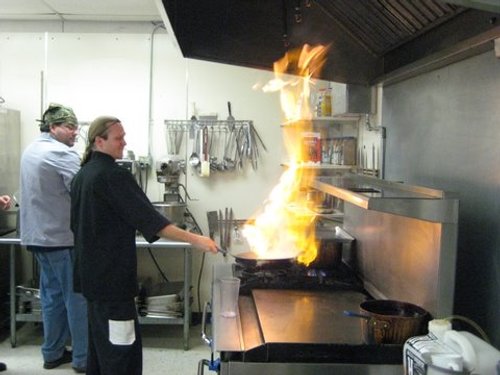
CLEARLAKE – Jackson Pollock didn’t take a class on how to throw paint at a canvas. He first attended art school and then developed his signature style.
The same can be said of the food at Aromas Restaurant at Yuba Community College Clearlake Campus. The food is good gourmet food without gilding it with pretentious truffles and caviar.
Chef Robert Cabreros, who teaches at the college, is currently training the next wave of culinary artists who will affect the food trends of Lake County and beyond. He recently hosted this writer over two full days, offering the chance to watch the students prepare and serve the lunch service at the college’s restaurant.
There are currently 18 students in the class with a full waiting list to enter the program.
Why is there so much interest in the culinary program nowadays? Cabreros said he believed it was because obtaining a position in the culinary industry is being viewed as an actual career now.
He said that opinions have changed in large part because of the way that food networks and learning channels have made cooking mainstream, and how the industry as a whole is now viewed with more professionalism as opposed to how it was seen 20 years ago.
Cabreros himself is a graduate of Le Cordon Bleu, which is the same cooking school that trained the legendary Julia Child. For you youngsters out there, it’s the same school from which Giada De Laurentis graduated.
He said he never intended to become a teacher, but he was hand-picked by his predecessor and now says he couldn’t imagine doing anything else.
The formality of some culinary schools is not required in this class. Demanding that every order be responded with the entire room yelling out “Yes Chef!” is set aside here; it’s very casual and Cabreros' students just call him “Robert.”
To watch Cabreros talk about his students is like watching a parent speak of their his child. You can see the pride in his face and hear it in his voice as he talks.
He doesn’t consider his class a springboard program so you need to go on to another school to add onto your education. His course is a complete package that gives culinary students everything they need to be successful in the industry.
Cabreros talks of his students with confidence saying, “He’ll be an executive chef within five years,” and “She’ll be a sous chef within two years.”
To look at the students of this particular class is to see the word “diversity” in its purist form: young, old, every race, sex, skill level, interest, financial background and personal style. The youngest student is 15 years old and the oldest is 60.
The restaurant itself is as “green” as it can be. Waste has been reduced 75 percent, everything that can be recycled is, and the edible waste is sent to a pig farm as feed.
Local produce is used when available, and the daily menus are even printed on half a sheet of paper. The to-go orders and “doggie boxes” are made of biodegradable bamboo.
Lake County has yet to have any rating system for how green a business is or even recognize businesses as green, but Aromas restaurant has pushed the envelope all on their own. The county could use this program as a template for rating other Lake County businesses that would like to brag about being “green.”
The sanitation and cleanliness of the restaurant is impeccable. A dirty spot or bad sanitation habit couldn’t be found. This is one of the cleanest kitchens this writer has ever seen, which is a fantastic foundation for the students coming from this program; they are learning good habits that will follow them to their next kitchen.
Even safety is top notch. “Knife!” and “Hot Pan!” are always shouted out when someone walks through the kitchen with one. On occasion a student would use poor knife practices, and Cabreros would be right there to show them the correct way to do it and remind them that scars aren’t cool.
The group of students move about the kitchen with the synchronized movement of a school of fish, but walk through the kitchen and all of a sudden the words “Excuse me,” “Pardon me,” and “Look out behind you!” were suddenly being said over and over.
Although all of the students have different skills and talentsm there are three that deserved mention.
Matt Morgan is so talented and skilled that this writer actually assumed he was part of the staff until Cabreros said otherwise. Morgan currently works with Julie Hoskins of Chic le Chef and cooks prolifically throughout the county. If you attend many public functions around the lake you’ve most likely already eaten his food. He’s also on the cover of the college’s most current class schedule.
Julie Wonderwheel also currently works in the food industry and it is evident in her incredibly precise knife skills. When she's doing cutting up onions it looks like they went through a mandolin. She works quietly in all of her tasks but her performance made her stand out.
Kacie Carson, a Tinkerbell-sized girl, has amazing creativity and an eye for detail that you rarely get to see so early in a career. When she decorated a plate with caramel and chocolate Cabreros said with excitement, “I have never seen anything like that before!” Remember her name; she’s going to be famous.
The prep work continues all morning with each individual doing a specific job on their own, with only as much supervision as they need. The individual students hustles through their particular tasks, but when the restaurant opened they seemed to transform without a word into a seamless machine working in unison to get the lunches out in quick order. It was impressive to see such teamwork, everyone knowing what needed to be done and doing it together.
The restaurant opens at 11:30 a.m. and people are seated right away. Since the restaurant has no particular theme or ethnic style they are able to make all sorts of dishes. Prices are almost freakishly inexpensive; if you have $10 you can easily eat lunch and if you have $20 you can bring a date.
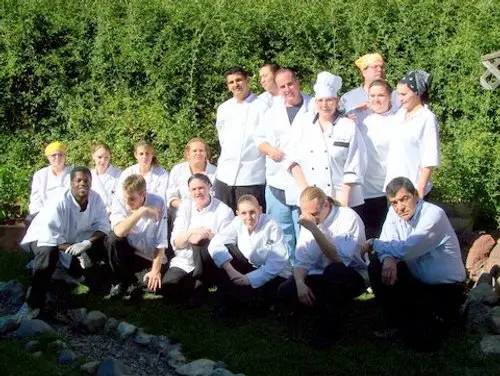
Thursdays are the busiest day of the week since it is prime rib for $8 a day. Prices are perfect for a restaurant on a college campus, giving starving students a much-needed break from ramen noodles.
The timing of the meal orders is impressive. The first table’s orders were placed and the kitchen put it together, completed it and had it on the table in three minutes. The next table took two minutes. The longest wait was five minutes from order to table.
Every table gets a comment card and they get filled in; service, cleanliness, food and speed are rated from one to 10 and a remarkable amount are turned in with 10s filled in across the board.
At 12:45 p.m. the entire crew was still going at full speed but the fatigue was starting to show on their faces after four hours of non-stop work. At 1 p.m. service is completed and the crew starts to prepare their own group lunch, after which is cleanup.
A recent bond measure will be providing the culinary program the funds to enlarge its facilities and hire a larger staff, so if you have ever been interested in a career in the culinary arts now is the time to sign up.
Remember, there can be a waiting list to get into this program. The next semester starts in January and sign up to join it starts Dec. 1 or if you just want a gourmet inexpensive lunch, drop by between 11:30 a.m. to 1 p.m.
Aromas Restaurant at Yuba Community College Clearlake Campus is located at 15880 Dam Road Extension, Clearlake. The restaurant can be reached at 995-4804; for general college information call 995-7900.
Ross Christensen writes the Foodie Freak column for Lake County News.

{mos_sb_discuss:2}
- Details
- Written by: Ross A. Christensen