 How to resolve AdBlock issue?
News
Judge Arthur Mann sentenced Donald Kirk Horne, 32, of Nice to seven years, four months in state prison for participating in a gang-related assault, evading a police officer and driving under the influence, according to Chief Deputy District Attorney Richard Hinchcliff, who prosecuted the case. Defense attorney Doug Rhoades represented Horne.
On June 3, 2006, Horne and several other members of a documented local Sureno gang, the Street Villians – also known as STV – approached a 28-year-old male near the Prestige Tattoo shop in Lakeport, according to investigation reports and witness accounts. Horne and the other gang members reportedly stated they were “Street Villians,” and all of them attacked the victim by punching and kicking him.
Hinchcliff said when the victim's 19-year-old girlfriend attempted to stop the attack by pulling Horne away from the victim, Horne punched her numerous times in the face and head.
According to the victims, Horne and other gang members had approached both victims in the Bruno's parking lot six months earlier, flashed gang signs, claimed to be Street Villians, and challenged the victim to fight.
An independent witness who was standing about 20 feet from the assault corroborated the victim's statements, Hinchcliff said.
The assault was investigated by Norm Taylor, a gang expert with the Lakeport Police Department. Taylor confirmed that Horne was a documented gang member with a prior history of gang-related criminal activity.
Horne also was charged with felony evading a peace officer and driving under the influence of alcohol.
According to investigation reports, on May 30 CHP Officer Kory Reynolds observed Horne speeding on Highway 29 near Kelseyville. When Reynolds attempted to pull Horne over, Horne tried to evade him by driving approximately 80 miles per hour on Highland Springs Road.
During the pursuit, Horne failed to negotiate a turn and rolled the vehicle over, leaving his passenger hanging upside down in the vehicle, according to Hinchcliff's report. Horne then attempted to convince officers that someone else was driving. It was determined Horne was driving under the influence of alcohol he had consumed after a softball game.
On June 16 Horne pleaded guilty to felony evading, misdemeanor DUI, and a felony charge of actively participating in a criminal street gang and promoting, furthering and assisting in felony conduct by gang members, said Hinchcliff.
In addition, Horne admitted having suffered a prior "strike" conviction in October 2000 for participating in a criminal street gang and assault on another person causing serious bodily injury. The prior strike conviction serves to double the sentence imposed for a new felony.
That 2000 conviction was for an assault on July 4 of the previous year, when Horne and the Street Villains jumped a group of young men they thought were Nortenos in Lakeport. The young men turned out to be visitors, according to a previous report from Lt. Brad Rasmussen. One of the men was significantly injured.
At sentencing on Monday, Horne asked the court to sentence him to less than the upper term in prison. Hinchcliff, in turn, asked the court to sentence Horne to the upper term because of his extensive criminal history, extensive background in gang-related activity and for the protection of the public.
Judge Mann sentenced Horne to the upper term, doubled for the prior “strike” conviction, for a total term of seven years, four months in prison.
Because of the prior strike conviction, Horne will be required to serve at least 80 percent of that time, rather than the usual 50 percent after good time and work time credits, said Hinchcliff.
Horne, Hinchcliff said, will be sent to San Quentin for processing and assignment to a prison for the remainder of his sentence.
{mos_sb_discuss:2}
- Details
- Written by: Lake County News reports
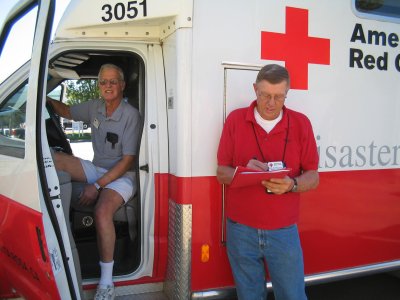
SANTA ROSA – American Red Cross chapters in the greater Bay Area have activated disaster response teams and Emergency Response Vehicles to assist with preparations for Tropical Storm Gustav.
The storm is poised to enter the Gulf of Mexico as a hurricane this weekend, and early next week could affect Louisiana, Mississippi and Texas.
Approximately 40 volunteers and three Emergency Response Vehicles are being deployed from the greater Bay Area through the weekend.
Volunteers from Sonoma-Mendocino Chapters, the Bay Area, Palo Alto area and Santa Clara Valley are en route to Alabama, Louisiana, Mississippi and Texas, where the Red Cross is staging personnel and hundreds of mobile feeding trucks along with supplies before landfall to assist with any necessary relief efforts in the threatened areas. The Red Cross is preparing to assist residents in the storm’s path with shelters, food and emotional support.
The volunteers will be serving by providing evacuated residents with a safe place to stay, food and counseling services both before and after the storm makes landfall.
Alan Phillips of Petaluma and Kenneth Reynoldson of Gualala were the first two local, trained Red Cross volunteers to deploy to San Antonio, in the southern part of the state. That’s the staging area for the Red Cross, where hundreds of volunteers from around the country will prepare in advance of the potential disaster.
Phillips and Reynoldson don’t know yet where their work will take them, since it depends on where the storm does the most damage and who needs Red Cross assistance. Both will be working on the job for three weeks, the standard length for Red Cross disaster deployments. The two men have both served on numerous national Red Cross assignments.
The volunteers know they will be facing what the Red Cross terms a “hardship assignment.” That can take many forms; in this case, they can expect high heat and humidity, power outages, sleeping in shelters and food shortages that may make their work more difficult.
Should evacuations occur, Red Cross volunteers will be working with residents in affected areas to register on the Red Cross Safe and Well Web site at www.redcross.org.
Bay Area and North Coast residents who are concerned about family members and friends in the affected area can search for information by entering the telephone number and address of their loved ones on the Web site.
The Web site also is equipped to receive donations from those who want to offer monetary support to the Red Cross, which provides its disaster assistance free of charge.
{mos_sb_discuss:2}
- Details
- Written by: Lake County News reports
Also showing a slowdown are the number of local deaths on roadways, according to the California Highway Patrol.
With Labor Day weekend about to begin, officials with the CHP, Caltrans, Office of Traffic Safety, Alcoholic Beverage Control and the Department of Motor Vehicles gathered in the state capital on Thursday to commemorate the “Holiday Death Count” – also known as the Maximum Enforcement Period.
The Holiday Death Count is a grim reminder of the deaths that occur each year on state roadways.
This year, however, the annual observance brings with it a hopeful message – people are dying on California roadways at a lower rate than has ever been previously recorded.
That finding is based on the CHP's Mileage Death Rate, which looks at the number of people killed per 100 million miles driven on state roadways.
For 2007, the Mileage Death Rate was 1.18 deaths per 100 million miles driven, down from 1.27 deaths per 100 million miles driven in 2006, CHP reported.
There were 3,967 people killed in collisions on California roadways in 2007, CHP reported, compared to 4,197 in 2006 and 4,304 in 2005.
In Lake County, CHP reported there were 17 fatalities in 2007, down from 20 in 2006. In 2005, there had been 13 deaths. The county's population was listed at 64,059 as of Jan. 1, a 0.5-percent increase over 2007.
Business, Transportation and Housing Agency Secretary Dale E. Bonner said the numbers were the result of a successful partnership between the state’s traffic safety professionals at all levels of government, the news media and the general public. “It proves we can change behavior for the better if we all work together,” he said.
The Mileage Death Rate for 2007 is about one-tenth of what it was in 1933, when California's population was nearly six million. Figures released in May by California's Department of Finance put the state's population at just over 38 million as of Jan. 1, 2008.
Had the numbers kept pace with the state's population growth, there would be a many as 160 traffic deaths each Labor Day weekend, said CHP Commissioner Joe Farrow.
The three major causes of fatal crashes in California are speeding, not wearing a seat belt and driving under the influence, CHP reported. Those factors have been the focus of aggressive enforcement and education by traffic safety organizations during the past several years.
Office of Traffic Safety Director Christopher J. Murphy said it wasn't a coincidence that the Mileage Death Rate dropped at the same time that the state had a reduction in alcohol-related crashes.
The National Highway Traffic Safety Administration also reported on Thursday that its 2007 Traffic Safety Annual Assessment of Alcohol-Impaired Driving Fatalities showed that 32 states – among them California – had decreases in the number of deaths on roadways attributed to driving under the influence, as compared to 2006.
In the 1940s, the state Legislature gave the CHP a mandate to compile traffic collision data. That became the Holiday Death Count.
As part of the effort to address the alarming numbers of driving-related deaths during holidays, in 1948 the CHP's first commissioner, Clifford Peterson, created the Maximum Enforcement Period to increase safety on the roadways.
Since the count began, the numbers of fatal crashes have shown a general decline, despite the state's large population increase and increasing number of miles driven, CHP reported.
“We believe this is due not only to safety improvements in the vehicles, but also the added public awareness combined with the increased enforcement,” said CHP Deputy Commissioner Skip Carter. “As a result, thousands of lives have been saved over the past 60 years.”
Officials said the area of motorcycle fatalities still has room for “considerable improvement,” as the number of registered riders and crashes have bucked the downward trend and are climbing.
“With more riders on the road, we continue to emphasize safe driving practices for new and veteran motorcycle riders,” stated Department of Motor Vehicles Deputy Director of Licensing Operations, Mimi Khan. “We are reaching out to folks and urging them to take it slow as they learn to ride.”
Likewise, the National Highway Traffic Safety Administration, as part of its Motorcycle Safety Program, reminds motorists to keep watch for motorcycles, which are smaller and can therefore be harder to see.
This weekend, CHP will hold one of its six annual Maximum Enforcement Periods in an effort to keep fatality numbers down.
Beginning at 6 p.m. Friday and lasting through midnight on Monday, up to 80 percent of CHP officers will be on the roads to monitor driving activity and look for speeders, people driving under the influence and those not wearing their seat belts.
Operation CARE (Combined Accident Reduction Effort) also will be in force this weekend, with extra patrols on interstate highways including I-5 and I-80.
CHP reported that it also plans to increase its educational outreach and enforcement efforts to ensure that all motorists safely share the road.
E-mail Elizabeth Larson at
{mos_sb_discuss:2}
- Details
- Written by: Elizabeth Larson
The Lake County Vector Control District and Lake County Health Services reported that they received confirmation that the third mosquito sample collected in Lake County, this time near Upper Lake on Aug. 18, showed the presence of West Nile Virus.
The two previous positive mosquito samples were from Lakeport, as Lake County News reported earlier this month.
So far this year, 1,101 West Nile-infected mosquito samples have been reported statewide, with nearly 300 of those found in Los Angeles County, according to the state's West Nile Virus Web site.
There have been 103 human cases in 13 counties – more than half in Los Angeles and Orange counties combined, the state reported. No human cases have been reported in Lake County.
In addition, 1,456 dead birds, 109 sentinel chickens, 10 squirrels and five horses have been infected with the disease across California. Lake County has had no reports of any of those animals being infected.
West Nile virus is transmitted by mosquitoes to a variety of animals and to humans. Mosquito and vector control agencies usually detect the virus in mosquitoes, birds and sometimes tree squirrels before human cases appear, according to the Thursday report.
The best way to stay healthy during West Nile virus season is to prevent exposure to mosquito bites, local officials said Thursday. West Nile virus is present throughout most of California, so if you plan to be outside, use a mosquito repellent.
Lake County Health Officer Dr. Karen Tait said that, when properly used, mosquito repellents that have been registered with the U.S. Environmental Protection Agency are safe and effective. She added that people should not rely on products that have not been scientifically tested.
Dr. Jamesina Scott, district manager and research director for the Lake County Vector Control District, said the agency is working hard to reduce the risk of mosquito bites and West Nile virus to Lake County residents and visitors.
However, there's one area they need help – and that's with finding backyard water sources like neglected swimming pools or ornamental ponds that can be mosquito breeding grounds, Scott said.
“Mosquitoes are easy to control in these habitats if we know where they are. Just one neglected swimming pool can produce thousands of mosquitoes per day, and cause problems for an entire neighborhood,” she explained.
The message local health officials emphasize to residents is the need to drain standing water sources around homes that may breed mosquitoes. People also need to protect themselves with long sleeves or an effective repellent during dawn and dusk when mosquitoes are most active.
Most people who become infected with West Nile virus do not show symptoms and will recover uneventfully, officials reported. Up to 20 percent of people will develop fever, headache and other nonspecific symptoms that may last several weeks. Approximately one in 150 people will develop severe illness known as neuroinvasive disease. People over age 50 and diabetics appear to be at most risk for the more severe forms of disease.
While there is no human West Nile Virus vaccine, very good equine vaccines are available and officials strongly recommended having horses vaccinated because the disease is potentially fatal for the animals. When West Nile Virus first hit the state several years ago, hundreds of horses died or were euthanized in the disease's initial peak years in California.
Residents can request service, get mosquitofish, or report neglected swimming pools to Lake County Vector Control District at 263-4770 or
To report a dead bird or squirrel, call 1-877-WNV-BIRD (1-877-968-2473) or visit the California Department of Public Health’s West Nile virus website at www.westnile.ca.gov.
For additional information on West Nile virus, visit www.westnile.ca.gov, www.cdc.gov/ncidod/dvbid/westnile/wnv_factsheet.htm or www.cdc.gov/ncidod/dvbid/westnile/RepellentUpdates.htm.
{mos_sb_discuss:2}
- Details
- Written by: Lake County News reports