 How to resolve AdBlock issue?
News
On Friday, the unit completed a productive week closing out several narcotic investigations which took the unit to the areas of Cobb and Hidden Valley Lake, according to a report from Detective Sergeant Chris Bertoli.
The operations were part of a separate investigation conducted by Sonoma County, Bertoli told Lake County News on Saturday. “We developed information over here and the case carried us over there,” Bertoli said.
On Monday, the unit served two search warrants finishing a two-month investigation involving a large-scale indoor marijuana growing operation in Kelseyville, according to Bertoli. Upon serving the first search warrant, detectives seized 622 marijuana plants.
He said the operation included a cloning room, a vegetation room, a flowering room, and processing room. In addition to the plants, detectives seized approximately 30 pounds of manicured “bud” marijuana.
While at the residence, it was determined the operation was capable of producing 15 pounds of marijuana each month, Bertoli reported. The marijuana was being sold for $3,200 a pound, making a monthly income of $48,000. The estimated street value of the manicured marijuana that was seized is $96,000.
Released at the scene was Warren Bullock, 30, of Cobb. Bertoli said a criminal complaint will be requested from the Lake County District Attorney’s Office. Bullock will be charged with cultivation of marijuana, possession of marijuana for sale, and manufacturing controlled substance (hashish).
A second search warrant was served in Hidden Valley Lake. Based on documents located at the first search warrant, detectives obtained a search warrant on Meadow Court in Hidden Valley Lake, said Bertoli.
The residence on Meadow Court was unoccupied at the time of the service, he said. Evidence located at the first residence connects the occupants, Travis and Stephanie Arnovick, to the indoor grow operation. A criminal complaint in this case also will be sought from the District Attorney’s Office.
{mos_sb_discuss:2}
- Details
- Written by: Lake County News reports
* * * * *
OK, so you probably aren’t going to believe me on this one, but give me a chance. We’ve recently tried using soy milk for the first time and ... and ... it’s good! I know, I’m as stunned as you are!
Over the past year, my husband and I decided it was time to start eating healthier. We cut way back on saturated fats and red meat, eat fewer calories, watch the sodium levels, get more fiber, and wherever possible cut out convenience items and make things from scratch. My husband has actually been the catalyst for this change, as I have very little willpower at all. Since he does the grocery shopping and the bulk of the cooking, it’s pretty easy for me to just sail along with it. But when he brought home soy milk, I thought, “Well, this experiment is doomed to fail.”
I tried soy milk a few years ago when it was only available at the health food stores, and I could barely swallow it. It tasted watery and still had a hint of vegetable flavor. Pour this over my cocoa nuggets? Put this in my coffee? Not a chance. But the soy milk my husband brought home recently has evolved from the earlier offerings and has gone mainstream. There’s no longer any hint of vegetable taste, and it’s richer than what I previously experienced. It even comes in fancy flavors like vanilla and chocolate.
The first soy milk we tried was the vanilla flavored. It tastes good all on its own, kind of like a melted milkshake, and when used on cereal it actually makes things taste better. If you have a cereal you normally add sugar to, you won’t need to if you use the vanilla soy milk.
One of the biggest tests it faced with me was, how’s this going to taste in my coffee? I’m one of those folks that don’t function well until I’ve had my morning coffee, and I like mine with all the trimmings. Once a week I allow myself real whipped cream in my coffee, so I was doubtful about how something that’s made up of ground beans would compare (and yes, I get the irony that coffee is ground up beans).
The soy milk works surprisingly well. The purpose of putting milk or any other dairy in coffee is to eliminate the bitterness, and it does this job just great. So we (I mean, my husband) started cooking with it. He put some of it in some mashed potatoes – it didn’t work. The vanilla flavor made it taste like a quadruple-thick, but warm, milkshake. Yecch!
So the vanilla soy milk got its foot in our door, but only for applications where a little sweetness is desired. So on the next grocery run the plain unsweetened variety made its first appearance. It also passed my coffee test (the plain is similar to regular milk, but I prefer the vanilla flavor), does well on cereal and works better than I expected in recipes.
For example, we substituted the soy milk for regular milk in some mac ‘n cheese, and it was barely noticeable that there had been a switch. There was a slight difference in texture, but not enough to be an issue. So far, we haven’t found an application where the soy milk hasn’t performed as well as regular cow’s milk, except one: my cats looked at me like I was trying to pull a fast one on them when I offered them the soy milk. It’s heartbreaking to see the disappointment on their little kitty faces ...
Soy milk is a beverage made from soy beans. It is a stable emulsion of oil, water and protein, and is produced by soaking dry soybeans and grinding them with water. Soy milk is nutritionally close to cow's milk, though most soy milk available today is enriched with vitamins such as B12. It naturally has about the same amount of protein as cow’s milk.
Unlike cow's milk it has little saturated fat and no cholesterol, which many consider to be a benefit to the cardiovascular system. Since soy doesn't contain galactose, a product of lactose breakdown, it can safely replace breast milk for children with a lactose intolerance. In many countries, this product may not be sold under the name milk since it is not a dairy product, hence the name soy drink.
Soybean milk is reputed to have been discovered and developed by Liu An of the Han Dynasty in China about 164 BC. Liu An is also credited with the development of "Doufu" (soybean curd) in China, which 900 years later spread to Japan where it is known as "tofu". Tofu is made by coagulating the protein from soy milk, just as cheese is made from milk.
I’m sure that my husband will now try to make his own homemade tofu out of soy milk, “just to try it.” He’s always doing things like that, experimenting and concocting, “just to try it.” It may sound good to some of you women out there – you’re thinking how nice it is to have a husband who does the majority of the cooking, and for the most part I am grateful not to have that daily chore. But many evenings I’m served a plateful of food that I can’t recognize, and I think to myself (sometimes I think out loud), “I just wish he’d make me a plain ol’ potato.”
Ross A. Christensen is an award-winning gardener and gourmet cook. He is the author of "Sushi A to Z, The Ultimate Guide" and is currently working on a new book. He has been a public speaker for many years and enjoys being involved in the community. His wife, Lacy, who wrote this column, edits his weekly columns for Lake County News.
{mos_sb_discuss:4}
- Details
- Written by: Ross and Lacy Christensen
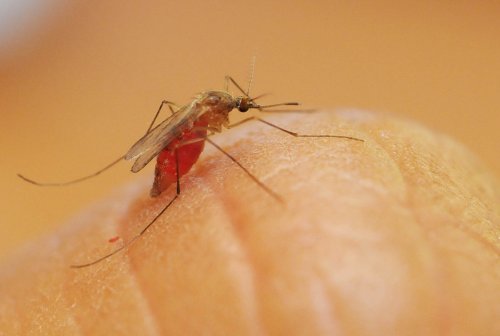
Summer is mosquito season, and a new study gives insight into why repellents work on mosquitoes.
Spray yourself with DEET, and you’ll repel mosquitoes, but why? It’s not because DEET jams their sense of smell; it’s because they dislike the smell of the chemical repellent intensely, researchers at the University of California, Davis have discovered in groundbreaking research published Monday.
“We found that mosquitoes can smell DEET and they stay away from it,” said noted chemical ecologist Walter Leal, professor of entomology at UC Davis. “DEET doesn’t mask the smell of the host or jam the insect’s senses. Mosquitoes don’t like it because it smells bad to them.”
The study's conclusions about how the repellent works is especially important in a time when West Nile Virus has reached California. The disease has so far affected 92 people in 13 California counties this summer, according to the state's West Nile Virus Web site.
DEET’s mode of action or how it works has puzzled scientists for more than 50 years.
The chemical insect repellent, developed by scientists at the U.S. Department of Agriculture and patented by the U.S. Army in 1946, is considered the “gold standard” of insect repellents worldwide. Worldwide, more than 200 million use DEET to ward off vectorborne diseases.
Scientists long surmised that DEET masks the smell of the host, or jams or corrupts the insect’s senses, interfering with its ability to locate a host. Mosquitoes and other blood-feeding insects find their hosts by body heat, skin odors, carbon dioxide (breath) or visual stimuli. Females need a blood meal to develop their eggs.
Entomologist James “Jim” Miller of Michigan State University praised the work as correcting “long-standing erroneous dogma.”
"For decades we were told that DEET warded off mosquito bites because it blocked insect response to lactic acid from the host – the key stimulus for blood-feeding,” said Miller. “Dr. Leal and co-workers escaped the key stimulus over-simplification to show that mosquito responses – like our own – result from a balancing of various positive and negative factors, all impinging on a tiny brain more capable than most people think of sophisticated decision-making.”
He said the work also shows that a recent study on DEET published in the flagship journal, Science, “apparently was flat-out wrong,” Miller said.
“One of the great attributes of science is that, over time, it is self-correcting,” he added.
Leal said previous findings of other scientists showed a “false positive” resulting from the experimental design.
The UC Davis work, “Mosquitoes Smell and Avoid the Insect repellent DEET,” is published in the Aug. 18 edition of the Proceedings of the National Academy of Sciences.
Mosquitoes detect DEET and other smells with their antennae. Leal and researcher Zain Syed discovered the exact neurons on the antennae that detect DEET, which are located beside other neurons that sense a chemical, 1-octen-3-ol, known to attract mosquitoes.
“I was so delighted when I first encountered the neuron that detects DEET, a synthetic compound,” said Syed. “I couldn’t believe my eyes because it goes against conventional wisdom so I repeated the experiment over and over until we discussed the findings in the lab.”
The UC Davis investigators set up odorless sugar-feeding stations, some containing DEET, and found that DEET actively repelled them. The mosquitoes they used were Culex quinquefasciatus, also known as the Southern house mosquito. The mosquito transmits West Nile virus, St. Louis encephalitis, and lymphatic filariasis, a disease caused by threadlike parasitic worms.
“Despite the fact DEET is the industry standard mosquito repellent, relatively little is known about how it actually works,” said UC Davis research entomologist William Reisen. “Previous studies have suggested a 'masking' or 'binding' with host emanations. Understanding the mode of action is especially important because DEET is used as the standard against which all other tentative replacement repellents are compared.”

What the study means to consumers
Dr. Jamesina Scott, district manager and research director for Lake County Vector Control, said there are several effective mosquito repellents on the market now – DEET, picaridin, oil of lemon eucalyptus, and IR-3535 – and understanding how DEET works to repel mosquitoes will help researchers to identify other compounds that work similarly to repel mosquitoes.
The Centers for Disease Control Web site (www.cdc.gov/ncidod/dvbid/westnile/RepellentUpdates.htm) has information for consumers about those four repellents, Scott said.
“For consumers, the critical point is that DEET is an effective mosquito repellent,” Scott said. “How DEET works is not as important to the consumer as the fact that it works well and that using a repellent reduces the risk of mosquito bites and mosquito-borne illness.”
The important things that consumers should know, according to Scott, are that:
They should use a mosquito repellent when they are outside, especially at dusk or dawn when mosquitoes are most active;
They should look for mosquito repellents containing DEET, picaridin, oil of lemon eucalyptus or IR3535
They should always follow the label directions when using a mosquito repellent.
{mos_sb_discuss:2}
- Details
- Written by: Lake County News reports
It's another twist in the most unusual case of Renato Hughes Jr., who turned 24 on Friday and was acquitted earlier this month in a homicide trial for which he was tried for the deaths of friends Christian Foster and Rashad Williams.
The two men were shot by Clearlake Park homeowner Shannon Edmonds, into whose home Foster, Williams and Hughes had allegedly broken in search of marijuana on Dec. 7, 2005. That resulted in Hughes' trial under the provocative act doctrine, because he was taking part in a crime that could result in a lethal response.
The trial was moved to Martinez in Contra Costa County after a judge granted a change of venue late last year.
On Aug. 8 the 12-woman jury found Hughes not guilty of the two homicide counts, robbery and attempted murder, with the jury hanging on assault causing great bodily injury three days later, as Lake County News has reported.
Hughes was convicted of burglary and assault with a firearm.
On Friday morning, Judge Barbara Zuniga summoned back to her Martinez courtroom District Attorney Jon Hopkins and defense attorney Stuart Hanlon.
Hopkins said there is a new judicial rule, passed in 2007, that sends a trial granted a change of venue back to the transferring court for sentencing. It's the first time he's run across it.
"No one has heard of it," Hanlon added Friday.
Hopkins said Zuniga remembered it and called them back to discuss it.
The rule is so new that there's not much legal history on it, said Hopkins.
But Zuniga felt her choice was clear – that the case will return to Lake County, where hearings will be held about where the sentencing should take place, Hopkins said.
"The idea behind it is the community in which the crime occurred is the court with the most interest in the post-conviction proceedings," Hopkins explained.
A hearing is scheduled for 9 a.m. Thursday, Aug. 28, in Judge Arthur Mann's courtroom, to decide if the sentencing will stay in Lake County or return to Martinez, he said.
Hopkins said the discussion will involve balancing Hughes' interest between having his sentencing conducted by the judge who heard the case and the community's interest in arriving at a decision.
Hanlon, who had filed three change of venue motions before succeeding in having the trial moved, said Friday he's happy to see it come back to Lake County for sentencing.
"I think we're probably better off with sentencing before Judge Mann," said Hanlon.
That's because he believes Zuniga – though she was very fair – probably thinks Hughes is guilty.
Sentencing had been scheduled for Sept. 9 in Martinez. Hopkins said that hearing was vacated, although Hanlon added that Hughes hadn't waived his time. That means sentencing could take place in Lake County on that date.
Hopkins, however, said the Lake County Probation Department will be hard-pressed to finish its sentencing recommendations by Sept. 9, especially if they're currently unsure of where the sentencing might be held.
Hanlon said he's hoping for a sentence where Hughes can get out of jail soon. He's been held in jail since December of 2005.
The burglary and assault with a firearm charge could bring an upper term of eight years in prison, with the burglary counted as a strike, according to Hopkins.
With credit for time served plus 50 percent, Hughes should have credit for four years and may spend very little time, if any in prison, due to sentencing guidelines that require the judge to sentence to the middle term unless there are extraordinary circumstances, as Lake County News has reported.
Even with those convictions, and with the uncertainty of the possible sentence, Hanlon said, "I think we've already won the case."
E-mail Elizabeth Larson at
{mos_sb_discuss:2}
- Details
- Written by: Elizabeth Larson