
News
The US Geological Survey reported that the quake occurred at 5:19 a.m. at a depth of 1.6 miles four miles northwest of The Geysers and eight miles west of Cobb.
The US Geological Survey received reports from residents who felt the quake from Santa Rosa and Cloverdale to Lakeport, and even as far away as Vacaville.
A 2.9-magnitude quake had occurred Saturday at 11:29 p.m. at a depth of less than a mile two miles west of Anderson Springs and five miles east southeast of The Geysers.
The last quake measuring in magnitude of 3.0 or above occurred Aug. 19 near Anderson Springs, according to the US Geological Survey.
A 4.4-magnitude earthquake hit the North Coast Saturday at 1:16 a.m., the US Geological Survey reported. That quake's center was in the ocean, 20 miles west of Petrolia in Humboldt County. Residents in faraway San Francisco even reported feeling that quake.
E-mail Elizabeth Larson at
{mos_sb_discuss:2}
- Details
- Written by: Elizabeth Larson
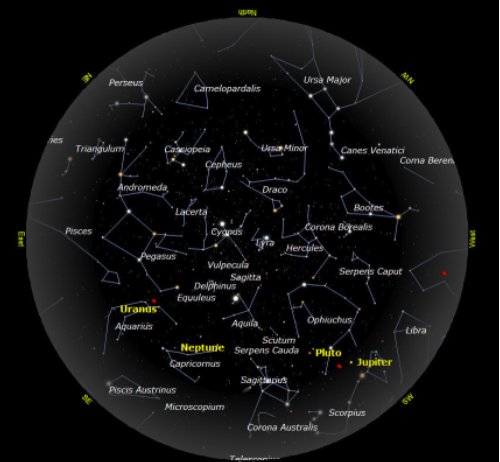
Lake County has some of the clearest, darkest skies in the country – perfect for stargazing! In this monthly column, we’ll talk about some of the things you can see during September nights.
Let’s start by looking at a star chart for September. The chart above is what the night sky will look like around Sept. 15 at around 9 p.m.
If you recall from last month, we mentioned the “Summer Triangle” made up of the bright stars Vega (in the constellation Lyra), Deneb (in the constellation Cygnus) and Altair (in the constellation Altair). This month, this trio of luminaries has moved directly overhead – you can see them in the star chart.
There are also four planets visible this month. Jupiter, the largest of the planets, is setting in the western sky – it’s the brightest object in that direction.
Next to Jupiter is Pluto, the “un-planet.” Up until the fall of 2006, Pluto was considered to be a planet. But this changed when the definition of the term “planet” changed, and Pluto was relegated to “dwarf planet” status. In spite of this change, we still affectionately refer to Pluto as a planet. As for viewing Pluto, you need a very large, powerful telescope, and even then, it will only appear as a faint point of light.
The other two visible planets are Neptune and Uranus. Both need a telescope to see. Neptune is bluish in color, and Uranus is greenish. Both appear very small through a telescope. Jupiter, Neptune and Uranus are what we term “gas giants.” They are huge balls of gas – they aren’t solid like our earth.
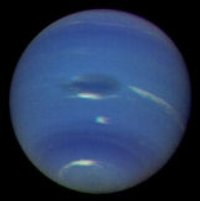
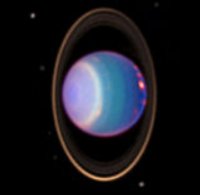
Uranus has a ring system similar to Saturn’s. Neptune has a beautiful blue tinted atmosphere. That beautiful color isn’t from water – it’s from methane gas, the kind of stuff cows produce (and no, there are no cattle ranches on Neptune!).
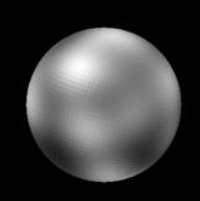
As for Pluto, even our most powerful telescopes take pictures that reveal very little detail, as shown in the photo at the left. Pluto is just too small and too far away to reveal very much.
To learn more about Lake County Skies in September, and to observe these objects through a telescope, visit Taylor Observatory (www.taylorobservatory.org) on Saturday, Sept. 15, from 8 to 11 p.m. This month’s observatory theme is “Global Warming – is Man destined to end up like the dinosaur?” After a presentation about global warming, there will be a planetarium show, followed by telescope viewing.
John Zimmerman has been an amateur astronomer for 50 years. He is a member of the Taylor Observatory staff, where, among his many duties, he helps create planetarium shows.
{mos_sb_discuss:2}
- Details
- Written by: Lake County News Reports





 How to resolve AdBlock issue?