
News
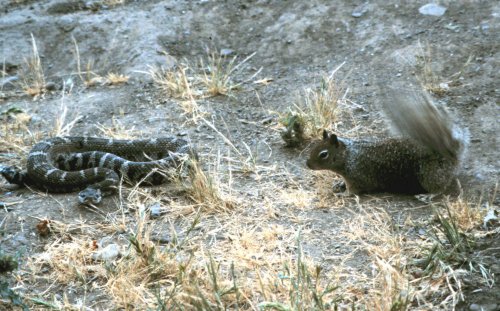
Rattlesnakes do not have it easy. Although they have evolved a characteristic ‘rattling’ warning system to advertise their dangerous venomous bites, these snakes are so feared and hated by humans they are often killed on sight. And, if their situation could not get any worse, Northern Pacific rattlesnakes also have to contend with their favorite prey item – California ground squirrels.
Rattlesnakes and ground squirrels co-occurred millions of years ago, leading to an ancient and intimate predator-prey relationship. Currently, there are about 30 species of ground squirrels in the western US and, for those in rattlesnake habitat, evolving methods to evade these rattlesnake predators was a strong source of natural selection.
In particular, California ground squirrels have evolved an amazing array of anti-rattlesnake behavior and physiology. Back in the 1940s naturalists noted some strange behavior in California ground squirrels – they would go straight up to rattlesnakes, waving their tails and kicking up dust. These naturalists knew that ground squirrels made up almost seventy percent of the northern pacific rattlesnake diet, so why would these prey animals put themselves into harm’s way?
Professor Donald H. Owings at UC Davis and his colleagues managed to explain this puzzling behavior and found that California ground squirrels are actually resistant to rattlesnake venom. Thus the danger of succumbing to a rattlesnake bite does not exist; at least for adult ground squirrels.
Juvenile ground squirrels were shown not to have enough of the venom resistance protein needed to survive a snake bite. This created a unique predator-prey relationship: rattlesnakes could kill and eat young ground squirrels but not the adults.
However, adult female ground squirrels are very protective of their pups and have evolved a sophisticated alarm call system to warn other squirrels of impending danger: a high pitched whistle to warn of aerial predators and a chattering call for terrestrial predators. But these alarm calls might also communicate to predators that they have been spotted and their ambush tactics will fail.
The calls do not, however, work against rattlesnakes. Rattlesnakes have amazing visual and chemosensory systems and can even perceive temperature changes – but they cannot hear. Thus ground squirrel adults attempting to protect their young by calling at a snake will not be heard. So, instead of an audible warning, ground squirrels have apparently keyed in on the rattlesnake’s most sensitive sensory organs – visual, infrared, and olfactory.
When a rattlesnake is discovered, ground squirrels will approach cautiously, bobbing their heads up and down to size up the snake and waving their long tails back and forth – termed ‘tail-flagging’ – the visual equivalent of an alarm call. Snakes seeing this motion are being told they have been spotted. In addition, recent studies by our research group have demonstrated that ground squirrels can actually heat up their tails during rattlesnake encounters, creating an infrared beacon to further get their message across.
Once the ground squirrel has moved closer, they begin ‘substrate throwing,’ flinging dirt and causing the snake to rattle. This behavior by the squirrel is not just to antagonize the snake, it turns out that the squirrel can determine how big and how warm the rattlesnake is by the frequency of its rattle. A large, warm snake is more dangerous than a small, cold one since warm rattlesnakes move faster and larger snakes have a stronger strike.
These harassment tactics are also thought to drive the snake out of the area and away from the younger and more vulnerable squirrels.
Ground squirrels cannot always be on the alert, however, especially at night when they are asleep in their burrows and when rattlesnakes seem to prefer to hunt. Nevertheless, there is some recent evidence that they have evolved yet another unique defense mechanism.
When California ground squirrels, particularly adult females and juveniles, come across a rattlesnake skin or a patch of grass where a rattlesnake has been resting, they chew on the snake-scented substance and apply it to their fur by licking their bodies. Why would they do this? Finding the answer to this question became the focus of my PhD research.
We had three hypotheses. First, the squirrel may fool predators sniffing around a burrow by smelling like a rattlesnake instead of a squirrel. Second, the predator scent may cause other ground squirrels to leave the area and not compete for food. Finally, applying scent to their bodies might repel the ground squirrels major parasite – fleas.
In a series of experiments, we found that ground squirrel scent mixed with rattlesnake scent reduced rattlesnake foraging behavior but had no effect on ground squirrels or fleas. Therefore, a sleeping adult female ground squirrel and her young might prevent a hungry rattlesnake from entering their burrow at night by applying snake scent to their bodies.
Even with all their defenses, rattlesnakes still get their fill of ground squirrel juveniles and, over millions of years, have not become endangered by these anti-snake tactics. Many rattlesnake species across the country are, however, threatened by humans.
As urban development and agriculture move into rattlesnake habitat, there is an increase in human encounters with rattlesnakes. Due to the fear and hatred felt for these snake species, humans often reflexively kill “rattlers,” including at organized events, or ‘rattlesnake roundups’ at which snakes are killed by starvation, crushing, skinning or other cruel and often horrifying ways in a public setting.
Though caution is appropriate when in an area where rattlesnakes can be found, rattlesnakes are not aggressive and will normally prefer to stay out of sight, and even rattle to warn about their presence. In fact, medical research shows that most rattlesnake bites are caused when a human picked up or provoked a rattlesnake.
If you encounter a rattlesnake in the field, respect its space, and if you find one in your yard think twice before killing it and instead about how you could change your behavior so you and the rattlesnake can safely coexist.
Barbara Clucas is a PhD student in the Animal Behavior Graduate Group at UC Davis and has been studying rattlesnakes and ground squirrels for 5 years. Tuleyome Tales is brought to you by: Tuleyome, a local non-profit working to protect both our wild heritage and our agricultural heritage for future generations. Past Tuleyome Tales articles are available in the library section of their website. www.tuleyome.org.
{mos_sb_discuss:2}
- Details
- Written by: Barbara Clucas
Emergency crews fighting fires in the Yolla Bolly-Middle Eel Wilderness have set up an incident base camp at the Paskenta Community Park where the Nome Cult gathering was previously scheduled to be held. The Nome Cult gathering has been moved to the nearby Elkins Elementary School, 2960 Elkins Road, in Paskenta. All times and activities remain the same as previously announced.
Next week, on Saturday afternoon, Sept. 15, the Round Valley Indian Tribes will sponsor a gathering at the Round Valley Reservation in Covelo to mark the completion of the 12th annual retracing of the original 100-mile trek.
Descendants of Native Americans who took part in the original relocation and other supporters will walk all the way from Chico to Covelo starting Sunday, Sept. 9, descending down into Round Valley on Sept. 15.
The theme for the walk and gatherings is "Honor Their Memory … A Path Not Forgotten." All events are free and are open to the public.
The Paskenta gathering will begin at 10 a.m. Saturday, Sept. 8, at the Paskenta Community Park with a program of historical presentations, followed by musical performances and a lunch. During the afternoon there will be performances by Native American dancers and singers, cultural demonstrations, and information on Passport in Time (PIT) excavations at sites on the Mendocino National Forest. Native American arts and crafts vendors will participate. Throughout the day there will be horseshoe and softball tournaments.
At the Covelo event, there will be presentations by the walkers and a meal, starting at about 3 p.m. Saturday, Sept. 15, at the Tribal Building, 77826 Covelo Road. From Sept. 9 through 15 the walkers will retrace the original trail, camping out each night along the way. The tribes welcome the public to join them for all or any part of the walk and for the gathering in Covelo on Saturday afternoon.
The National Forest requests that people traveling the forest roads along the trail route be careful of the walkers to ensure their safety.
The removal of Indians from Chico to the Nome Cult Reservation in 1863 is one of the many forced relocations following the establishment of reservations in Northern California in the 1850s. Several different tribes were moved to the Nome Cult Reservation after it was established in Round Valley in 1856.
In September 1863, 461 Indians were marched under guard from Chico to the Nome Cult Reservation, nearly 100 miles across the Sacramento Valley and rugged North Coast Ranges. Only 277 Indians completed the journey. Some were killed, a few escaped, and others were left behind, too sick to go on.
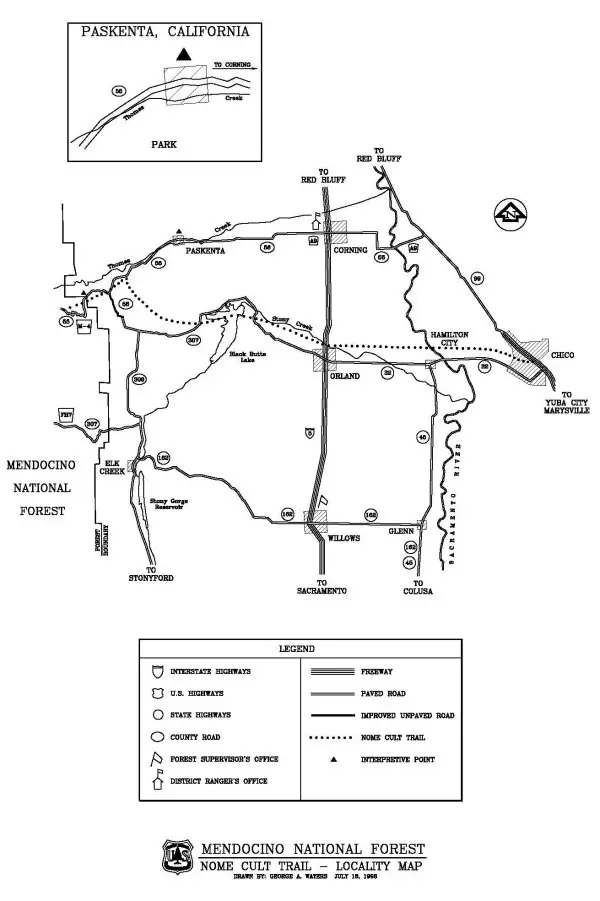
Although the path itself has disappeared, this route is now called the Nome Cult Trail. The most grueling part of the trail passed through what is now the Mendocino National Forest. The Forest Service has marked places where the Indians and their military escorts camped by placing interpretive signs along the route. The Forest Service has also prepared a free brochure and trail map which is available from Mendocino National Forest offices for persons who may want to travel the route.
This year the walkers, many of whom are descendants of those who made the trek in 1863, will begin west of Chico at at the Irvine Finch Park at River Road and State Highway 32 at 6 a.m. on Sunday, Sept. 9. They will walk west on State Highway 32 and camp at the Buckhorn Campground at Black Butte Lake the first night. For the remainder of the week they will walk across the Mendocino National Forest, following the Nome Cult Trail.
Their planned schedule is:
Monday, Sept. 10, camp at Paskenta (evening gathering at Grindstone Rancheria).
Tuesday, Sept. 11, camp at Black Bear Campground.
Wednesday, Sept. 12, camp at Log Springs.
Thursday, Sept. 13, camp at Wells Cabin Campground.
Friday, Sept. 14, camp at Eel River Campground.
Saturday, Sept. 15, walk into Round Valley.
The Round Valley Tribes will welcome the walkers with a gathering and potluck dinner at the Tribal Administration Building in Covelo on Saturday afternoon, Sept. 15.
For further information on the September 8 Paskenta event, please contact Kim Freeman, Paskenta Band of Nomlaki Indians at (530) 680-3842; or Phebe Brown at the Mendocino National Forest, (530) 934-3316, TTY (530) 934-7724. For further information on the Covelo event and the re-enactment walk, please contact Alberta Azbill at (707) 983-6126, Rema Lincoln at (707) 983-6188, EXT 30, at Round Valley Tribes; or Arlene Ward, Chico Mechoopda Tribe, at (530) 899-8922.
{mos_sb_discuss:2}
- Details
- Written by: Lake County News reports





 How to resolve AdBlock issue?