
News
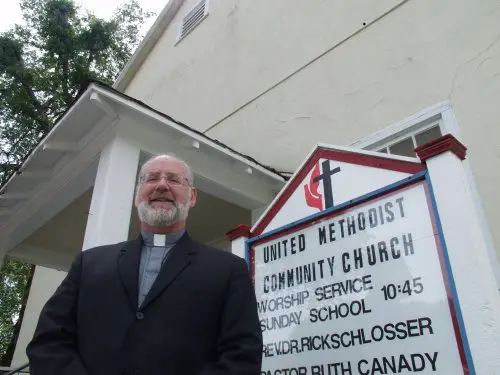
CLEARLAKE OAKS – Christian activism may evoke ideas of politically conservative evangelicals for many people.
The common perception leaves out progressive, mainstream groups and churches who say that they're succeeding in furthering the goals of social justice and compassion.
To find a local expression of that part of the story, one needs look no further than Clearlake Oaks Community United Methodist Church.
The church's senior pastor is Rev. Dr. Rick Schlosser, who also serves as executive director of the California Council of Churches and its sister organization for public policy advocacy, California Church IMPACT.
California Council of Churches, a nonpartisan organization based in Sacramento, received the first Father Robert Drinan Award on April 28 from the California Democratic Party, during its annual convention in San Diego.
State Democratic Chair Art Torres presented the award to Schlosser. Torres cited Church IMPACT's successful Capitol and grassroots lobbying for social justice legislation and its campaigns for statewide ballot propositions that reflect their moral values.
The Drinan Award recognizes courage in the struggle for social justice.
The California Council of Churches and California Church IMPACT represent 21 Protestant and Orthodox Christian denominations with 1.5 million members in the state. The council was created in 1913 “to educate faith communities to pursue justice through study and service, equity, and fairness in the treatment of all people, in particular those most vulnerable in society,” according to its mission statement.
"We have a different perspective on the place of faith and public policy than do conservative church members," said Schlosser. "We address policy coming from a faith perspective. We have no desire to impose our values nor to create a theocracy. We don't evangelize; we educate and advocate."
The council educates church members on the moral values involved in major public policy issues while Church IMPACT advocates for legislation and budget items on issues ranging from poverty to nonviolence and environmental protection to civil rights, Schlosser said.
Schlosser said the council's primary focus is working at the state level to create an unconventional measure of worth, “a moral economy, that includes everyone.”
IMPACT, he said, lobbies for and against legislation, applying spiritual and moral principles to legislative issues. Schlosser said the group lobbies in Sacramento for those who might not otherwise have a voice there.
“The primary part of our mission is to advocate for justice and equity for all people, especially the most vulnerable,” he said.
IMPACT also creates study guides for congregations on issues such as child care and health care.
Health care is a primary focus for the group right now, he said, which has six proposal for universal health care. They're also working on immigration reform, Schlosser said.
Church IMPACT won victories including helping secure the first part of the path-breaking clean-air act, achieving several key bills on poverty issues, and passing the state's path-breaking hate crimes legislation and women's rights bill, Schlosser said.
In addition, he said IMPACT helped convince Assembly members to vote for Assemblyman Mark Leno's same-gender marriage equality bill in 2006, giving the bill the majority it needed to pass.
In the 2005 special election, its non-partisan "IMPACT Sundays" campaign is believed to have provided enough votes to help defeat the closest two initiatives on the ballot, parental notification and the
anti-labor so-called "paycheck protection" initiative.
The Democratic Party initiated the Father Drinan award following the January death of Rev. Robert Drinan, a Catholic priest and former Democratic Congressman, who brought his values and dedication to social justice to his political work.
Schlosser said the California Council of Churches and IMPACT were deeply honored to receive the award. “Father Drinan was a model for us all. He led by example showing us that we have a duty to stand for principles that shape our public policy. He also showed us how moral courage and commitment are compatible with respect for people with differing views."
While faith organizations can accept acknowledgments from political parties such as the Drinan award, Schlosser said it's “unethical” for faith groups to give support to any political organization.
"We believe in the separation of church and state," he said. "We work closely through our advocacy organization, Church IMPACT, with legislators from both parties, and we are glad that our voice for
justice has received recognition. We would be happy to accept an award for that from anyone."
Church works for a better community
A resident of Sacramento, Schlosser drives to Lake County two to three days a week in his role of church pastor.
Schlosser became the church's senior pastor following the sudden death in 2005 of the congregation's beloved pastor, Bill Thornton, who, along with his wife, Ruth Canady, had guided the church.
Canady, Schlosser said, decided she didn't want to be the church's main leader, but would rather do pastoral work with people who were sick or otherwise in need.
So Rev. Benito Silva-Netto, superintendent of the United Methodist Church's Shasta District, contacted Schlosser, saying the church "really needed a community-minded, progressive pastor to help carry forward the church's goals for making The Oaks a better place," Schlosser said.
"I came up and preached a few times and I loved the church – and they seemed to like me – so here I am," Schlosser said.
Bishop Beverly Shamana subsequently appointed him as the church's pastor, he said.
Schlosser, who was ordained in 1979, said the church in Clearlake Oaks shares values with the California Council of Churches.
"The church in Clearlake Oaks and the council both look at spirituality as something that should be a positive, inclusive force in society, and not a judgmental, excluding force," Schlosser said. "The church tries to work on a very specific local level on some of the same issues."
The Oaks is also a good place to put to the test those ideas about social justice, according to Schlosser.
"In the Oaks, it's obviously a very challenged area economically," Schlosser said, with people struggling to find employment and health care. "Those are two of the things that I see most frequently."
With the church's No. 1 priority being to make Clearlake Oaks a better place for all of its residents, it set out to identify the greatest needs and respond to them, said Schlosser.
So the church created L'il Acorns Preschool to help working families, which Schlosser said has been a "resounding success."
The needs of seniors are also apparent in the community, said Schlosser, and are another big focus for the church. The congregation itself illustrates the area's large senior population, with Schlosser estimating that more than 80 percent of the church's membership is over retirement age.
"These are primarily people who aren't retired from life," he said of his flock, adding that the congregation includes some of the most active 80 years olds he's ever seen.
The church is imbued with community spirit, he said, with many members involved in projects and working for others, including cooking meals for people and providing transportation to those who need it.
He said the list of creative ways church members support each other is endless.
That includes outreach to the community at large. The church is preparing to break ground later this year on a 4,500-square-foot community center next door to the church and preschool on The Plaza, said Schlosser.
The church plans to provide counseling, outreach and other services to the community, along with senior daycare, said Schlosser. They're also working with the firm Eskaton to build a new senior housing complex in the Oaks and with Lake County Redevelopment on the Plaza redevelopment
project.
What's next for the council
Earlier this month, the California Council of Churches joined with other national and regional faith groups to launch an initiative for a nuclear free world.
The effort came in response to a proposal by the Bush administration for a build-up in nuclear weapons, according to a statement from the council.
The council is lobbying members of Congress to reject the plan, which would require a minimum of $150 billion.
Schlosser said he can see a better use of the funds.
“It is immoral for so much money to be directed into weapons development when so many human needs are going unmet. Here in California, people need quality, affordable health care – and instead the funds that could pay for it are going to an unnecessary expansion of our bloated nuclear arsenal.”
The California Council of Churches, the National Council of Churches and the National Religious Partnership on the Nuclear Weapons Danger announced that they plan to spread the word about the nuclear weapons build-up over the next several months in an effort to stop it.
Schlosser called the decision to abandon peace and prepare for war “immoral.”
“California is already threatening to cut out spending for every child whose parents cannot meet welfare work hour obligations,” he said. “We are choosing to spend money on weapons, which can obliterate our civilization, rather than spending for health, education, and humanity. This is utterly unacceptable in a civilized society.”
For more information about the California Council of Churches and its activities, visit www.calchurches.org. To learn more about Clearlake Oaks Community United Methodist Church call 998-9435.
E-mail Elizabeth Larson at
{mos_sb_discuss:2}
- Details
- Written by: Elizabeth Larson
MENDOCINO NATIONAL FOREST – A young man who was found dead in the Mendocino National Forest earlier this spring appears to have died of natural causes, officials are reporting.
As Lake County News reported previously, a young man who was in a remote part of the forest with his father died and his body was recovered by Lake County Sheriff's Office officials March 29 near Hull Mountain.
It was later discovered that the man's body was located in Mendocino County, so the investigation was turned over to the Mendocino County Sheriff's Office.
The young man, identified as Jovanny Perez-Ortiz, 22, was with his father, Alfredo Perez, when he died, reported Lt. Rusty Noe, the Mendocino County Sheriff's chief deputy coroner.
Perez then reportedly walked all day to reach the Soda Creek Store near Lake Pillsbury, where he reported his son's death and authorities were called.
Noe said he was lowered from a California Highway Patrol helicopter into the area where Perez-Ortiz's body was, on a steep hillside. There was no evidence of anyone else being with Perez-Ortiz and his father, Noe said.
This week, Mendocino officials reported the final results of Perez-Ortiz's autopsy and toxicology results.
Perez-Ortiz's toxicology results came back clear, said Tia Turner of the Mendocino County Coroner's Office. Nothing was found in his system that would have caused his death, which has been ruled natural, Turner said.
Last month, Captain Kevin Broin of the Mendocino County Sheriff's Office said he expected the toxicology tests would play a big role in understanding the young man's sudden death, and said at the time the department would wait for those results before making a final ruling on the death.
Resolution to the case was prolonged, said Broin, because of the involvement of several agencies, including the National Forest.
Noe said Perez-Ortiz was a Mexican national, as was his father, but both had Santa Rosa addresses.
The men were in a very rugged, remote area, said Noe. “They were up in an area where most people don't go hiking.”
Those circumstances had given rise to concerns that the men were there to locate a site for an illicit marijuana garden, which has become an increasing problem in the Mendocino National Forest. Last year, the forest was the site of the largest amount of illicit marijuana seized in the state.
As to what they were doing in the remote area of the forest, Noe said, “There was really no evidence to indicate that they were there to cultivate marijuana.”
Perez-Ortiz's death has been ruled accidental, said Noe, with no signs of foul play.
Mike Ricker, a Redding-based National Forest Service special agent, assisted in the investigation.
“When somebody is lost in the forest or injured, as it becomes more detailed, if they need more investigations done, they refer it to this branch,” he said.
Perez-Ortiz's situation was “a real sad case,” said Ricker.
Ricker said his part in the case was investigating the activities of the two men in the forest.
The Forest Service relies on the sheriff's determination on the cause of death, said Ricker.
On Friday, Ricker – who has since been working on another case – said he hadn't yet determined if he needed to continue an investigation into what men were doing in the forest.
E-mail Elizabeth Larson at
{mos_sb_discuss:2}
- Details
- Written by: Elizabeth Larson





 How to resolve AdBlock issue?