
News
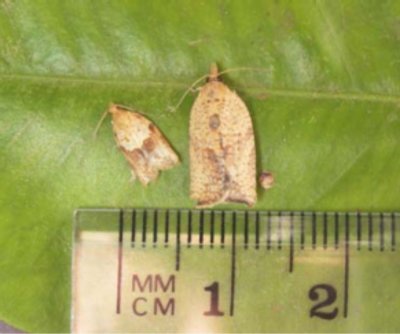
The light brown apple moth has been found in neighboring Napa County, state and federal officials confirmed Wednesday.
The California Department of Food and Agriculture and the U.S. Department of Agriculture reported that a single adult light brown apple moth was found May 9 in a residential area of Napa.
Officials made the announcement following lab confirmation by Department of Food and Agriculture entomologists, with supporting confirmation by USDA scientists.
“This moth is a threat not only to agriculture but also to our urban environment – our landscaping, our parks and our natural habitat,” state Agriculture Secretary A.G. Kawamura said in a statement. “We are moving quickly to detect the extent of any infestation and contain the problem in the smallest possible area.”
The Department of Food and Agriculture, USDA and the county agricultural commissioner's office have already begun setting and collecting additional traps in the area to determine the extent of the problem. No additional moths have been found in the vicinity to date.
The light brown apple moth, which is native to Australia, was first detected in the Bay Area in February, state officials reported. Since then, it has reached nine counties – Alameda, Contra Costa, San Francisco, Marin, Monterey, Santa Clara, Santa Cruz, San Mateo and now Napa.
More than 2,000 moths have been detected in those nine counties since February, the Department of Food & Agriculture reported, with most of the moths found in Santa Cruz, which officials believe may be an original infestation point.
Trapping is taking place in 40 of the state's 58 counties, but so far Lake hasn't been added to that list. However, trapping is taking place in Mendocino, Sonoma and Yolo.
Officials say the light brown apple moth is of particular concern because it can damage a wide range of plants including many commonly found in our urban and suburban landscaping, public parks and natural environment.
The list of agricultural crops that could be damaged by this pest includes as many as 250 plant species, from grapes and pears to citrus and stone fruits. The pest damages plants and crops by feeding on leaves, new shoots and fruit.
On Tuesday, SB 556, a piece of urgency legislation introduced by North Coast Sen. Patricia Wiggins to address the moth issue, passed the Senate Agriculture Committee. The bill would create an advisory task force to advise Kawamura on the moth issue.
“As we find out more about the spread of this pest, the department and the Legislature will be better able to assess what resources and programs California may need to protect our precious and vulnerable agricultural products from potential harm,” she told the committee at the hearing.
This week, the USDA informed county agricultural commissioners that Mexico has implemented restrictions on shipments of certain fruits and vegetables to that country from the infested counties.
In addition, the USDA reported that seven states – Arizona, Colorado, Florida, Georgia, Nevada, Oregon and Wisconsin – have asked the Department of Food & Agriculture for advance notification of shipments from the quarantined counties.
Late in April state agricultural officials established a quarantine to cover the affected counties, which required inspections and clearances for shipments of plants and fruits from within the affected counties.
On May 2, the USDA added a federal quarantine regulating movement of plant materials between California and other states, with similar inspection requirements as those found in the state quarantine.
USDA and the Department of Food & Agriculture reported that they have assembled a technical working group comprised of international experts on light brown apple moth to discuss survey and mitigation strategies to safeguard against this potentially damaging pest and prevent its further spread.
The group will meet in San Jose today and Friday, May 17-18, to discuss California's situation and make recommendations about the project.
For more information on the light brown apple moth, visit the Department of Food and Agriculture's Web site, www.cdfa.ca.gov.
E-mail Elizabeth Larson at
{mos_sb_discuss:2}
- Details
- Written by: Elizabeth Larson
SACRAMENTO – The Senate Appropriations Committee on Monday approved the following bills by Sen. Patricia Wiggins (D – Santa Rosa):
– SB 557, which seeks to include qualified doctors of audiology among those medical professionals who may be appointed by the administrative director of the Division of Workers' Compensation as qualified medical evaluators.
The bill’s sponsor, the California Academy of Audiology, asserts that an audiologist is the most qualified professional to determine whether a hearing loss would impair a worker's ability or whether a hearing loss was secondary to noise exposure on the job.
– SB 565, which would create the position of hospital and health services director at the Yountville Veterans’ Home.
Yountville is the only state veterans’ home with a hospital. Yountville has an emergency room, skilled nursing facility, pharmacy, and an Alzheimer unit. Yountville has a medical director and a nursing director but no one to administer and coordinate the medical care and medical personnel for all the facilities on the property.
Veterans and veterans’ advocacy groups believe that patients would be better served with a hospital and health services director on-site.
– SB 581, which would transfer the Volunteer Firefighters Length of Service Award System away from CalPERS and direct administrative responsibilities of the program to the California State Fire Employees Welfare Benefit Corporation.
Currently there are approximately 54 fire departments participating in the program, and 128 volunteer firefighters who are receiving monthly payments and who are eligible for the death benefit. The total membership is comprised of 3,983 volunteer firefighters and the balance in the fund is approximately $2.6 million.
In 1998, CalPERS changed the methods and assumptions it used in determining the administrative costs of the VFLSA. Since that time, the administrative costs have increased from $10,000 to an estimated cost of $139,025 for 2007-08.
The system is funded entirely by contributions from contracting fire entities and investment earnings.
– SB 861, which would authorize the North Coast Railroad Authority (NCRA) to use $5.5 million in previously allocated state funds for environmental cleanup of rail lines.
Specifically, this bill would allow the NCRA to use $5.5 million in funds allocated through the Transportation Congestion Relief Program to meet cleanup obligations under an environmental remediation consent decree ($4 million), along with some administrative responsibilities.
The authority would be prohibited from spending more than $500,000 annually on administrative expenses.
Monday's actions mean that all four bills are now eligible for a vote by the full Senate.
Wiggins represents California’s 2nd Senate District, which stretches from Solano County to Humboldt County and includes part or all of Lake, Mendocino, Napa and Sonoma Counties as well. Visit her Web site at http://dist02.casen.govoffice.com/.
{mos_sb_discuss:3}
- Details
- Written by: Editor





 How to resolve AdBlock issue?