
News
- Details
- Written by: Patricia England

Terrace Middle School students recently went all out for “Paint Our Town Purple Day.”
Students decorated the trees in front of the school with purple ribbons, wore purple clothes and some had purple hair or faces. The effort is to raise funds and support for the upcoming Relay for Life.
The whole school had a "Purpleist" contest with each grade level chosing the "purpleist" class whose students were treated to purple doughnuts. A student from each winning class was chosen to compete for the "purpleist" student in the school and the winner, Jessica Henson, received special gifts.
There is a money jar in the office to support American Cancer Society Relay For Life. The students who donate money can put a name on a purple paper heart to go on a large banner on the window. The theme is The Power Of Purple. The students have donated more than $240 so far.
The Lake County Relay For Life will be held from 10 a.m. Saturday May 19, to 10 a.m. Sunday May 20, at Clear Lake High School's Don Owens Stadium. Everyone is invited to attend.
There will be entertainment the full 24 hours and special ceremonies to honor cancer survivors and to remember those lost to cancer.
The Relay For Life committees extend special thanks to the students, teachers and staff of Terrace Middle School for supporting Paint Our Town Purple Day.
{mos_sb_discuss:2}
- Details
- Written by: Elizabeth Larson
On Thursday night, the House of Representatives passed an emergency spending bill that would provide much-needed funding for rural schools, the Pacific salmon fisheries disaster, agricultural disaster relief and wildfire emergencies.
HR 2207 passed with a strong bipartisan vote of 302-120, according to Congressman Mike Thompson's office.
The bill would provide $425 million for a one-year extension of the county payments law, known officially as the Secure Rural Schools and Community Self-Determination Act, Thompson reported.
Lake County receives funds from that bill, which allocates money for rural schools and roads based on historic timber receipts. The county's most recent payment was about $1 million, according to local school and county officials.
The county payments law ran out last year, and the 109th Congress failed to pass a renewal bill, as Lake County News previously reported.
Provisions to extend the bill were then included in a recent Iraq War supplemental bill, which President Bush vetoed earlier this month because, among other things, it included timelines for troop withdrawal from Iraq.
The bill also includes $60.4 million for California and Oregon's commercial salmon fishing industry, a provision introduced by Thompson. The relief is needed for fishermen, tribes and businesses impacted by the commercial fishery failure of 2006, which Thompson's statement attributed to irresponsible Bush Administration water policies.
"The emergency relief for our salmon industry is long overdue," said Thompson. "Last year's commercial salmon fishing closure was the largest in U.S. history. The affected families and businesses need aid right away, and the president's claim that they should take out loans is illustrative of his disconnect from the real needs of working Americans."
"Due to the fishing closure last year, my business lost $50,000," said Deniel Caouette, owner of Deniel's Place Café in Klamath. "That may not seem like much to the president, but we're holding on by a thread and his suggestion that we just 'borrow' the money reveals how out of touch he is with plight of working people on the Klamath River."
In addition, the bill includes $500 million for wildland firefighting, and money for agriculture disaster relief.
A Bush statement of administration policy, issued May 10, said if presented with the bill, the president would veto it, calling the $7 billion included in the bill “unrequested spending that is unjustified and not appropriate for an emergency spending bill.”
In addition, the administration said the bill circumvents the new House “pay-as-you-go” rule and stretches the definition of “emergency.” The statement called the $500 million in wildfire suppression activities the bill proposes as “unnecessary, saying this year Congress has appropriated enough funding for such emergencies.
Regarding the county payments law provisions, the statement noted that the administration has “serious concerns” with the bill's provisions, and that the president has proposed his own “responsible” extension for the law that includes funding for a more sustainable level of timber harvest, with phase-out provisions.
"This president says he wants to leave no child behind while simultaneously keeping funding out of our schools," continued Thompson. "This veto signals that he doesn't care about getting rural students a good education."
Oregon Congressman Greg Walden also took issue with the administration statement. “To say that the closing of jails, schools and libraries as is occurring right now in my district and in others is not somehow an emergency is to simply ignore reality of what's happening in the rural west. It is outrageous.”
Walden said the federal government has failed to properly fund wildfire suppression, with 10 million acres of federal land burning last year at a cost of $1.5 billion to taxpayers to extinguish those fires. He said the government also has failed to replant those forestlands.
"Without funding, our county schools are at severe risk," said Jan Moorehouse, Superintendent of Del Norte County Unified School District. "These funds should have been secured last year and the president's callous disregard demonstrates he is ignorant to the needs of rural communities in the West."
The spending bill, entitled the Agriculture Disaster Assistance and Western States Emergency Unfinished Business Appropriations Act of 2007, now goes to a vote in the Senate.
Thompson's office reports there is enough support in the House to override the president's veto.
To view Rep. Thompson's floor speech click here: http://recap.fednet.net/archive/Buildasx.asp?sProxy=80_hflr051007_140.wmv&sTime=00:00:51.0&eTime=00:03:25&duration=00:02:33.0&UserName.
To see the White House statement of administration policy, visit www.whitehouse.gov/omb/legislative/sap/110-1/hr2207sap-h.pdf.
To learn more about the bill, visit www.thomas.gov and search for HR 2207.
E-mail Elizabeth Larson at
{mos_sb_discuss:3}
- Details
- Written by: Elizabeth Larson
SACRAMENTO – With state officials concerned about the spread of the light brown apple moth, a bill is now in the state legislature that proposes to form an advisory task force to address the pest issue.
North Coast Sen. Patricia Wiggins on Friday said she introduced urgency legislation, SB 556, to form a light brown apple moth advisory task force.
Appointments to the task force would be made by the California Department of Food & Agriculture secretary – currently A.G. Kawamura – with task force members required to issue a report on the pest to the secretary no later than Sept. 1, Wiggins' office reported.
The Department of Food & Agriculture reported that the light brown apple moth was discovered in the Bay area in February.
Since then, it has reached a total of eight California counties – Alameda, Contra Costa, Marin, Monterey, San Francisco, San Mateo and Santa Cruz.
A total of 1,979 moths have been found according to the most recent Food & Agriculture situation report, released May 8. Most of the moths have been found in Santa Cruz County, which officials believe may be the original infestation point.
Trapping is taking place in 40 counties, with more than 17,000 traps put into urban and rural areas, according to the Department of Food & Agriculture.
No traps have been put out in Lake County, according to the Department of Food & Agriculture. Traps have been placed in the neighboring counties of Sonoma, Mendocino and Yolo, but so far those traps have yielded no moth finds.
The presence of the moth has been confirmed in as many as 250 kinds of plants and trees, according to the Department of Food & Agriculture.
In particular, the moth has been known to damage pears and grapes, important North Coast crops.
The moth, originally from Australia, has since become established in New Zealand, New Caledonia, Hawaii and the British Isles, the Department of Food & Agriculture reported.
Moth infestations led the state Department of Food & Agriculture to announce April 20 that it was establishing quarantines in the affected counties. On May 2, federal agriculture department officials implemented a federal order restricting the interstate movement of various agricultural products originating from the same counties listed above, as well as Hawaii.
“California stands as the nation’s leader in agricultural exports, shipping more than $7.2 billion in food and agricultural commodities around the world in 2003 alone,” Wiggins said. “The light brown apple moth has the potential to cause significant economic damage due to increased production costs and the possible loss of international and domestic markets.”
SB 556 has been scheduled for its first legislative hearing on May 15 before the Senate Committee on Agriculture at the State Capitol.
E-mail Elizabeth Larson at
{mos_sb_news:3}
- Details
- Written by: Elizabeth Larson
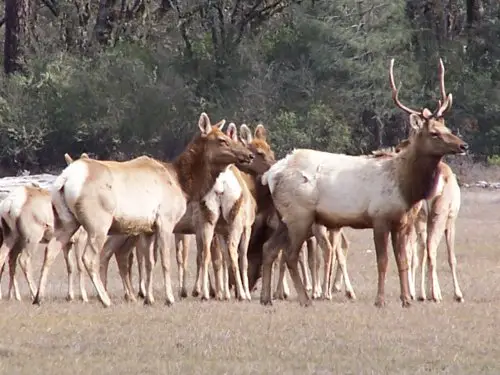
MENDOCINO NATIONAL FOREST – A small herd of tule elk is thriving at Lake Pillsbury thanks to efforts during the past three decades to reintroduce the animals, which were nearly hunted to extinction.
Tule elk once were at the brink of disappearing due to habitat changes and overhunting, said Lee Morgan, a Mendocino National Forest biologist.
Beginning in the state's Gold Rush era, “market hunters” – who shot the animals and then sold the meat – began to erode herd numbers, Morgan explained.
Within 30 years, market hunters had nearly wiped out the tule elk statewide, said Morgan, a situation he said was similar to what happened to the American bison.
Different historical accounts put the tule elk's lowest numbers at between two and 20, he said.
The elk had also been at home in Lake County, which Morgan said is on the edge of the tule elk habitat.
Beginning in the 1970s, the state Department of Fish & Game began reintroducing the animals to the Lake Pillsbury Basin, according to a report by Phebe Brown, the forest spokesperson.
Fish & Game initially brought in 20 animals, Brown reported. Several years ago, Morgan said, another group of elk were brought in.
In January, forest biologists counted 68 elk, including 17 branched bulls, Brown reported.
Morgan said it's a steadily growing herd. “We're expecting to see about a dozen calves this year,” he said, which would bring the herd size to about 80.
“It's the only tule elk herd on our forest that's regularly present,” said Morgan, although some tule elk sometimes travel in from other areas, such as Covelo.
Mendocino National Forest and the Los Padres National Forest in Goleta are the only two national forests in the state to have tule elk, Morgan reported.
The Pillsbury elk can't be hunted, said Morgan, as there's no elk hunting season in that area.
What's a tule elk?
The Rocky Mountain Elk Foundation, a conservation organization based in Missoula, Mont., reports there are four elk subspecies: the Rocky Mountain, found in the Rocky Mountain West region; Roosevelt's, found along the Pacific Coast; the tule, in central California; and the Manitoban, found in the northern Great Plains.
Tule elk are a smaller breed of elk, Morgan said, normally about two-thirds the size of a Rocky Mountain elk.
The cows they've collared in the Pillsbury herd range between 300 and 350 pounds, he said, with the biggest bull weighing in at roughly 500 pounds.
Tule elk tend to prefer flatter ground, he said, and don't range as far as some other elk species.
Although Rocky Mountain Elk are found in California, Morgan said that there is some disagreement among scientists about whether or not that elk subspecies is actually native to California.
Grants helped elk project
The effort to make the elk at home once more was aided by a partnership between the Mendocino National Forest, Fish & Game and the Rocky Mountain Elk Foundation.
The Rocky Mountain Elk Foundation gave the effort a grant to help pay for radio telemetry, which is used to county and monitor the elk and their habitat usage, Brown reported. Fish & Game and the Forest Service have worked together to capture and monitor the elk.
Brown reported that several types of recent projects have benefited tule elk around the lake. The Rocky Mountain Elk Foundation, Fish & Game and California Deer Association have provided grants that, combined with Forest Service funding, helped pay for work that improves forage for tule elk, deer, and other wildlife.
Visitors can see mechanical brush management and burning projects that have been completed on several hundred acres on the flats at the north end of the lake, Brown reported. The work produces additional food for wildlife as well as reduces fuel concentrations that pose a threat to adjacent homes and forested habitat.
The National Forest has initiated several new forest thinning and fuel reduction projects that will create additional understory forage on more than 1,500 acres on ridges to the east and west of the lake, according to Brown. Elk forage and elk use had been limited on those ridge locations prior to project work, but elk use has already increased where that work has begun east of the lake. Planned future understory burns should help maintain favorable forage conditions while keeping fuel profiles reduced.
Morgan said an Elk Foundation grant will help fund a 100-acre project that this year that will burn older chaparral to provide better feed for area deer and elk. When the chaparral grows back, the elk find the younger growth more palatable and will mow it down, he said, which in turn helps control the brush.
The forest's tule elk also enjoy wild clovers and grasses, he said, and when the main grasses dry out, they'll focus more on the green summer and fall foliage around Lake Pillsbury's edges.
Fish & Game overflies the herd monthly, said Morgan. The National Forest monitors the elk from the ground; Morgan said he comes over monthly to check on them, making more visits during calving season.
Fish & Game wildlife biologist David Casady said the agency is excited about how the elk are doing at Pillsbury.
“There are more elk here than we thought and the herd is growing nicely,” he said. “We have learned new information about local elk movements and relative habitat usage from the telemetry so that land managers can better plan elk enhancement projects near the lake.”
He added, “We are hoping the ongoing bull telemetry will show if some animals are moving between here and adjacent herds.”
Knowing where the elk go and along what general routes can help prioritize future habitat work to improve habitat linkage between elk herds, Casady said.
Elk herd the visible sign of success
Wildlife enthusiasts can consistently view tule elk and other wildlife at Lake Pillsbury, though they are not necessarily all visible all day long, Morgan said.
It's also important to remember that the animals are wild, Morgan said.
“Nature watchers need to remember that these elk are wild animals and not to approach too closely,” he said. “Folks can often park on a road and get a good view of the elk with binoculars from their car without spooking the elk into the cover.”
He added, “Elk viewing can be pretty special here, between the views of the elk, the lake, and adjacent mountains, coupled with the sounds of the elk and waterfowl around the lake. Some of the resident tule elk are visible every day if you know where to look. They are usually most visible early and late in the day and spend many hours out in the lake bed as the water drops.”
Forest Supervisor Tom Contreras said the results of the partnership between government and private agencies are visible in the herd itself.
“Successful partnerships like the ones we have forged around Lake Pillsbury help us to manage our national forests to benefit both wildlife and people,” Contreras said.
E-mail Elizabeth Larson at
{mos_sb_discuss:2}





 How to resolve AdBlock issue?