
News
- Details
- Written by: Elizabeth Larson
LAKE PILLSBURY – Earthquake activity has continued at Lake Pillsbury, with another sizable quake hitting the area Sunday afternoon.
The US Geological Survey reported that a 3.1 magnitude quake, with its epicenter located 9 miles west northwest of Lake Pillsbury, was recorded at 1:10 p.m. Sunday.
It was preceded by a 2.0 quake in the same location at 10:34 a.m. A microearthquake measuring 1.5 hit at 10:49 p.m. about a mile away from the earlier quakes.
Quakes have been recorded in that same area for the last several weeks, with a sizable 4.8 quake hitting early Wednesday, followed later that day by a 3.3 magnitude quake.
US Geological Survey seismologist David Oppenheimer said last week that the fault along which the quakes have been occurring has not been named by scientists, and not much is known about it. He added, however, that it isn't thought to be a large fault capable of larger quakes.
In recent weeks, however, activity has measurably increased, according to US Geological Survey records. While seismic activity is a daily occurrence in the Cobb, Anderson Springs and Geysers areas, Lake Pillsbury rarely showed up on daily seismic charts until earlier this month.
Nearly 70 earthquakes have been recorded in the same area west northwest of Lake Pillsbury in the last week alone.
E-mail Elizabeth Larson at
{mos_sb_discuss:2}
- Details
- Written by: Elizabeth Larson
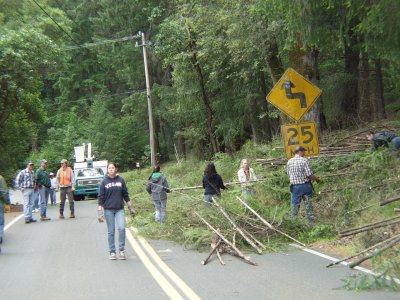
THE BLACK FOREST – Several dozen volunteers came out on Saturday morning to help clear cut brush and make the Black Forest safer before the coming fire season.
The Earth Day project at the Black Forest, which Buckingham resident Joel Witherell led the charge in organizing, resulted in an estimated 25 cords of fire hazard material being cleared and chipped, Witherell estimated Sunday.
Cal Fire (formerly known as CDF) crews had begun cutting the brush and fallen trees early last week in preparation for the weekend volunteer effort. Carle High School students worked during the week to drag the cut materials to the roadside. Volunteers then put the materials through the chippers, which Witherell said worked a total of 10 hours over both Friday and Saturday.
Witherell estimated it will take a 15-person Cal Fire crew to finish the chipping of materials still located along a portion of Soda Bay Road.
He reported that Cal Fire Captain Todd Nelson said the work has helped created "defensible space needed by fire agencies," and that the work that the volunteers did “gives fire personnel a chance to extinguish a fire before it gets out of hand.”
“I think we had nine chain saws going all morning,” Witherell said of Saturday morning's effort.
About 130 different people worked throughout the week on the project, he added. County staff assisted in providing signs and permits for road closure, Jeff Rein of the administrative office pulled together the money to pay for the chipping, Kelseyville Fire's Howard Strickler and Brian Burnham kept an ambulance on hand in case of injuries to volunteers.
Carle High School Principal Bill MacDougall and his students worked on the project for two days, said Witherell. Teachers Tami Kramer of Kelseyville High and Oscar Dominguez of Clear Lake High also brought students Saturday. Even the Brownies came to help work – and play – in the forest.
Others who were important in the effort included Adam Nichols of Nichols Tree Service, Jack Pauling of Paulin Family Tree Service, and Dave Mostin and his crew, which worked for two days. Bob Braito worked on Saturday clearing brush off Soda Bay Road, said Witherell.
The county's deputy redevelopment director, Eric Seely, spent hours in the forest with a 42-inch chain saw, cutting up dead trees. County Administrative Officer Kelly Cox was a steady force during the day, working tirelessly to load brush into the chippers.
Witherell thanked Karen MacDougall and Phyllis Clement for working at the registration table; Helen Finch and Victoria Brandon; Steve Devoto, who worked at a chipper Saturday and helped handle the original escrow papers that saved the forest from logging several years ago; Neil Towne, Sandy Moura and others who did trash pickup for miles; the Big Valley Lion Club members who directed parking; Don Fehr, another Big Valley Lion, who provided 15 pizzas for the celebration lunch; Wayne Scott; Jodelle Scott; Kevin, Karen and Frank Bradley; and Kris Perkins.
He also recognized Julie Berry of the Buckingham Homes Association, who he called an “amazing support” during the six months of planning the event, as well as working at the registration table during the morning and organizing the lunch for volunteers at the association's clubhouse.
Witherell, who has spent months organizing the event, had the support of his entire family in the project, including wife Virginia, and his sons and daughters.
On Sunday, Witherell said the difference in the forest was strikingly apparent in the wake of so much brush and debris being cleared out.
“The deer are grazing in the background and have quickly recovered from the chain saw activity yesterday,” he said. “The cars are slowing down and looking into the forest. The huge rocks with bright green moss shimmering in the sun. One family that worked yesterday said they wanted to bring their Girl Scout Troop back and have a picnic in the Forest. They had no idea what was behind the brush along the road.”
He added, “There was an amazing community spirit in Lake County for the Earth Day-Black Forest project.”
E-mail Elizabeth Larson at
{mos_sb_discuss:2}
- Details
This is the third installment in Lake County News' ongoing series, Feeding Awareness: Food Insecurity in Lake County.
LAKE COUNTY – They're not a company. They're not a club. They're not a registered nonprofit. They don't do any fundraising. So, just what is the Lake County Hunger Task Force?
An active advocacy group for food insecurity, hunger, and health education, the Hunger Task Force (HTF) starts up and maintains multiple community gardens to help feed Lake County's hungry and also
holds events and seminars on nutrition to help fight poor health and obesity.
"We figured we didn't need another agency," laughs nutrition guidance counselor Ron Jones, one of the founding and current active members.
So, they've kept it simple: "No one should go to bed hungry in Lake County" – a motto that completely defines HTF's intentions and efforts.
Entirely volunteer-based, the group was formed in 2000 after Evelyn Conklin-Ginop initiated a study on hunger in Lake and Mendocino counties.
HTF works with Lake County Community Action Agency (LCCAA), AmeriCorps, the Rural Food Project, Lake County First Five, the Office of Education, local senior centers and other food pantries.
The connection? "We contribute food to their programs," says Lorrie Gray, community garden coordinator of HTF and also a founding member.
"We applied to the Lake County Wine Alliance some years ago for a grant and we received it," explains Jones. They've been operating on it for several years, using the grant money to purchase equipment and
supplies.
HTF grows fruits and vegetables in multiple community gardens throughout the county. Typically, seeds are donated to HTF – sometimes space in a private garden is donated – and Gray and HTF member Pat Schuman of Lake County Social Services are usually the ones to initially plant the seeds and sometimes weed and garden, as well. Gardens are maintained by community organizations, schools, and other individual volunteers throughout the county.
Sometimes, property owners just want somebody to come out and help get rid of the overabundance of fruit or vegetables.
Volunteers who maintain the gardens are welcomed to eat from them, and the abundance of fresh fruits and vegetables goes to food pantries around the county.
Many of the volunteers experience some level of food insecurity or poor nutrition, and they directly benefit from the program.
Lou Denny of LCCAA, another active member of HTF, says the group especially targets low-income families with children. "It's important for them to enhance their ability to get food because there is a
direct relationship between healthy food and achievement in academics."
"As part of the garden program, we try to get fresh fruits and vegetables into the hands of people who can't afford them," says Gray.
Gardens are even maintained in the winter, when spinach, lettuce, chard, kale, and other greens can be harvested.
"Most people we feed are the working poor," Denny adds. "They have jobs, but the money just doesn't stretch."
"The main reason we started the community gardens here is that during the summer time students are not getting subsidized lunches and food from school," says Gray.
In the participating schools, the gardens double as an educational tool, so that children learn, according to Jones: "You take care of the garden. You plant it, you water it, and then you get to eat from it."
Jones also holds educational seminars throughout the county that address all groups of people on how to read labels, how to manage weight without fancy diets, and how to make healthy meals easily.
"Ron Jones was one of the pioneers of the county for addressing food insecurity, hunger and nutrition," says Denny.
The other prominent members not yet mentioned are Tammy Alakszay of AmeriCorps, Bev Bergstrom of Senior Support Services, Annie Barnes from Tribal Health, nutritionist and WIC advisor Helen Sandager, and Hedy Montoya from the Rural Food Project.
People always are jumping on board to help out, too, according to Denny. Barry Miller, for example, is a tutor and professional gardener who is starting a community garden at Clearlake Community School in Clearlake.
"We do a lot of networking with people who want to solve problems with hunger," explains Gray. "For instance, we were granted permission from the Steele Wines farmers' market to set up an informational booth on the first Saturday of each month."
The Hunger Task Force, in conjunction with LCCAA, participated in the 2005 Hunger Survey for Lake County, conducted by Pacific Union College out of Angwin. The results were compiled into a booklet, which is available to all interested agencies.
"A big part of our group is addressing issues of health, growth, and, of course, longevity for seniors," says Denny.
Each year, HTF holds a countywide food forum on hunger and nutrition, and all are welcomed to attend.
HTF also gives free canning lessons each fall to best teach people how to use excess fruits and vegetables. The classes are taught by Lorrie's husband Brian. Every student engages in hands-on learning of how to can tomatoes and pears, and each participating household receives a water bath canner, jar lifter, book, and a case of canning jars to use at home.
But that's not all. HTF is always on the move.
"For several years," Lorrie Gray explains, "we've participated in Make a Difference Day – a nationwide volunteer day held the last Saturday in October. They pick one organization per county is to honor their efforts; we were the honorees chosen from Lake County twice."
During Make a Difference Day, HTF in collaboration with AmeriCorps and other organizations, collects nonperishable food in front of Lake County's supermarkets to give to local food banks.
Hunger Action Day is May 8, and people from all over California join in Sacramento to educate their legislators about hunger and nutrition.
Explains Denny: "When we try to serve nutritious foods, it really has a greater impact on our society and its productivity. And it cuts down on healthcare costs."
He continues: "There are 2 million people in California who are eligible for food stamps who do not get them because it's a long process, they have to be fingerprinted, and various other reasons. We are pushing for some bills that will streamline that."
"The big stumbling block," adds Gray, "is a sense of shame. They're ashamed to take a handout and that's why we can't get them to sign up. There are still hungry people, and as a county with an abundance of fresh fruit and vegetables, we're trying to fill that void."
The Lake County Hunger Taskforce meets every fourth Monday of the month to deal with hunger issues in Lake County. The informal meetings are held at various sites around the county from 11:30 am. to 1 p.m. Most attendees bring lunch and drop-ins are welcome. Membership is not restrictive at all.
The next meeting of the Hunger Task Force will be held Monday, April 23, at St. Joseph's Catholic Church, 21396 Highway 175 in Middletown.
For more information on the Lake County Hunger Task Force, contact Lorrie Gray, 277-9227.
E-mail Penny Dahl at
{mos_sb_discuss:2}
- Details
- Written by: Elizabeth Larson
LAKE COUNTY – A bill that will fund flood protection around the country – including Lake County – has passed the House of Representatives.
On Thursday night the House of Representatives overwhelmingly passed its version of the Water Resources Development Act of 2007 (WRDA), HR 1495, according to Anne Warden, spokesperson for Congressman Mike Thompson's Washington office.
The WRDA authorizes the Army Corps of Engineers to construct flood protection projects and improve the nation's rivers and harbors. The bill authorizes a reported $15 billion to hundreds of projects around the nation.
The bill passed the House of Representatives Thursday by a vote of 394-25.
The legislation, Warden reported, will help restore wetlands, protect communities from catastrophic floods and enhance natural resources across the country.
Thompson said federal authorization for those projects is “long overdue.”
"This legislation will give our communities added flood protection and enhance natural resources nationwide,” he said.
Here in Lake County, the bill will hopefully result in the Middle Creek Restoration Project moving forward.
The project will restore 1,200 acres of wetlands and 500 acres of floodplain in the Clear Lake area, Warden said. It entails reconnecting Scott's Creek and Middle Creek to the historic Robinson Lake wetland and floodplain. These two watersheds provide 57 percent of the water flow into Clear Lake.
The bill included an authorization for the project added by Thompson, Warden said. Thompson was successful in adding language to this legislation that will fund, design and construct the Middle Creek Ecosystem Restoration Project.
"Restoring Middle Creek is a critical step toward enhancing the area's flood protection and improving the wetlands surrounding Clear Lake," said Thompson.
Thompson has been working with local officials on the legislation for years. He also had also lined up authorization for Middle Creek in a version of WRDA that died without action in Congress late last year.
That the WRDA bill failed last year isn't exactly a new occurrence.
The legislation, which is usually passed each year, was first introduced in 1974. A backgrounder on WRDA by the National Wildlife Federation says that legislation is an important vehicle for water projects the US Army Corps of Engineers would plan and develop. WRDA also helps enact policy changes in the Corps' water resource programs and projects, the federation reported.
However, no WRDA bill has been passed since 2000, a fact that's been attributed to a desire to reform the Corps' policies and prevent pork barrel politics. In the past, members of Congress have added earmarks to the legislation that will no longer be allowed under new reforms.
The legislation states that the Middle Creek project will cost $45.2 million, with an estimated federal cost of $29,500,000 and an estimated non-federal cost of $15,700,000.
Bob Lossius, Lake County's assistant director of Public Works, said they're not asking for that $29 million this time around. “All we're asking for at the federal level right now is $1.2 million,” said Lossius.
That would help the county begin the project's design phase, which is estimated to cost $1.6 million, said Lossius. The rest of the funding can come from other sources, such as the state or the county.
Lossius said he's talked with state Sen. Patricia Wiggins' staff about a bill to authorize the project at the state level and allocate 50 percent of the nonfederal share of $15 million. The county's Flood Control and Water Conservation District also has funds set aside in next year's budget to get the first phase started, he said.
In February, Lossius sent a letter to Thompson and Sens. Barbara Boxer and Dianne Feinstein asking for their help in getting the project back on track.
“We've been this far before,” said Lossius, who also has been disappointed before when the bills stalled in Congress.
He said he met with Boxer's office earlier this week to reemphasize the need for the project.
“I do get a sense we're closer because of the overwhelming approval in both houses (of Congress),” said Lossius, noting how quickly the bill moved through the Senate committee and the House.
One issue which hasn't been worked out so far in the House version is a matter of transfering a parcel of land into trust for Robinson Rancheria.
The tribe owns 30 acres which will be flooded in the project, Lossius said. The county wants to help Robinson transfer other land the tribe owns – located a mile from the project area – into trust in exchange for the property that will go underwater. That issue has been perceived as “trust hunting” by some members of Congress, and in the past has become a point of contention.
Lossius said the issue will need to be worked out either on the Senate floor or in a joint committee when the two houses come together to arrive at final legislation.
“Everybody wants to get this bill passed,” said Lossius, adding that he's concerned that they don't want to throw in the tricky trust issue for fear of stalling the bill.
Lossius said the bill would have until the end of this year to pass Congress or else meet the fate of earlier failed versions.
However, he said he doesn't recall it being passed out of the House this early before.
Warden said Senate and House members hope to have a final version on President Bush's desk by July 4.
"President Bush indicated that he opposes the bill's level of authorization, but has not threatened a veto,” Warden said. “Since the previous majority in Congress neglected to pass this bill last year when it was supposed to be reauthorized, we strongly encourage the president not to veto these critical authorizations."
E-mail Elizabeth Larson at
{mos_sb_discuss:3}





 How to resolve AdBlock issue?