
News
- Details
- Written by: Elizabeth Larson
LAKE COUNTY – Hydrologists are saying that a recent snow survey in the Mendocino National Forest shows one of the driest years in decades, at the same time as county officials say that less precipitation overall has resulted in low stream and lake levels.
Phebe Brown, spokesperson for the Mendocino National Forest reported that snowfall in the forest in February replenished the nonexistent snowpack on Anthony Peak, elevation 6,200 feet. Forest hydrologist Bob Faust said Anthony Peaks sits in the middle of the forest, between the Sacramento River and Eel River watersheds.
Thanks to that snow, Anthony Peak reached 92 percent of average depth and 67 percent water content, Brown reported.
Since the February survey, however, officials say snow and moisture levels in the forest have plummeted.
A March 30 snow survey conducted by Covelo Ranger District employees Conroy Coleman and Jordan Saylor revealed that the snow pack had dwindled to 26 inches (40 percent of average depth) and 12 inches of water (43 percent of average), Brown reported.
Saylor and another forest staffer, Fred Burrows, checked out the Plaskett Meadows snow course on April 2, said Brown. Seven of the 10 snow sample sites were bare, said Brown. Average snow depth was 2.6 inches with only 1/10 inch of water.
"This is the driest April reading on record since 1944," said Faust. "More recent dry years were 1972 and 1997 when there were 6 to 7 inches of snow and about 1 inch of water content."
Brown said Mendocino National Forest has been measuring winter snow depths and moisture content since 1944 and the averages are calculated based on all those years.
Precipitation from Anthony Peak drains down the Grindstone watershed, into Stony Creek and the Black Butte Reservoir, ending up in the Sacramento River. Precipitation from Plaskett drains to the Black Butte River and into the middle fork of the Eel River, Brown reported.
The sparse snow pack will affect area lakes and streams, Faust said.
Water in Lake Mendocino dropped from last month's 101 percent of average to 90 percent, Brown reported. The same was true for Black Butte Lake in Glenn County, with water levels dropping from 99 percent of average to 88 percent.
The Central Valley Project water regulators are keeping Shasta Lake and Lake Oroville full at 107 percent and 113 percent of average, respectively, Brown reported.
Past snow measurement records show that there are years when the snow pack has increased during the month of April. However, Faust cited a report from the state's climatologist, which says that a La Nina pattern is expected to develop in the Pacific over the next three months, which means ocean temperatures will become cooler than average near the equator.
Those conditions are expected to lead to below normal precipitation throughout California for the rest of this year and into the winter.
"Longer term concerns with a strong La Nina are dry to drought-type weather conditions next winter for the western U.S.," the report stated.
Brown said the Covelo Ranger District snow survey team will make one more reading this season on Anthony Peak prior to May 1. The measurements are a part of the statewide California Cooperative Snow Survey program run by the California Department of Water Resources.
Lake County doesn't rely on snowpack
Tom Smythe, water resources engineer in the county's Water Resources Division, said Lake County is definitely drier this year.
The county's watersheds aren't dependent on snowpack, Smythe said. “If we were, we'd be in big trouble,” he said.
However, rainfall has been sparse this year, Smythe said.
Rainfall levels tracked by the Cobb Area Water District and the City of Lakeport show a much drier year this year, especially as measured against last year's extremely rainy conditions. Cobb's measurements show totals at roughly half of average. In Lakeport, numbers from the first four months of of this year amount to about 20 percent of last year's total.
The result is lower levels in local creeks, said Smythe.
A US Geological Survey stream gage reading for Kelsey Creek, one of the creeks responsible for the most flow into Clear Lake, was at 16 cubic feet a second (cfs) on Friday, substantially below the median flow of 39 cfs.
Putah Creek east of Hidden Valley Lake is flowing at 30 cfs, while the median is 93 cfs, according to the US Geological Survey stream gauges. The North Fork of Cache Creek at Hough Springs (above Indian Valley Reservoir) is flowing at 28 cfs, where the median flow is 60 cfs.
Smythe estimated that the other streams are probably in similar flow conditions.
"This will reduce late season groundwater recharge and probably lead to lower groundwater levels through the summer and fall," Smythe said. "We do not have sufficient information on how much lower than normal groundwater levels will be this year."
Smythe said Water Resources recently completed measurements of 86 wells in the county's major water basins in order to know local groundwater conditions. “Our groundwater basins are pretty close to normal,” he said, thanks to above-normal rainfall from previous years.
The ultimate result will be seen in Clear Lake. The lake on Friday was at 5.85 feet Rumsey, below the median level of 7.18 feet Rumsey. The lake peaked at 6.14 feet Rumsey on March 30, said Smythe. The lake's average level is 7.21 feet Rumsey.
Despite the drier conditions this year, Smythe said the county has been in an unusually wet period. This will be the fourth year in the last 15 years that Clear Lake has not filled above "full," which is 7.56 feet Rumsey, he said.
“Basically, we've been full for five years in a row,” he said, adding that he's also seen several-year runs of a lake that didn't hit the full mark.
The lake also is a its lowest point since 2001, when the lake's highest point was 5.20 feet Rumsey.
"We don't anticipate any major problems in Clear Lake due to the lake level," he said.
The biggest impact will be to Yolo County Flood Control, said Smythe, which will have approximately 85,000 acre-feet less available form Clear Lake for irrigation supplies in Yolo County, down from its normal annual allocation of 150,000 acre feet.
Yolo County is already warning its farmers about the water shortage, he said.
E-mail Elizabeth Larson at
{mos_sb_discuss:2}
- Details
- Written by: Editor
LAKE COUNTY – State Superintendent of Public Instruction Jack O’Connell has announced up to 1,257 grantees will share $32 million in Enhancing Education Through Technology (EETT) grants.
Among the recipients are several local schools districts, receiving grants totaling more than $27,000.
"These grants help bridge the digital divide between the ‘have’ and ‘have-not’ students," said O’Connell. "All of our students, regardless of where they live or their parents’ income level, need to be prepared for today’s more global and technologically challenging economy. The appropriate use of technology in the classroom can be a critical component in students’ education and all students need access to technology."
The 1,257 grants represent both the formula and competitive portion of EETT that is funded through Title II, Part D of the federal No Child Left Behind Act of 2001.
EETT is designed to assist every student in becoming technologically literate by the time they finish eighth grade, regardless of their race, ethnicity, gender, family income, geographic location, or disability.
Local districts receiving funds are Kelseyville Unified, $3,280; Konocti Unified, $12,580; Lake County International Charter, $277; Lake County Office of Education, $598; Lakeport Unified, $4,771; Lucerne Elementary, $718; Middletown Unified, $2,189; Upper Lake Union Elementary, $2,029; and Upper Lake Union High, $696.
In the original application for EETT funding, eligible grantees included those schools with the highest number of students from low-income families and had a substantial need for help in acquiring and using technology in the classroom.
Some of the funding must be used to provide ongoing, intensive, high-quality professional development in the integration of advanced and emerging technologies into curricula and instruction, and in using those technologies to create new learning environments.
All the applicants must have a technology plan approved by the California Department of Education that met the EETT and State Board of Education criteria.
As a result of these conditions, no application was needed for this round of funding and the California Department of Education automatically generated and mailed the grant award documents each year funding was available.
This round of funding represents a 45-percent decrease from the previous year and a 62-percent decrease over two years because of federal funding reductions in the No Child Left Behind program.
The grant awards range from a low of $8 to a high of $4 million, with almost half of the EETT Formula grants under $2,000.
The drastically reduced funding is anticipated to only help school districts maintain their status quo and may fail to help them make progress toward their technology plans. The EETT program is currently slated for elimination from the federal budget in fiscal year 2008-09.
"The possibility that the EETT program could be eliminated is disturbing in light of the obvious need for more technology in the classroom," O’Connell said. "I am urging Congress to reestablish EETT funding to the 2004-05 level.”
He added, “California schools have invested enormous time, energy, and resources into creating an infrastructure and learning environment for our students to use technology as a tool in the classrooms. This progress must be continued to best prepare our students for success in our competitive global economy."
{mos_sb_discuss:2}
- Details
- Written by: Elizabeth Larson
The US Geological Survey reported that eight more small earthquakes occurred throughout the day Thursday, the largest a 2.2 magnitude.
The microquakes were centered 8 to 9 nine miles west northwest of Lake Pillsbury, the location of the 4.8 quake, the US Geological Survey reported.
Late Wednesday, a 3.3 and a 2.9 hit Pillsbury along the same epicenter, according to US Geological Survey records.
In total, there have been 49 quakes at the Pillsbury area since Wednesday.
Seismologist David Oppenheimer of the US Geological Survey said the fault along which the large quakes are occurring does not have a name and not much is known about it.
Until faults break to the surface, it's hard to study them or know their exact locations and sizes, Oppenheimer said. A fault's length helps determine the size of its earthquakes, he added.
He said this week it's unlikely the unnamed fault would produce the kinds of quakes found along larger faults, like the San Andreas and Calaveras.
E-mail Elizabeth Larson at
{mos_sb_discuss:2}
- Details
- Written by: Elizabeth Larson
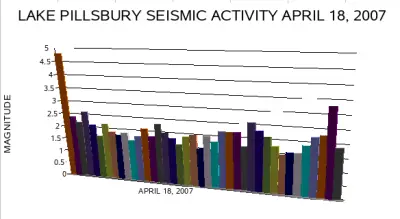
LAKE PILLSBURY – A 4.8 quake that shook residents of the Lake Pillsbury area awake early Wednesday morning was the area's largest quake since 1977, according to a seismologist.
The earthquake was recorded at 1:42 a.m. by the U.S. Geological Survey.
The series of almost 40 aftershocks that followed the quake included a sizable 3.3 magnitude temblor that occurred at 8:52 p.m. Wednesday.
David Oppenheimer, a seismologist for the U.S. Geological Survey, said the last time there was an earthquake above magnitude 4.5 in the Lake Pillsbury area was Nov. 22, 1977.
That quake, he said, happened nine miles southwest of the lake, rather than nine miles west northwest, the area where Wednesday's quake was centered.
Area residents said they definitely felt it when it happened.
“It just about knocked us out of bed,” said Soda Creek Store owner Nick Uram.
Despite the early morning shaker's magnitude, Uram said items weren't knocked off the shelves at his store, although his home on Lake Pillsbury Ranch was shaken up “pretty good.”
No one coming into his store Wednesday reported any damage, Uram said.
Dixie Offt of Lake Pillsbury Resort & Marina said the resort's full-time caretaker was awakened moments before the quake by his cat.
The caretaker checked the water lines, cabins and marina for the resort – which will open for the season on Memorial Day – and found everything to be all right, said Offt. “We sustained no damage.”
As for the lake and its dams, they also escaped damage, according to David Eisenhauer, a spokesman for Pacific Gas & Electric, which oversees Lake Pillsbury.
As soon as the earthquake occurred, Eisenhauer said, PG&E staff inspected both Cape Horn and Scotts dams and found no problems.
“We're keeping a close eye on all of our facilities up there, but so far everything is looking sturdy,” said Eisenhauer.
Oppenheimer said there is a “persistent band of seismicity” that goes through Lake Pillsbury.
“It's a bit unusual to see behavior like what's happened with this earthquake,” he said.
Particularly unusual, said Oppenheimer, was the quake's aftershock sequence, with nearly 40 smaller quakes occurring throughout the day.
“We don't know exactly why some earthquakes have robust aftershock sequences and others don't,” he said.
An earthquake's behavior is influenced by a variety of factors, said Oppenheimer, including rock type or fluid pressure in the fault zone.
Serpentine, a common rock found in the state's coastal ranges, tends to be associated with faults that creep a lot and have larges number of small earthquakes, said Oppenheimer. “So maybe there's some serpentine in this fault zone.”
Oppenheimer explained that strain in the earth's crush is released through the state's larger faults – such as the San Andreas and Calaveras. The larger faults account for up to 90 percent of overall plate motion. Oppenheimer said the size of an earthquake tends to correlate to the total length of the fault.
Along with those major quakes, there are secondary and tertiary faults, and there are enough of them that seismologists don't even know where they all are because the smaller faults don't break through to the surface.
Such is the case with the fault along which Wednesday's quake took place. There are no mapped faults for the quake's epicenter, Oppenheimer said. “We don't know about these faults until they pop off.”
It's also hard to guess just how big of a quake could ultimately occur there, although this week's quake could be at the fault's upper limits, he added.
“It's not a major player in releasing strain in California,” Oppenheimer said. “Those are the ones that do come to the surface, like the San Andreas fault.”
There are other named faults in that area, said Oppenheimer, such as the Maacama fault. As to concerns about the aftershocks triggering a quake from that fault, Oppenheimer said the probability is “exceedingly low.”
For people worrying about “the big one,” Oppenheimer says it's doubtful that it would occur on the unnamed fault.
“The big one, if you're a seismologist, is a repeat of the 1906 earthquake,” he said, referring to the massive 7.8 earthquake that occurred along the San Andreas fault near San Francisco 101 years ago Wednesday.
Oppenheimer said scientists are learning all the time about the state's seismicity.
“We don't have a very complete picture of earthquake activity in California,” he said. Monitoring only began in the 1930s, reaching current standards in the 1970s.
Seismic activity isn't organized, he said, with some faults not showing activity for hundreds, sometimes thousands, of years.
E-mail Elizabeth Larson at
{mos_sb_discuss:2}





 How to resolve AdBlock issue?