 How to resolve AdBlock issue?
Education
- Details
- Written by: Nicholas Phipps

LOWER LAKE, Calif. – As mentioned in the last article Angie Siegel, Carlé’s science teacher, instructed a hazardous materials class started on Jan. 3.
In order to pass this HAZMAT class students were required to take a state test. All the students successfully took and passed the test. These students are: Marco Aguiano, David Bajar, Caleb Burrus, Jose Carillo, Taylor Churchill, Tarah Denson, Donovan Harvey, David Jones, Erick Marks, Teagan Tompioner and Shaina Yaquinto.
I asked Siegel how everyone performed during the HAZMAT class and test and she responded, “This has been one of the best HAZMAT classes I’ve taught, every student passed on the first attempt which is very difficult, it takes hard work. They were all very focused during the entirety of the class.”
I asked students if they would recommend this class for others and they all responded of course. They said it was fun and interesting learning about ways to respond to hazardous material spills; you end up learning about all these cool chemicals and will never look at a placard carrying truck the same way again.
Bruno Sabatier of Woodland College visited Carlé On Jan. 17, 18 and 19 during our sixth period.
He gave students information about what classes are available and how to sign up. He also brought with him John Hamner, a water treatment instructor. Hamner told student they have opportunities all around the state in water and guaranteed these jobs will always be available.
Sabatier always shows Carlé love and we can’t show how grateful we are for his kindness. We already have students enrolled in college classes because Sabatier comes and assists students with signing up and guiding them on what they need.
Jonathan Killops from Lake Family Resource Center will return to Carlé with the S.H.A.R.P. program. Killops will be visiting Carlé on Jan. 29 and 30, Feb. 5 through 8.
The S.H.A.R.P. program is a course designed to help kids make safe decisions in life regarding their relationships with other people. After completion of two classes students will receive either elective credit or health credit.
Killops has visited Carlé with the S.H.A.R.P. program many times through the years, and each time students are happy with having taken it. Thank you, Mr. Killops, you’re awesome.
Nicholas Phipps is a student at Carlé Continuation High School in Lower Lake.
- Details
- Written by: Editor
While not the first donation given to the Fund, it is unique in how the donation is from both far away and close to home.
The donor, Mariah Larwood, received the Mendocino Forest Products Community Scholarship when she graduated high school in 2014.
She started her postsecondary studies at the Boston College Carroll School of Management and was named to the Gabelli Presidential Scholars Program.
The donation she made to the Community Recovery Fund comes from Mario Gabelli, for whom the college’s Presidential Scholars Program was named.
Each year, Gabelli awards a sum of money to each Presidential Scholar with instructions to give to a charity of their choosing. Larwood has given to other organizations in past years, including the American River Foundation and the Community Fund.
“The idea is to teach us as scholars who are receiving so much, how to give back, to understand what it means to donate to a cause,” Larwood explained. “Being from Ukiah, where everyone was affected by the fires, I just felt like the right thing to do was to bring the money back home.”
“This donation captures the strength and pull of home for so many Ukiah young adults who are making their way through the world,” said Bob Mertz, CEO. “Mariah has inspired us with her generosity of thought and action, and sets a fine example for her generation.”
Larwood is currently in her senior year of her Business Administration and Marketing program at the College’s Carroll School of Management.
When she graduates in May 2018, she will begin working as a marketing associate in the San Francisco office of Deloitte.
The Redwood Valley and Santa Rosa Community Recovery Fund was established by the Mendocino Family of Companies through the Community Foundation of Mendocino County to support community restoration for youth, elderly, educators, emergency workers, and animals affected by the devastating Nuns, Redwood Valley and Tubbs fires.
Every dollar contributed to the Fund will be matched up to $400,000 by the Mendocino Family of Companies and distributed in Mendocino and Sonoma Counties.
Funds will be disbursed by the Community Foundation of Mendocino County via an independent committee, until the fund is exhausted. To ensure each donation directly benefits the community, the Mendocino Family of Companies will also pay all related administrative and promotional costs to manage the fund.
To donate to the Redwood Valley and Santa Rosa Community Recovery Fund, please visit http://bit.ly/forward-together.
- Details
- Written by: Editor
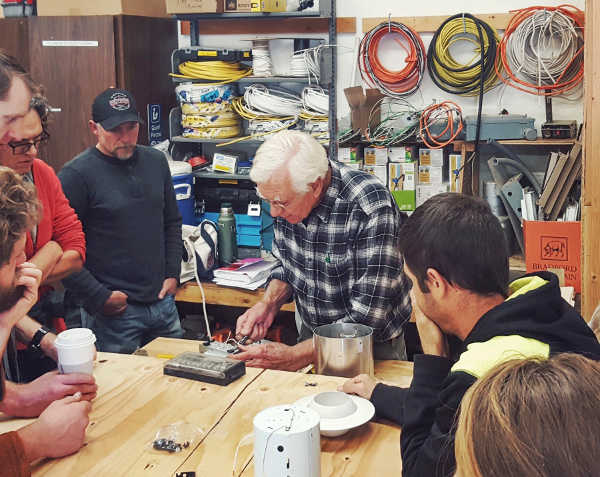
LAKEPORT, Calif. – People in Lake and Mendocino Counties can get affordable, hands-on training through the Sustainable Construction and Energy Technology Program at Mendocino College.
Semester-long classes begin Jan. 22.
“Given the number of structures that burned in recent fires, construction workers of all skill levels are in high demand in our area, and will be for the foreseeable future. Our program teaches people the skills they need to start a career in construction, or to work on their own homes,” said program coordinator Jennifer Riddell.
Riddell noted that because the name of the Mendocino College program includes words like “sustainable” and “energy technology,” some people have been under the mistaken impression that the program focuses primarily on solar panel installation when, in fact, it includes all aspects of basic construction.
This semester, courses include Safety Standards for Construction, Construction Documents I & II, Residential Remodel and Repair, Construction Management, Introduction to Clean Technology, Advanced Construction, Introduction to Residential Electric, Residential Solar Thermal, Building Performance, Occupational Work Experience and Sustainability Overview.
Two courses will be offered through the Lake County campus this semester: Construction Fundamentals and Residential Electric.
Ben Hittle is enthusiastic about his upcoming Construction Fundamentals course (SCT 180). He said, “We’ll start with houses for birds, bats and bees, then move on from there.”
Hittle will incorporate his 20-plus years of experience as he teaches students about the tools and materials commonly used in construction, as well as safety practices so students do not harm themselves or others.
He will blend classroom instruction with experiential learning to teach students how to build small structures like birdhouses, bat houses and beehives. Once students master basic construction skills on a small scale, they will take on larger building projects.
Hittle also plans to introduce alternative building materials such as straw bales and “hempcrete” – a concrete-like substance that includes fibrous material, making it more durable and lighter-weight than concrete. Hittle said students do not need prior experience, and he welcomes students of all backgrounds and ages.
The Residential Electric course (SCT 186) will be taught by longtime Lake and Mendocino County electrician, Craig Bach.
Bach has been a licensed electrician since 1983, working as an independent contractor since 1991. He teaches students about the tools of the trade and “how not to electrocute yourself,” he explained.
He compared electrical safety with aviation safety, saying, “It’s much like flying – you want to be about three mistakes above the ground at all times.” He said one of the first rules he teaches about electricity is to “turn it off” before you start working.
Like Construction Fundamentals, the Residential Electric course is also an introductory course. Bach said, “You’ll not be an electrician after you complete the course, but you will know the basics.”
Bach’s meticulous approach provides students with information on how to troubleshoot electrical problems and safely wire residences. The course includes lectures as well as hands-on practice.
For students who are motivated to seek a career in this field, Bach recommended online certification courses through the Western Electrical Contractors Association (www.weca.com).
Riddell said Mendocino College began its Sustainable Construction and Energy Technology program in 2011 to help industry professionals who wanted to expand their skills and keep up with California’s ever-changing regulations, including Title 24 regulations that will go into effect in 2020, affecting “everyone in the construction trades.”
The program was also intended to support students who wanted to pursue the building trades and homeowners who wanted to do their own repairs and remodels.
Today, the program has grown beyond Ukiah to offer classes in Lakeport, Willits and Laytonville, as well as anywhere people have an internet connection (some classes are offered online).
Riddell credits the program’s success to its “extremely knowledgeable instructors” who use a step-by-step approach to demystify everything from plumbing and electricity to reading blueprints.
Students can take individual courses or sign up for certificate programs in Construction, Renewable Energy, and/or Residential Performance and Efficiency.
“Our instructors really are amazing. Most of them have been in the business for decades and they share that experience with the students. In Lake County, we’re lucky to have long-time instructor, electrician Craig Bach, and our newest instructor, Ben Hittle, who has more than 20 years of construction experience repairing and remodeling homes,” Riddell said.
Although the program is primarily intended for those 18 years and older, Mendocino College collaborates with local high schools to provide “dual-enrollment” classes, allowing high school students to get college credit at Willits High School, Laytonville High School, and Ukiah High School.
The classes are unusual compared to other courses taught on those campuses because the classes include both high school students and community members.
The increasing focus of public schools on Career and Technical Education (CTE) makes the Mendocino College Sustainable Construction program a perfect fit.
Because of their practical, hands-on nature, CTE courses provide students with an environment that encourages learning in a more kinetic way, and the practical skills students gain can help them eventually earn a living doing work they enjoy.
Riddell, who is both the program coordinator and an instructor, encourages anyone interested in taking construction courses to visit www.mendocino.edu/sustainabletech .
To register, students should visit https://www.mendocino.edu. Classes begin Jan. 22.
- Details
- Written by: Editor
Los Angeles Trade Technical College and Santa Barbara City College were chosen for developing programs that fit the year’s theme of “Guided Pathways.”
The programs help provide guided exploration for undecided students, and provide proactive academic and student support that are integrated with instruction.
Guided Pathways is a systemwide framework that provides students with a structured approach to promote better enrollment decisions and prepares students for future success.
“These programs are leading the way when it comes to putting students on a dedicated path to completion, whether their goal is to transfer or earn a certificate or degree,” said California Community Colleges Board of Governors President Cecilia V. Estolano. “Through these programs, Los Angeles Trade Technical College and Santa Barbara City College are helping students navigate a successful community college career while ultimately improving student outcomes.”
Los Angeles Trade Technical College (LATTC) was selected to receive the Exemplary Program Award for its Advanced Transportation and Manufacturing (ATM) Pathway.
The ATM Pathway was created from LATTC’s initiative titled: Pathways to Academic, Career, and Transfer Success.
The initiative aims to assist students, many of whom are from traditionally marginalized groups, to successfully plan and complete a certificate or degree while negating barriers to completion.
The ATM Pathway program is composed of 22 full-time faculty members. With collaboration being a central focus to the initiative, the ATM program invokes this theme by breaking down traditional silos and barriers between student services and academics.
Students have direct access to a dedicated counselor who is well versed in program requirements, has strong relationships with pathway faculty and deploys immediate interventions to connect students to resources.
Beyond the campus, the program expands to deep community partnerships with local agencies and named as a maintenance partner in all three bids for the $3.5 billion Automated People Mover (APM) at the Los Angeles World Airports.
Santa Barbara City College (SBCC) was honored with the Exemplary Award for the Express to Success Program, which is designed to help students complete basic skills educational goals in a timely manner. The program also better prepares students to begin taking courses required for a degree or transfer.
Express to Success is open to all students, but specifically targets Latino and low-income students to offer accelerated learning communities in transfer level math and English for students who assess at one or two levels below college standards.
The program has demonstrated success in closing the achievement gap compared to SBCC students overall. Latino students have an enrollment rate of 60-70 percent and low-income students an enrollment rate of 70-80 percent. This increase in enrollment is due to program growth from 10 to 23 learning communities to more than 1,100 students in 2016-17.
Both colleges receive cash awards of $4,000 for the recognition. The Skyline College Engineering Tech Scholars STEM Pathway program and the MiraCosta College Bridge to Success in Math program were selected as honorable mentions.
The annual Exemplary Program Award is sponsored by the Foundation for California Community Colleges.
Award nominees must show the overall success of their program; a contribution to faculty engagement; demonstrate a response to the needs of students, faculty and the college; collaborate with other programs on campus or within the community; provide evidence that demonstrates how the program supports the community college mission; and can be used as models for other community colleges.