How to resolve AdBlock issue?
Education
- Details
- Written by: Editor
LAKEPORT, Calif. – Lakeport Christian Center Preschool invites the public to its annual Christmas program this Thursday, Dec. 19.
The program begins at 6:30 p.m. in the church at 455 S. Forbes St.
The children will be dressed in full costume and are very excited about the event.
- Details
- Written by: Editor

DAVIS, Calif. – On Monday at UC Davis, Congressman John Garamendi (D-Fairfield, CA) spoke at a panel discussion on college affordability and President Obama’s initiative to create a uniform rating system that measures universities on the basis of access, completion, affordability, innovation, and transparency.
Garamendi is a former University of California Regent and California State University Trustee who represents the UC Davis campus community as a member of Congress.
He was joined by Congressman Ami Bera (D-Elk Grove), U.S. Deputy Under Secretary of Education Jamienne Studley and UC Davis Chancellor Linda Katehi, as part of a panel of more than a dozen educators and campus leaders.
“Students and parents are faced with the reality that the public is no longer investing in education as much as they once did,” said Garamendi, the proud father of three UC Davis graduates. “It’s a national problem. It’s a national tragedy. With students now facing more than a trillion dollars in college loan debt, the president has challenged us to measure the value of an education to make sure every student finds the right school for them.”
As a regent and trustee, Garamendi voted against every undergraduate tuition increase because he was gravely concerned about skyrocketing student loan debt pricing students out of an education.
“We need to understand that going to college is a major consumer decision. Students are going out and accumulating incredible debt, so let’s give them the information they need to help them make the correct decision for their needs,” Garamendi added.
The UC Davis panel was the fifth of five panels this year that took place across the country in an effort to solicit feedback from education leaders as the Administration crafts the college rating policy.
Deputy Under Secretary Studley noted that the purpose of the president’s initiative is to help make clear to students what schools are offering the best value for the needs of every student.
She stressed that the system being designed is a rating system, not a ranking system, with broad categories and benchmarks taking precedence over a numbered list that offers an imprecise and unhelpful measure of campuses across the nation.
The college rating system, which is scheduled to reach fruition in 2015, hopes to not just make sure that taxpayer dollars are invested wisely but also to encourage colleges to offer a better value.
Incentives are being developed that reward campuses for helping lower income and disadvantaged students complete their college education.
It will also help ensure that no student is required to pay more than 10 percent of their income in repaying loans to give students more opportunities and flexibility to establish their lives in early adulthood.
UC Davis and the greater University of California system are leaders in trying to keep higher education affordable in America. Fifty three percent of undergraduates are able to have their tuition paid for without taking out loans, while 44 percent receive Pell Grants. Two-thirds graduate with less than $25,000 in student loan debt, well below the national average.
The campus has recently expanded access to middle class scholarships for families too poor to afford an unsubsidized education but too wealthy to qualify for most need-based grants.
They’ve also partnered with Central Valley businesses to help create a smoother transition from college to the workplace, especially in communities that need the talent pool.
The campus recently raised $1 billion from private donors to create 1,500 new scholarships and significantly increase fellowship opportunities for post-graduates.
The campus also has been a leader in helping California foster children graduate with little to no debt.
- Details
- Written by: Editor

Here at Carlé High School we are coming closer and closer to the end of the third grading period, being the halfway mark of the school year.
Students, make sure that you are caught up on any missing assignments before the grading period is over so you can make as many credits as possible towards graduation. Stay true to your goals!
The week of Dec. 9-13 was Spirit Week at Carlé!
Monday was ugly sweater or ugly outfit day.
Tuesday was the day students could just roll out of bed and come to school, because it was Pajama Day. The students were very good about keeping the pajamas school appropriate, thank you for that.
Wednesday was crazy hat or hair day; the students had a lot of fun with that one.
Yee haw! Country Western Day was on Thursday and we saw a lot of cowboy hats and camouflage.
Last but not least, Friday was Carlé Spirit Day, where the students wore the Carlé school colors or shirts they have made at Carlé – or they wore both, bringing double the spirit!
On Wednesday, Leeann from Yuba College showed up to help students sign up for FAFSA. Thank you for taking the time to help these students sign up and prepare for their future.
On Thursday during sixth period, all the students decorated the campus and the doors to the rooms to make Carlé look festive as the holidays draw near.
Roxie Purdum-White also presented her portfolio that afternoon. Congratulations on the great presentation and on graduating!
The CHILY prize winner during spirit week was Johnny Roofener, who chose a basketball.
Alan and Barbara decided to make candy grams for the students to keep the holiday spirit alive. Each of the candy grams has a candy cane and other types of candies at a price of fifty cents per gram.
The money made from the grams will go towards student government and funding prom. Students can buy some for themselves or for friends. If a student wants to give one to someone but is shy about it, the grams can be given anonymously.
Sometimes the students at Carlé High School are so fantastic that the teachers cannot simply choose one student of the week. This is the case for the students of spirit week! Two students were awarded.
The first was Malinda Mitchell who has done a lot of community service recently, thank you for helping the community and being such a great student.
The second student of the week was Isaiah Piazza, who got a perfect score of four out of four on his environmental detectives paper for Angie, which will look really good when he presents his portfolio.
Congratulations to you both on getting student of the week! Enjoy your free small DJ’s pizza, front-of-the-lunch-line pass, and your item of choice from the school-based enterprise.
There is an ongoing ping pong tournament going on at Carlé that is organized by Ms. Shrive. There have been some great match ups so far.
Carlé student Roy Kirk, also known as Buggy, designed and made the medallions for the top three ping pong winners to be awarded once the tournament comes to an end. Winners will be announced in the next article.
As we near the halfway point of the year, the Chronicle encourages the students to look at their credits and see if they are halfway to what they want to accomplish within this year. If not, make plans to get you there. Anything is possible with determination.
Kasandra Colwell is a student at Carlé Continuation High School in Lower Lake, Calif.
- Details
- Written by: Editor
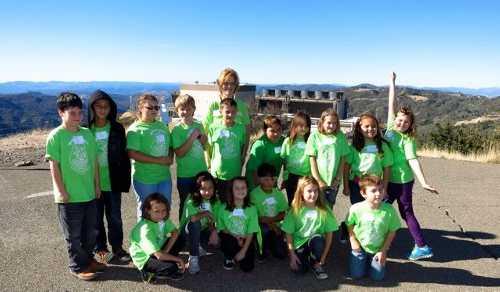
LAKE COUNTY, Calif. – Konocti Christian Academy’s third and fourth graders enjoyed a field trip to Calpine to cap off a series of science lessons about electricity.
Accompanied by their teacher, Becky Madison, and eight parents, 16 students participated.
When the children arrived, they explored Calpine’s visitor center and geothermal power.
They learned that deep below the earth’s surface, temperatures are extremely high. The heat radiates to other layers of rock, heating water that is trapped in pores and fractures. That water turns into steam, and Calpine can turn that steam into electricity using turbine engines.
The Calpine plant in Middletown generates more geothermal energy than any other place in the world,
and its impact on the environment is minimal.
To ensure that the water Calpine uses is replenished, wastewater from Santa Rosa and Lake County is injected into the Geysers Reservoir.
“If you are in Lake County and live north of 11th Street in Lakeport,” explained Calpine personnel, “every time you flush your toilet, the water comes here.”
Naturally, that explanation prompted a few giggles among the students.
The children climbed aboard Calpine’s tour bus and began the steep winding climb over rugged terrain to the first stop of the day.
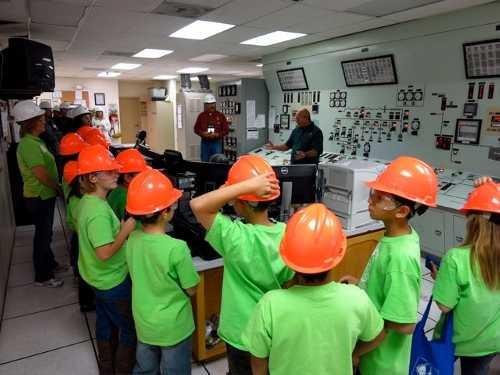
Donning hardhats, eye protection and earplugs, students got to see and smell the hydrogen sulfide abatement system.
“It smells like rotten eggs,” commented fourth grader Allison Stangland, staring at the massive powdery substance emanating from the system. Several of her classmates concurred.
From there, students toured the control room, where they peppered Calpine staff with questions.
Walls full of switches and levers prompted fourth grader Michael Wiser to ask, “How many buttons do you have in here?”
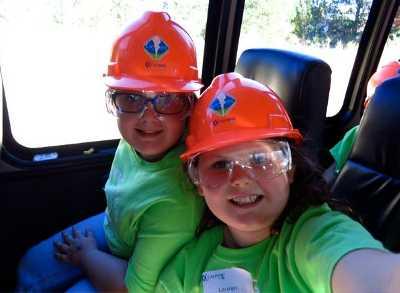
Third grader Megan Call asked, “What do all those buttons do?"
And fourth grader Lauren Trippeer asked, “Why is there a basketball hoop in the plant?”
After exploring the control room, the children got back on the tour bus and saw where huge drills had bored holes deep into the earth.
They also saw Calpine’s massive pipes where steam was being trapped to make electricity. One of the pipes had a small leak, so students could see what the steam looked like and how it travels.
As the bus made its way to the summit, the bus driver stopped to point out a spot where Black Bart had hidden among the boulders during his infamous stage coach robberies during the 1870s.
He explained how Black Bart was finally caught when he left a handkerchief behind at the scene of the crime.
A watermark on the handkerchief enabled detectives to determine where he had had his laundry done. They staked out the laundry until he returned and made their arrest, a story which the students found fascinating.
At the tour’s summit, students took in the spectacular view, which included layer after layer of mountainous terrain and a clear expanse of the Pacific Ocean.
During their electricity unit at school, the children drew wiring diagrams, conducted experiments, and made their own circuit boards with batteries and levers. The field trip to Calpine culminated the
unit with a full day off campus.
“Hands on experience,” explained Madison, “makes classroom lessons more fun and relevant. Students really benefit from this type of exposure.”
It was a great day for Konocti Christian Academy’s third and fourth graders, who extended their thanks to Calpine.
“I wish we could have field trips every day,” said fourth grader Alex Hadgis, summing up a great day at school.