How to resolve AdBlock issue?
Health
- Details
- Written by: Lake County News Reports
Friday’s order will expedite efforts by the Department of General Services and the Department of Public Health to establish and operate up to three sites for use as laboratories to increase the state’s COVID-19 testing capacity.
California is aiming to stand up a laboratory facility and begin processing tens of thousands of additional tests by November 1 and run at full capacity by no later than March 1, 2021.
Under the deal announced earlier this week, the state will be able to process up to an additional 150,000 COVID-19 diagnostic tests a day, with a contractual turnaround time of 24 to 48 hours.
The text of the governor’s executive order can be found here.
- Details
- Written by: Lake County News Reports
Resumption of testing by Verily will be reevaluated on a daily basis.
Those with appointments currently scheduled for Monday, Aug. 24, will need to reregister here.
While the active wildfires are at the forefront of all of our minds right now, COVID-19 is very active in our region.
If you have an urgent need to get tested, please contact your medical provider, or reach out to Public Health,
Free COVID-19 testing is generally available five days a week in Lake County through Verily, click here to complete the screening process and schedule testing.
At-home testing kits are also available here.
- Details
- Written by: Lake County News Reports
The governor announced $52 million for Central Valley counties – San Joaquin, Stanislaus, Merced, Madera, Fresno, Kings, Tulare and Kern – to help expand disease investigation, contact tracing and quarantine efforts.
In addition, the state will deploy three Unified Support Teams to these counties, which are experiencing increased cases and hospitalizations.
Statewide, Latinos make up 38.9 percent of the population but comprise a disproportionate number of COVID-19 cases (56 percent) and deaths (45.7 percent).
In the Central Valley, where between 41-65 percent of any given county is Latino, there are a disproportionate number of Latino deaths compared to population – for example, in Fresno County, Latinos comprise 52.6 percent of the population and 65 percent of COVID-19 deaths.
We also know that of the cases where we have no race or ethnicity data, based on surnames, local public health officials estimate that roughly 70 percent appear Latino, thus the current case numbers likely underestimate the total number of Latinos who are impacted by the virus.
“The data is clear that COVID-19 is disproportionately impacting Latinos in California,” said Gov. Newsom. “The rising community transmission rates we are seeing, particularly among Latinos in the Central Valley, are concerning. This is alarming and we are taking action. That’s why today we are making $52 million available to counties in the Central Valley to support local public health departments with additional resources to stop the spread of the virus and reduce the number of hospitalizations related to COVID-19.”
In collaboration with local partners, the state will deploy Unified Support Teams into the eight Central Valley counties to support and boost on-the-ground efforts to reduce transmission rates. The teams will work side by side with local public health, emergency, medical, community and business organizations to evaluate on-the-ground needs and develop strategies and interventions to address them.
These assessments could include an evaluation and improvement in testing, contact tracing, disease investigation, data management, public education and surge planning for local health care systems.
The teams will review data and look at outbreaks in factories and congregate settings such as long-term care facilities, high-density housing developments and agricultural workplaces where individuals may be exposed to COVID-19.
The mission will be supported by various state agencies and departments including the California Governor’s Office of Emergency Services, Department of Public Health, Department of Food and Agriculture, Business, Consumer Services and Housing Agency, Cal/OSHA and the Department of Social Services.
This mission is similar to the one carried out recently in Imperial County, which included the deployment of state and federal personnel to reduce transmission rates, augment surge capacity at local hospitals and operate an 80-bed alternate care site.
That effort boosted public health support for disease investigation and contact tracing and helped manage outbreaks at workplaces and other congregate settings. Those efforts also dramatically reduced the number of COVID-19 patients being transferred out of the county for care. For context, in Imperial County the 14-day case rate dropped 63 percent, from 836 cases per 100,000 to 308 cases per 100,000 people.
The state’s targeted efforts are funded in part with a grant from the Centers for Disease Control and Prevention (CDC), which has provided California $499 million to support the state’s response to COVID-19, of which $286 million is being made available to local governments in their efforts to fight COVID-19.
Nearly $52 million of these funds will go to eight counties in the Central Valley – Fresno, Kern, Kings, Madera, Merced, San Joaquin, Stanislaus and Tulare.
California is grateful to its federal partners for their continued support. Recently, and in coordination with the state, a federal COVID-19 Response Assistance Field Team was deployed to California to help us further assess local need and leverage all federal resources to stop the spread of the COVID-19 in Kern, Stanislaus and San Joaquin counties.
- Details
- Written by: Lake County News Reports
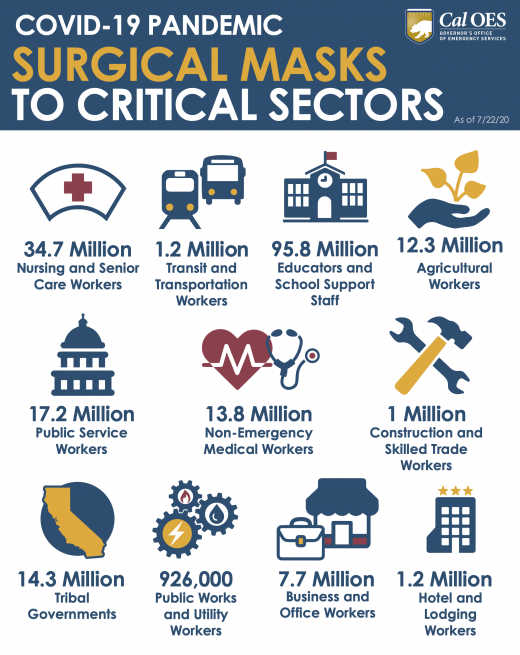
“Providing front-line workers the protective equipment they need is critical to our state’s response to COVID-19,” said Gov. Newsom. “Securing a reliable supply chain of PPE allows us to distribute millions of protective masks to our essential workforce while preserving millions more in our state’s stockpile for future use.”
Further building a stable stockpile so that health care and essential workers in California do not face the same supply shortages that characterized the early stages of the pandemic, Gov. Newsom has directed the Department of Public Health and Office of Emergency Services to further increase the state’s strategic stockpile to 100 million N-95 respirators and 200 million surgical masks by early fall in order to account for the potential need given the recent rise in COVID-19 cases.
Wednesday’s announcement builds on early action taken by the state to secure a stable, reliable supply chain and envision short and long-term strategies to procure respirators and masks.
California’s strategy has paid off. The state has been able to supply millions of medical providers, essential workers, and schools with critical PPE to preserve public health and safety.
To date, the state has distributed 86.4 million N-95 respirators and 297 million surgical masks to Californians working on the front lines against COVID-19, including to our hospitals, emergency responders, farm and factory workers and nursing home workers.
In order to fulfill the stockpile goal, which was developed in consultation with health leaders and informed by advanced modeling data, the Governor’s Office of Emergency Services has entered into a new contract with California-based BYD North America to produce 120 million N-95 respirators and 300 million surgical masks for the state.
The global COVID-19 pandemic has created worldwide competition and shortages for vital PPE supply, with certified N-95 respirator masks in highest demand. California, like other states and national governments all over the world, is working to secure a reliable supply of PPE for the front-line health care workforce and other critical infrastructure workers.
California has also been able to help other states with their unmet emergency PPE needs, supplying 17 million surgical masks to our neighbors in Arizona, Nevada, Oregon and Alaska.
Ensuring continued supply
The announcement is part of an ongoing effort to move expeditiously in a globally competitive market to meet California’s anticipated demands, by putting a bridge contract into place with the critical supply of life-saving masks.
The bridge contract signed today with BYD will ensure California can provide PPE to its front-line workforce during the ongoing global pandemic, at a competitive price rate and with an established and reliable partner.
In the longer term, California is establishing a leveraged master procurement where any manufacturers can apply, and California purchasers can secure supplies at competitive pricing.
Other actions to secure PPE
This new bridge contract is part of a wider effort by the administration to prioritize the acquisition, dispersal and reuse of critical personal protective equipment and other emergency assets and commodities during the COVID-19 pandemic to protect the public health and safety.
Operation Airbridge: The state has worked closely with FEMA and the federal government to provide a total of 14,757,500 N-95 masks, and 87,552,500 surgical masks to private sector medical providers who sold to hospitals and clients.
Safely Making CA: In June, the Governor announced a partnership with the California Manufacturers and Technology Association (CMTA) to allow small businesses, health care providers and others in need of PPE to purchase PPE directly from the California-based businesses.
There are approximately 400 companies signed up to sell non-medical grade PPE on this website. Since the Governor announced Safely Making CA, the site has had over 40,300 unique hits, with 435 product listings (e.g. cloth masks, face shields, hand sanitizer and gloves).
For more information about California PPE manufacturers, visit www.safelymakingca.org .
Battelle Units: Through partnership with FEMA, the state leveraged Battelle Critical Care Decontamination systems to decontaminate N-95 respirators, allowing for their reuse during the supply chain shortage of this critical piece of PPE. On April 20, the first Battelle site was established in Burbank. The second was established in Fremont on April 25.
As of July 19, California’s Battelle units have decontaminated 194,865 N-95 respirators, with 1,904 facilities signed up for the service.
Facilities currently utilizing the decontamination units include hospitals, assisted living facilities, skilled nursing facilities, hospice care, first responders, state and local government, U.S. Veterans Affairs hospitals and other health care facilities.