 How to resolve AdBlock issue?
Health
- Details
- Written by: Editor
LAKEPORT, Calif. – As children prepare to head back to school in a few weeks, California health officials are requiring parents to add one more item to the school supplies list for all seventh through 12th graders – a whooping cough booster shot.
A new school immunization law requires all students entering seventh through 12th grades in the 2011-12 school year in California to be immunized with a pertussis (whooping cough) vaccine booster called Tdap.
Pertussis is a very contagious respiratory disease that can be severe and last for months. The immunity received from either early childhood immunization or pertussis disease wears off over time, leaving older students and adults susceptible again to pertussis.
Immunization with Tdap can protect students, schools and communities against pertussis.
The new requirement affects all students – current, new, and transfers – in public and private schools. Updated immunization records will need to be presented to the school office before the start of the new school year.
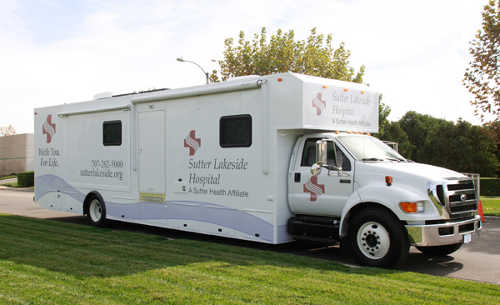
Sutter Lakeside Hospital’s Mobile Health Services Unit will be hosting a Tdap vaccination clinic for school aged children.
The Tdap vaccination clinics will be provided on the following dates at the following locations:
Monday, Aug. 15: Kelseyville Lumber, 3555 N. Main St., 1 p.m. to 3 p.m.;
Tuesday, Aug. 16: Live Oak Senior Center, 12502 Foothill Blvd., Clearlake Oaks, 1 p.m. to 3 p.m.;
Wednesday, Aug. 17: Lucerne Senior Center, 10th and Country Club, from 1 p.m. to 3 p.m.;
Thursday, Aug. 18: Bruno’s Shop Smart parking lot, 355 Lakeport Blvd., Lakeport, from 1 p.m. to 3 p.m.
Friday, Aug. 19: Middletown, across the street from post office (the post office is located at 16595 Highway 175), from 10 a.m. to noon.
No appointment is necessary. Walk-ins are welcome. Qualified patients may sign up for free coverage.
Please bring your insurance card and immunization record. A parent or guardian must be present to receive vaccination.
For more information, call the Sutter Lakeside Hospital Mobile Unit at 707-262-5076 or visit www.sutterlakeside.org.
- Details
- Written by: Editor
The California Department of Insurance (CDI) announced that it has issued an Order to Show Cause against Blue Shield of California Life and Health Insurance Company for failing to comply with the California Mental Health Parity Act. Enacted in 1999, the law requires private insurance plans to provide equal coverage for selected mental health conditions and physical conditions.
At a hearing of the Senate Select Committee on Autism, representatives from CDI explained that Applied Behavior Analysis (ABA) therapy, a common and proven approach toward improving the lives of children with autism, is required to be covered by insurers under California's mental health parity law.
Furthermore, the representatives highlighted independent medical reviews (IMR's), which showed ABA to be necessary therapy.
"Our purpose and goal is to ensure that insurance companies are in full compliance with California's mental health parity law," Adam Cole, general counsel at CDI, said. "CDI is taking this action to address the barriers faced by families attempting to obtain behavior therapy and increase their access to proven transformative therapies."
CDI has filed an enforcement action to make Blue Shield comply with California's mental health parity law. The Department asserts that Blue Shield violated the law by:
Denying coverage on the ground that ABA isn't "medically necessary."
Denying coverage on the ground that ABA is "experimental."
Denying coverage on the ground it is available only for services performed by a licensed provider and ABA providers are not licensed.
Denying coverage on the ground that ABA is not a "health care service," but instead is a service for "learning disabilities or behavioral problems or social skills training/therapy."
Not including ABA providers in its network.
Refusing to provide insureds with definitive denials of coverage within 30 days of receiving a claim, thereby preventing insureds from invoking IMR.
The action comes after the parents of two autistic children sought the department's assistance when Blue Shield refused to approve coverage for Applied Behavior Analysis (ABA) therapy recommended by their children's physicians.
ABA therapy is based on behavioral conditioning techniques and reinforcement of positive behaviors to shape behaviors and teach new skills. Blue Shield claims it is experimental.
"Decades of research show it to be a successful and well-established treatment for autism and not an experimental or investigational treatment," said Cole.
After the children were denied coverage for the treatment, the parents sought IMR by CDI, which found that ABA therapy was medically necessary in both cases, but Blue Shield refused to comply with the binding determinations in the IMR decisions. In addition, when CDI sent out a request to all insurers to identify their provider networks, as required by law, Blue Shield refused to submit a provider report and roster.
In response to the company's unwillingness to submit its provider networks and its refusal to initially cover ABA for the individuals who complained, the department is issuing a cease and desist order.
- Details
- Written by: Editor
The GE Senographe 2000D provides higher quality images with greater speed and efficiency. The equipment became available as of May 2.
"Our goal is to improve the quality of life and health for patients of Lake County," said David Santos, Vice President of Operations at St. Helena Hospital Clear Lake. "We want to drive down wait times, length of stay and increase access to precision care."
Part of that precision care includes the new digital mammography equipment.
St. Helena Hospital Clear Lake goes beyond offering this higher quality imaging modality.
“Along with early detection we strive to provide prompt follow-up for those women where an abnormality is suspected. When necessary, a breast ultrasound and mammogram will be scheduled on the same day at the same facility,” said Stacey Nester, mammography lead at St. Helena Hospital Clear Lake.
"Overall, the new digital technology ensures our patients are getting the best care possible at St. Helena Hospital Clear Lake," said Santos.
To schedule an appointment please contact the St. Helena Hospital Clear Lake’s Medical Imaging department at 707-995-5760.
St. Helena Hospital Clearlake, part of the Adventist Health System, is a Critical Access Hospital serving the communities of Middletown, Hidden Valley, Cobb, Lower Lake, Kelseyville, Clearlake and Clearlake Oaks. If offers 24-hour emergency care, surgery, medical imaging, intensive care, women’s care and obstetrics, and laboratory services at its Clearlake campus as well as outpatient rehabilitation services and family health centers in Clearlake, Middletown and Kelseyville, providing a full spectrum of health services to the Lake County community.
- Details
- Written by: Editor
The concept began when a local nurse, Sue Perry, shined light on a gap in community services in Lake County.
Perry took her concern to the Maternal, Child, Adolescent Health (MCAH) Advisory Board for Lake County, which then worked diligently to secure funding for the program before hiring program coordinator, Jaclyn Ley, in February 2010.
Ley has since developed an incredible team of volunteers and staff to support Lake County moms with home visits, and now, weekly playgroups.
The mission of Mother-Wise is to help new moms understand, through home visitation, that they are not alone, and if they get depressed there’s lots of help available. The group's services are available for all new and expecting moms in Lake County.
Mother-Wise is forming weekly playgroups, where new and expecting moms come together with their newborns and discuss the joys and challenges of being a new mom.
The first hour of open discussion is hosted by Laurel Bailey, and focuses on important (but often overlooked) topics like self care, sleep and breastfeeding.
Moms are then invited to participate in a one-hour yoga class, lead by Roslyn Griffin. Griffith draws from years of experience to prove that yoga is one of the best ways for moms to reconnect with their bodies. Never tried yoga before? Not a problem.
Mother-Wise's first playgroup is forming in the city of Clearlake, with more groups planned for the rest of Lake County.
Mother-Wise provides childcare for ages 1-5 during the sessions, with an Early Childhood Education specialist actively engaging kids in age-appropriate activities and games.
They are always seeking more volunteer companions with compassion and experience to share. As one Mother-Wise volunteer said, “If we could all help ONE family it would make such a huge difference.”
All of Mother-Wise's volunteer companions are trained on home-visiting, values, active listening and perinatal mood disorders.
The next volunteer training/orientation will be Aug. 18 through Aug. 20 in Lakeport.
For more information, please call Jaclyn Ley at 707-349-1210 or Vicki at 707-263-6169.