 How to resolve AdBlock issue?
Health
- Details
- Written by: Editor
ST. HELENA – Lilly Oncology On Canvas, an art exhibition honoring the journeys people face when confronted by a cancer diagnosis, will be on display at the Martin-O’Neil Cancer Center at St. Helena Hospital from Aug. 9 through 20.
This free public exhibit, which is touring communities nationwide, will showcase 25 select pieces of art from the Oncology On Canvas competition.
Exhibit hours will be 3 p.m. to 6 p.m., Monday through Friday.
A reception tea will be held from 3 p.m. to 5 p.m. on Thursday, Aug. 12.
Launched in 2004, the Lilly Oncology On Canvas art competition and exhibition provides everyone affected by cancer – those who have been diagnosed with any cancer, their health care providers, family members, friends and caregivers – the opportunity to express the life-affirming changes that give their cancer journey meaning and to share their journey through art.
The themes range from hope, to fear, to the loss of individualism, to the support of family and friends, to the memory of those lost, to the perseverance of those who survive.
The traveling exhibition of art is currently touring hospitals, cancer centers, patient advocacy group meetings and other venues nationwide.
Oncology On Canvas is presented by Lilly Oncology, dedicated to delivering innovative solutions that improve the care of people living with cancer, in partnership with the National Coalition for Cancer Survivorship (NCCS), which advocates for quality cancer care for all Americans and provides tools that empower people affected by cancer to advocate for themselves.
This exhibit is made possible by the participation of the Martin-O’Neil Cancer Center which provides a full spectrum of outpatient cancer treatment services on the campus of St. Helena Hospital.
For information about Lilly Oncology On Canvas visit www.LillyOncologyOnCanvas.com.
St. Helena Hospital's Martin-O’Neil Cancer Center is located at 10 Woodland Road, St. Helena.
- Details
- Written by: Editor
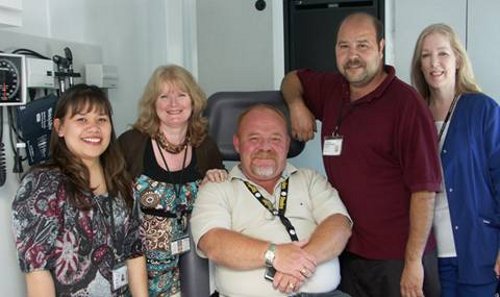
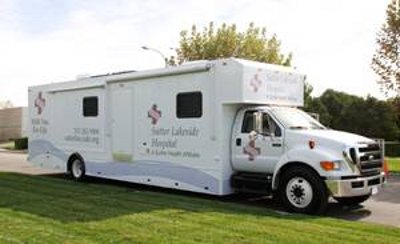
LAKEPORT – Sutter Lakeside Hospital is excited to announce that on Wednesday the mobile health services unit received full licensing from the California Department of Public Health (CDPH).
This licensing means that the mobile unit is approved to begin seeing patients and providing medial care.
“This has been a long journey,” said Soraya Ringer, Sutter Lakeside Hospital Outpatient Clinics director, who has oversight over the mobile unit’s clinical operations. “We’ve been working on the planning stages since January 2009 and have now reached the final chapter of this project.”
The two and a half hour CDPH site visit included a walk-through of the mobile unit and interviews of the unit’s staff. The walk-through was conducted to verify that the unit is fully equipped to the same standards as a typical physician office or hospital based clinic.
“The mobile unit is literally a moving physician office,” explained Ringer. “Even though the unit will be traveling from location to location, it is equipped with all of the supplies necessary to care for patients from the beginning to the finish of each visit.”
The mobile services unit includes two exam rooms, an Americans with Disabilities Act-accessible restroom, two work stations and a patient blood draw station. The expandable sides of the unit make it as roomy and comfortable as any physician office.
The unit's staff interviewed included Debbie Allen, LVN, Jose Beltran, fleet operator and James Huston, fleet manager. The interview process verified that each staff member understands their job duties to ensure quality and safe patient care.
Pending the arrival of the newly hired physician assistant who is moving to Lake County from Idaho, the unit will begin seeing patients in mid August.
“Although are not able to announce the exact date of when we will begin seeing patients at this time, we currently have contractual agreements with two sites – the Live Oak Senior Center and the Lucerne Senior Center. Both sites will be kept apprised of when the unit will arrive to their location,” said Ringer.
Health screenings provided on the mobile unit will include basic vision, basic hearing, blood pressure screening, and diabetes screening just to name a few. Education will also be provided and will cover topics such as diabetes, obesity/weight loss, asthma, chronic obstructive pulmonary disease and pregnancy.
Sutter Lakeside extended thanks to the following people who worked hard to ensure that the mobile unit was ready for inspection: Dr. Elyse Donald, Dr. Bruce Deas, Soraya Ringer, Tammy Carter, Susan Meyers, Debbie Allen, Jose Beltran, James Huston and Angie Lagle.
Everyone at Sutter Lakeside Hospital would also like to thank the generous citizens of Lake County who gave so freely during our fundraising efforts for the purchase of the mobile unit. It is because of these individuals that lives across the county will be touched for years to come.
Would you like to see the unit for yourself? Join us at the Lake County Fair Sept. 2 through 5 where the mobile unit will be providing free health screenings. The unit will be parked in the Cloverleaf area, between the Live Music Stage and Lewis Hall. Health screenings will be provided from open to 8 p.m. every day of the fair.
For more information, please visit www.sutterlakeside.org and click on the picture of the mobile health services unit in the lower left corner.
Sutter Lakeside Hospital is committed to providing access to high quality, affordable health and wellness services to the residents of Lake County.
- Details
- Written by: Editor
SACRAMENTO – U.S. Rep. Mike Thompson, who has been a strong advocate for improving access to health care and voted for landmark federal legislation reforming the health care system, has received the “2010 Legacy Award” from a collection of Northern California county medical societies.
The California Medical Association (CMA) 10th District delegation caucus – which includes representatives from medical societies in Marin, Sonoma, Napa, Solano, Mendocino, Lake, Humboldt and Del Norte counties – presented Thompson with the honor recently at its annual meeting.
“Mike Thompson has fought hard for California patients and the physicians who serve them,” said Brennan Cassidy, M.D., president of CMA. “He is tough and compassionate. He is a courageous leader who cares about making sure his constituents can get the quality medical care they need.”
Among Thompson’s accomplishments are:
He joined 218 of his House colleagues in March 2010 in voting to pass historic health care reform legislation. The bill will reduce the deficit by an estimated $130 billion over 10 years – and $1.3 trillion over 20 years – and extend coverage to 80 percent of California’s uninsured.
As chair of the Blue Dog Coalition’s health care task force, Thompson is continually working with both Democrats and Republicans to WHAT address the issues of health care professionals’ workforce shortage.
In February 2009, he supported reauthorization of the State Children’s Health Insurance Program (SCHIP) to provide cost‐effective health coverage for 4 million more children whose parents earn too little to provide their own insurance, but too much to qualify for Medicaid, and preserved coverage for 7 million children already enrolled.
As a state senator, he wrote landmark legislation requiring health insurance providers to offer all children comprehensive preventive care.
He wrote legislation funding a comprehensive telemedicine initiative (North Coast Telemedicine Network) in the rural regions of California’s north coast. The program became model for other state legislatures across the nation.
In addition, Thompson has supported significant legislative efforts to:
Raise low Medicare reimbursements for physicians in 14 California counties, including Sonoma and Santa Cruz counties, where rates have not kept up with the costs of doing business. Thompson backed legislation fixing the counties’ geographic practice cost index (GPCI) rates with $400 million in increased payments. The boost in rates would improve senior citizens’ access to care in many communities.
Repeal Medicare’s outdated Sustainable Growth Rate (SGR) funding formula, which mandates steep cuts in the program’s physician payments. Thompson supported the Medicare Physician Payment Reform Act in November 2009 that would have replaced SGR with a more stable and realistic funding system to protect seniors’ access to care. The legislation passed the House but did not clear the Senate.
Improve beneficiary access to Medicare’s cancer screening services so more seniors will get screened, saving lives and money.
CMA and the county medical societies work closely with elected representatives to ensure that the interests of patients and the physicians who serve them are well represented. California’s physicians have pushed hard for reform that includes universal access to health care, insurance market reforms, shared responsibility and stable long-term funding.
The California Medical Association represents 35,000 physicians in all modes of practice and specialties. CMA is dedicated to the health of all patients in California.
- Details
- Written by: Editor
DALLAS – After two days of hearings, an advisory committee to the U.S. Food and Drug Administration (FDA) recommended that the FDA allow the type 2 diabetes drug rosiglitazone (brand name, Avandia), to stay on the market, but with most committee members suggesting that the label be revised to include increased warnings.
Rosiglitazone is one in a class of drugs called thiazolidinediones (TZDs), used to treat type 2 diabetes.
The advisory committee voted 20 to 12 (with one abstention) to keep rosiglitazone on the market and recommended 20 to 10 (with two abstentions) that the TIDE trial continue.
This trial, requested by the FDA, is evaluating patients with type 2 diabetes and a history of or risk for cardiovascular disease, and comparing the cardiovascular effects of long-term treatment with rosiglitazone, pioglitazone or placebo when added to standard care.
The trial will also compare the effects of long-term supplementation with vitamin D on death and cancer.
The FDA will consider these recommendations and make a final ruling.
“The advisory committee’s deliberations were difficult, since the available data were limited, controversial, and subject to multiple interpretations by seasoned investigators and reviewers,” said Ralph Sacco, M.D., president of the American Heart Association. “We agree with the committee that further research is necessary to answer the remaining questions, and we encourage the FDA to continue to evaluate and assess carefully all new clinical data as they become available.”
For patients with diabetes, the most serious consequences are heart disease and stroke, and the risk of suffering from them is significantly increased when diabetes is present.
“It’s especially important that patients not change or stop medications without consulting their health care provider,” said Sacco.
For patients with diabetes, the American Heart Association recommends the following:
The cornerstone of prevention and treatment should be healthy lifestyle choices, such as not smoking, following a healthy diet and remaining physically active.
Because of the increased risk of heart disease and stroke, it is very important to achieve optimal control of your blood sugar, blood pressure and lipids (such as cholesterol and triglycerides) with lifestyle and medications when needed. For people with diabetes who are also at increased risk for heart disease, low-dose aspirin therapy is recommended as a reasonable way to prevent a first heart attack or stroke.
Focus on blood sugar control, keeping your HbA1c level below 7.0, is likely to reduce the risk of the “microvascular” complications of diabetes, such as kidney failure, painful nerve problems and decreased vision or even blindness.
For health care providers, the American Heart Association offers the following guidance on glucose-lowering medications:
Metformin should generally be the first choice, particularly in obese patients. If it does not produce adequate HbA1c control, other medications can be considered, recognizing that knowledge is limited about the effect of other glucose-lowering agents on cardiovascular risk.
If a TZD (such as pioglitazone or rosiglitazone) is considered for lowering glucose, patients should not expect it to reduce the occurrence of heart attack or stroke. The rationale for choosing a TZD should be discussed with a physician. However, patients who have successfully achieved recommended HbA1c control on a TZD may consider remaining on their medication. If the treating physician and/or the patient are uncomfortable with using a TZD, another medication could be substituted.