
Health
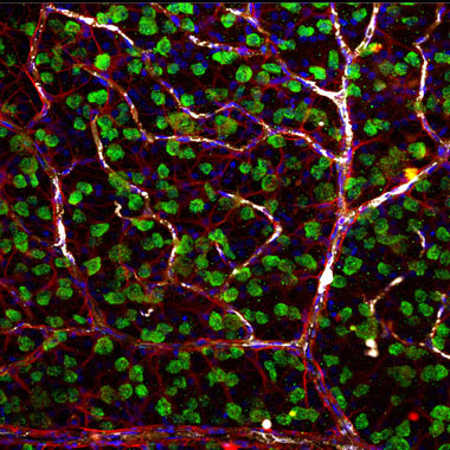
BERKELEY, Calif. – Vision scientists at the University of California, Berkeley, and the University of Toronto have discovered that naturally occurring molecules known as lipid mediators have the potential to halt the progression of glaucoma, the world’s second-leading cause of blindness.
Their findings, published Monday in the online edition of the Journal of Clinical Investigation, mark a major step forward in the pursuit of a cure for glaucoma, a neurodegenerative disease in which fluid buildup in the frontal eye causes irreversible damage to the optic nerve and vision loss.
At present, there is no cure for glaucoma, which is estimated to affect 80 million people worldwide.
“Not only could this discovery lead to drugs to treat glaucoma, but the same mechanism, and options for prevention, may be applicable to other neurodegenerative diseases,” said study senior author Karsten Gronert, professor of optometry and chair of vision science at UC Berkeley.
Using rodent models, Gronert and fellow researchers found that inflammation-regulating lipid mediators known as lipoxins, secreted from star-shaped cells known as astrocytes, stopped the degeneration of retinal ganglion cells in rats and mice with glaucoma. Ganglion cells are the neurons of the retina and optic nerve that receive information from photoreceptors.
“We’ve taken something everyone assumed was anti-inflammatory, and found that these same small molecules play a key role in neuroprotection, which is really exciting,” said study co-senior author John Flanagan, dean and professor of optometry. Much of the study was conducted at UC Berkeley.
Specifically, researchers found that astrocytes, which help maintain brain function and form the nerve fiber layer of the retina and optic nerve, release therapeutic biological agents known as lipoxins A4 and B4, but only when the astrocytes are at rest and maintaining nerve function.
“It is commonly assumed that astrocytes activated by injuries release stress signals that kill off ganglion cells in the retina, causing optic nerve damage,” said Flanagan. “However, our research discovered that astrocytes that are triggered by injury actually turn off novel neuroprotective signals that prevent optic nerve damage.”
Researchers discovered secretions of lipoxins A4 and B4 in resting astrocytes in culture in the retina and optic nerve head. To test their potential as a treatment, they administered the lipoxins to rodents eight weeks after the onset of glaucoma-like damage and neurodegeneration.
At 16 weeks, they gauged electrical activity in the rodents’ ganglion cells, among other measures, and found that lipoxin B4 in particular stopped the cells’ degeneration.
“This little-known lipid mediator has shown the potential to reverse cell death,” Gronert said. “We know of no drug that can do this.”
For decades, pharmaceutical companies have searched for neuroprotective drugs to treat glaucoma and other disorders marked by the death of nerve cells such as Alzheimer’s, Parkinson’s and ALS. Glaucoma is by far the most prevalent of these neurodegenerative diseases.
“At the same time, lipoxins have been explored as promising drug targets for treating inflammatory diseases, but nobody has been looking at them as being neuroprotective,” Gronert said.
At present, the treatment option for glaucoma is to lower ocular pressure, but there are no effective treatments for preventing or stopping the neurodegeneration of glaucoma, which is irreversible and eventually leads to blindness, Flanagan said
The study authors are excited at the prospect of further investigations into the therapeutic benefits and mechanisms of lipoxins A4 and B4 and their potential to stop or reverse neural damage. They have jointly filed a patent application for use of lipoxins A4 and B4 to treat glaucoma and neurodegenerative diseases. Their eventual goal is to test the lipoxins as drugs in humans.
"These naturally occurring small lipids have great potential as therapies because they may play a fundamental role in preventing other neurodegenerative diseases. And that's hugely significant, " Flanagan said.
In addition to Flanagan and Gronert, Jeremy Sivak, associate professor of ophthalmology at the University of Toronto, is a senior author on the study. The study’s co-lead authors are Izhar Livne-Bar of the University of Toronto and Jessica Wei and Hsin-Hua Liu of UC Berkeley. Other co-authors are Samih Alqawlaq, Gah-Jone Won and Alessandra Tuccitto of the University of Toronto.
Yasmin Anwar writes for the UC Berkeley News Center.
- Details
- Written by: Yasmin Anwar

CLEARLAKE, Calif. – Adventist Health Clear Lake has collaborated with two local organizations to assist patients who need transportation.
Through a partnership with Lake Transit Authority, or LTA, and a generous gift from Community First Credit Union, Adventist Health Clear Lake now has two vehicles available to shuttle patients to and from important medical appointments.
The partnership with LTA allows the hospital to use a wheelchair-accessible eight-passenger minibus to transport patients who have difficulty getting to and from medical appointments in Lake County.
“Residents who struggle with transportation in Lake County have expressed a need for a service that allows them to not only see their provider, but to accommodate labs and other health screenings following their medical appointments as well,” said Mark Wall, general manager of LTA. “After learning that Adventist Health Clear Lake was fundraising to replace their patient transport vehicle, we approached them about using our available vehicle.”
The bus was put into service by Adventist Health Clear Lake on June 30.
Operated by an Adventist Health Clear Lake driver, the shuttle is already busy taking patients to and from medical appointments around the county.
“It’s crucial that our patients reach their medical appointments as quickly, comfortably and as efficiently as possible,” said Garin Fuhriman, director of outpatient operations at Adventist Health Clear Lake. “Lake Transit has allowed us to better fulfill our shared commitment to those in our community with transportation and health challenges.”
Karl Parker, mobility programs coordinator for LTA, understands the need for non-emergency patient medical transportation in the county.
“LTA dispatchers and I talk regularly with individuals who are unable to take LTA’s fixed-route buses to non-emergency medical appointments because of the distance from their homes to stops, their specific medical issues and other challenges,” Parker said. “Partnerships like these and Lake Links’ Pay Your Pal program are effective, efficient ways to help.”
The partnership with LTA follows Adventist Health Clear Lake’s successful 2016 fundraising campaign for a new vehicle.
The More Than Wheels campaign met its goal thanks in part to a matching challenge grant of $15,000 from Community First Credit Union (formerly Mendo Lake Credit Union).
The challenge grant rallied Adventist Health Clear Lake employees to give over $26,700 in support of the campaign. The result is a 2016 Ford Transit vehicle to replace the aging blue patient bus. The addition of the LTA coach means Adventist Health Clear Lake now has two comfortable, reliable vehicles to transport patients.
“Our vision is to make health care in Lake County as accessible as possible, and collaborating with community partners who share this goal allows us to use our resources to thoughtfully serve our community,” said David Santos, Adventist Health Clear Lake President & CEO. “Through partnerships like this and the work we are doing with the Hope Rising coalition, we are seeing an improvement in quality of life in Lake County.”
Both the new bus purchased by donations from the community and Community First Credit Union and the bus loaned from Lake Transit Authority operate Monday through Friday and travel throughout Lake County.
Patients can request shuttle service when they make their medical appointment at Adventist Health Clear Lake Medical Office locations in Clearlake, Hidden Valley Lake, Kelseyville and Middletown or at the hospital.
- Details
- Written by: Editor





 How to resolve AdBlock issue?