 How to resolve AdBlock issue?
Health
- Details
- Written by: Editor

CORVALLIS, Ore. – Most large, clinical trials of vitamin supplements, including some that have concluded they are of no value or even harmful, have a flawed methodology that renders them largely useless in determining the real value of these micronutrients, a new analysis suggests.
Many projects have tried to study nutrients that are naturally available in the human diet the same way they would a powerful prescription drug.
This leads to conclusions that have little scientific meaning, even less accuracy and often defy a wealth of other evidence, said Balz Frei, professor and director of the Linus Pauling Institute at Oregon State University, in a new review published in the journal Nutrients.
These flawed findings will persist until the approach to studying micronutrients is changed, Frei said.
Such changes are needed to provide better, more scientifically valid information to consumers around the world who often have poor diets, do not meet intake recommendations for many vitamins and minerals, and might greatly benefit from something as simple as a daily multivitamin/mineral supplement.
Needed are new methodologies that accurately measure baseline nutrient levels, provide supplements or dietary changes only to subjects who clearly are inadequate or deficient, and then study the resulting changes in their health.
Tests must be done with blood plasma or other measurements to verify that the intervention improved the subjects' micronutrient status along with biomarkers of health.
And other approaches are also needed that better reflect the different ways in which nutrients behave in cell cultures, lab animals and the human body.
The new analysis specifically looked at problems with the historic study of vitamin C, but scientists say many of the observations are more broadly relevant to a wide range of vitamins, micro nutrients and studies.
“One of the obvious problems is that most large, clinical studies of vitamins have been done with groups such as doctors and nurses who are educated, informed, able to afford healthy food and routinely have better dietary standards than the public as a whole,” said Frei, an international expert on vitamin C and antioxidants.
“If a person already has adequate amounts of a particular vitamin or nutrient, then a supplement will probably provide little or no benefit,” Frei said. “That's common sense. But most of our supposedly scientific studies take results from people with good diets and healthy lifestyles and use them to conclude that supplements are of no value to anyone.”
Vitamin or mineral supplements, or an improved diet, will primarily benefit people who are inadequate or deficient to begin with, OSU researchers said.
But most modern clinical studies do not do baseline analysis to identify nutritional inadequacies and do not assess whether supplements have remedied those inadequacies. As a result, any clinical conclusion made with such methodology is pretty much useless, they said.
An optimal diet, rich in fruits and vegetables, can provide most of the nutrients needed for good health – which critics say is reason enough not to use supplements. LPI researchers say that misses a pretty obvious point – that most Americans do not have an optimal diet.
“More than 90 percent of U.S. adults don't get the required amounts of vitamins D and E for basic health,” Frei said. “More than 40 percent don't get enough vitamin C, and half aren't getting enough vitamin A, calcium and magnesium. Smokers, the elderly, people who are obese, ill or injured often have elevated needs for vitamins and minerals.
“It's fine to tell people to eat better, but it's foolish to suggest that a multivitamin which costs a nickel a day is a bad idea.”
Beyond that, many scientists studying these topics are unaware of ways in which nutrients may behave differently in something like a cell culture or lab animal, compared to the human body. This raises special challenges with vitamin C research in particular.
“In cell culture experiments that are commonly done in a high oxygen environment, vitamin C is unstable and can actually appear harmful,” said Alexander Michels, an LPI research associate and lead author on this report. “And almost every animal in the world, unlike humans, is able to synthesize its own vitamin C and doesn't need to obtain it in the diet. That makes it difficult to do any lab animal tests with this vitamin that are relevant to humans.”
Many studies have found that higher levels of vitamin C intake are associated with a reduced incidence of chronic disease, including coronary heart disease, stroke, diabetes, hypertension and some types of cancer. The levels of vitamins needed for optimal health also go beyond those needed to merely prevent deficiency diseases, such as scurvy or rickets.
Even though such studies often significantly understate the value of vitamin supplements, the largest and longest clinical trial of multivitamin/mineral supplements found a total reduction of cancer and cataract incidence in male physicians over the age of 50. It suggested that if every adult in the U.S. took such supplements it could prevent up to 130,000 cases of cancer each year, Frei said.
“The cancer reduction would be in addition to providing good basic health by supporting normal function of the body, metabolism and growth,” he said. “If there's any drug out there that can do all this, it would be considered unethical to withhold it from the general public. But that's basically the same as recommending against multivitamin/mineral supplements.”
- Details
- Written by: Editor
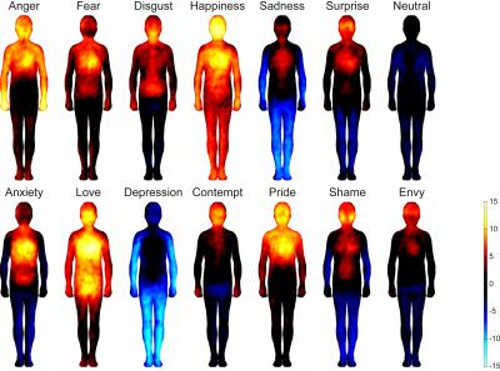
Emotions adjust our mental and also bodily states to cope with the challenges detected in the environment.
These sensations arising from the bodily changes are an important feature of our emotional experiences.
For example, anxiety may be experienced as pain in the chest, whereas falling in love may trigger warm, pleasurable sensations all over the body.
New research from Aalto University reveals, how emotions are literally experienced through the body.
The researchers found that the most common emotions trigger strong bodily sensations, and the bodily maps of these sensations were topographically different for different emotions.
The sensation patterns were, however, consistent across different West European and East Asian cultures, highlighting that emotions and their corresponding bodily sensation patterns have a biological basis.
Emotions adjust not only our mental, but also our bodily states. This way the prepare us to react swiftly to the dangers, but also to the opportunities such as pleasurable social interactions present in the environment.
Awareness of the corresponding bodily changes may subsequently trigger the conscious emotional sensations, such as the feeling of happiness, said assistant professor Lauri Nummenmaa from Aalto University.
The findings have major implications for our understanding of the functions of emotions and their bodily basis. On the other hand, the results help us to understand different emotional disorders and provide novel tools for their diagnosis.
The research was carried out online, and over 700 individuals from Finland, Sweden and Taiwan took part in the study.
The researchers induced different emotional states in their Finnish and Taiwanese participants. Subsequently the participants were shown with pictures of human bodies on a computer, and asked to colour the bodily regions whose activity they felt increasing or decreasing.
- Details
- Written by: Editor
Difficulty with activities of daily living often affect Alzheimer's patients, which is estimated to affect as many as 5.1 million Americans.
These issues are among the most taxing burdens of the disease for caregivers, which total about 5.4 million family members and friends.
New research from the faculty of Icahn School of Medicine at Mount Sinai working with Veterans Administration Medical Centers suggests that alpha tocepherol, fat-soluble Vitamin E and antioxidant, may slow functional decline (problems with daily activities such as shopping, preparing meals, planning, and traveling) in patients with mild-to-moderate Alzheimer's disease and decrease caregiver burden.
There was no added benefit for memory and cognitive testing with the vitamin.
The study is published online first in the Jan. 1 Journal of the American Medical Association.
“Since the cholinesterase inhibitors [galantamine, donepezil, rivastigmine], we have had very little to offer patients with mild-to-moderate dementia,” said Mary Sano, PhD, trial co-investigator, and professor in the department of psychiatry, Icahn School of
Medicine at Mount Sinai, and director of research at the James J. Peters Veteran's Administration Medical Center, Bronx, New York. “This trial showed that vitamin E delays progression of functional decline by 19 percent per year, which translates into 6.2 months benefit over placebo.”
The finding is valuable because vitamin E is easy to purchase at local drugstores and it is also inexpensive.
The clinical trial investigators believe it can be recommended as a treatment strategy, based on the double-blind randomized controlled trial.
The Veteran's Administration Cooperative Randomized Trial of Vitamin E and memantine in Alzheimer's Disease (TEAM-AD examined the effects of vitamin E 2,000 IU/d, 20 mg/d of memantine, the combination, or placebo on Alzheimer's Disease Cooperative Study/Activities of Daily Living (ADCS-ADL) Inventory Score. Cognitive, neuropsychiatric, functional, and caregiver measures were secondary outcomes.
A group of 613 patients with mild to moderate Alzheimer's disease were in the study, which was launched in August 2007 and finished in September 2012 at 14 Veterans Affairs Medical Centers.
Dr. Sano previously led a study on vitamin E in patients with moderately severe Alzheimer's disease. She found that the vitamin slowed disease progression in this group of patients as well.
Kenneth Davis, MD, Chief Executive Officer and President of the Mount Sinai Health System and Gustave L. Levy Distinguished Professor, applauded the study. “This study is the first to show an added benefit for vitamin E in mild-to-moderate disease,” he said. “Now that we have a strong clinical trial showing that vitamin E slows functional decline and reduces the burdens on caregivers, vitamin E should be offered to patients with mild-to-moderate Alzheimer's disease.”
Research by Dr. Davis and colleagues contributed to the establishment of conventional medical therapies for Alzheimer's disease.
- Details
- Written by: Editor
SACRAMENTO – California Department of Public Health (CDPH) Director and State Health Officer Dr. Ron Chapman on Tuesday warned people not to eat cashew cheese products manufactured by The Cultured Kitchen because they may be contaminated with Salmonella.
Fifteen cases of illnesses have been reported in the Western United States, with twelve of the cases occurring in California.
Three patients have been hospitalized and no deaths have been reported.
The Cultured Kitchen of West Sacramento, California has initiated a voluntary recall of all flavors of its cashew cheese products with expiration dates on or before April 19, 2014, due to the risk of contamination with Salmonella.
The products were sold in natural food stores throughout Northern California and Northern Nevada, and at farmers markets in Sacramento County.
The cashew cheese products were sold in eight-ounce plastic containers in the following flavors: Herb, smoked cheddar, pepper jack, habanero cilantro lime, basil pesto and white cheddar.
While the cashew cheese products are no longer being sold at retail facilities, CDPH is concerned that consumers may still have some of these products in their homes.
Consumers in possession of these recalled products should discard them or return them to the place of purchase for a refund.
Symptoms of Salmonella infection include fever, abdominal cramps and diarrhea, which may be bloody.
Most infected people recover within a week; however, some may develop complications and require hospitalization. Infants, the elderly and people with weakened immune systems are at highest risk for severe illness.
Consumers experiencing any ill effects after eating these products should consult their health care provider.
Consumers who observe the product being sold should call CDPH’s toll-free complaint line at 800-495-3232.