 How to resolve AdBlock issue?
Health
- Details
- Written by: Editor
Just when some scientists were becoming more hopeful about finding a strategy to outwit HIV's ability to resist, evade and otherwise survive efforts to rid it from the body, another hurdle has emerged to foil their plans, new research from Johns Hopkins shows.
In a cover-story report on the research to be published in the journal Cell online Oct. 24, Johns Hopkins infectious disease experts say the amount of potentially active, dormant forms of HIV hiding in infected immune T cells may actually be 60-fold greater than previously thought.
The hidden HIV, researchers say, is part of the so-called latent reservoir of functional proviruses that remains long after antiretroviral drug therapy has successfully brought viral replication to a standstill.
The disappointing finding comes after a three-year series of lab experiments, which they say represents the most detailed and comprehensive analysis to date of the latent reservoir of HIV proviruses.
If antiretroviral therapy is stopped or interrupted, some proviruses can reactivate, allowing HIV to make copies of itself and resume infection of other immune cells.
Senior study investigator Robert Siliciano, M.D., Ph.D., who in 1995 first showed that reservoirs of dormant HIV were present in immune cells, said that while the latest study results show most proviruses in the latent reservoir are defective, curing the disease will depend on finding a way to target all proviruses with the potential to restart the infection.
Study results showed that among 213 HIV proviruses isolated from the reservoirs of eight patients and initially unresponsive to highly potent biological stimuli, some 12 percent could later still become active, and were capable of replicating their genetic material and transmitting infection to other cells.
Siliciano said that all of these non-induced proviruses had previously been thought to be defective, with no possible role in resumption of the disease.
Siliciano, a professor at the Johns Hopkins University School of Medicine and a Howard Hughes Medical Institute investigator, said his team's latest study findings pose a serious problem to prevailing hopes for the so-called “shock and kill” approach to curing HIV.
That approach refers to forcing dormant proviruses to “turn back on,” making them “visible” and vulnerable to the immune system's cytolytic “killer” T cells, and then eliminating every last infected cell from the body while antiretroviral drugs prevent any new cells from becoming infected.
Siliciano said this new discovery could boost support for alternative approaches to a cure, including renewed efforts to develop a therapeutic vaccine to stimulate immune system cells that attack and kill all HIV. “Our study results certainly show that finding a cure for HIV disease is going to be much harder than we had thought and hoped for,” he said.
Lead study investigator and Johns Hopkins postdoctoral fellow Ya-Chi Ho, M.D., Ph.D., says the team's investigation of “the true size” of the latent reservoir was prompted by a large discrepancy between the two established techniques for measuring how much provirus is in immune system cells. She said the team's original method of calculating only reactivated proviruses yielded numbers that were 300-fold lower than a DNA-based technique used to gauge how many total proviral copies, both dormant and reactivated, are present. “If medical researchers are ever going to lure out and reactivate latent HIV, then we need to better understand exactly how much of it is really there,” said Ho.
In the latest study, researchers sequenced, or spelled out, the entire genetic code of HIV proviruses that reactivated and those that could not be induced to do so.
Twenty-five of the 213 non-induced isolates, when sequenced, had fully intact genomes when compared to those that did reactivate.
Analysis of the remaining (88 percent of) non-induced proviruses showed that all were defective, possessing genetic deletions and mutations that would forestall viral replication.
Further lab experiments on the cloned proviruses showed that the intact, non-induced proviruses could be reconstructed to produce active virus, which in turn could replicate in human immune cells. Researchers also found that cloned proviral DNA lacked a latency-inducing chemical methyl group.
When researchers looked at where non-induced proviral DNA showed up in infected human immune cells, they found some 92 percent of the non-induced proviral DNA was located in actively transcribed regions of the human cell DNA.
This finding, they said, suggests that non-induced proviral DNA is not permanently hidden in some inaccessible regions of the host chromosomes but instead lies in regions where it could become reactivated.
Statistical modeling later showed these figures equated to a 60-fold increase in the potential size of the latent reservoir when compared to the team's original method for counting only reactivated viruses.
Additional experiments showed that repeated chemical stimuli could reactivate proviruses that failed to respond to initial attempts at reactivation.
Ho said the study results, although discouraging, will energize HIV experts to refine and improve methods for detecting proviruses capable of reactivation.
Siliciano is next helping to organize in November a San Francisco conference, jointly sponsored by the journals Cell and The Lancet, entitled “What Will it Take to Achieve an AIDS-free World?”
Currently, there are more than 34 million people in the world living with HIV, including an estimated 1,178,000 in the United States and 23,000 in the state of Maryland.
- Details
- Written by: Editor
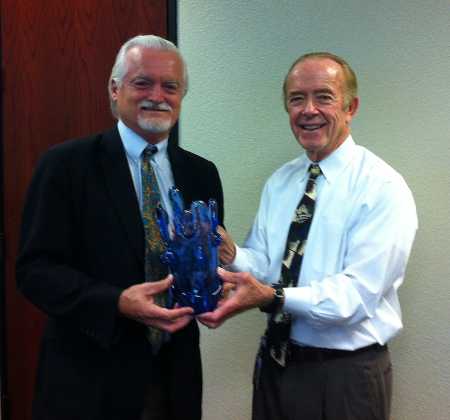
NORTHERN CALIFORNIA – Partnership HealthPlan of California (PHC) honored Assemblyman Wesley Chesbro during its board of commissioners meeting this past Wednesday, Oct. 23, at PHC’s Fairfield headquarters.
Assemblyman Chesbro is retiring at the end of his current term in the State Assembly after serving 34 years in elected office, beginning as an Arcata city councilman in 1974.
His elections and appointments included service on the Humboldt County Board of Supervisors, the California Integrated Waste Management Board, the State Senate, the California Mental Health Oversight and Accountability Commission, Open Door Community Health Centers board and Humboldt Bay Housing and Development Corp.
“Wes has worked tirelessly on behalf of PHC to help us further our mission to bring healthcare to underserved populations,” said Jack Horn, CEO of Partnership HealthPlan of California. “As the state began the move to managed care for the Medi-Cal program in all counties, Wes advocated for PHC and its model of care for the northern region. He has been instrumental in paving the way for us in eight new counties.”
Assemblyman Chesbro personally lobbied Gov. Jerry Brown, Health and Human Services Agency Secretary Diana Dooley and Department of Health Care Services Director Toby Douglas.
His work in the Legislature added statutory language to a law that allowed PHC to expand its services to Del Norte, Humboldt, Lake, Lassen, Modoc, Shasta, Siskiyou and Trinity counties.
Chesbro’s advocacy for the elderly, the indigent, the mentally ill, the disabled and people with substance abuse problems has been invaluable in aiding PHC with the work it does for its members.
After listening to the resolution and commendation, Assemblyman Chesbro complimented the PHC commissioners. “I had the easy part, he said. “You provide the product.”
PHC began operating in 1994. Additional information can be found at www.partnershiphp.org .
- Details
- Written by: Editor
WASHINGTON, DC – U.S. Rep. Mike Thompson (CA-05) announced Wednesday that he introduced H.R. 3306, the Telehealth Enhancement Act of 2013, bipartisan legislation to expand telemedicine.
By allowing Medicare payments for remote patient monitoring, the bill expands the locations where patients can receive Medicare-covered teleheath services.
The bill also gives states the opportunity to expand Medicaid coverage to include telehealth services for women with high-risk pregnancies.
U.S. Reps. Gregg Harper (MS-3-R.), Devin Nunes (CA-22-R), and Peter Welch (VT-D-AL) joined Thompson in introducing the legislation.
“Telehealth is health care, and it should be a tool in every doctor’s toolbox,” said Thompson. “By expanding Medicare and Medicaid telehealth coverage through this legislation, we can make sure more people can get high-quality care no matter where they live or how far away they are from a doctor. Patients and providers want telehealth health, and the reason is simple – it saves money and saves lives. This bill is a big step in the right direction, and we need to keep working until telehealth is an option for everyone.”
Under the Telehealth Enhancement Act, patients will be able to receive Medicare-covered teleheath services at an expanded network of locations such as critical access and sole community hospitals, a patient’s home, and/or other locations that are convenient, necessary and appropriate for the care of the patient, such as hospice care, home dialysis and homebound beneficiaries.
States that choose to expand Medicaid coverage to include telehealth will be able to create birthing networks that would allow medical providers to treat conditions such as gestational diabetes and hypertension for women with high-risk pregnancies.
During his time in the California State Senate Thompson introduced and passed the Telemedicine Development Act of 1996, the foundation of California’s robust telehealth system. Thompson’s State Senate-passed legislation prohibits private and public insurers from requiring in-person services for services appropriately provided through telemedicine.
Thompson has continued to be a leader on telehealth issues. He has introduced legislation to strengthen and expand telehealth in each of the last three Congresses.
“Studies have shown that telehealth can improve access, reduce costs and improve the quality of healthcare,” said Jonathan Linkous, chief executive officer of the ATA. “To unlock this potential, we need to give health providers the ability to use this technology wherever appropriate. ATA supports this legislation because it takes a sensible approach to move aside government restrictions and allow patients access to health services wherever they are located. Instead of going to the doctor, it allows the doctor to go to the patient.”
The bill has been referred to the House Committee on Ways and Means on which Thompson and Nunes serve, and the House Committee on Energy and Commerce on which Harper and Welch serve.
Congressman Mike Thompson represents California’s 5th Congressional District, which includes all or part of Contra Costa, Lake, Napa, Solano and Sonoma counties.
- Details
- Written by: Editor
LAKE COUNTY, Calif. – Ever wonder what really matters to people? Focus groups are one way to find out.
The “Climb to the Peak of Health” project is working toward bettering community health by looking at ways to support emotional well-being, reduce tobacco use, encourage healthy eating and increase physical activity.
About 12 focus groups, representing a cross-section of the community, were conducted to help create messaging about these topics.
Focus groups were asked about the kind of health ads that typically get attention. For many, they recalled the women smoker who had her larynx removed and was continuing to smoke through her stoma, or the ad about the fried egg being compared to your brain on drugs.
It was significant that while people found these ads to be memorable and attention-getting, in most cases they didn’t seem to think they actually led to making a behavior change.
The general consensus was that effective messaging is positive, to the point, and offers readily available, do-able action steps.
For quitting tobacco, folks can easily access California’s 1-800-NO-BUTTS helpline, where a live, knowledgeable person will provide support and coaching to assist in quitting the habit. People in the focus groups who quit smoking this way found it to be very helpful.
The group’s comments on creating messaging about emotional well-being were varied. We all know there’s a strong relationship between emotional and physical health, but how do we talk about some of the deep, lasting emotional impacts on children when they live with maltreatment or chronically chaotic environments in which addictions and absentee parenting prevail?
As comments from the focus groups were tallied, a common theme on emotional well-being emerged-- how we treat each other really matters, and kindness counts.
Emotional well-being begins in the family circle with the quality of relationship between parent-child, husband-wife, partners, grandparents, extended family, and it continues beyond family relationships to friendships, relationships with co-workers, within organizational culture, student-teacher, parent-teacher relationships, within our extracurricular activities.
In short, each and every interaction we have is an opportunity to support (or not) emotional wellness.
In keeping with the focus group directives to shape messages that are positive, on point, and with immediate action steps, kindness counts messaging was crafted as a platform on which to continue building. Kindness was seen as a fundamental ingredient in treating one another with understanding, dignity, and respect.
A few examples of action steps include: encourage someone today, count to 30 and think about your words, give away at least 3 hugs today, be an outstanding friend, smile and laugh more than you can count, help a senior do yard work, and parents are memory makers—make memories your children will cherish.
The overarching goal of Climb to the Peak of Health is reduction of chronic health conditions. Lake County currently ranks at the bottom of California’s 58 counties for poorest health due to death from all causes.
That statistic results from a number of unfavorable health factors, such as being in the bottom five counties for deaths from lung cancer, heart disease, stroke, and suicide.
These statistics can be attention-getting.
Smoking contributes to lung cancer and heart disease. Recent studies also show a relationship between smoking and depression. Before the addictive properties of nicotine became well known, medical providers prescribed nicotine as an anti-depressant.
Poor emotional health can also contribute to heart disease as well as substance use, suicide and myriad other conditions. The 1-800-NO-BUTTS number is a resource anyone can use to quit smoking. Taking small steps to treat each other with kindness is a way that everyone can boost emotional well-being.
Recent media coverage about Lake County's poor health profile highlights how community organizations are responding to the crisis, now it's time for all of us – the actual community – to step forward.
If each one of us joins together to take that first step, we can all begin climbing to the peak of health to better our community health as a whole.
Speaking of taking steps, stay tuned; a countywide Climb to the Peak of Health activity challenge is in the works. How about a community march for wellness as a way to take that first step together?
For more information about Climb to the Peak of Health, visit www.climbtothepeakofhealth.org or www.facebook.com/climbtothepeakofhealth .