 How to resolve AdBlock issue?
Recreation
- Details
- Written by: Carrie Wilson
Casting with a potato gun-style launcher
Question: Is it legal to use the “Sandblaster Baitcaster” in California?
This device is supposed to be great for surf fishing from the beach. It uses compressed air to cast your bait up to 300 yards from shore.
See it at their Web site, www.bunkerupfishin.com/ . (Victor H.)
Answer: This line launching device is really just another form of the old “potato guns” that were popular for a while until they were outlawed in public areas.
According to California Department of Fish and Wildlife (CDFW) Lt. Dennis McKiver, potato guns are legal under federal law. Under state law, potato guns that use combustion (instead of compressed air) to launch the projectile are "firearms," and one with a bore of over 0.5 inches is a destructive device.
Pneumatic potato guns like this one use compressed air and are legal as long as they are not used like a weapon (e.g. shot at a person, etc.), so this line launching device would be legal under state and federal laws.
However, you should check for local city and county ordinances because some local governments prohibit use of any devices that propel projectiles, and if you intend to use this line launching device on any state beach, you may also want to consult State Parks.
As far as using it to cast a fishing line, nothing in the Fish and Game Code or its implementing regulations prohibit using this compressed air launcher as long as the fishing line is attached to a rod and reel, or a person is brave enough to hold the other end of the line in their hands!
What to do when catching invasive fish species?
Question: What should we do when we catch invasive fish in local lakes? Specifically, Balboa Lake in the San Fernando Valley remains warm enough in winter to support some tropical fish.
Certain aquarium fishes breed as well as survive in these waters. The problem now are Plecostomus (commonly found in home fish tanks to eat the algae) that have taken over the lake and the Los Angeles River.
A couple of us have caught over 200 since February in one little cove while fishing for carp. We were told by park personnel to kill them (seemed reasonable) but I wanted to make sure they are inedible so that we won’t get into trouble for wasting fish. Please advise. Thanks. (Bill S.)
Answer: From a biological standpoint, CDFW would like to see these invasive fish disposed of (killed) rather then placed back in the system. The law prohibits the waste of any fish taken in waters of the state (California Code of Regulations Title 14, section 1.87). This regulation is intended to encourage people to eat any fish they kill, and to avoid needlessly killing fish. But, any use of fish that are legal for sale by an aquarium or pet store would satisfy the requirements of this regulation, including their use as fertilizer for your garden.
Here’s something that might surprise you … Plecostomus are consumed by humans in some of their native Central and South American waters. Jackson Landers, author of “Eating Aliens: One Man’s Adventures Hunting Invasive Animal Species” includes a recipe for Plecostomus in this book.
SCUBA diving for Dungeness crabs?
Question: In a recent column you said that you could not take Dungeness crabs on SCUBA. Did I read that correctly or were you referring to seasons? (Duanne S.)
Answer: I said when Dungeness crab season is open, they may be taken by hand via SCUBA but divers may not possess any hooked device while diving or attempting to dive for them (CCR Title 14, section 29.80(g)).
Sale of pig mount … Is it legal?
Question: My brother harvested a pig about 20 years ago on a private ranch in California and had the head mounted. He wants to sell the mount, but doesn't want to break the law and can’t get a definitive answer from anyone.
Could you help? Thank you as always for your help! (Dave)
Answer: Your brother can give it away but cannot sell or trade it to anyone. With a few exceptions (that don’t apply to your brother), the law prohibits the sale or purchase of any part of a bird or mammal found in the wild in California. (Fish and Game Code, section 3039)
Any limits on sand crabs?
Question: Is it legal to catch sand crabs with a fishing license, and if legal, what is the limit?
Can sand crabs be taken on all beaches of the state? (Gina N.)
Answer: Yes, it is legal to catch sand crabs with a fishing license statewide wherever fishing is authorized. The limit is 50 crabs per day and in possession (CCR Title 14, section 29.85(d)).
Carrie Wilson is a marine environmental scientist with the California Department of Fish and Wildlife. While she cannot personally answer everyone’s questions, she will select a few to answer each week in this column. Please contact her at
- Details
- Written by: Editor
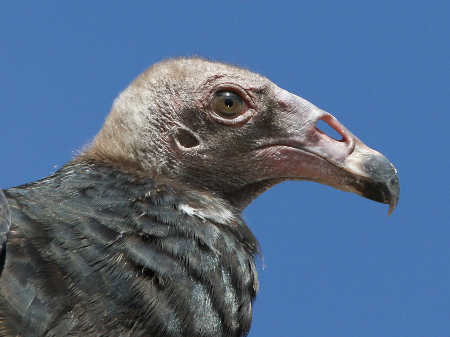
KELSEYVILLE, Calif. – At 1 p.m. this Saturday, June 28, the Clear Lake State Park Interpretive Association will present a nature talk on the natural history of the turkey vulture.
The presenters – Bob Keiffer, superintendent of agriculture at the University of California’s Hopland Research and Extension Center, and Greg Giusti, director for the University of California Cooperative Extension programs in Lake and Mendocino – have been studying turkey vultures for a number of years and will present their findings, observations and stories.
This is a great opportunity to learn more about the habits and characteristics of the common, but mysterious turkey vulture.
The program will take place at the park visitor center and will last about 90 minutes.
Clear Lake State Park is located at 5300 Soda Bay Road, Kelseyville. Entry into the park is free for those attending the presentation.
Anyone having special needs should contact the Clear Lake State Park Sector Office Tuesday through Thursday between 8 a.m. and 5 p.m. at 707-279-2267.
- Details
- Written by: Editor
NORTHERN CALIFORNIA – The California Department of Fish and Wildlife’s (CDFW) Advanced Hunter Education will offer an upland game hunting clinic on Saturday, Aug. 23 at Hasting Island Hunting Preserve, near Rio Vista.
Designed for hunters of all skill levels, the clinic will be led by an experienced certified California Hunter Education instructor.
Topics to be covered will include hunting regulations, where to hunt, hunting alone vs. hunting with others, hunting with or without a dog, proper types of firearms and ammunition for upland game hunting, upland game bird habitat, and hunter responsibilities and ethics.
The clinic will include dog handling and game care demonstrations.
The clinic will run from 9 a.m. to 5 p.m. The cost is $45 for adults. Youths 16 years and younger are free but must be accompanied by an adult.
CDFW’s Advanced Hunter Education Program will provide all necessary class equipment.
Space is limited, so participants are asked to preregister online at www.dfg.ca.gov/huntered/advanced/index.aspx .
After registering, participants will receive an email with a map to the facility and a list of items to bring.
Hastings Island Hunting Preserve is located approximately eight miles north of Rio Vista.
- Details
- Written by: Editor
HIDDEN VALLEY LAKE, Calif. – The HVL Men’s Niners Golf Club held a medal play tournament on Thursday, June l9.
The results were:
- First Flight: Bill Eagleton and Olie Smith tied for first with net 31. Rick Conrad and Rick Erickson tied for third with 33.
- Second Flight: Ed Brooks was first at 33. Tim Greer and Don Dornbush tied for second at 34.
- Third Flight: Jim DeRosa and John Jones tied for first with 31. Brian Panizzera, Jeff Markham and Sam DeBone all tied for third with 37.
Closest to the par 3 pins were Bruce Brashares and Bill Eagleton.
Chip-ins were scored by Keith Ipsen, Mike Riley, Arch Madsen and Dave Mann.
Forty-seven men participated in this event.