 How to resolve AdBlock issue?
Recreation
- Details
- Written by: Editor
LOWER LAKE, Calif. – Anderson Marsh State Historic Park continues to hold monthly guided nature walks, followed by a tour of the Historic Ranch House Museum.
A special walk will be held on Saturday morning, March 8, that will focus on native and non-native plants, the effects of the recent controlled burn performed at the park and native plant restoration plan being created by the Department of State Parks.
Joining Park Docents Henry Bornstein and Gae Henry on the walk will be Jim Dempsey, the State Parks environmental scientist who has primary responsibility for designing the plant restoration program at Anderson Marsh State Historic Park.
Participants on the walk will be able to have their questions answered about what it might meant to bring the park into a more “natural” state, the status of restoration efforts at the park and the initial effects of the recent controlled burn.
Bring binoculars and meet in front of the Ranch House at 8:15 a.m. for time to experience the early morning wildlife to be found in the Ranch House and Barn complex yard – walk begins at 8:30 a.m.
Many of the trees are “naked” in the winter, making it easier to see the many species of birds that frequent the Park at this time of year.
A tour of the historic Ranch House Museum will begin immediately after the walk. If rain cancels the walk, the ranch tour will begin at 8:30 a.m. There is no charge for those attending.
Anderson Marsh State Historic Park is located on Highway 53, between Lower Lake and Clearlake.
For more information about the walk and tour, email
For more information about the park, visit http://www.parks.ca.gov/?page_id=483 .
- Details
- Written by: Editor
The Office of Administrative Law (OAL) this week approved emergency regulations adopted by the California Fish and Game Commission on Feb. 5 to close some waters to angling in response to severe drought conditions throughout the state.
The following closures are now in effect:
- Closure of the American River from Nimbus Dam to the SMUD power line crossing at the southwest boundary of Ancil Hoffman Park until April 30.
- Closure of the Russian River main stem below the confluence of the East Branch of the Russian River until April 30.
- Extension of the low flow restrictions angling closures for the north coast and central coast areas In the South Coast District (i.e., San Mateo, Santa Cruz, Monterey and San Luis Obispo counties), close all portions of any coastal stream west of any Highway 1 bridge until April 30.
The above regulatory actions were approved by OAL and became effective Feb. 19. The California Department of Fish and Wildlife (CDFW) learned about OAL’s approval.
Also, CDFW has closed some waters to fishing in order to protect native salmon and steelhead from low water flows in California streams and rivers that have been significantly impacted by drought. These closures are within CDFW’s authority under Title 14 and did not need Commission adoption.
A map of the closures can be found here: http://www.dfg.ca.gov/biogeodata/gis/fishing_closures.asp .
CDFW has the authority under Title 14, Article 4, Section 8.00(c) to close south central coast streams to fishing from December 1 through March 7 when it determines that stream flows are inadequate to provide fish passage for migrating steelhead trout and salmon.
As a result, the following waters are closed to angling until March 7 or until stream flows are sufficient to allow fish passage for returning adult steelhead and salmon.
To determine whether or not these waters are open to fishing, please call the south central coast closure hotline at 831-649-2886:
- Pescadero Creek and all anadromous reaches of San Mateo County coastal streams normally open for fishing, from Elliot Creek through Milagro Creek.
- The San Lorenzo River and all its tributaries, as well as all anadromous reaches of coastal streams normally open for fishing in Santa Cruz County from the San Lorenzo River on North through Waddell Creek.
- Aptos and Soquel Creeks (Santa Cruz County).
- The Pajaro River and Uvas, Llagas and Corralitos Creeks (Santa Cruz, Monterey and Santa Clara counties).
- The Carmel River and those sections of San Jose, Gibson, Malpaso and Soberanes creeks west of Highway 1.
- The Big Sur River and those Big Sur area streams from Granite Creek to Salmon Creek west of Highway 1.
- The main stem of the Salinas River below its confluence with the Arroyo Seco River and the Arroyo Seco River (Monterey County).
In addition, CDFW has the authority under Title 14, Article 4, Section 8.00(a) to close north coast streams to fishing when it determines that the flow at any of the designated gauging stations is less than minimum flows stated in regulation through Jan. 31.
The OAL approval extends the end date of that authority to April 30. As a result, the following north coast streams will be subject to angling closures until April 30.
To determine whether or not these waters are open to fishing, please call the north coast closure hotline at 707-822-3164:
- The main stem Eel River from the paved junction of Fulmor Road with the Eel River to the South Fork Eel River.
- The South Fork of the Eel River downstream from Rattlesnake Creek and the Middle Fork Eel River downstream from the Bar Creek.
- The main stem Van Duzen River from its junction with the Eel River to the end of Golden Gate Drive near Bridgeville.
- The main stem Mad River from the Hammond Trail Railroad Trestle to Cowan Creek.
- The main stem of the Mattole River from the mouth to Honeydew Creek.
- The main stem of Redwood Creek from the mouth to its confluence with Bond Creek.
- The main stem Smith River from the mouth of Rowdy Creek to the mouth of Patrick Creek (tributary of the Middle Fork Smith River); the South Fork Smith River from the mouth upstream approximately 1,000 feet to the County Road (George Tyron) bridge and Craig’s Creek to its confluence with Jones Creek; and the North Fork Smith River from the mouth to its confluence with Stony Creek.
Under Title 14, Article 4, Section 8.00(b) the following central coast streams are subject to angling closures through April 1. Today’s OAL approval extends that end date to April 30. To determine whether or not these waters are open to fishing, please call the central coast closure hotline at (707) 944-5533:
- Sonoma Creek (Sonoma County), and all streams tributary to the Pacific Ocean (and its bay) in Mendocino, Sonoma and Marin counties, except the Russian River.
- Napa River (Napa County) between Trancas Avenue in Napa and Oakville Cross Bridge near Yountville.
These closures listed above represent only about 5 percent of the fishable rivers in the state. There are still plenty of opportunities for California anglers to catch fish in the state’s rivers, streams, lakes and reservoirs. Additionally, California’s coast offers substantial ocean fishing. All are subject to current regulations already in place.
For more on fishing in California, please visit http://www.dfg.ca.gov/fishing/ .
CDFW low flow closure hotlines:
North Coast: 707-822-3164;
Central Coast: 707-944-5533;
South Central Coast: 831-649-2886.
- Details
- Written by: Carrie Wilson
How to handle loaded firearms around wildlife officers?
Question: What should a person do when approached by a wildlife officer for inspection?
Should they put the gun onto their car so that it’s in plain sight? Should they tell the officer to wait while they unload the gun? Should they place the gun on the ground?
What is the proper protocol in this type of situation? Please advise. (Rheannon O.)
Answer: First of all, placing a loaded long gun in or on a vehicle which is in a place open to the public is a violation of the law. Vehicles should automatically be considered a poor choice to place or to store a loaded firearm.
When a wildlife officer approaches, the first thing you should do is follow the directions that the officer gives you.
Absent any directions, here are some good options:
1) Some people unload their firearm in a calm manner to show respect for what a loaded firearm can do and respect for the officer. This shows the officer you are handing him a safe unloaded firearm. If you are within talking distance, ask the officer if he/she wants you to unload the firearm. If directed to unload, make sure to control the muzzle away from anyone.
2) Many folks simply hand the firearm to the officer, and that is also acceptable. If you do, make sure to tell the officer the gun is loaded.
3) Setting the gun on the ground is acceptable so long as the muzzle is pointed in a safe direction, but depending on the terrain (mud, sand, etc), this may not be a prudent choice.
Transporting a friend’s lobsters after a multiday fishing trip?
Question: There will be three of us going to Catalina to hoop for lobsters with a multi-day permit.
One guy will only be able to hoop two of the three days and then will have to take the Flyer back to go to work.
Can my friend and I transport this guy’s catch back for him as long as we have his license/report card with us without being in violation of limits? He will not be able to take his catch with him. (Larry H.)
Answer: No. Multi-day permits require that “All passengers must disembark at place of return as stated” on the permit (California Code of Regulations Title 14, section 27.15(b)(5)).
Your friend can “gift” you his lobsters, but they will count towards your overall take/possession limit. You and your friend are allowed to take/possess only your own limits.
In this situation, your friend must go home with his catch or else all three of you are allowed to catch no more than a limit for two people.
Retaining just one claw when crabbing?
Question: Our fishing club is planning a fishing trip for local crab out of the Santa Monica Bay area. Some people in the group insist we should only keep one claw from each crab so they can be put back to grow another claw and still live.
I know with lobsters we are instructed to leave them whole until they are ready for consumption to allow the wildlife officer to verify it’s a legal catch.
Is it legal to keep only one claw or do we need the entire crab to allow the wildlife officer to verify? (Jerry E.)
Answer: You are required to take the whole legal-sized crab to prove your crab is of legal size. Possessing just claws would be a violation because the size of the crabs they came from cannot be determined (Fish and Game Code, section 5508).
Crabs also carry a lot of meat in the body. Crab season for all crabs of the genus Cancer (except Dungeness crabs) is open all year.
The size limit in Southern California is four inches and the part of the crab that we measure is the main body shell (edge of shell to edge of shell at the widest part).
While crabs may be able to regenerate lost claws under good conditions, crabs with only one claw have a far tougher time fending off predators than if they had both claws for protection.
Predators will go after any weakened animal, so just removing a claw may be considered a waste of fish – also a state violation.
Minimum age to apply for a deer drawing?
Question: Can you apply for a deer drawing if you are only 11 but will be 12 before the hunt starts or do you have to be 12 before you put in for the drawing? (Jacob W.)
Answer: You must be 12 years old by July 1 to apply.
Carrie Wilson is a marine environmental scientist with the California Department of Fish and Wildlife. While she cannot personally answer everyone’s questions, she will select a few to answer each week in this column. Please contact her at
- Details
- Written by: Editor
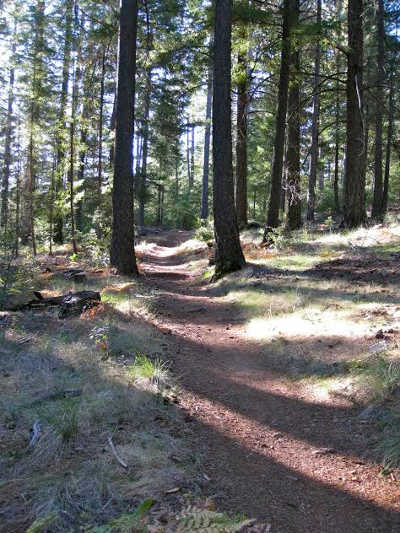
BOGGS MOUNTAIN, Calif. – The Friends of Boggs Mountain will be offering a 2.25-mile hike on various Boggs Trails on Wednesday, Feb. 19, at 9 a.m.
This will be moderate-level hike on moderate terrain with some elevation and will be led by Darlene Hecomovich.
This is an opportunity to get some exercise while you appreciate the outdoors and the wonders of nature.
Check out the forest flora in its winter aspect from the ground cover of bracken, bunch grass and mosses to the understory filled with coffeeberry and manzanita, and on to the upper story of magnificent Douglas fir and sugar and ponderosa pines.
Hikers can admire the silhouettes of the leafless deciduous trees and shrubs, and with all the recent rain, the mosses and lichens should be vibrant. Come and enjoy it all as we hike!
Wear sturdy shoes, dress appropriately for weather conditions, and bring water and enthusiasm.
Meet at the parking lot kiosk promptly at 9 a.m. The forest entrance is located off Highway 175 just one and one half miles north of Cobb Village. Turn at the blue State Fire Station/Boggs Mountain Forest sign.
For further information phone Darlene Hecomovich at 707-928-5591 or email at